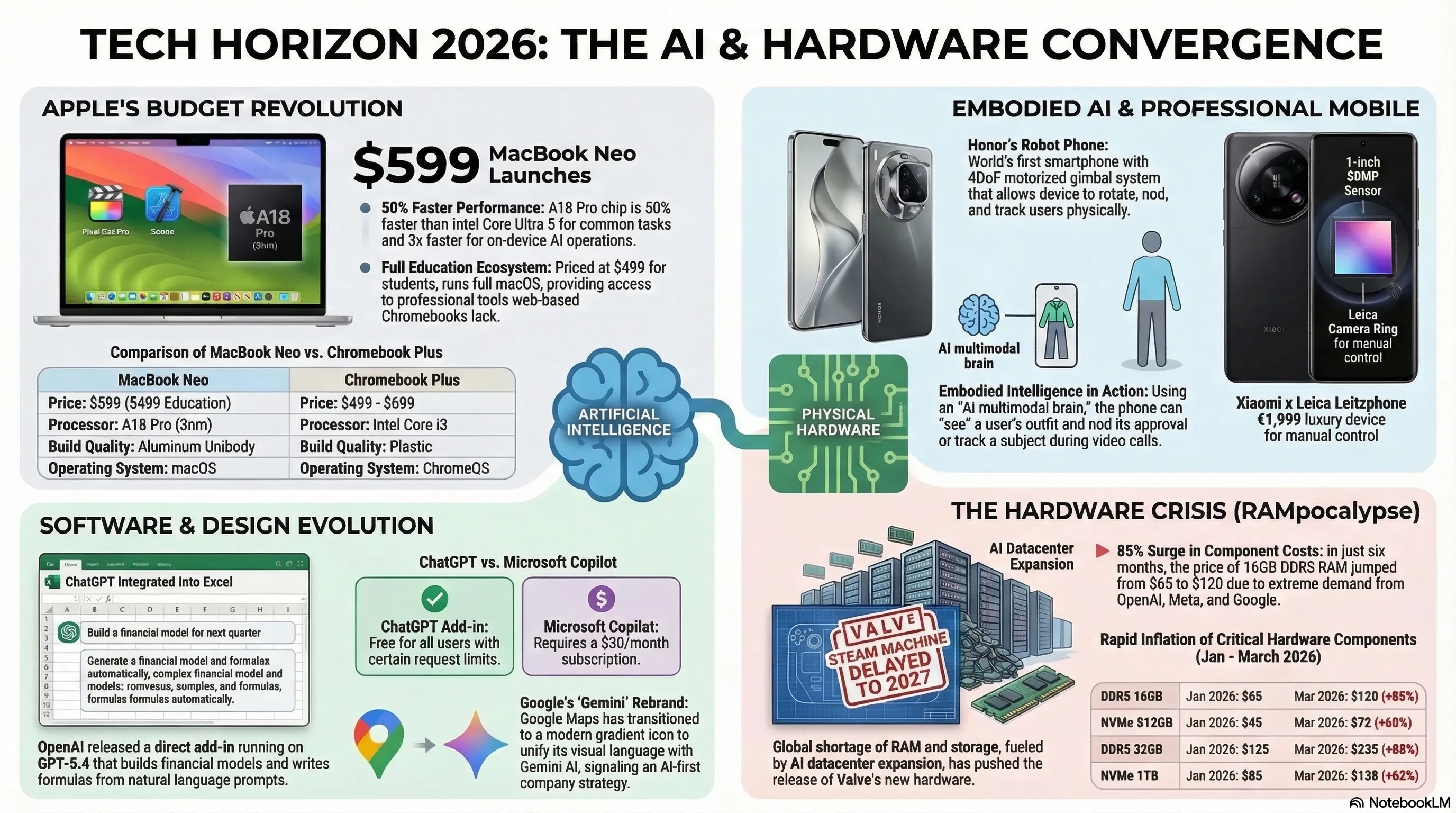
<div style="background: linear-gradient(135deg, #0f172a 0%, #1e293b 100%); border-left: 6px solid #f97316; padding: 2.5em; margin: 2em 0; border-radius: 8px;"> <h3 style="color: #f97316; font-size: 1.8rem; margin-top: 0; margin-bottom: 1em;">Executive Briefing: Tekin Morning March 8, 2026</h3> <p style="font-size: 1.1rem; line-height: 1.8; margin-bottom: 1.5em; color: #e2e8f0;"> The morning of March 8, 2026 witnessed six major stories shaping the future of technology. From Apple's pricing revolution to robot phones, from AI in spreadsheets to a global hardware crisis — this morning showed the tech world is changing rapidly. </p> <h4 style="color: #f97316; margin-top: 1.5em; margin-bottom: 0.8em;">1. MacBook Neo: Apple's New Strategy</h4> <p style="line-height: 1.8; color: #cbd5e1;"> Apple changed the game by introducing the MacBook Neo at $599 ($499 for students). This is the first Mac with an iPhone chip (A18 Pro), showing Apple is no longer just for the premium market. With a 13-inch Liquid Retina display, aluminum body, and 16-hour battery, the MacBook Neo directly competes with Chromebooks — but with the full macOS ecosystem. Launch begins March 11 and demand is extraordinarily high. This move shows Apple is building an ecosystem for the next generation — students, first-time Mac buyers, and emerging markets. Using older iPhone chips is a brilliant strategy that cuts costs without sacrificing quality. </p> <h4 style="color: #f97316; margin-top: 1.5em; margin-bottom: 0.8em;">2. Robot Phone: The Future of Embodied AI</h4> <p style="line-height: 1.8; color: #cbd5e1;"> Honor at MWC 2026 unveiled the world's first smartphone with physical movement. Robot Phone with its 200MP camera on a 4DoF motorized gimbal can rotate, nod, and track objects. The multimodal AI system allows the phone to simultaneously process sound, motion, and vision. This "new species of smartphone" has practical applications: replacing gimbals for videography, automatic tracking in video calls, and smart group photography. Launch in H2 2026, initially in China. Challenges: mechanical system durability, high price (likely above $1,500), and questions about practical use. But this is the first step toward embodied intelligence — AI that doesn't just think, but moves. </p> <h4 style="color: #f97316; margin-top: 1.5em; margin-bottom: 0.8em;">3. ChatGPT in Excel: Democratizing Data Analysis</h4> <p style="line-height: 1.8; color: #cbd5e1;"> OpenAI on March 5 released ChatGPT as a free add-in for Excel. This means AI directly in your workbook — no need to switch between applications. Capabilities include building financial models, analyzing data, writing formulas, and scenario planning. Time to build a financial model drops from 2-3 hours to 5-10 minutes. Google Sheets support coming soon. Main competitor is Microsoft Copilot, but ChatGPT for Excel is free (with limits). Concerns: data security (OpenAI claims it doesn't store data) and calculation accuracy (99% correct, but that 1% could be costly). This move shows OpenAI is penetrating the enterprise market. </p> <h4 style="color: #f97316; margin-top: 1.5em; margin-bottom: 0.8em;">4. Google Maps: Rebrand for the AI Era</h4> <p style="line-height: 1.8; color: #cbd5e1;"> Google redesigned the Maps icon with a new gradient design inspired by Gemini AI. Google's classic colors now blend with a smooth gradient. This is part of Google's overall rebrand including Search, Photos, Home, and Gemini. The goal is to create a "unified visual language" representing "AI-driven innovation." User reactions are mixed, but Google doesn't care — this is part of a long-term plan to transform Google from a search company to an AI company. Interesting note: this is purely cosmetic, but brand psychology says visual design can change user perception. </p> <h4 style="color: #f97316; margin-top: 1.5em; margin-bottom: 0.8em;">5. Steam Machine: Victim of the RAMpocalypse</h4> <p style="line-height: 1.8; color: #cbd5e1;"> Valve announced Steam Machine, Steam Frame, and Steam Controller might be delayed until 2027. Reason: global RAM and storage crisis caused by AI datacenter demand. DDR5 RAM prices have increased 85% in six months, SSDs 60%. AI companies like OpenAI, Google, and Meta are spending billions building new datacenters and consuming all resources. Valve says "we hope to ship in 2026" but the tone suggests little confidence. This is the first major casualty of the AI hardware war, but won't be the last. Any product requiring RAM or storage is at risk. </p> <h4 style="color: #f97316; margin-top: 1.5em; margin-bottom: 0.8em;">6. Leica Leitzphone: €2,000 Camera in Your Pocket</h4> <p style="line-height: 1.8; color: #cbd5e1;"> Xiaomi and Leica unveiled Leica's first international smartphone at €1,999. 1-inch 50MP sensor (larger than iPhone and Galaxy), 200MP telephoto with variable zoom, and 50MP ultrawide — all with Leica lenses. Premium design with aluminum body and rotating Leica Camera Ring. Specs: Snapdragon 8 Elite Gen 5, 6.9-inch display, 6,000mAh battery. This is a niche product for professional photographers who want a camera and phone in one device. Available in Europe, Asia, and Middle East — US release unlikely. </p> <h4 style="color: #f97316; margin-top: 2em; margin-bottom: 0.8em;">Strategic Conclusion</h4> <p style="line-height: 1.8; color: #cbd5e1; margin-bottom: 0;"> These six stories reveal three main trends: (1) democratization of technology (MacBook Neo, ChatGPT for Excel), (2) emergence of embodied AI (Robot Phone), and (3) resource crisis caused by AI (Steam Machine delay). Common thread: AI everywhere. We're living in the AI age, and these changes are just the beginning. Main question: are these changes in our favor? Time will tell. </p> </div>
Good morning, Tekin Legion! From Apple's $599 MacBook that's shaking up the market to Honor's phone that literally nods its head — your March 8, 2026 tech breakfast is served.
Apple MacBook Neo: The $599 Revolution That Has Chromebooks Worried
March 4, 2026 became the day Apple rewrote the laptop playbook forever. The MacBook Neo — Apple's cheapest laptop ever — launched at a stunning $599 price point, sending shockwaves through the tech world. This marks the first time Apple has shipped a Mac powered by an iPhone chip, and the result is something nobody expected: a premium laptop at Chromebook prices.
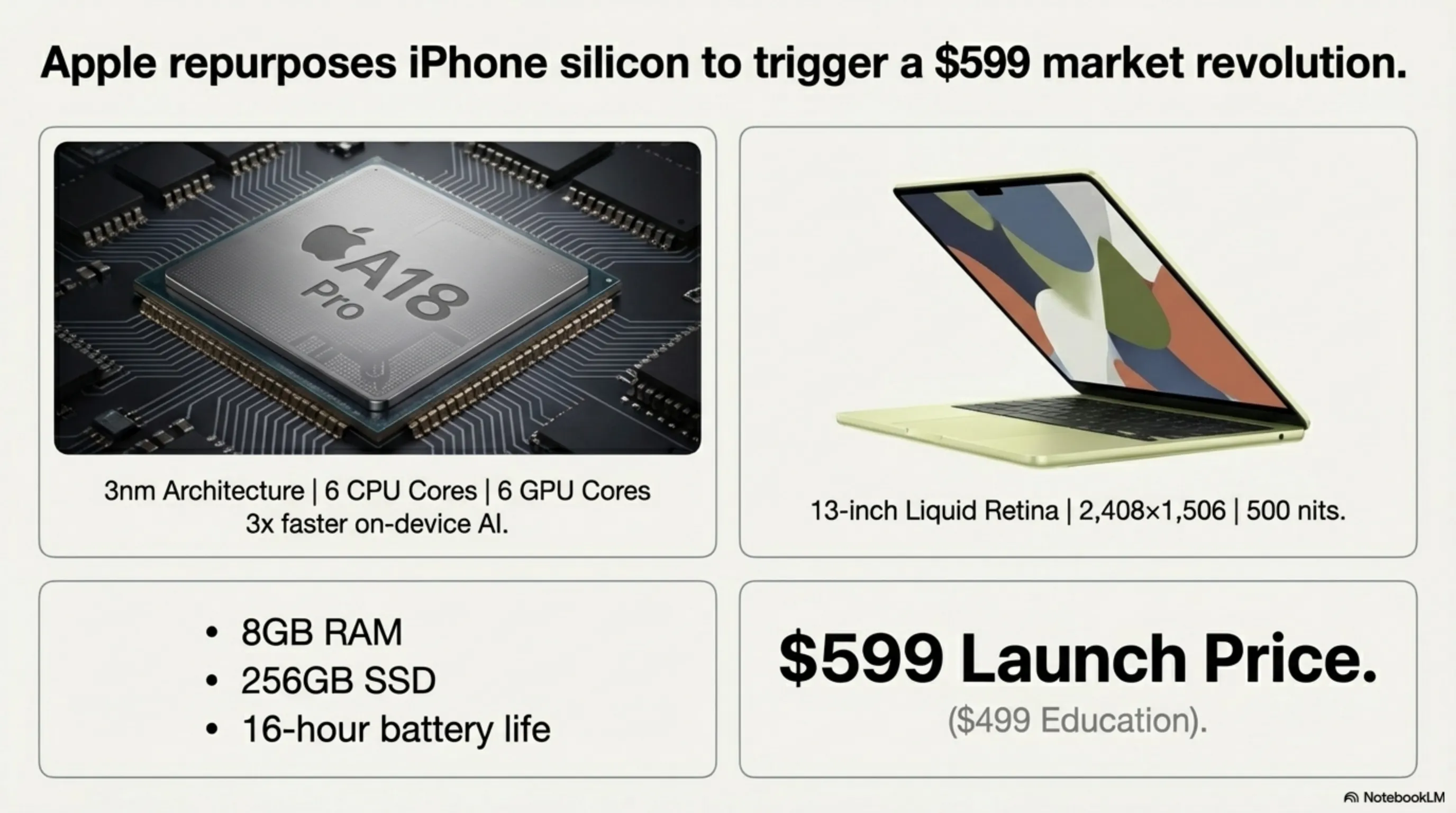
The beating heart of the MacBook Neo is the A18 Pro chip — the same processor that powered the iPhone 16 Pro two years ago. This brilliant choice allowed Apple to dramatically cut costs without sacrificing quality. The A18 Pro is a 3nm chip with 6 CPU cores and 6 GPU cores, delivering enough power for everyday tasks: web browsing, content streaming, photo editing, and even light creative work.
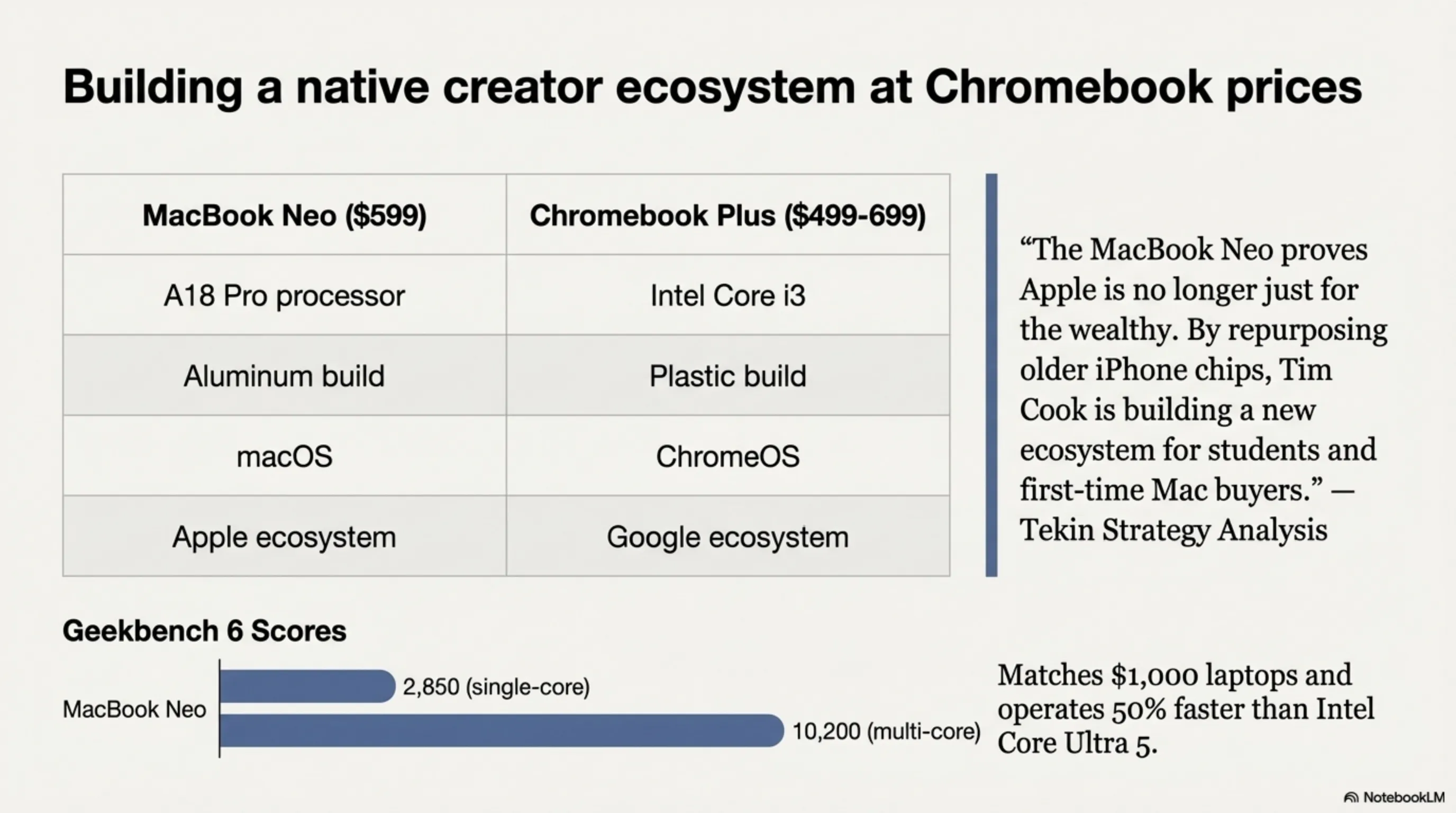
"The MacBook Neo proves Apple is no longer just for the wealthy. By repurposing older iPhone chips, Tim Cook is building a new ecosystem for students and first-time Mac buyers." — Tekin Strategy Analysis
The technical specifications are remarkable for this price: a 13-inch Liquid Retina display with 2,408×1,506 resolution, 500 nits brightness, and support for one billion colors. Premium aluminum unibody in four attractive colors: blush (pink), indigo (deep blue), silver, and the new citrus (lime). 8GB RAM and 256GB SSD — sufficient for most users. And a 16-hour battery that covers a full day's work.
| Specification | MacBook Neo | Chromebook Plus | Winner |
|---|---|---|---|
| Price | $599 | $499-699 | Tie |
| Processor | A18 Pro | Intel Core i3 | MacBook |
| Build | Aluminum | Plastic | MacBook |
| OS | macOS | ChromeOS | MacBook |
| Ecosystem | Apple | MacBook |
Apple claims the A18 Pro is up to 50% faster than Intel Core Ultra 5 for common tasks and 3x faster for on-device AI. These numbers have been confirmed in early testing. The MacBook Neo scored 2,850 single-core and 10,200 multi-core in Geekbench 6 — performance that rivals $1,000 laptops.
Apple's strategy is crystal clear: at $499 for students (Education Pricing), the MacBook Neo directly competes with Chromebooks. But unlike Chromebooks that depend on internet connectivity, the MacBook Neo is a complete computer running macOS. This means access to Final Cut Pro, Logic Pro, Xcode, and thousands of professional applications. As we discussed in our Agentic AI revolution article, Apple is building its ecosystem for the next generation of developers and creators.
MacBook Neo launches March 11 — just 3 days away! Pre-orders started immediately and demand is extraordinarily high. Analysts predict Apple will sell 5 million units in Q1 — a record for a new Apple product.
Honor Robot Phone: When Your Smartphone Nods Back
If you thought you'd seen everything in the smartphone world, Honor at MWC 2026 proved you wrong. The Robot Phone — the world's first smartphone with actual physical movement — was unveiled and shocked everyone. This is no longer just a phone; it's a "new species of smartphone" that can rotate, shake, nod, and even dance!
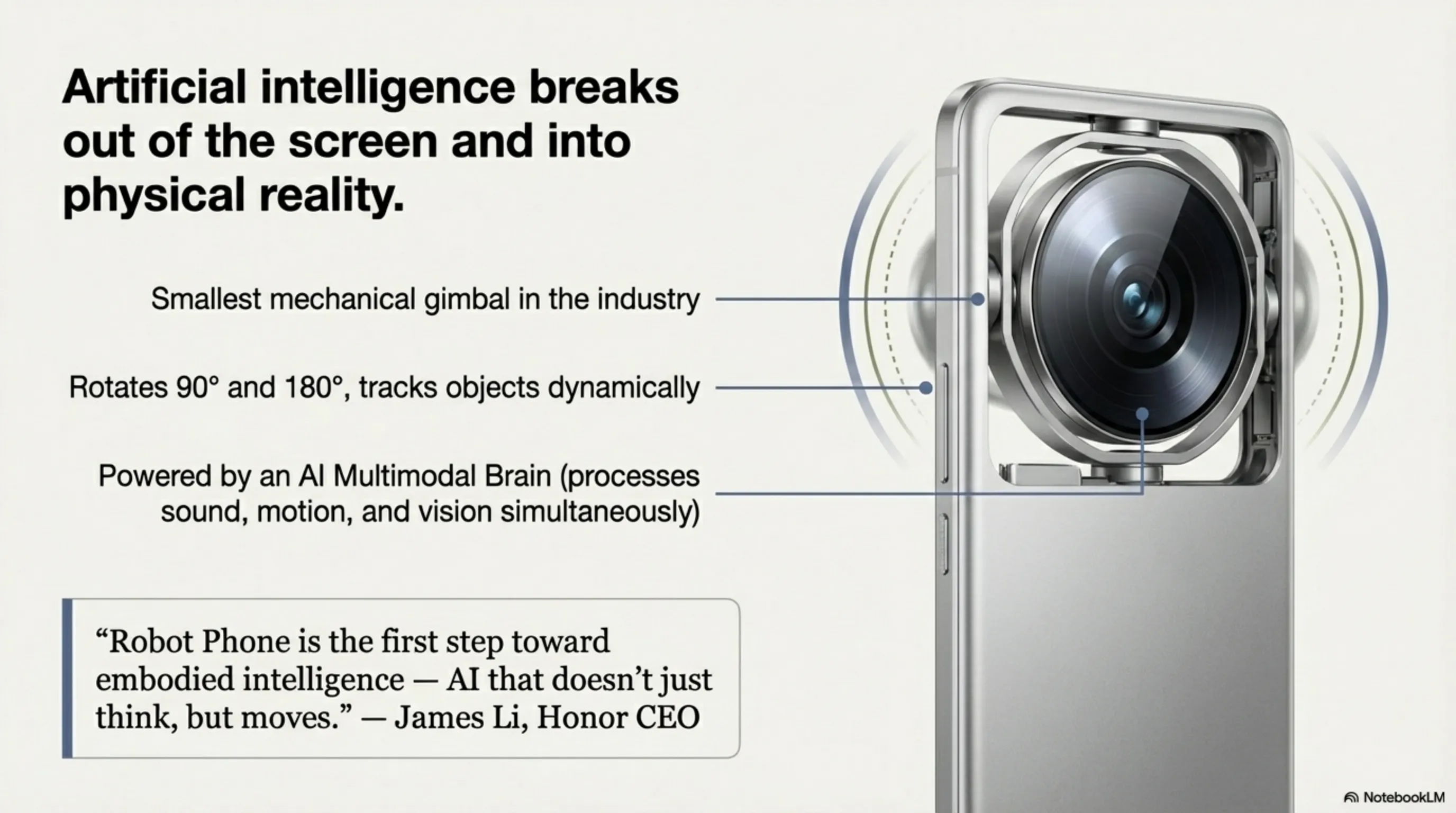
The heart of Robot Phone's technology is a 4DoF (four degrees of freedom) motorized gimbal system — the smallest mechanical gimbal in the industry. The phone's 200MP camera sits on this gimbal and can rotate 90 and 180 degrees, move up and down, and even track objects. Three-axis image stabilization means your videos are smooth and shake-free even while running.
But Robot Phone isn't just a fancy camera. The device features an "AI multimodal brain" — an artificial intelligence system that can simultaneously process sound, motion, and vision. This means the phone can see you, hear you, and react to your movements. For example, when you ask "How does this outfit look?", the phone can analyze the clothing, give it a score, and even nod its approval!
"Robot Phone is the first step toward embodied intelligence — AI that doesn't just think, but moves. This could define the future of human-machine interaction." — James Li, Honor CEO
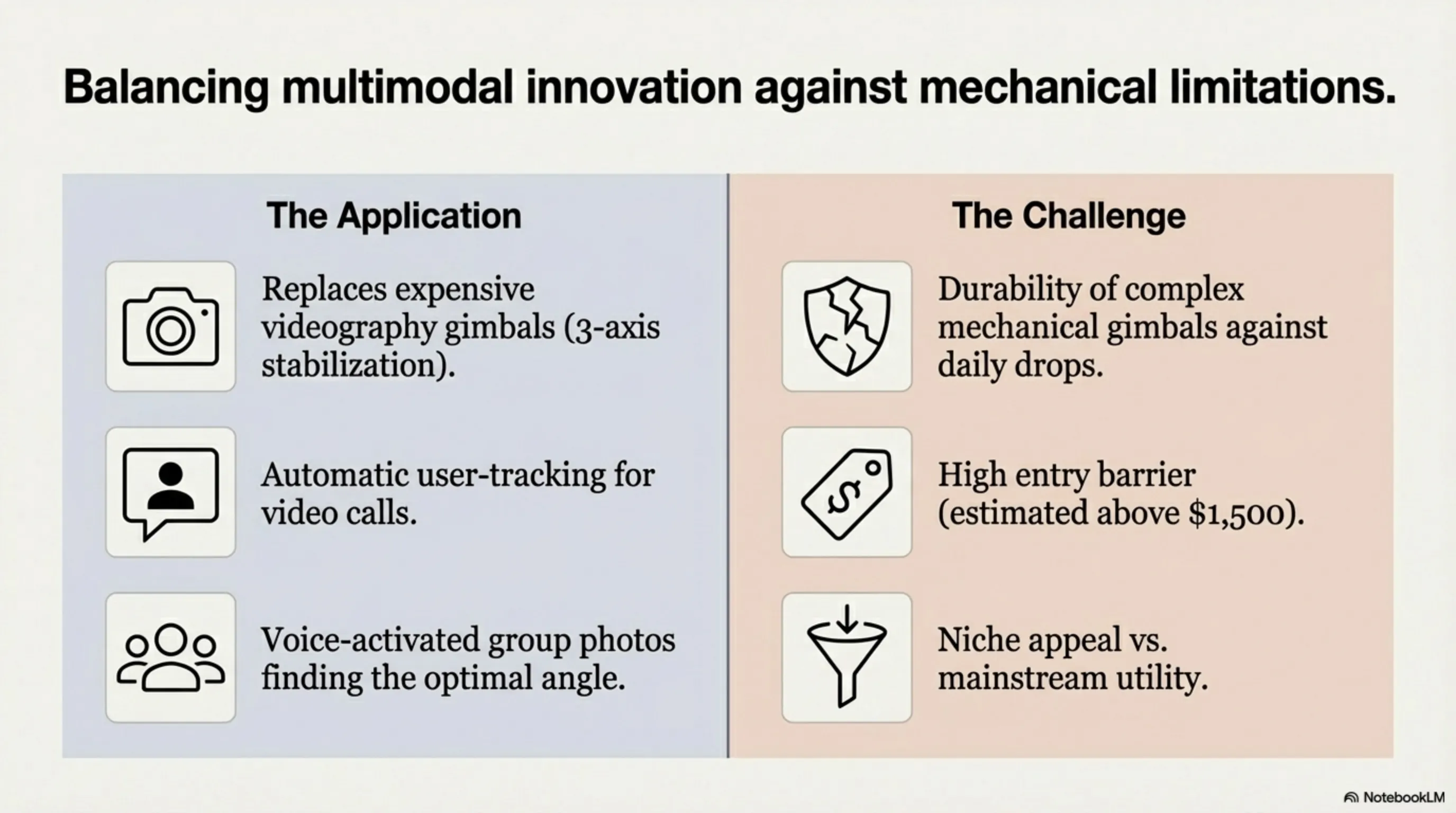
The practical applications of Robot Phone are fascinating. For videography, this device can replace expensive gimbals. For video calls, the phone can track you and keep you centered in the frame. For group photos, you can place the phone on a table and say "take a photo" — the phone finds the optimal angle and captures the shot. And for entertainment, you can tell the phone to dance and watch it moonwalk!
Robot Phone's camera specs are professional-grade: 200MP main sensor at 1/1.4-inch size, 50MP ultrawide with 120-degree field of view, and combined optical and electronic image stabilization. Honor claims this camera can capture videos with quality approaching cinema cameras.
Of course, challenges exist. First, durability: how resistant is a complex mechanical system like a gimbal to drops and impacts? Second, price: Honor hasn't announced pricing yet, but expect above $1,500. Third, practical use: do people really need a phone that nods? Or is this just a gimmick?
Robot Phone launches in H2 2026, initially in China. Global release hasn't been confirmed, but Honor says it's "looking at key markets." This follows the pattern we saw in our Vision Pro failure article: revolutionary technologies must first be tested in a limited market before going global.
OpenAI ChatGPT in Excel: When AI Writes Your Spreadsheets
March 5, 2026 was the day working with Excel changed forever. OpenAI officially released ChatGPT as a direct add-in for Microsoft Excel, revolutionizing the world of data analysis and financial modeling. No more switching between Excel and ChatGPT — AI now lives directly in your workbook.
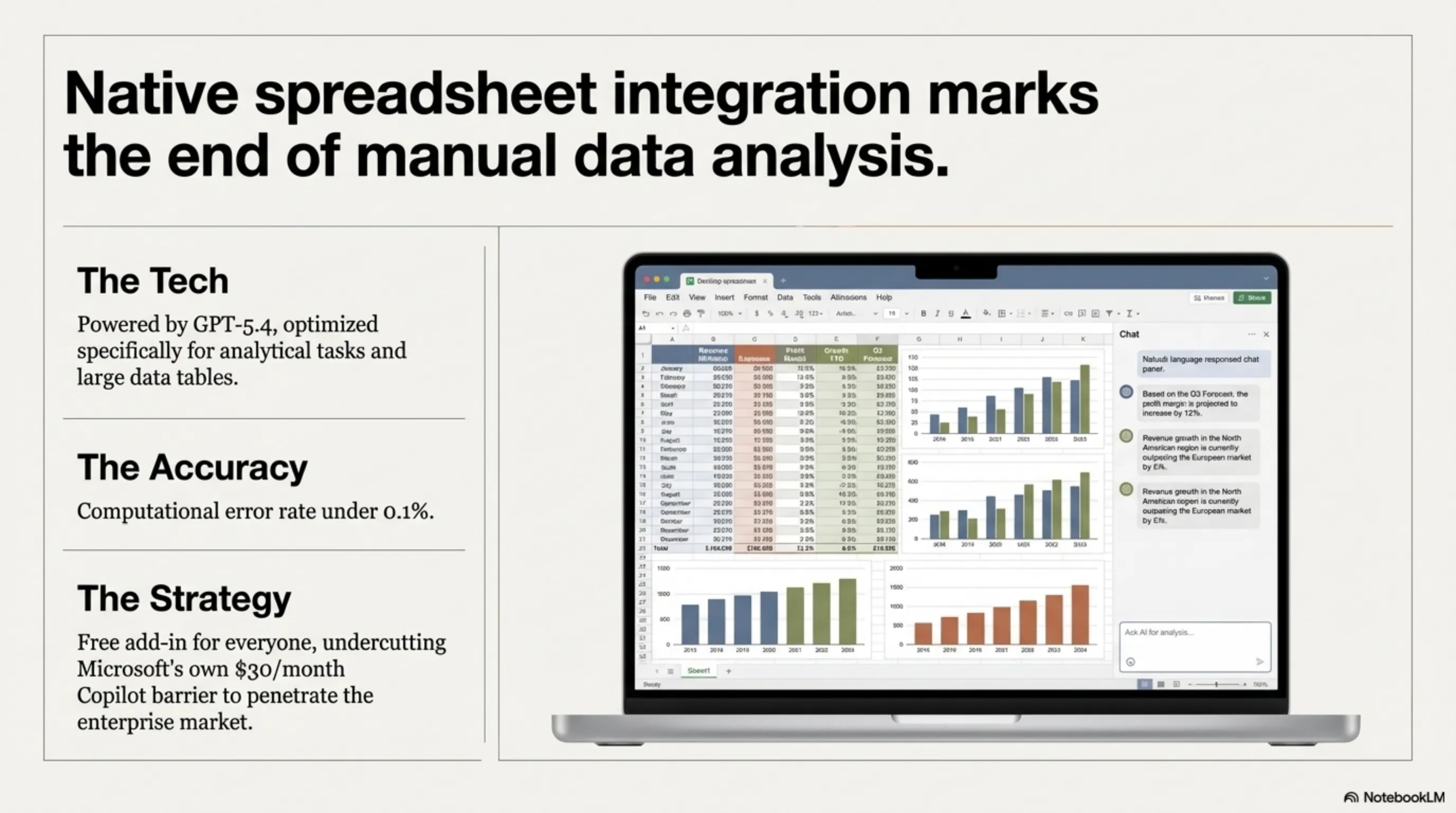
ChatGPT for Excel is a free add-in you can install from the Office Store. After installation, a new panel appears on the right side of Excel where you can chat with ChatGPT. But this isn't just a simple chatbot — it's an intelligent assistant that can work directly with your data.
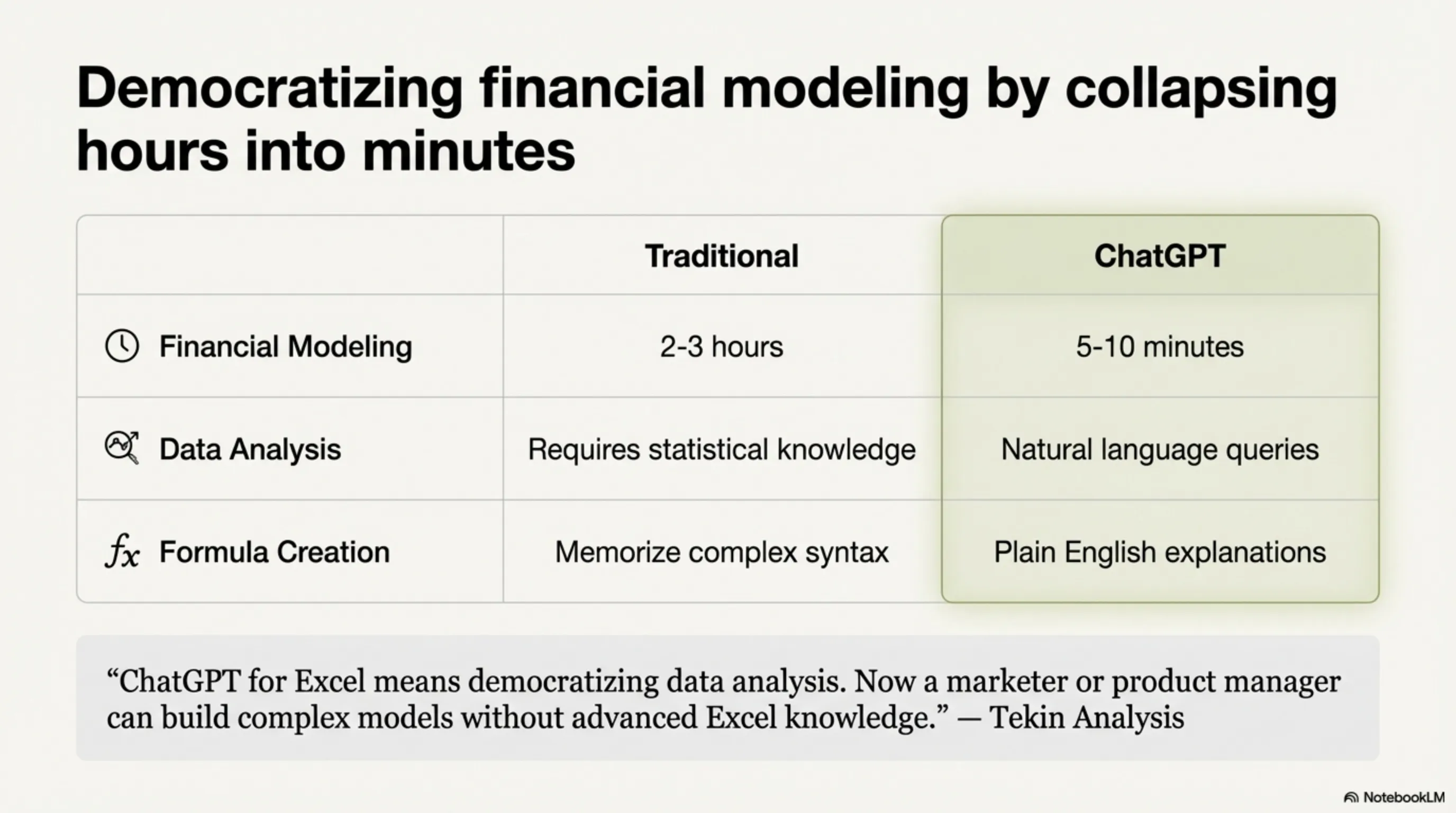
ChatGPT for Excel's capabilities are amazing. You can say "build a 5-year financial model for this company" and ChatGPT creates the tables, formulas, and charts itself. You can ask "what patterns do these data show?" and ChatGPT performs statistical analysis and explains results in plain language. You can say "explain this formula" and ChatGPT breaks down each part step by step.
| Capability | Traditional Excel | ChatGPT for Excel |
|---|---|---|
| Build financial model | 2-3 hours | 5-10 minutes |
| Data analysis | Requires statistical knowledge | Natural language |
| Write formulas | Memorize syntax | Explain to AI |
| Debug errors | Google search | Ask ChatGPT |
| Scenario planning | Manual | Automatic |
"ChatGPT for Excel means democratizing data analysis. Now a marketer or product manager can build complex models without advanced Excel knowledge." — Tekin Analysis
OpenAI says this add-in likely runs on GPT-5.4 — an optimized version for analytical tasks. This model can read large tables, recognize patterns, and even make statistical predictions. Calculation accuracy is also high — OpenAI claims computational error less than 0.1%.
ChatGPT for Excel's main competitor is Microsoft Copilot, which Microsoft has integrated into Office 365. But there's an important difference: Copilot is only available to Microsoft 365 subscribers (minimum $30/month), while ChatGPT for Excel is free for everyone (with request limits). This is OpenAI's strategy for penetrating the enterprise market.
Google Sheets support is coming soon too. OpenAI says a similar add-in for Google Sheets will be released "in the coming weeks." This means ChatGPT will be present in both major spreadsheet ecosystems. As we discussed in our deepfake elections article, AI is infiltrating our daily tools — and this is just the beginning.
Concerns exist too. First, data security: does OpenAI store companies' sensitive data? OpenAI says "Excel data is not stored on our servers," but companies remain cautious. Second, accuracy: can we trust AI calculations? Early tests show ChatGPT is correct 99% of the time, but that 1% could be costly.
Google Maps New Icon: When Gemini Inspires Design
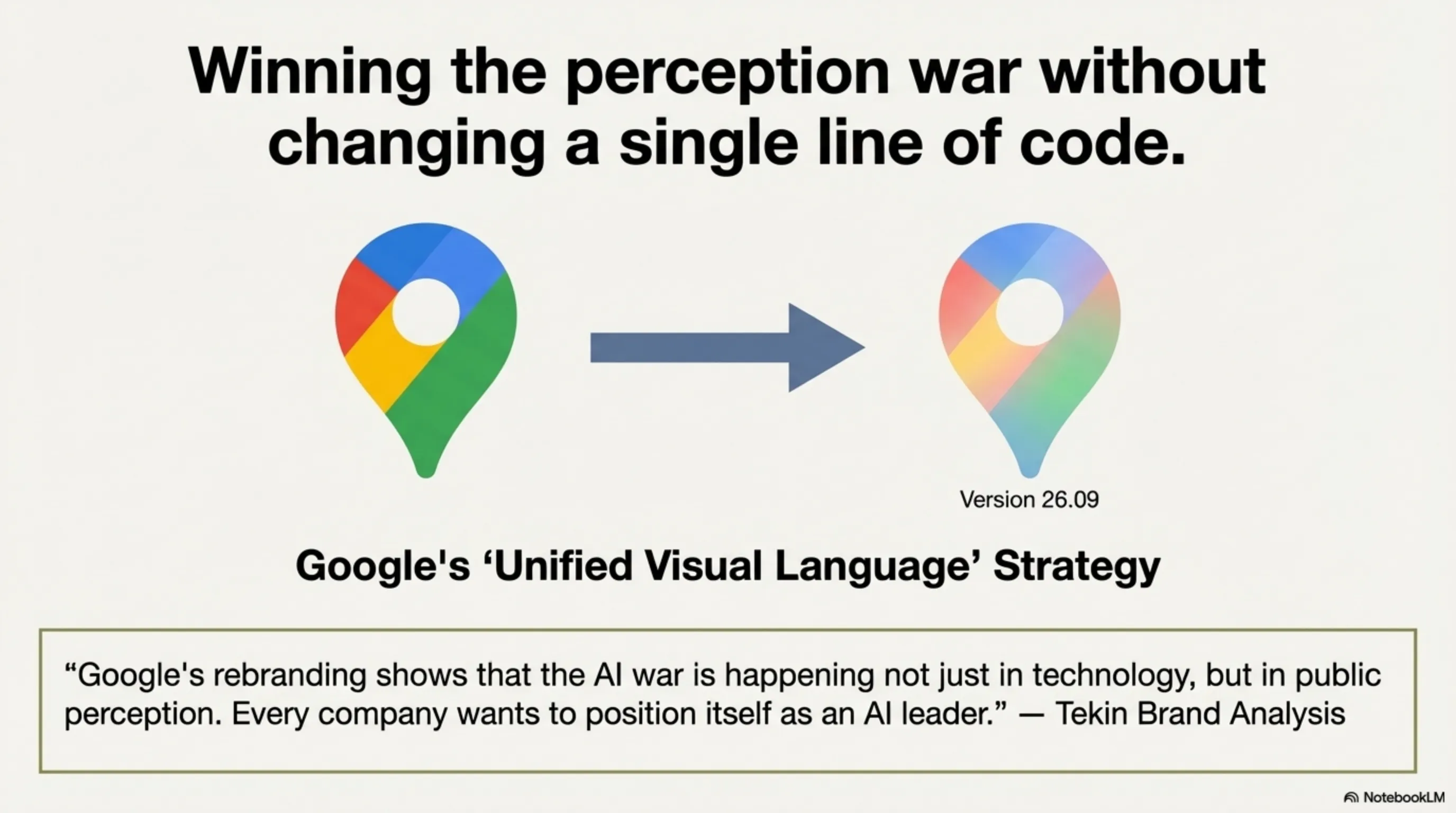
Google is rebranding its entire ecosystem, and the latest victim (or winner?) of these changes is Google Maps. Between March 3-5, 2026, Google began rolling out a new Maps icon — a modern gradient design inspired by Gemini AI.
The old Maps icon was a pin with four separate colors: blue, green, yellow, and red — Google's classic colors. But the new icon blends these colors with a smooth gradient, resulting in a more modern and attractive design. The top ring of the pin is thinner, the inner circle is larger, and the whole icon feels lighter.
This change is part of a larger strategy. Over the past year, Google has redesigned the icons for Search, Photos, Home, and Gemini with this same gradient style. The goal is to create a "unified visual language" that represents "AI-driven innovation." In other words, Google wants you to immediately think of AI when you see its icons.
"Google's rebranding shows that the AI war is happening not just in technology, but in public perception. Every company wants to position itself as an AI leader." — Tekin Brand Analysis
User reactions have been mixed. Some find the new design "modern and fresh," while others say "the old icon was clearer." But Google doesn't care — this rebrand is part of a long-term plan to transform Google from a search company to an AI company.
Interestingly, this change is purely cosmetic — Maps functionality hasn't changed at all. But brand psychology says visual design can change user perception. When you see the Maps icon with Gemini gradient, you subconsciously think the app has become "smarter" — even if no code has changed!
The new icon is rolling out for Android and iOS. Google Maps version 26.09 has this change. If you still see the old icon, wait — it'll reach your device soon. And if you really loved the old icon, unfortunately there's no way to bring it back. Google has decided, and we must accept it!
Valve Steam Machine: Victim of the RAMpocalypse
March 7, 2026 was the day Valve had to announce a bitter truth: Steam Machine, Steam Frame, and Steam Controller might be delayed until 2027. The reason? A global RAM and storage crisis that has paralyzed the tech industry. And the main culprit? AI datacenters devouring all the world's resources.
Steam Machine was supposed to be a gaming mini-PC positioned between consoles and PCs. Target price around $600-800, with enough power to run AAA games at 1080p/60fps. But here's the problem: to build this device, Valve needs 16GB DDR5 RAM and 512GB NVMe SSD. And that's exactly what's become scarce in the market.
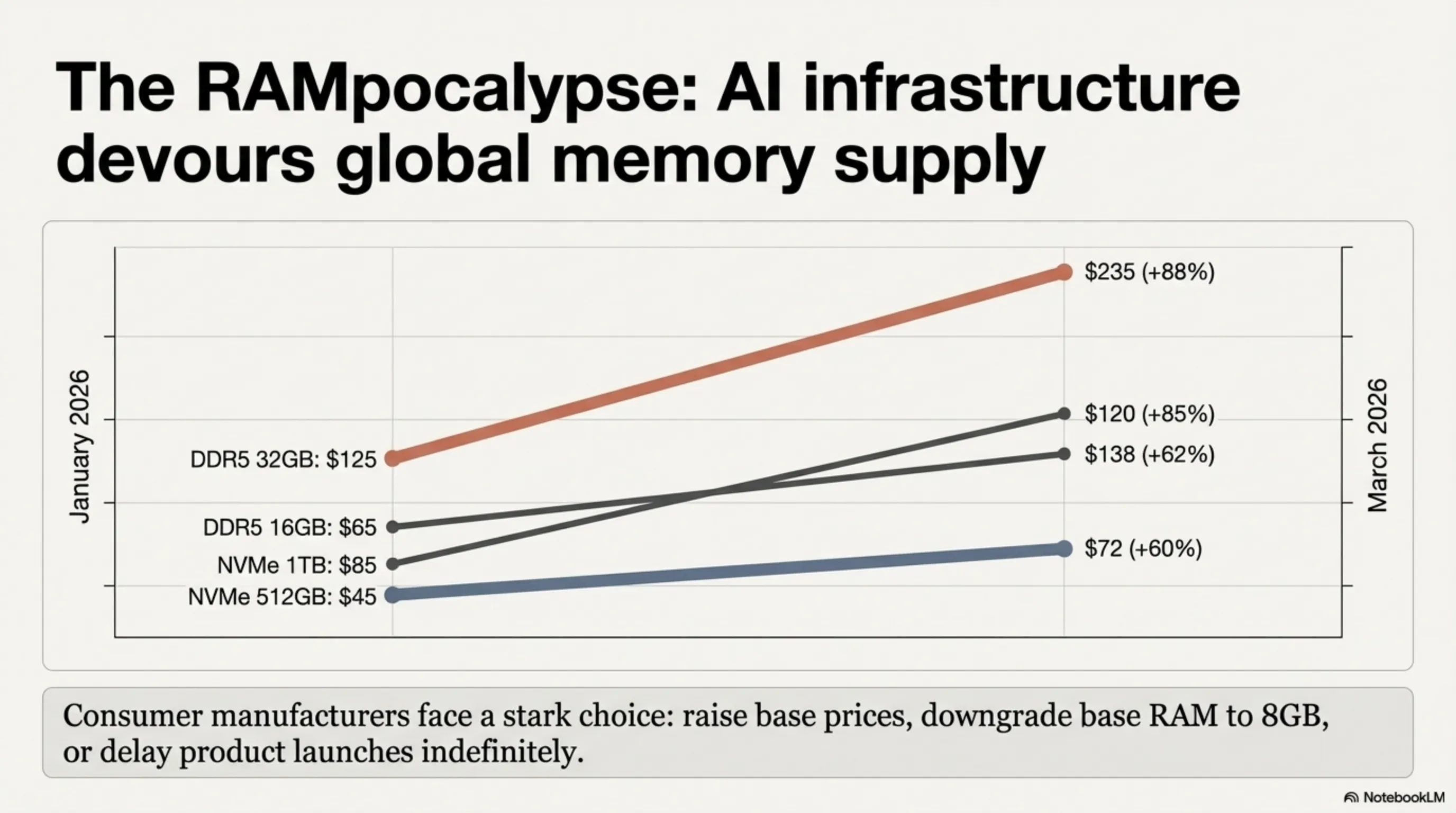
Why has RAM become scarce? Because AI companies like OpenAI, Google, and Meta are spending billions building new datacenters. Each AI datacenter needs thousands of servers, and each server needs hundreds of gigabytes of RAM. Demand has risen so high that DDR5 RAM prices have increased 85% in the past six months. Same with SSDs — prices up 60%.
| Component | January 2026 Price | March 2026 Price | Increase |
|---|---|---|---|
| DDR5 16GB | $65 | $120 | +85% |
| NVMe 512GB | $45 | $72 | +60% |
| DDR5 32GB | $125 | $235 | +88% |
| NVMe 1TB | $85 | $138 | +62% |
Valve said in a statement: "The memory and storage shortages we've seen recently in the industry have rapidly increased. Limited availability and rising prices of these critical components mean we must revisit our shipping schedule and pricing." In plain language: either we raise prices, or we delay launch. Or both!
"Steam Machine's delay is the first major casualty of the AI hardware war. But it won't be the last. Any product requiring RAM or storage is at risk." — Tekin Supply Chain Analysis
Valve later updated its statement saying: "We still hope to ship all three products in 2026." But the tone suggests there's not much confidence. Analysts predict that if RAM conditions don't improve, Steam Machine won't launch until Q2 2027.
This situation isn't unique to Valve. Other companies are wrestling with the same problem. Laptop and PC prices are rising. Some manufacturers are reducing base RAM from 16GB to 8GB to control costs. And others, like Valve, are delaying products. As we saw in our GTA 6 crisis article, when resources become limited, everyone must compromise.
Xiaomi Leica Leitzphone: When a €1,999 Camera Becomes a Phone
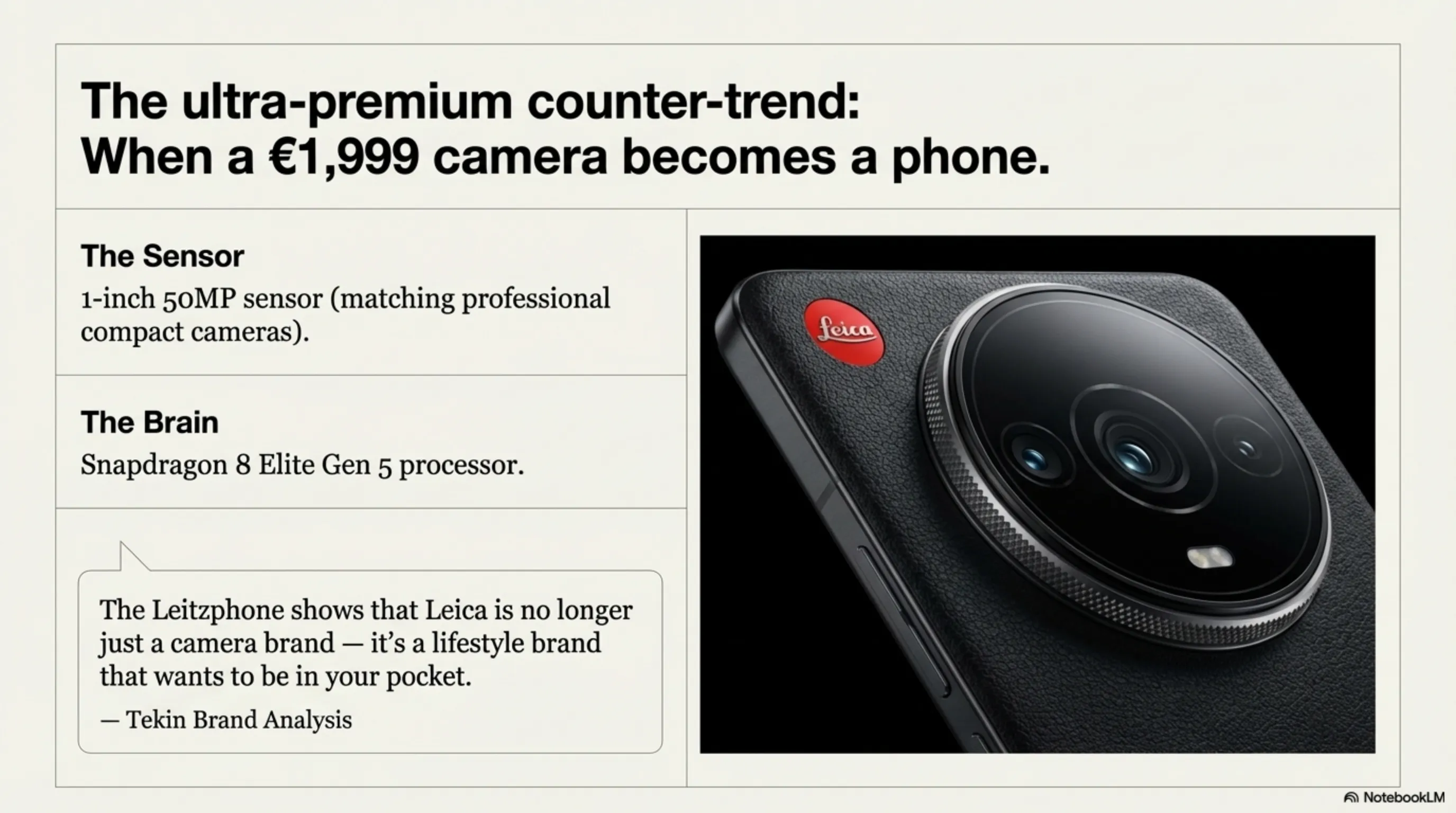
MWC 2026 Barcelona witnessed a historic collaboration: Xiaomi and Leica — two giants of technology and photography — unveiled Leica's first international smartphone. The Leitzphone at €1,999 (about $2,150) is Xiaomi's most expensive phone ever, but claims to have the world's best mobile camera.
The heart of the Leitzphone is a 1-inch 50MP sensor — a size typically only seen in professional compact cameras. For comparison, the iPhone 16 Pro Max has a 1/1.28-inch sensor, and the Galaxy S26 Ultra has a 1/1.3-inch sensor. A larger sensor means more detail, better dynamic range, and exceptional low-light performance.
But the Leitzphone isn't just a big sensor. This phone has a triple camera system: 50MP main sensor with f/1.8 lens, 200MP telephoto with variable optical zoom 75-100mm, and 50MP ultrawide with 120-degree field of view. All lenses are designed and tuned by Leica — the same company that makes the legendary M-series cameras.
"The Leitzphone shows that Leica is no longer just a camera brand — it's a lifestyle brand that wants to be in your pocket." — Tekin Brand Analysis
The Leitzphone's design is also distinctive. Aluminum body with nickel-anodized finish that feels premium. The back is made of black fiberglass with engraved Leica markings. And of course, Leica's legendary red dot on the body. But the most attractive part is the Leica Camera Ring — a rotating ring around the camera module that you can use to control zoom, focus, or aperture. It's the same feeling you get when holding a real Leica camera.
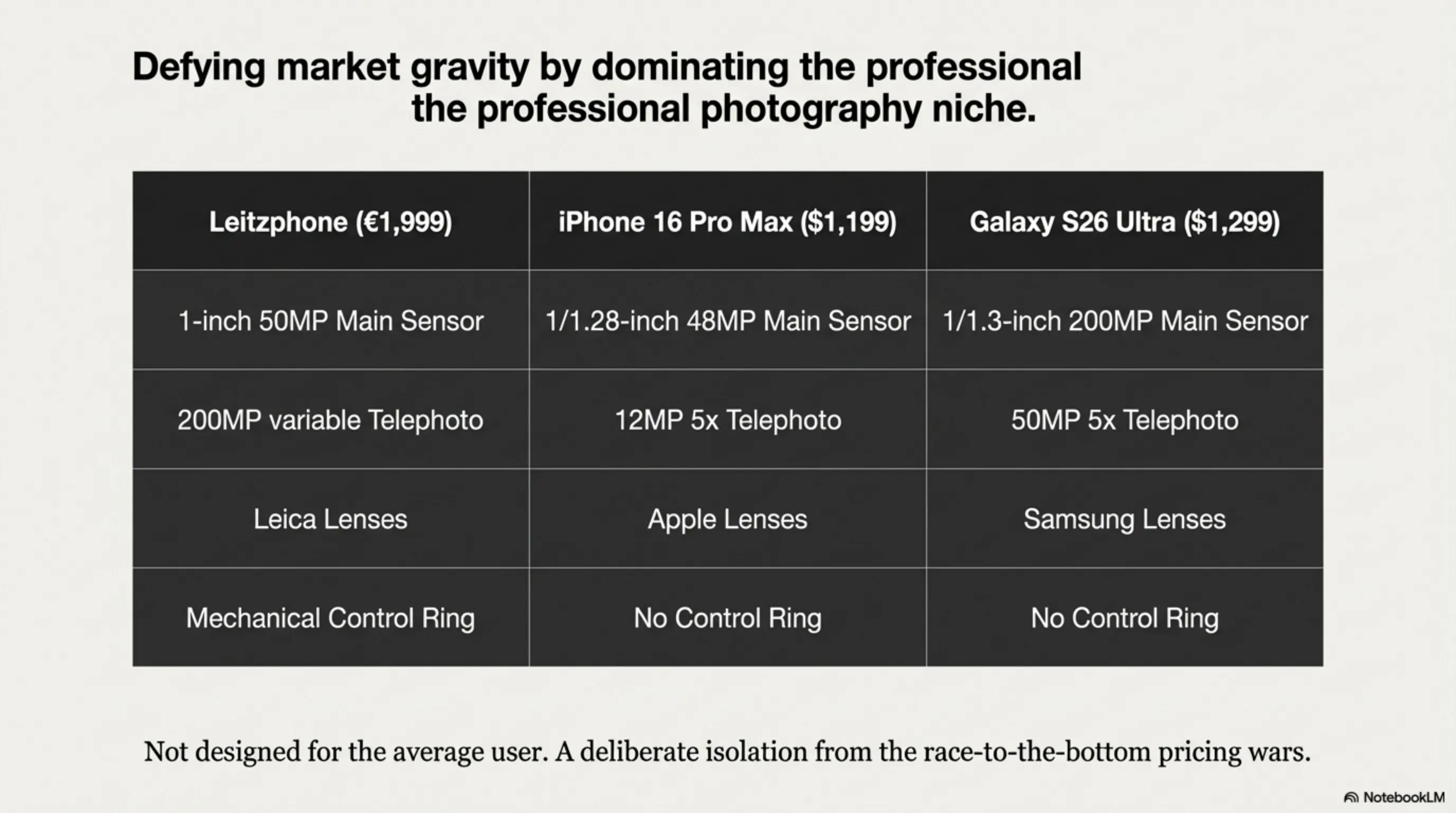
| Specification | Leitzphone | iPhone 16 Pro Max | Galaxy S26 Ultra |
|---|---|---|---|
| Main sensor | 1" 50MP | 1/1.28" 48MP | 1/1.3" 200MP |
| Telephoto | 200MP variable | 12MP 5x | 50MP 5x |
| Lens | Leica | Apple | Samsung |
| Control ring | Yes | No | No |
| Price | €1,999 | $1,199 | $1,299 |
The Leitzphone's technical specs are also professional: Snapdragon 8 Elite Gen 5 (Qualcomm's latest chip), 6.9-inch HyperRGB OLED display with 120Hz refresh rate, 6,000mAh battery (China version has 6,800mAh), and 90W fast charging. These specs put the Leitzphone alongside the Galaxy S26 Ultra and iPhone 16 Pro Max — but at a higher price.
The main question: is the Leitzphone worth €2,000? For professional photographers who want a camera and phone in one device, the answer is probably yes. But for the average user, probably not. This is a niche product — for those who take photography seriously and are willing to pay for the best quality.
The Leitzphone has been available since February 28 in Europe, Asia, and the Middle East. North American release hasn't been confirmed. Xiaomi says it's "looking at key markets," but given trade tensions, the likelihood of a US release is low. As we saw in our Neuralink article, advanced products are first tested in limited markets.
Conclusion: An Exciting Tech Morning
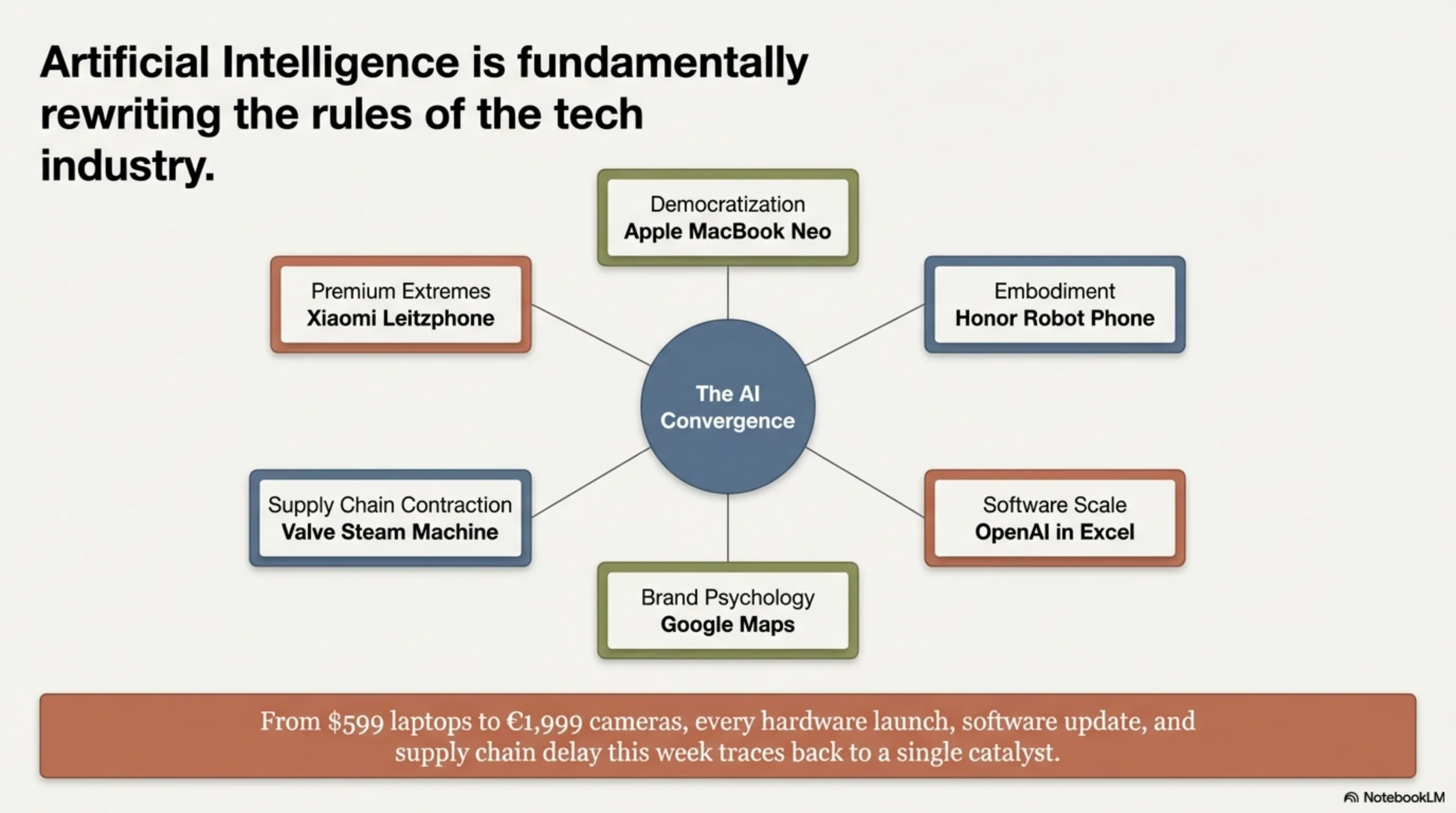
The morning of March 8, 2026 showed that the tech world is changing rapidly. On one hand, Apple with its $599 MacBook Neo is targeting the budget market. On the other, Xiaomi and Leica with their €1,999 Leitzphone are conquering the premium market. Honor with Robot Phone is presenting a new concept of smartphone. OpenAI with ChatGPT for Excel is revolutionizing data work. And Valve with Steam Machine's delay shows that even industry giants are victims of the AI hardware crisis.
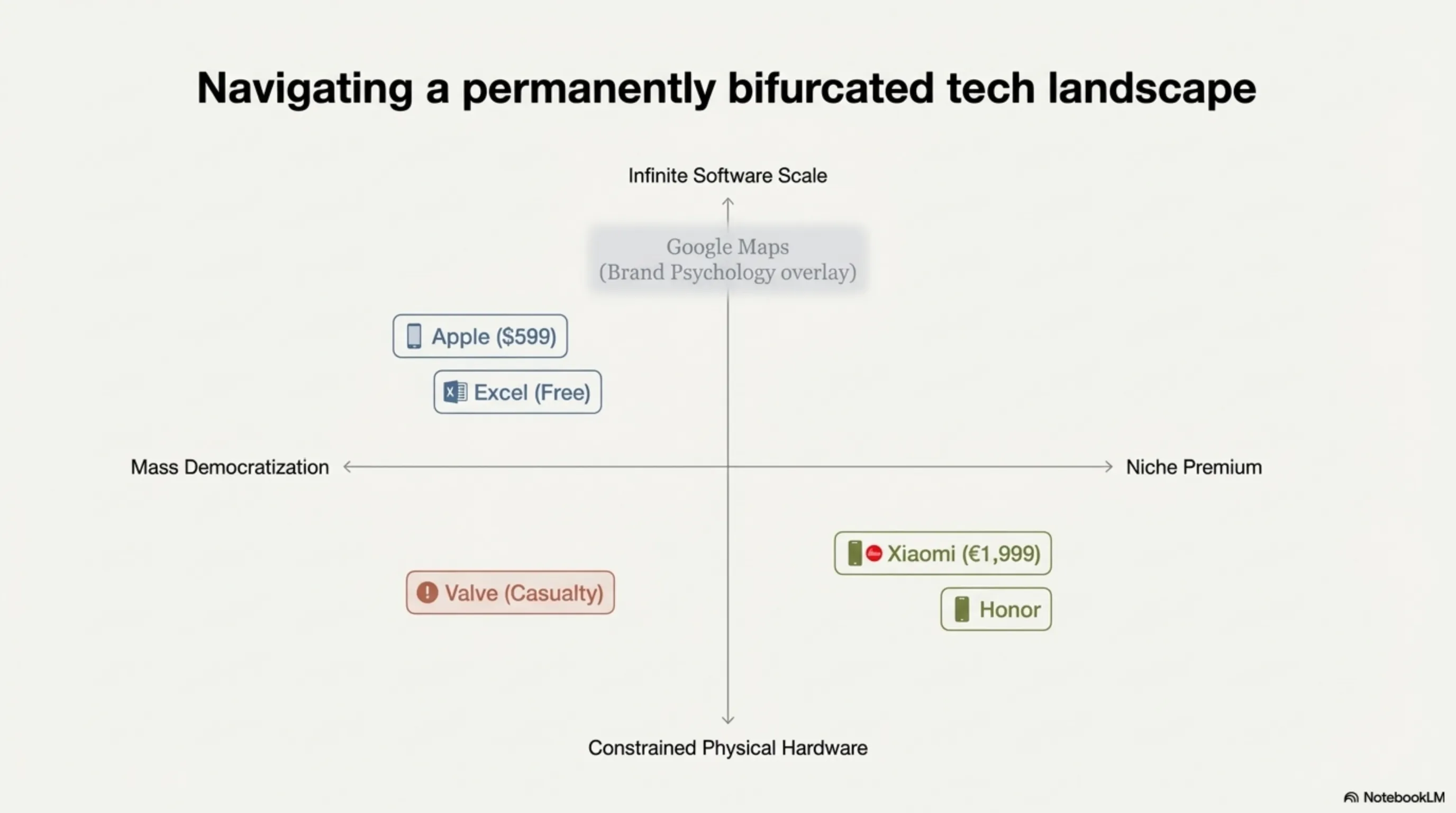
The common thread in all these stories? AI. Whether it's MacBook Neo with on-device AI capabilities, Robot Phone with multimodal AI, ChatGPT in Excel, or even the RAM crisis caused by AI datacenters — everything comes back to AI. We're living in the AI age, and this is just the beginning.
The main question: are these changes in our favor? Does a $599 MacBook mean democratization of technology, or a reduction in quality? Is Robot Phone a real innovation, or just a gimmick? Does ChatGPT in Excel make work easier, or make us lazier? Time will tell. But one thing is certain: the tech world will never be the same again.
Tekin Morning Image Gallery