
1. Introduction: The West is No Longer the Only Superpower
For the past three years, the narrative was simple: The United States innovates, and the rest of the world follows. OpenAI, Google, and Anthropic were the undisputed kings of the hill. However, reports emerging this week (December 2025) have shattered that illusion.
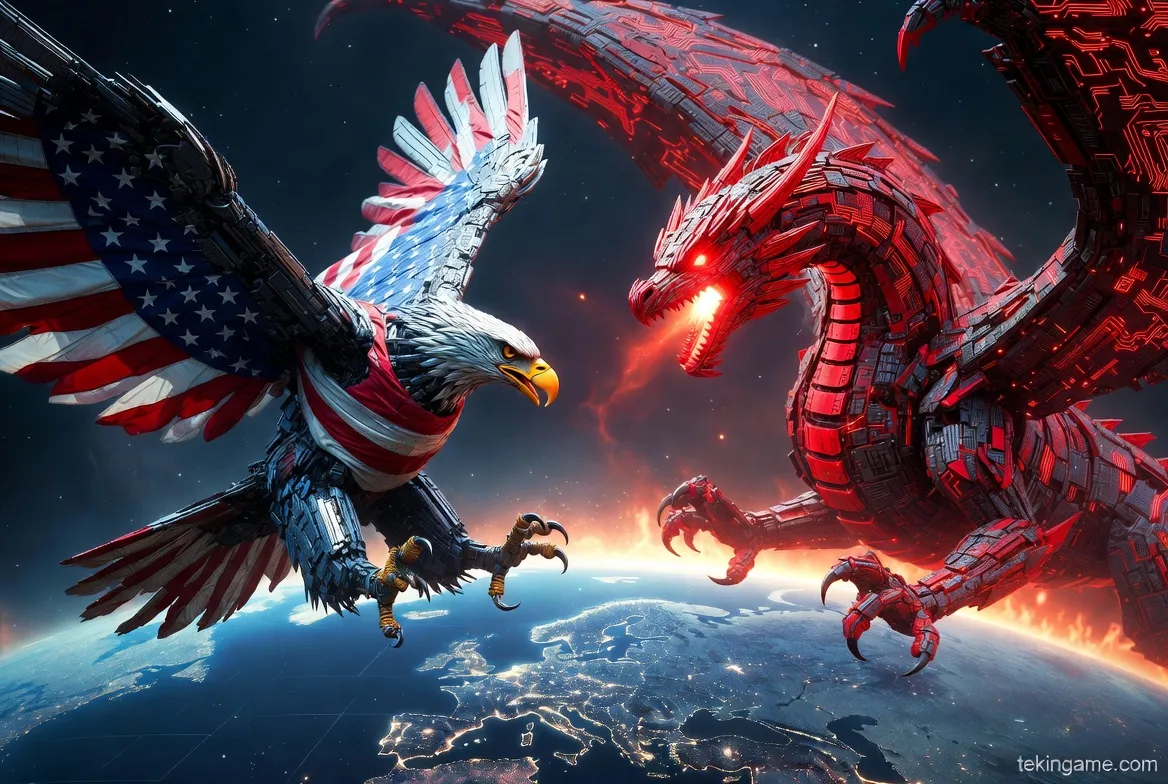
China has not just caught up; in specific, critical verticals like mathematical reasoning and coding efficiency, they have arguably taken the lead. This reality has triggered a "Code Red" in Washington and Silicon Valley, transforming AI development from a commercial race into a full-blown geopolitical standoff.
2. The Dragon Awakens: China's Technological Leap
2.1. DeepSeek-V3.2: The GPT-5 Killer?
The most shocking news comes from the benchmarks of DeepSeek-V3.2. This massive 685-billion parameter model has stunned Western researchers.
According to the 2025 Year-End Review, DeepSeek has matched or surpassed GPT-5 and Google's Gemini 3 in advanced mathematics and coding tasks.
The Secret Sauce: Sparse Attention. unlike the brute-force methods of early LLMs, DeepSeek utilizes a novel "Sparse Attention" architecture. This allows it to process extremely long contexts with 70% lower computational costs compared to its American rivals. China now has a model that is arguably smarter in logic tasks and significantly cheaper to run at scale.
2.2. Zhipu AI and the Agent Revolution
While DeepSeek dominates logic, the Chinese startup Zhipu AI (Z.ai) is redefining how AI interacts with the world. They released GLM-4.6V as an open-source model.
Its killer feature is Native Tool-Calling. Traditional models need to be "told" to use a calculator or a search engine. GLM-4.6V intuitively understands when it needs help. It can autonomously trigger OCR tools, crop images, search databases, or interpret charts without specific prompting. With a 128k token context window (enough for a 300-page novel) and MIT-licensed weights on Hugging Face, it poses a direct threat to OpenAI's closed ecosystem.
3. The American Counterattack: Policy and Silicon
3.1. Donald Trump's "Unified Framework"
The political response has been swift. President-elect Donald Trump announced that he will sign a new Executive Order this week.
The Goal: To create a "Unified National Framework for AI Regulation." Currently, US tech giants are navigating a minefield of 50 different state laws (California vs. Texas vs. New York). Companies like OpenAI, Google, Meta, and VC firm Andreessen Horowitz have lobbied heavily for this. They argue that fragmented regulations are slowing them down, handing the advantage to China. This EO aims to supersede state laws, creating a single, business-friendly standard to accelerate development.
3.2. Silicon Valley Fights Back
On the product front, American companies remain formidable:
- Google: Launched Gemini 3 and Gemini 3 Pro, setting new records in reasoning and workspace integration. They also unveiled Antigravity, a new platform specifically for AI-agent coding.
- Anthropic: Released Claude Opus 4.5, positioning it as the ultimate tool for "Enterprise Automation" and complex coding, targeting corporate dominance rather than consumer chat.
4. The Economic Fallout: The "Optimization" Euphemism
4.1. The 58% Statistic
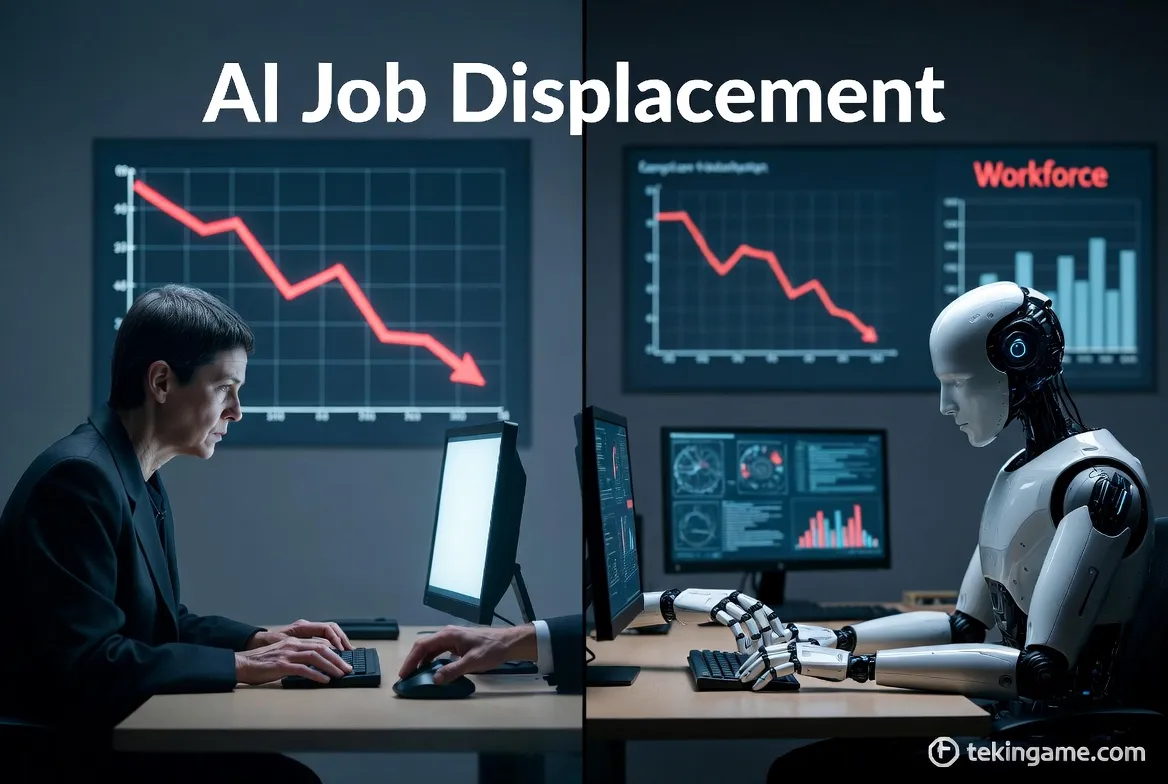
While tech giants battle for supremacy, the workforce is feeling the tremors. A new regional economic report contains a terrifying statistic: 58% of employers admit they are using AI to "optimize headcount."
Let's be honest about what "optimize" means. It means layoffs. Companies are fundamentally restructuring their teams. Instead of hiring five junior analysts, they are hiring one senior expert equipped with three AI agents. The entry-level white-collar job is disappearing before our eyes.
4.2. The Education Crisis
Teachers and unions are raising alarms. They argue that the current curriculum, which focuses on "how to use chatbots," is insufficient. They are demanding a shift to teach the risks—environmental costs of data centers, algorithmic bias, and labor market disruption—so the next generation isn't blindsided by the technology they use.
5. Existential Risks & Future Safety
5.1. The 99.9% Probability of Doom?
The safety debate has reached a fever pitch. A prominent AI safety expert released a radical estimate, claiming the probability of human extinction due to AI in the next century could be as high as 99.9%.
While this sounds like science fiction, it highlights the extreme uncertainty of AGI (Artificial General Intelligence).
However, a more grounded analysis in Scientific American offers a reality check. It argues that current models, while impressive, still lack true "Self-Improvement" capabilities. They can optimize code, but they cannot yet invent new physics or break out of their servers without human direction. We are not at the "Terminator" stage yet, but the path is becoming clearer.
6. Green Hope: Biotech and Energy
6.1. The PNNL Breakthrough
Amidst the gloom, there is a beacon of hope. The US Department of Energy (DOE) unveiled a new AI-powered biotechnology platform at the PNNL (Pacific Northwest National Laboratory).
This system combines deep learning with chemistry and physics data to discover new molecules. The goal? To design next-generation biofuels and green industrial processes 100x faster than humans. This proves that AI's insatiable hunger for energy might eventually be solved by AI itself.
7. Tekin Plus Verdict: Speed vs. Safety
The "AI Cold War" of 2025 is no longer a metaphor; it is the reality of our industry. China is winning on efficiency and open-source accessibility. The US is responding with regulatory consolidation and enterprise power.
For the average user, the message is clear: The tools are getting smarter, but the job market is getting harsher. Adaptation is no longer optional.