
February 2026 will be recorded as the turning point for "Smart Sovereignty" in regional history. While the strategic alliance between Abu Dhabi’s G42, America’s Cerebras, and India’s C-DAC has shifted hardware boundaries with an 8-Exaflop supercomputer, the Central Bank of the UAE (CBUAE) has ensured ethical and financial security with the most comprehensive regulatory framework to date. This mega-article from Tekin Garage dissects the intersection of "Absolute Computing Power" and "Regulatory Discipline" across 6 vital axes: from Cerebras’ 8-E
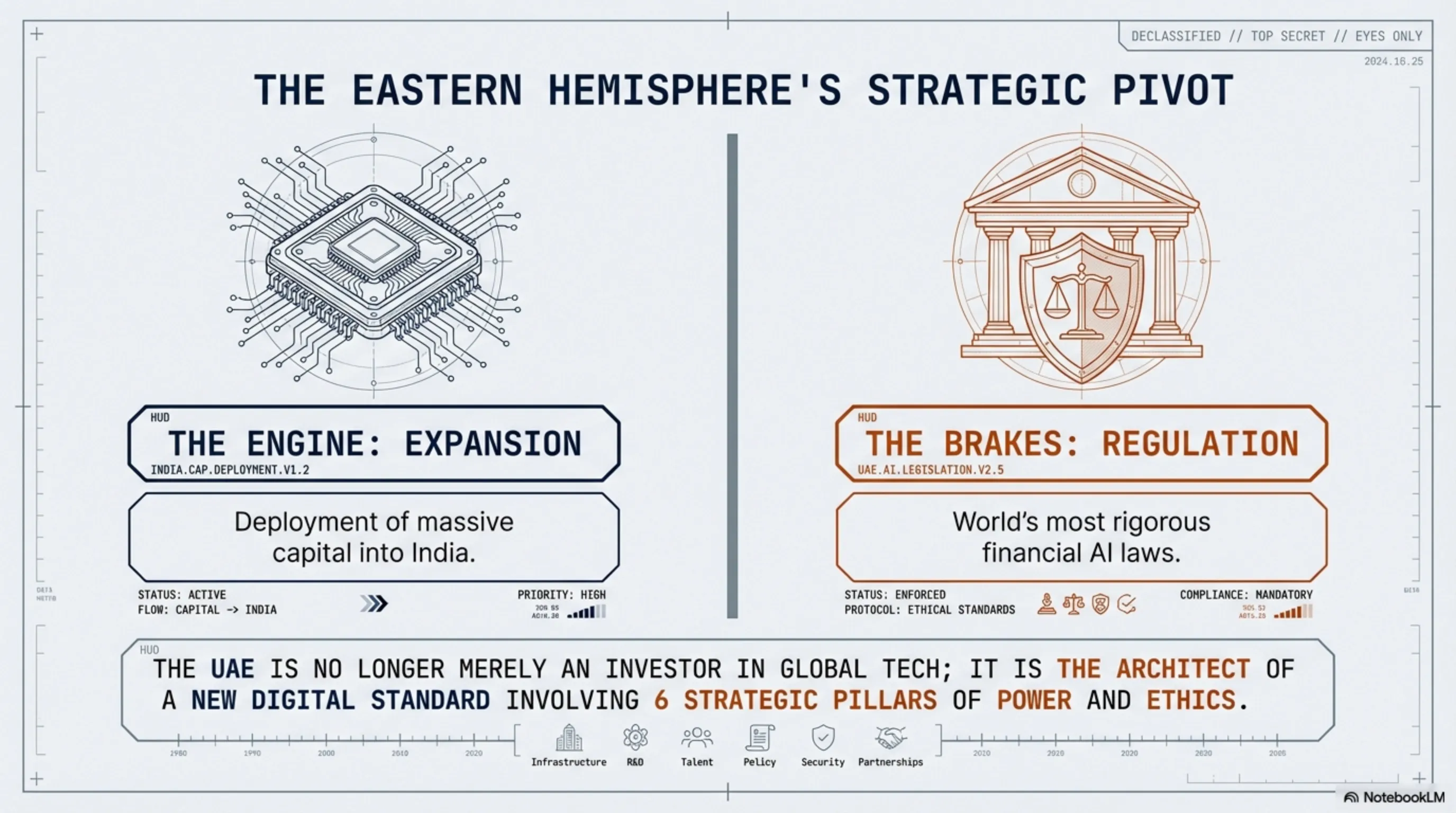
Welcome to the war room at Tekin Garage. Today is February 25, 2026, and we are monitoring a monumental "Geopolitical Power Shift" in the Eastern Hemisphere. The UAE is no longer merely an investor in global tech; it is now the architect of the new digital standard. On one front, we see the deployment of massive capital and technical intelligence into India to build the region's most powerful AI supercomputer. On the other, the UAE is implementing the world's most rigorous AI regulations in the financial sector. Your Chief Inspector is ready to debug the layers of this new order across 6 strategic pillars of power and ethics.

1. The 8-Exaflop Beast: G42, India, and the Cerebras Architecture
The project, initiated during the high-level strategic dialogues of late 2025 and finalized during the UAE President's historic January 2026 visit to India, has officially gone live. The alliance between G42 Group, the Mohamed bin Zayed University of Artificial Intelligence (MBZUAI), and Cerebras Systems has delivered an 8-Exaflop computational monster (8 quintillion calculations per second) to the heart of Delhi.
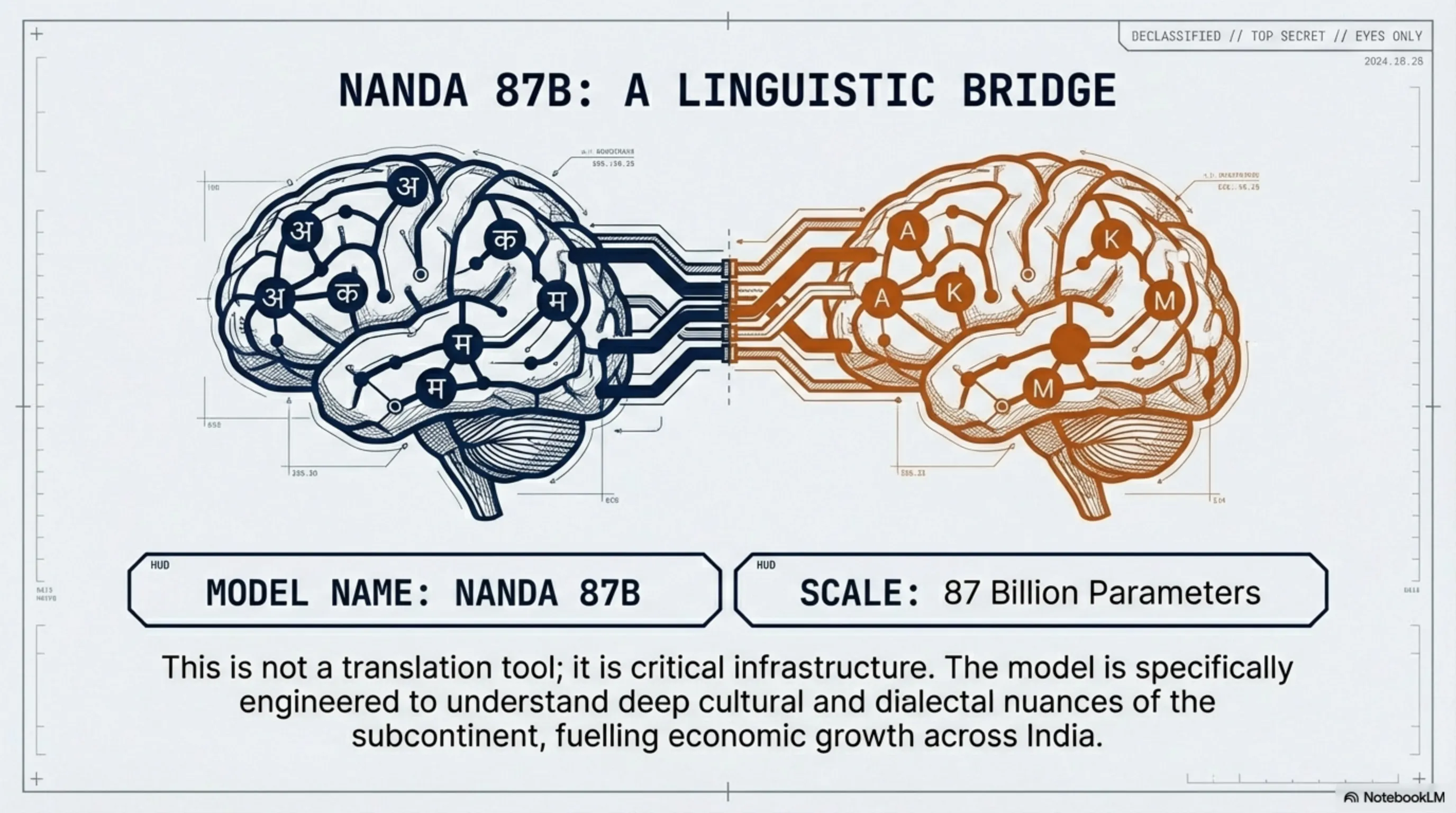
Unlike traditional supercomputers that rely on thousands of linked GPUs, this system utilizes Cerebras’ proprietary Wafer-Scale Engine (WSE) technology. This "Giant Chip" architecture allows for near-instantaneous data transfer, making it the perfect engine for training the NANDA 87B model. With 87 billion parameters, NANDA is not just an LLM; it is a linguistic bridge specifically engineered to understand the deep cultural and dialectal nuances of both Hindi and English. This is critical infrastructure designed to fuel economic growth across the entire Indian subcontinent.
2. Data Sovereignty: The National Red Line in Indian Soil
A pivotal and highly classified layer of this agreement is "Data Residency." In the previous era, developing nations often exported their citizens' data to Silicon Valley for processing. This G42-India alliance has rewritten that script: Every byte of data and the physical hardware itself must remain within Indian borders.
This ensures the Indian government maintains absolute sovereignty over its national data assets. This "Sovereign AI" model ensures that national security protocols, private financial records, and citizen identity data are managed within an isolated, high-security environment governed by local laws. For G42, this is a strategic blueprint—offering nations the power of AI without the risk of digital colonialism. It is a paradigm shift in how global powers trade technology for trust.
3. Democratizing AI: Breaking the Monopoly of Silicon Valley
In a global landscape where AI dominance is concentrated in a handful of "Big Tech" firms, the UAE-India partnership is actively working to "Democratize" this power. The 8-Exaflop capacity is not a walled garden for G42; it is a public-private utility. Under the partnership terms, the supercomputer is accessible to local Indian startups, research universities, and government bodies at a fraction of global cloud costs.
This move is intended to ignite "Bottom-up Innovation." From agricultural startups predicting crop cycles to healthcare labs identifying early-stage diseases in rural populations, the barrier to high-end computing has been removed. India is no longer just a consumer of foreign algorithms; it is now a producer of intelligent models capable of competing on the global stage, backed by Abu Dhabi’s strategic capital.
🛡️ Strategic Lab Briefing: The "Brakes" on AI
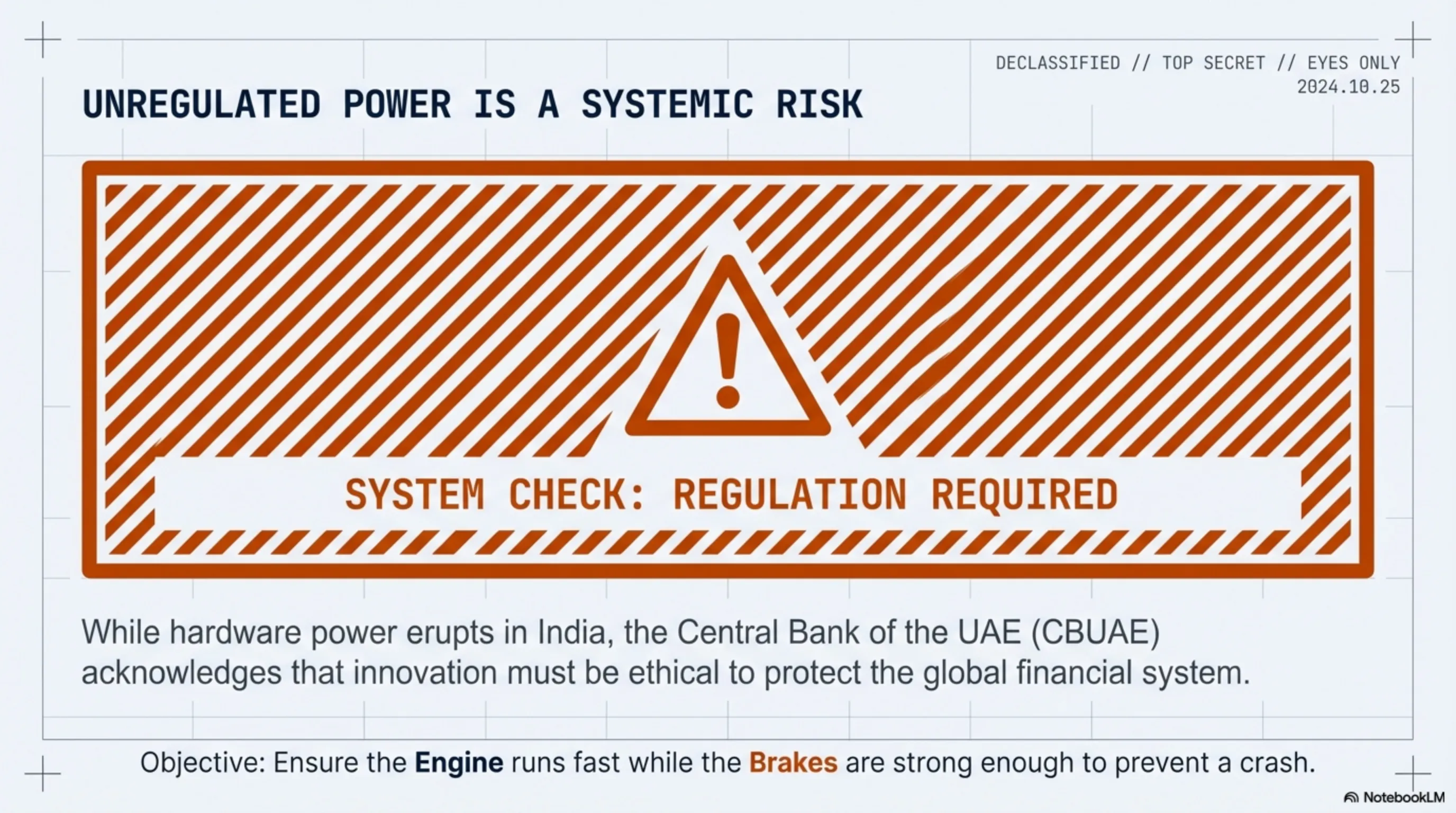
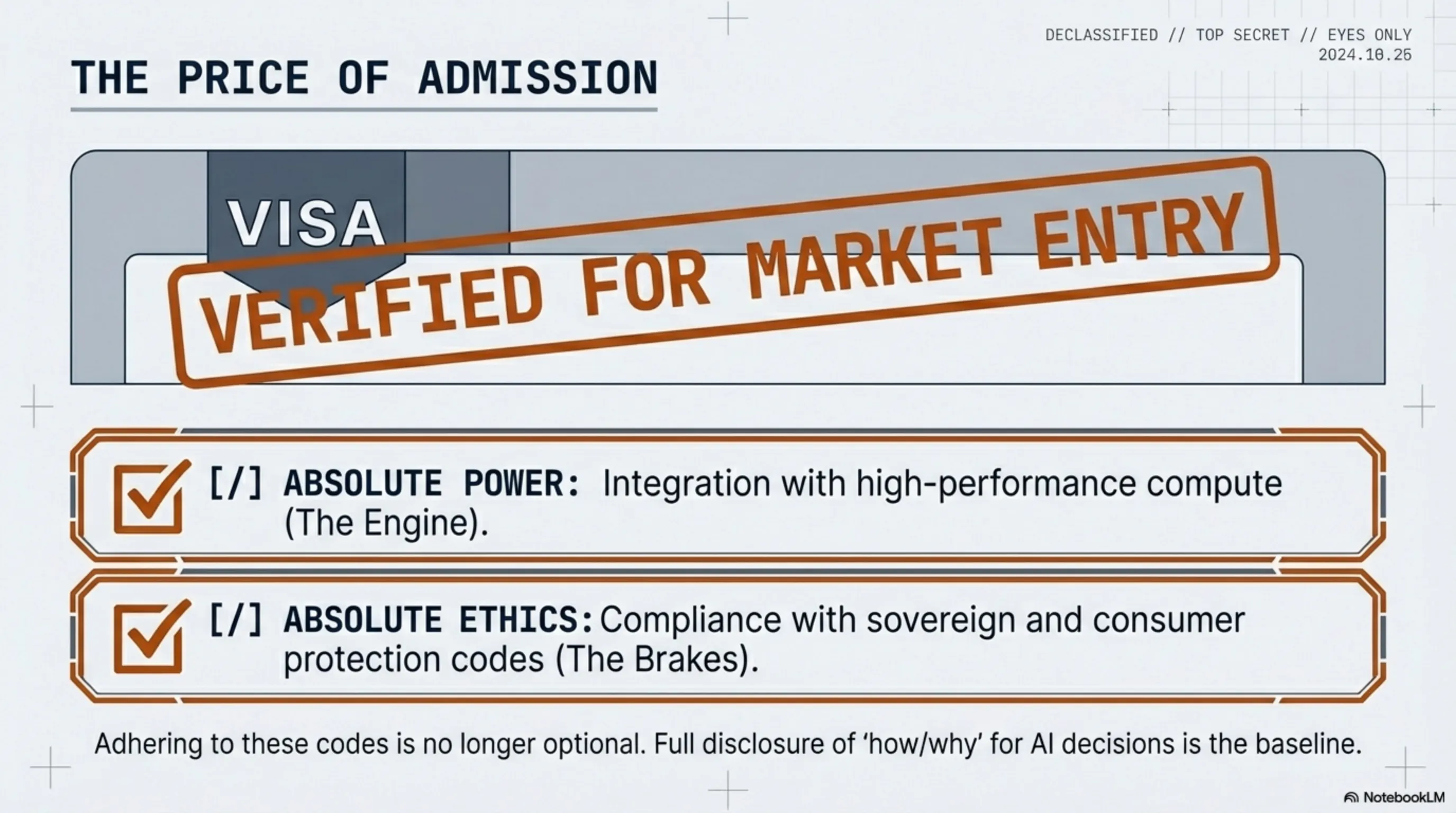
While hardware power erupts in India, the Central Bank of the UAE (CBUAE) has realized that unregulated power is a systemic risk. Their new "Responsible AI" directive serves as the regulatory anchor. It ensures that while the "Engine" (G42) runs fast, the "Brakes" (Regulation) are strong enough to protect the global financial system. Innovation must be ethical, or it will not be allowed.
4. The Abu Dhabi Regulatory Earthquake: CBUAE’s New AI Laws
The Central Bank of the UAE has issued a landmark, binding document for all licensed financial institutions (LFIs). This move makes the UAE a global pioneer in regulating AI within the high-stakes financial sector—including banks, insurers, and digital payment providers. The primary mission? To ensure that the rapid adoption of AI and Machine Learning (ML) does not compromise financial stability or consumer trust.
Khaled Mohamed Balama, Governor of the CBUAE, stated that this framework is a proactive measure aimed at fostering a secure environment for digital transformation. Institutions are now legally required to integrate "Governance" and "Ethical Auditing" into their automated decision-making pipelines. Every algorithm that touches a customer's wallet in the UAE is now subject to government-mandated transparency standards.
5. Responsible AI: From Senior Accountability to Anti-Bias Protocols
Debugging the CBUAE's new legal codes reveals three core pillars that now govern the UAE's financial architecture:
- Senior Management Accountability: The "Black Box" excuse is dead. Boards of Directors are now personally and legally responsible for AI outcomes. If an algorithm fails or causes systemic loss, the blame lies with the leadership, not the code.
- Algorithmic Neutrality & Anti-Bias: AI systems must undergo rigorous testing to ensure they do not discriminate based on race, gender, religion, or social status. Fairness in credit scoring and insurance premiums is now a legal mandate, not just a moral suggestion.
- Full Disclosure: Customers must be explicitly informed when they are interacting with AI. Every AI-driven decision must come with a clear, human-readable explanation of "how" and "why" that decision was reached.
6. Designing for the Consumer: The Right to Human Review
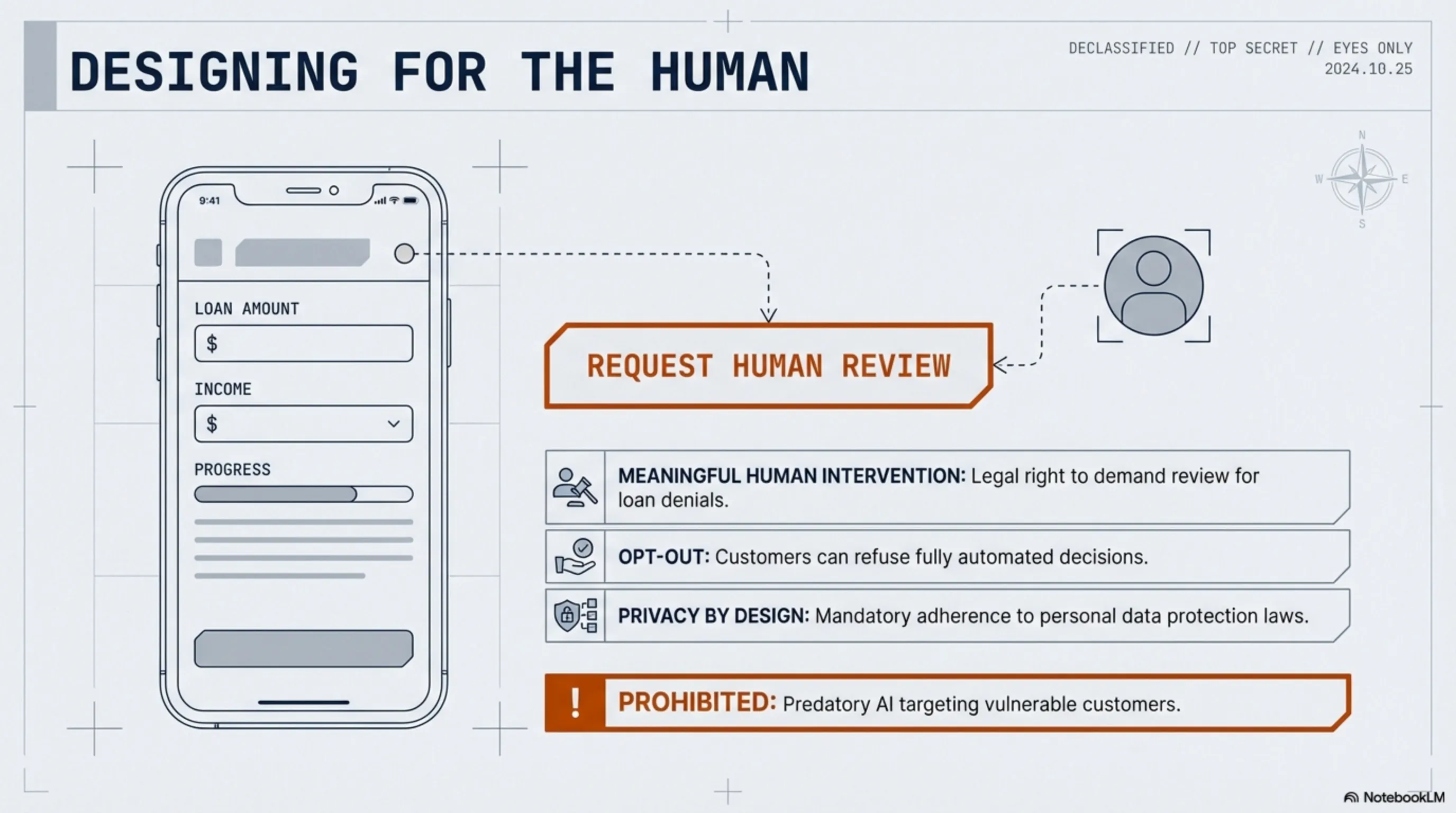
One of the most advanced aspects of the UAE’s new regulations is the "Meaningful Human Intervention" requirement. The Central Bank has mandated that AI systems must not operate in a vacuum. Customers now have the legal right to demand a human review of any AI-generated decision, particularly in loan denials or insurance claims. This "Opt-out" right from fully automated decisions is a massive win for consumer protection.
Furthermore, the principles of "Privacy by Design" and "Security by Design" are now mandatory. Data used for AI training must strictly adhere to the UAE's personal data protection laws. The CBUAE has also issued a stern warning against "Predatory AI"—the use of algorithms to target vulnerable customers for high-interest products. In 2026, AI in the UAE must be a tool for financial inclusion, not a weapon for exploitation.
📊 The Tekin Verdict: A New Digital Sovereignty
February 2026 has witnessed the birth of a new "Digital Superstructure." The alliance between the UAE and India (8 Exaflops) combined with Abu Dhabi's aggressive regulatory leadership proves that this region is no longer a passenger in the tech revolution; it is the pilot. This balance between Absolute Computing Power and Human-Centric Algorithmic Ethics is the new gold standard for the 21st century.
For any global corporation wishing to enter the Middle Eastern or Asian markets, adhering to these ethical and sovereign codes is no longer optional—it is the price of admission. Tekin Garage monitors this power shift as a victory for digital independence. The war for the future is being won here, and we have only just begun. System online!