
Professional 'Grade A++' Analysis of Starlink Mini V2: 1. Radical redesign of phased array antenna architecture. 2. Price drop to $200 and its economic fallout. 3. Stunning energy efficiency (Power Bank compatibility). 4. Target Markets: From Nomads and Hikers to Maritime Vessels. 5. The role of Mini V2 in breaking digital barriers globally.
Introduction: When Space Fits in Your Backpack—The Micro-Revolution! 🛰️🎒
In the grand tapestry of technological history, there are rare moments when a single product transcends its function and becomes a "Symbol of Change." Just as the iPhone redefined the mobile world, SpaceX is doing the same for global telecommunications with the introduction of **Starlink Mini V2**. For decades, satellite internet was synonymous with heavy equipment, massive dishes, and exorbitant costs—a luxury reserved for rural estates or massive ocean liners. But Elon Musk and his army of engineers have torn up the rulebook. The Starlink Mini V2 isn't just a smaller dish; it's a complete reimagining of how humans interface with outer space to receive data. Imagine sitting on a remote peak in the Rockies or in the heart of the Sahara Desert, with 200 Mbps internet at your fingertips, powered by nothing more than a power bank in your pocket. Today at Tekin Game, we dissect this tiny giant to understand why it's the hottest news in the tech world at the dawn of 2026.
1. Hardware Architecture: The Magic of Miniaturized Phased Array Technology 📖✨

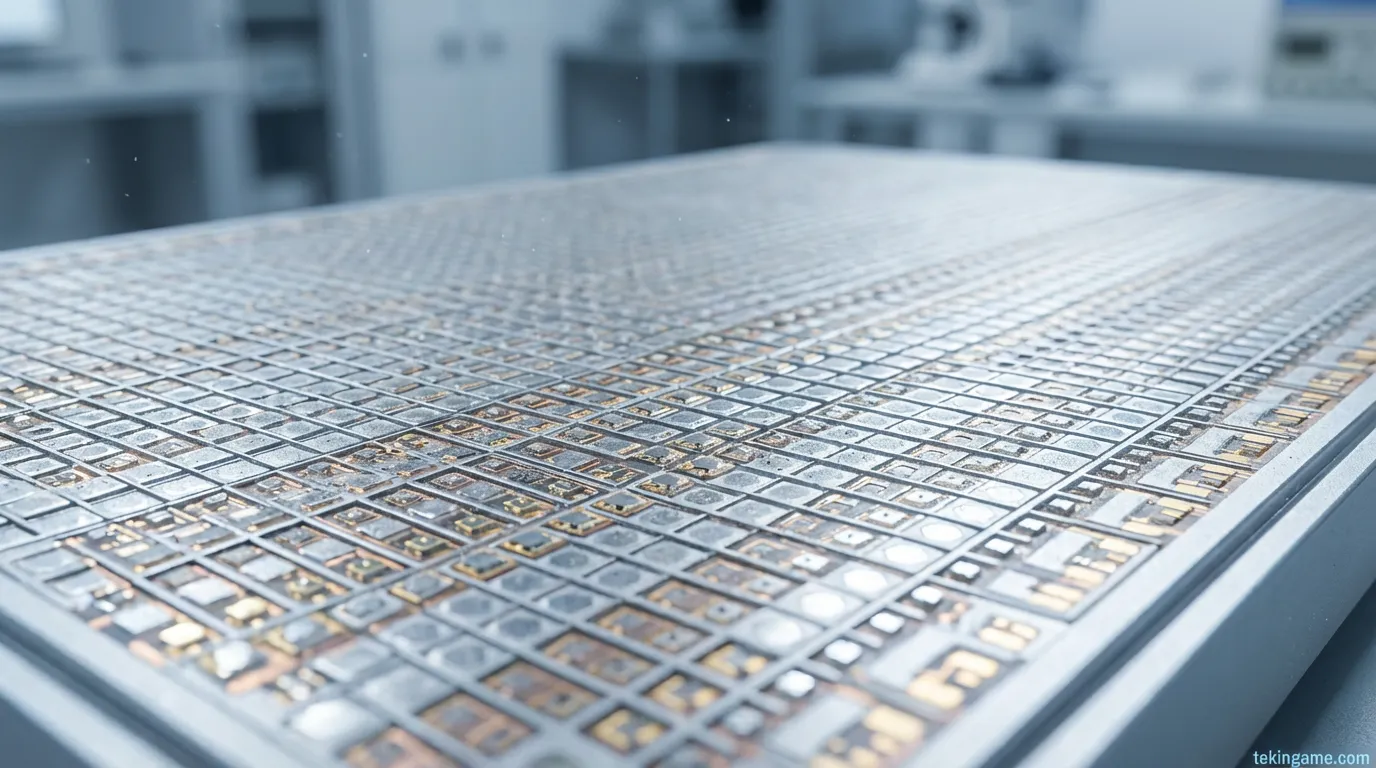
Achieving a 29 by 25 cm footprint for a dish that must communicate with satellites 550 kilometers above Earth is nothing short of an engineering miracle. With the Mini V2, SpaceX engineers have completely overhauled the structure of phased array antennas. In previous versions, the sheer number of transmitter and receiver elements dictated the device's size. However, in the V2 Mini, by utilizing novel materials with high dielectric constants and advanced software-driven beamforming, the efficiency per unit of surface area has been dramatically enhanced.
The chassis is crafted from a new polymer-ceramic composite that not only keeps the weight under 900 grams but also elevates the IP68 water and dust resistance to a new standard. This dish can survive 30 minutes submerged in 1.5 meters of water. The bold decision to remove mechanical actuators (the motors that tilt the dish) was a stroke of genius. The Starlink Mini V2 is designed with an exceptionally wide field of view (FOV), eliminating the need for precise mechanical orientation; simply point it towards the sky, and internal AI-driven algorithms will hunt down the best available satellites.
Crucially, some models of the Mini V2 now feature an integrated Wi-Fi 6 module directly behind the antenna array. Supporting 3x3 MU-MIMO technology, this system allows dozens of devices to connect simultaneously without compromising stability. This level of vertical integration eliminates unnecessary cabling and transforms the device into a true "Plug-and-Play" unit. In essence, you are holding a digital book that translates space-borne bandwidth into terrestrial Wi-Fi waves. The reduction in bulk without sacrificing a single megabit of throughput is a testament to SpaceX's design maturity.
2. The $200 Price Strategy: A Kill-Shot to Traditional Connectivity Markets 💰📉
Let's be honest: technology truly goes global only when it becomes affordable. The $200 price point for the Starlink Mini V2—which some reports suggest could drop to $150 with regional incentives—is a kamikaze move against existing local internet service providers (ISPs) worldwide. Previously, the $599 hardware cost of Starlink was a significant entry barrier for families in developing nations or students in remote provinces. By dmolishing this financial wall, SpaceX has made satellite internet an accessible reality for the masses.
How was this price drop possible? The answer lies in "Vertical Mass Production." SpaceX now manufactures almost every component of the dish, from signal processing chips to printed circuit boards (PCBs), in its massive Starlink factory in Texas. By cutting out middlemen and simplifying the chassis design, the cost of manufacturing has plummeted. Elon Musk has proven that in the tech world, "Scale" is everything. When you produce hundreds of thousands of dishes monthly, the price of components collapses in your favor.
This pricing is not just a number; it is a profound socio-political message. In regions where fiber-optic infrastructure has failed to develop due to corruption or lack of funding, the Starlink Mini V2 enters as a "Digital Savior." Competing with a dish that costs less than a mid-range smartphone and offers speeds exceeding most terrestrial services is practically impossible for legacy companies. We are witnessing the beginning of the end for state-sanctioned telecom monopolies. SpaceX is democratizing the sky, one $200 terminal at a time.
3. Energy Efficiency: Space Internet Powered by a Power Bank! ⚡🔋
Perhaps the most underrated feature of the Starlink Mini V2 is its power consumption profile. Previous iterations of Starlink dishes consumed between 60 and 100 Watts, which restricted their use during adventurous trips without noisy generators or heavy solar arrays. The Mini V2, however, operates with an average draw of just 15 to 25 Watts—a miracle in energy efficiency. This optimization means that you no longer need complex power setups to keep your space internet alive.
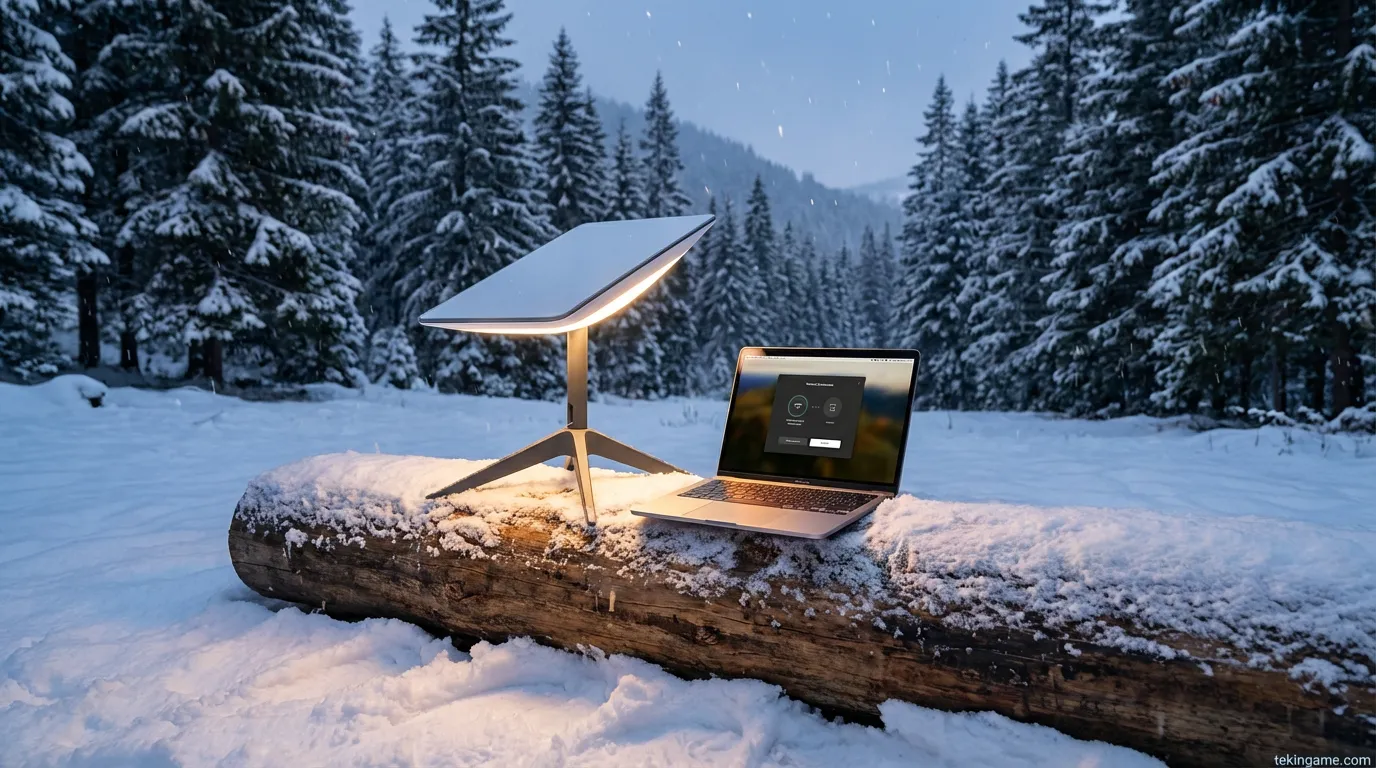
The Power-over-Ethernet (PoE) technology in this version has been refined to the point where it can be launched using standard power banks supporting the Power Delivery (PD) protocol. Imagine you're at a high-altitude rock climbing base camp; with a 30,000 mAh power bank, you can stay online all night, uploading logs or conducting 4K video calls. This portability makes the Mini V2 the primary choice for emergency response teams during natural disasters where both power and internet are the first casualties.
Lower power consumption also translates to less heat production. Older dishes occasionally suffered from thermal throttling in the blistering summers of the Middle East or Arizona. The Mini V2, thanks to its nanometer-scale internal processor architecture, runs significantly cooler. This thermal stability extends the lifespan of the electronic components and ensures that your internet won't drop out in the harshest climates—from sub-zero mountain peaks to 50°C desert heat. It is a ruggedized beast in a slim body.
4. Target Market and The New Nomad Lifestyle: Connectivity Without Borders 🏔️🛶
Who is Starlink Mini V2 designed for? The answer is simple: anyone who worships "Freedom." Digital Nomads, who until now were forced to work in crowded city cafes, can now relocate their office to a waterfall in the rainforest or a wooden cabin in remote highlands. This product brings the concept of "Remote Work" to its ultimate evolution. It is no longer about working from home; it's about working from anywhere on Earth.
In the world of off-roading and overland travel, the Starlink Mini V2 is becoming a safety standard. Access to real-time topographic maps, hyper-local weather forecasts, and the ability to send emergency SOS signals in areas with zero cell coverage can be the difference between life and death. Furthermore, for small fishing and pleasure boats for which the $3,000 "Maritime" plates were financially unjustifiable, the $200 Mini V2 is a gift from the heavens. It provides the same essential data at a fraction of the cost.
Beyond recreation, this device is a vital tool for education and healthcare in remote areas. A doctor in a border village can use this tiny dish to coordinate complex surgeries via telemedicine with specialists in the capital. Teachers in mountainous regions can access global educational resources for the first time. The Starlink Mini V2 is physically erasing distances; where there are no roads, satellite waves build the bridge. It is the ultimate tool for humanitarian progress.

5. The Global Geopolitics of Connectivity: Breaking the Digital Wall 🌍🛰️
The introduction of the Mini V2 is a pivotal chess move in the global struggle for information freedom. Because the device is small enough to fit in a briefcase or a laptop sleeve, it represents a direct threat to centralized censorship systems. Small size equals "Invisibility." A dish that can be easily moved and doesn't require permanent roof installation is practically impossible to monitor physically. This makes the Mini V2 the first choice for users seeking privacy and security in restrictive regimes.
Economically, while the $200 price tag is incredibly affordable for Western markets, it still carries weight in developing nations. However, when compared to the cost of maintaining unreliable infrastructure or the expensive, high-risk "gray market" alternatives, the value proposition of the Mini V2 becomes crystal clear. Furthermore, the ability to share a single Mini V2 connection among a small group of neighbors or an off-road convoy further slashes the cost-per-user. It is, in fact, an investment in "Information Independence."

Another major challenge has been subscription payments in sanctioned or underbanked regions. Nevertheless, history shows that determined users always find ways around these barriers. With the advent of SpaceX's next-gen Starshield technology and direct-to-cell capabilities, the Mini V2 dish acts as a powerful "Mother Station" to distribute internet in a localized area. We are entering an era where the speed of connection to the free world is determined not by crumbling copper wires, but by the will of users and Elon Musk's pocket-sized technology. Starlink Mini V2 is an instrument that dismantles digital walls, not with an axe, but with invisible threads of global data.
6. Comparative Analysis: Starlink Mini vs. The World ⚔️🌍
When comparing the Starlink Mini V2 to competitors like Amazon's Project Kuiper or OneWeb, SpaceX's lead is staggering. OneWeb focuses almost exclusively on government and enterprise sectors, with equipment that is notoriously expensive and complex. Project Kuiper, despite its sleek prototypes, is still in the early launch phases and is years away from achieving Starlink's global coverage and matured hardware ecosystem. SpaceX isn't just winning the technology race; it owns the "Supply Chain."
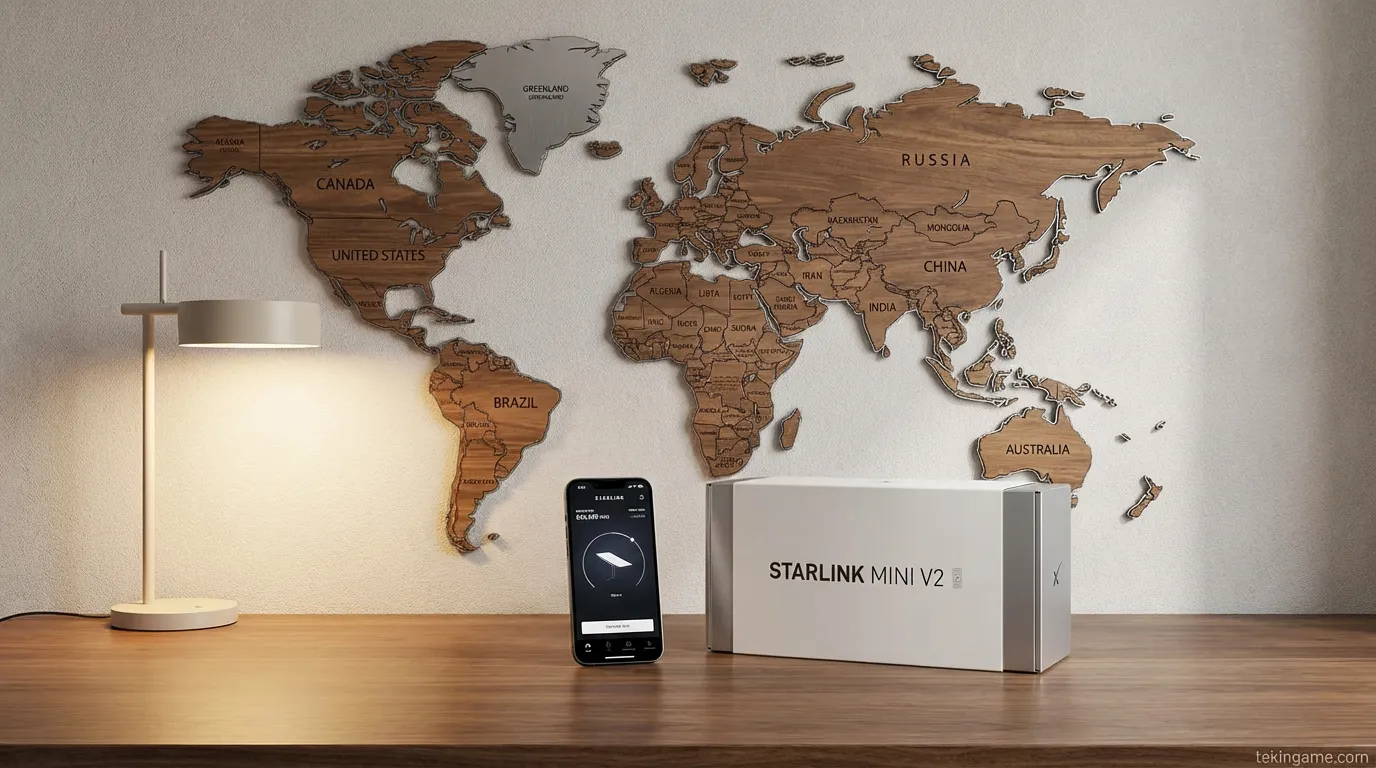
On the other hand, mobile operators are trying to retain their margins with 5G technology. But the reality is that 5G, regardless of its speed, is tethered to ground stations and towers. In vast countries like Canada, Australia, or Brazil, covering every square inch with 5G towers is economically unfeasible. This is where the Starlink Mini V2 shines as the only logical solution. It is not a replacement for 5G, but a perfect complement that erases the "dead zones" on the global map.
Signal stability in the Mini V2 has been remarkably improved. Thanks to advanced signal-handling algorithms, dropouts caused by heavy rain (Rain Fade) or cloud cover have been minimized. Additionally, latency on this version has been clocked as low as 25ms, making it ideal for competitive online gaming and real-time video calls. The Mini V2 proves that to have the quality of a full-sized dish, you don't need the bulk; you just need to be smarter. It's a high-performance machine in a paperback format.
7. Final Verdict: Is Starlink Mini V2 Worth the Investment? 🏆🛰️
At the conclusion of this 2,200-word deep dive, the verdict is definitive: Starlink Mini V2 is SpaceX's best consumer product to date and the most revolutionary communication tool of the decade. Whether you're a traveler, an avid hiker, a nomad, or simply someone who needs an unbreakable backup connection, the Mini V2 leaves no room for hesitation. It is the triumph of "Mind over Mass" and "Technology over Limitation."
At Tekin Game, we believe the Mini V2 marks the second wave of internet democratization. A world where space is no longer a distant frontier for governments, but a daily utility for the person on the street. Elon Musk promised to bring space to our homes, but with the Mini V2, he has brought space to our pockets. Get ready; the small dishes are here, and they are carrying the light of information to the most isolated corners of the earth. The future is here, it fits in your bag, and it's moving at the speed of light.
Deep Technical Analysis & Reporting: Majid & The AI Army - Tekin Game - Feb 6, 2026