
According to the Tekin Garage War Room on February 25, 2026, Intel has permanently altered graphics processing equations by releasing a revolutionary driver update for the Arc family. The new XeSS 3 technology, equipped with Multi-Frame Generation, is now active across the entire Intel ecosystem (from desktop cards to Core Ultra integrated graphics)—unlike Nvidia's DLSS 3, which is locked behind expensive hardware. In this mega-article, we debug 6 vital layers: the AI frame injection mechanism, hardware democratization, the strategic blow to Nv
Welcome to the war room at Tekin Garage. Today is Thursday, February 25, 2026. Yesterday, all our radars were locked onto Nvidia's 1200W monsters, but in the shadow of that hardware noise, Intel's blue army executed a lethal software maneuver. The new Intel Arc driver was released this morning, bringing a magical feature called "XeSS 3 Multi-Frame Generation." But the terrifying part (for Nvidia) isn't how well this tech works; it's who Intel gave this power to. While the green team has locked its frame generation technology behind thousand-dollar hardware walls, Intel has unleashed it for all gamers—even those playing on an integrated graphics chip in a budget laptop. Drink your coffee and boot up the monitoring systems; your Chief Inspector is ready to debug this silicon earthquake line by line across 6 axes.
1. Decoding the Source Code: The Birth of XeSS 3 Multi-Frame Generation
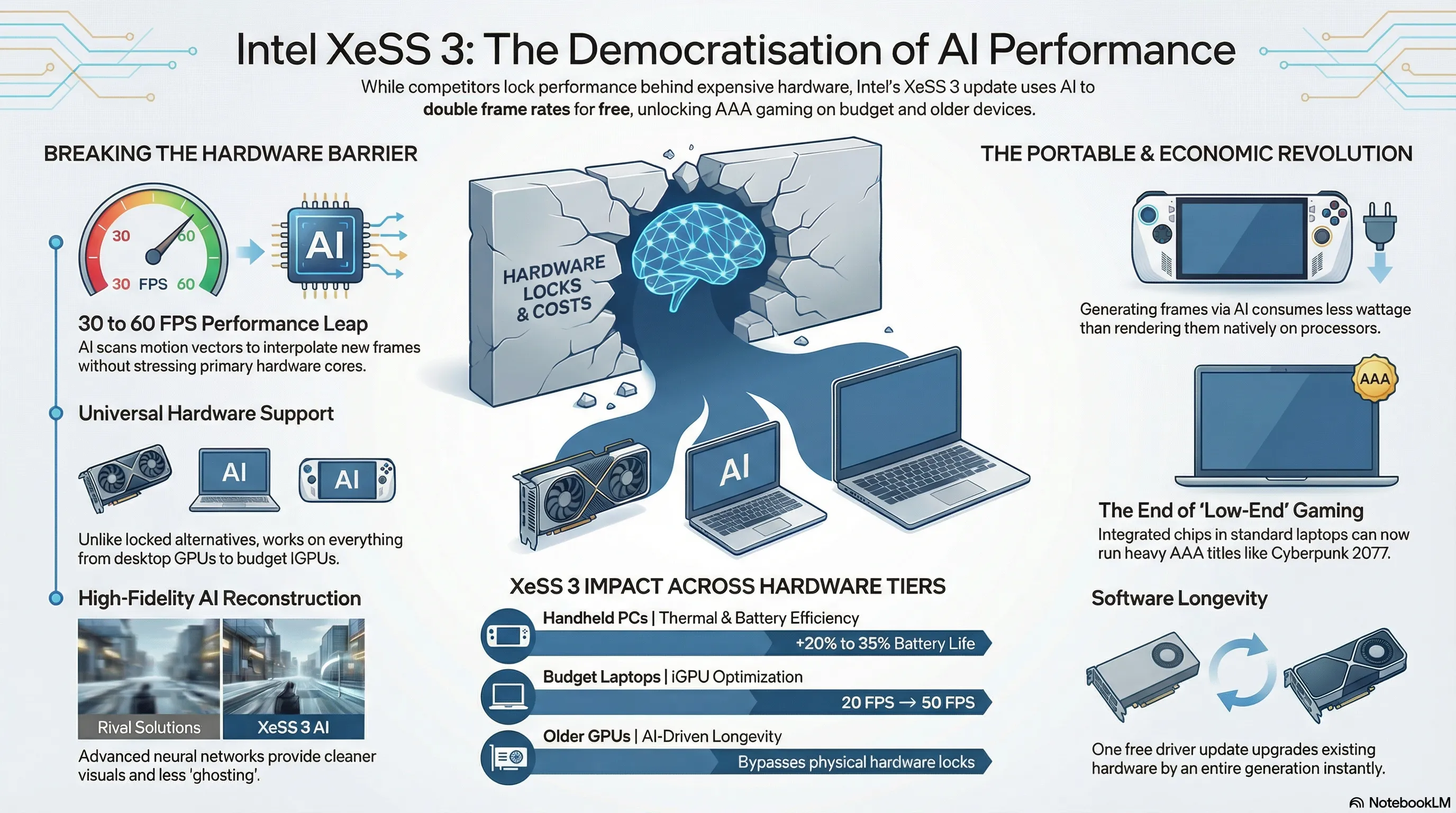
For years, PC gamers have been forced to pay astronomical prices for GPU upgrades just to run heavy AAA games at 60 or 120 frames per second. Spatial upscaling technologies like the original XeSS, DLSS 2, or FSR 2 partially solved this problem by lowering the base resolution, but Intel's February 25 update completely rewrites the laws of rendering physics. The new Arc series driver, deployed globally today, officially injects XeSS 3 Multi-Frame Generation into the gaming ecosystem.
But how exactly does the source code of this technology work? In simple terms, instead of just stretching and upscaling the pixels of a single rendered frame, Intel's AI engine now simultaneously scans two consecutive in-game frames. It analyzes Motion Vectors and depth of field, and uses machine learning models to interpolate a completely new, "AI-generated frame" between them. The mathematical result? If your game is running at 30 FPS due to CPU or GPU bottlenecks, the system uses software to boost it to 60 FPS without stressing the primary cores. This is the exact magic that, until now, was exclusively reserved for wealthy Nvidia users.
2. The Miracle of Democratization: From Desktop to Core Ultra iGPUs
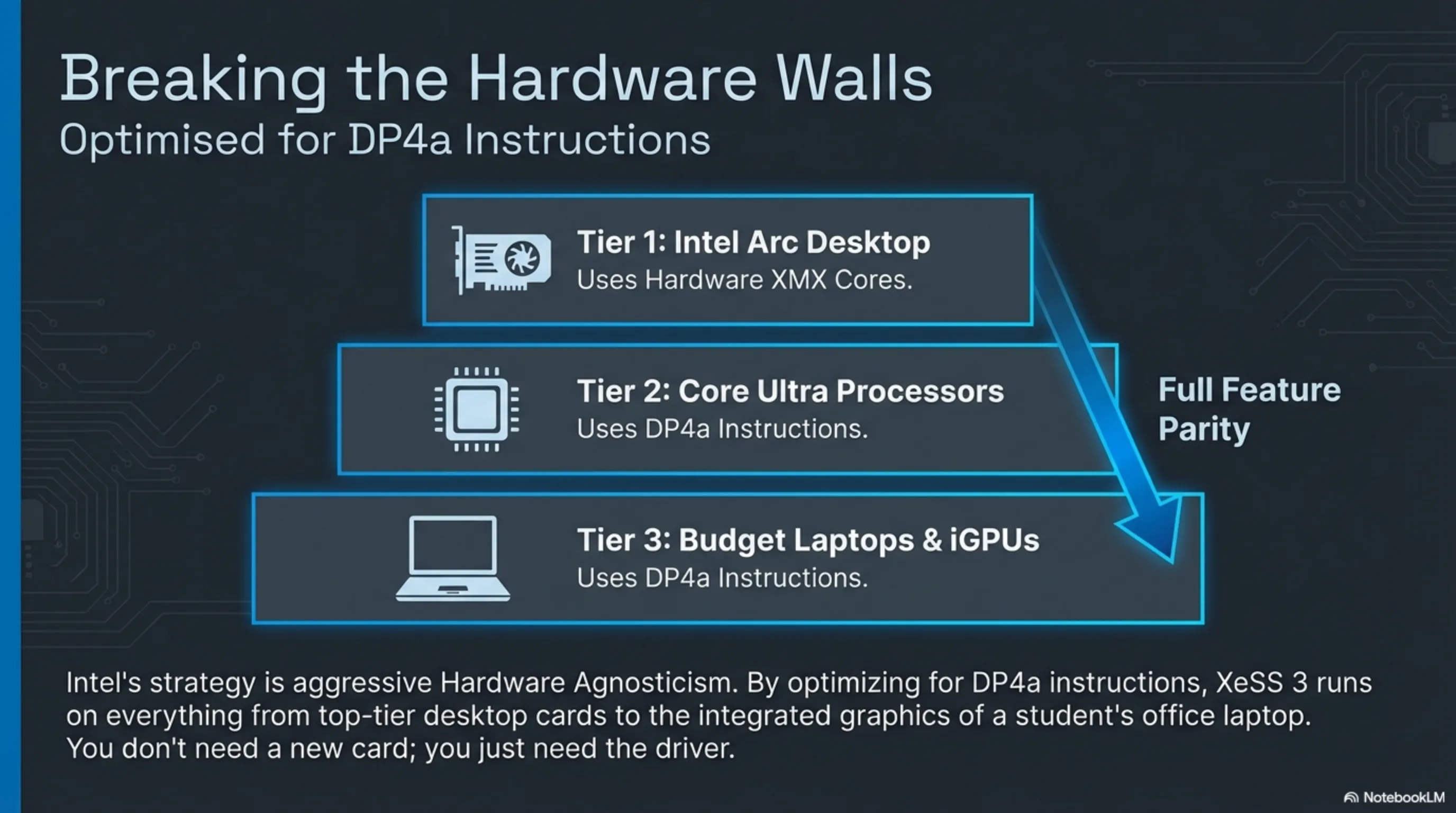
The biggest and most dangerous bombshell of this update for competitors is not the tech itself, but its Hardware Agnosticism. When Nvidia introduced DLSS 3, they locked it exclusively to the Ada Lovelace architecture (RTX 4000 series and above). But Intel, desperate to claw back lost market share, has adopted a completely different and aggressive strategy.
Debugging the new driver codes reveals that XeSS 3 not only runs on all Arc series desktop graphics cards (even the ultra-budget A380) at the highest possible quality using hardware XMX cores, but it is also enabled via software optimization (using DP4a instructions) for the integrated graphics (iGPUs) of the new generation Core Ultra processors. This means a student or office worker who bought a cheap laptop without a dedicated GPU can now run a heavy game like Cyberpunk 2077—which previously stuttered at 20-25 FPS—at a perfectly playable 40 to 50 FPS with the help of this AI. With a single line of code, Intel has officially erased the term "Low-End Gaming" from the hardware dictionary.
3. Nvidia's Achilles Heel: Why Did the Green Team Block Everyone?
Inside the Silicon Valley war room, Intel's move feels like a brutal slap to Nvidia's monopolistic strategies. The biggest question echoing across Reddit and YouTube forums today is: Why can't a corporate giant like Nvidia offer frame generation to the tens of millions of gamers still using popular cards like the RTX 3060 or RTX 2060?
The answer lies in "architectural and hardware sales policies." Nvidia claims that DLSS 3 requires a specific hardware component called the Optical Flow Accelerator to function without latency, a component that is only fast enough on the 40 and 50 series. But companies like AMD (with FSR 3) and now Intel (with XeSS 3) have proven that AI has become smart and flexible enough to bypass this physical limitation via software optimization. The reality is that by locking this technology, Nvidia intended to force gamers into buying new thousand-dollar cards. Today, with a free driver update, Intel dramatically increased the value proposition of its mid-range cards and older processors, calling Nvidia's bluff.
🔬 Inspector's Lab Analysis
The critical factor regarding any frame generation technology is Input Lag. When you generate fake frames, mouse and keyboard response times increase. To solve this, Intel has integrated its proprietary Anti-Lag technology at the driver level alongside XeSS 3. Early benchmarks show that input lag with XeSS 3, even on weaker laptops, remains under 50 milliseconds—a staggering achievement for narrative-driven games.
4. CPR for Handheld Consoles: The Battery Life Revolution
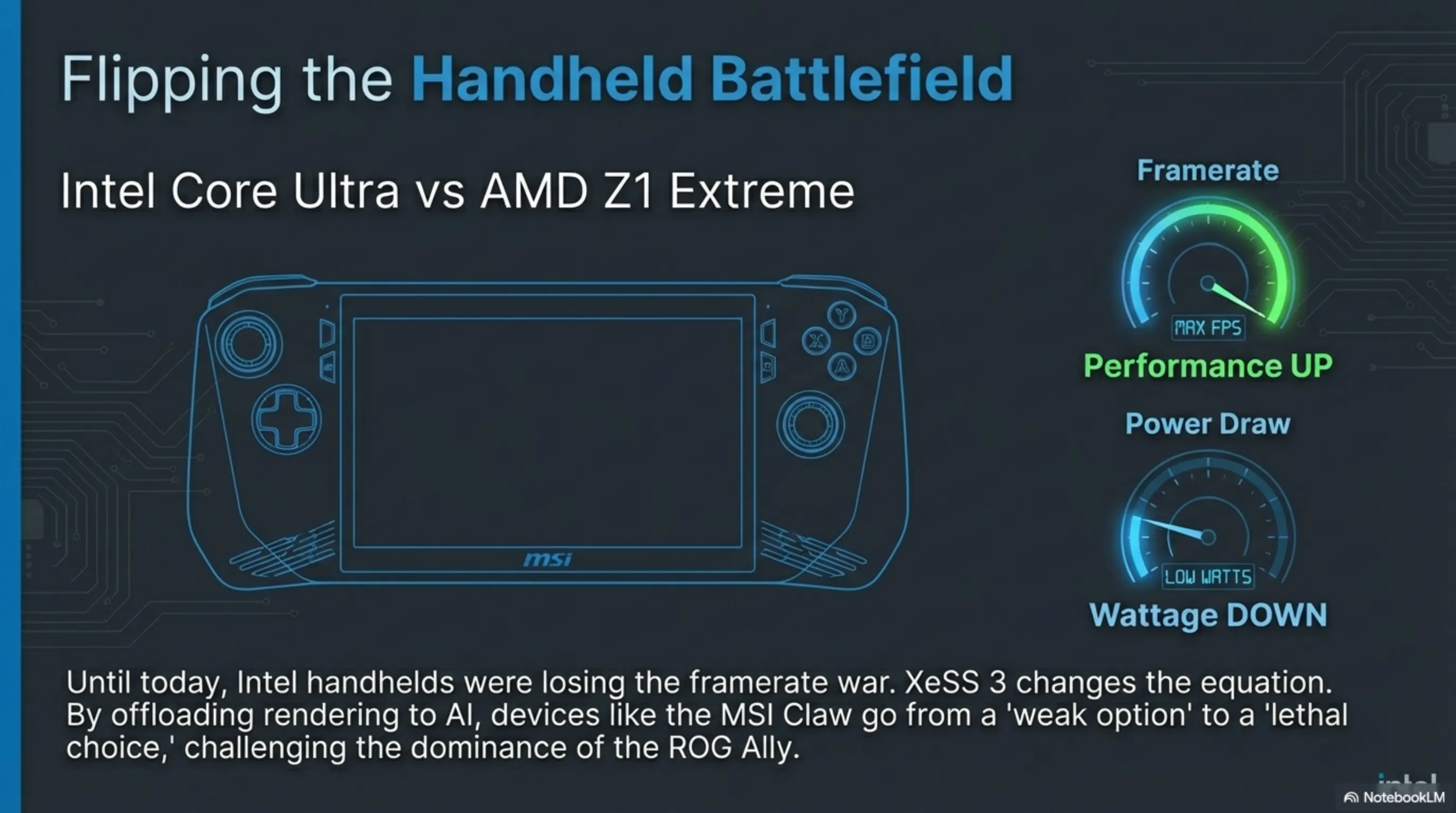
The biggest and most definitive winner of Intel's February 25 update is the volatile and highly popular Handheld PC market. Until today, devices like the MSI Claw or newer GPD iterations (all powered by Intel Core Ultra processors) were losing the framerate war against AMD's Z1 Extreme chipsets (found in the ROG Ally or Lenovo Legion Go). But the deployment of XeSS 3 has completely inverted the equations of this portable battlefield.
Battery life and Thermal Throttling are the greatest enemies of a handheld console. With Multi-Frame Generation active on the iGPU of these devices, your console can now comfortably render the game at 30 FPS (consuming less than 15 watts of power) instead of pushing the processor to 25 watts to hit a native 60 FPS, while the AI generates the remaining 30 frames for free. This means not only do games run smoother, but device temperatures drop, fans run silently, and most importantly, battery life increases by 20 to 35 percent. This software update has transformed Intel-based Handhelds overnight from a "weak option" into a "lethal purchasing choice."
5. Visual Fidelity and Neural Networks: The Battle Against AMD FSR 3 Artifacts
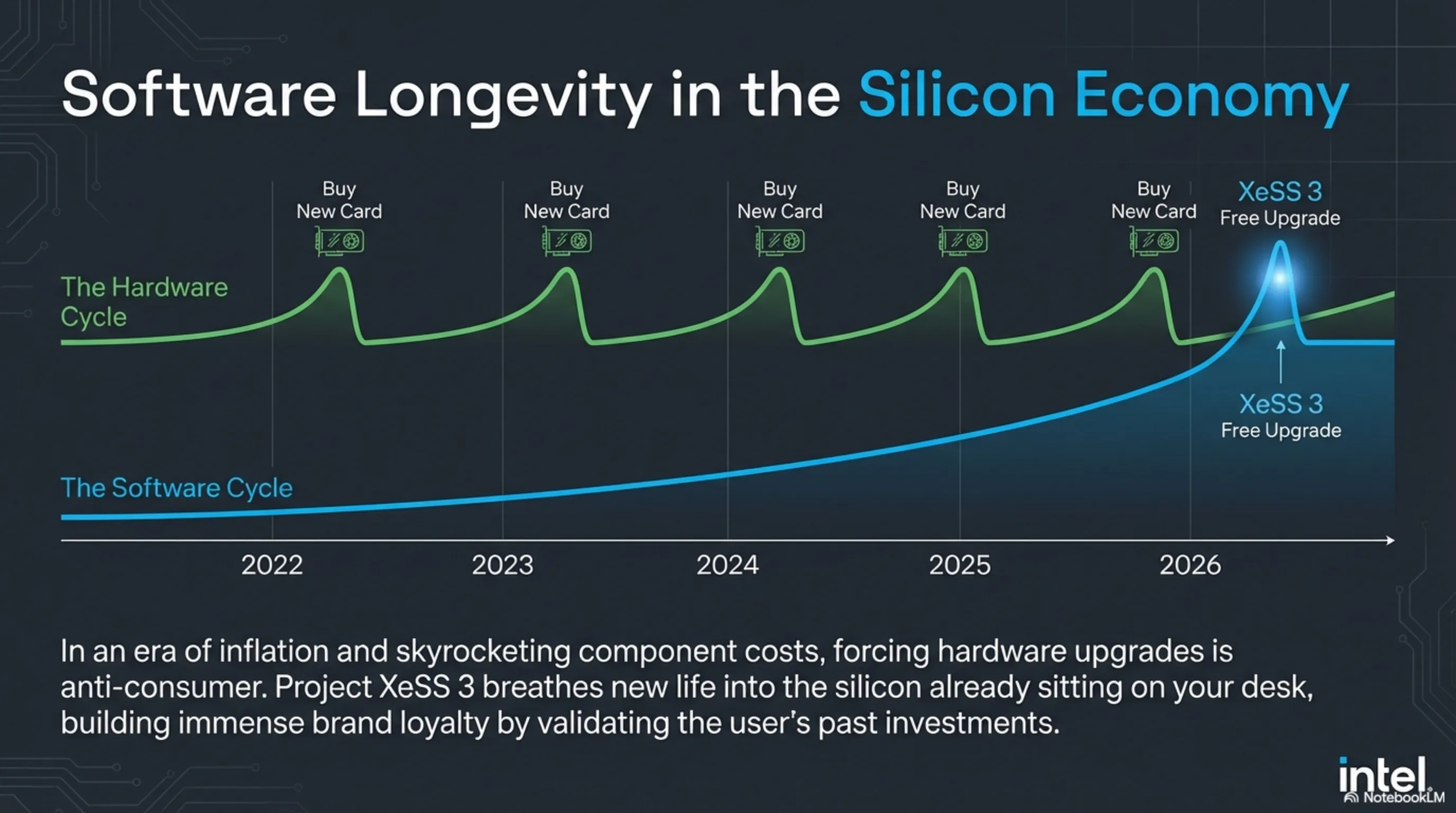
In the world of upscalers, delivering high framerates is only half the journey; the other half is maintaining Visual Fidelity and preventing image blurring. Before Intel, AMD also unlocked frame generation for all cards with FSR 3. However, the major flaw of FSR 3 (especially in its early versions) was its lack of a hardware AI core, resulting in severe visual noise (Artifacts), UI Ghosting, and screen tearing in fast-paced games.
But an autopsy of the XeSS 3 engine reveals that Intel took a radically different path. From the very beginning, Intel trained its models using advanced AI-driven neural networks. This AI can reconstruct pixels with minimal ghosting even on hardware lacking a dedicated AI accelerator (via DP4a instructions). Initial reviews from Digital Foundry and credible media outlets in these first few hours indicate that XeSS 3's visual quality at 1080p and 1440p resolutions easily defeats FSR 3, making it nearly indistinguishable from Nvidia's DLSS 3 to the naked eye in many games.
6. Silicon Economy: The End of Forced Hardware Upgrades
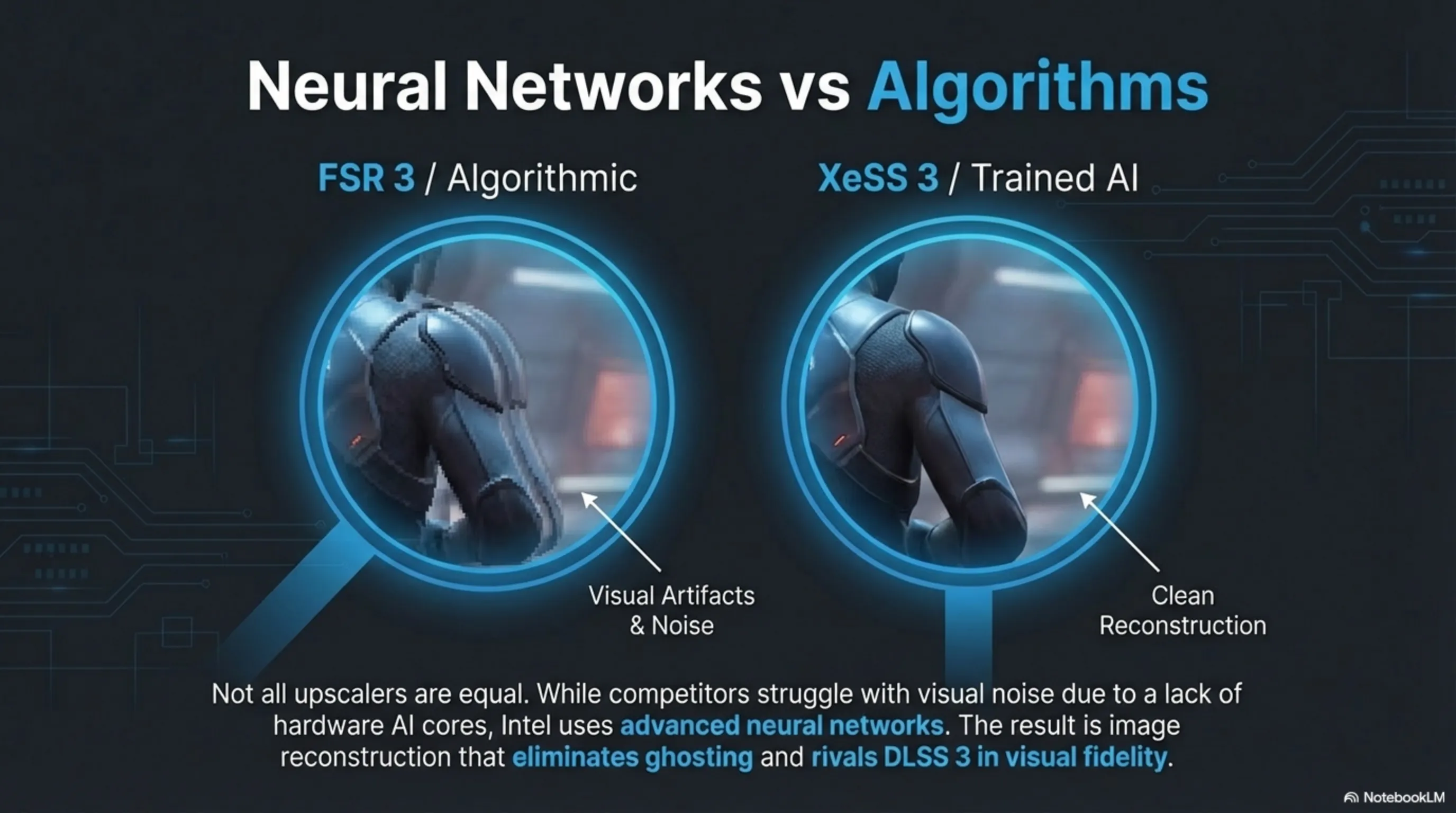
With this software maneuver, Intel has transmitted a highly crucial strategic and economic message to the entire gaming industry. In an era where GPU prices have skyrocketed due to the crypto boom and now the AI Boom, and global inflation has reduced gamers' purchasing power, forcing users to upgrade hardware every generation is a distinctly anti-consumer policy.
Project XeSS 3 is the ultimate symbol of Software Longevity. Instead of just selling new silicon, Intel has breathed new life into the hardware currently sitting on your desk. This strategy not only drastically increases user loyalty to the blue brand, but it also incentivizes game studios to optimize their code for XeSS rather than relying exclusively on Nvidia's tools, granting them access to the largest demographic of gamers (including office laptop and handheld users). The real war is no longer about transistor counts; it's about the quality of algorithms.
💻 Hardware Verdict
The February 25 shift proved that in the Silicon Valley war, software operates far more lethally than hardware. The "AI for All" strategy implemented by Intel with the XeSS 3 architecture was not only a fatal blow to Nvidia's paid monopolies, but it also flipped the handheld console game in its favor.
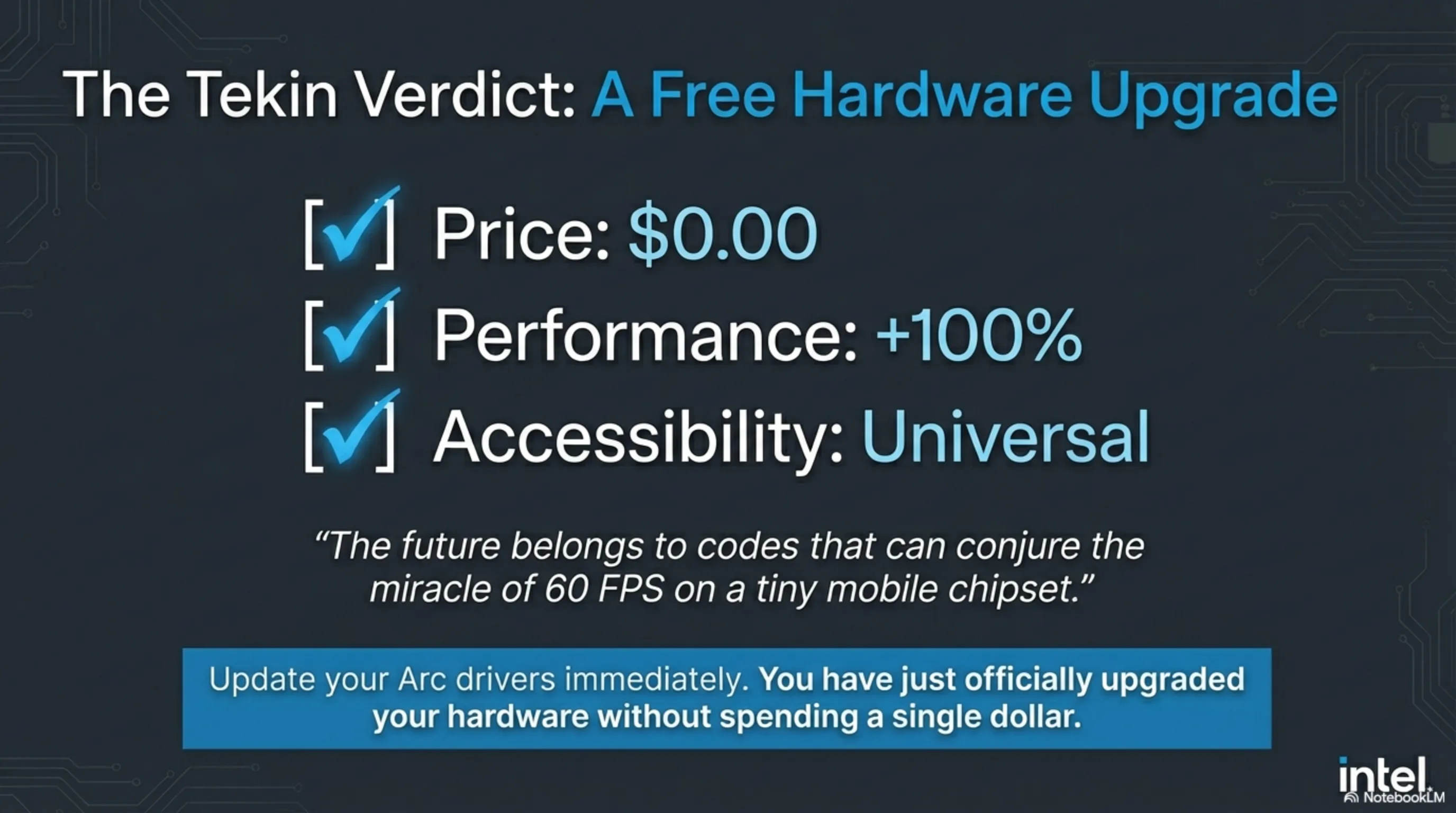
At Tekin Garage, we believe the future of gaming isn't tied to 600W graphics cards and massive power supplies; the future belongs to codes that can conjure the miracle of 60 FPS on a tiny mobile chipset or a budget student laptop. If you own a laptop with a Core Ultra processor or an Arc graphics card, there are no excuses; update your driver immediately. Without spending a single dollar, you have officially upgraded your hardware by an entire generation. Tekin Army, continue monitoring the market; Nvidia will absolutely not leave this attack unanswered.