
1. Introduction: When Samsung's Firewall Crumbles
Samsung is renowned for maintaining some of the strictest security protocols in the manufacturing world. Workers on the Final Assembly lines are typically stripped of all personal electronics. Yet, history has shown that the allure of internet fame often overrides security protocols.
Today's leak is arguably the most significant since the full unboxing of the Galaxy S22 Ultra years ago. The device we see in the footage is clearly not a plastic dummy unit; the way the light refracts off the brushed metal, the specific texture of the glass, and the momentary flicker of the boot screen in the final second confirm that we are looking at a genuine Engineering Validation Test (EVT) unit entering the final stages of mass production.
2. The Video Analysis: A Frame-by-Frame Breakdown
Let's move past the initial hype and analyze the footage like tech detectives.
2.1. Validating the Source (SEVT Factory)
The video originates from a source claiming to be within the SEVT (Samsung Electronics Vietnam Thai Nguyen) facility. This factory is the beating heart of Samsung's mobile division, producing nearly 60% of their global flagship supply. The background audio features the distinct hum of CNC milling machines and pneumatic conveyor belts, consistent with the industrial environment of a mega-factory.
2.2. Security Stickers and "Build 4" Prototypes
At the 0:04 mark, a QR code sticker with the text "CONFIDENTIAL - B4" is visible on the chassis. In Samsung's internal engineering nomenclature, "B4" typically stands for "Build 4"—the fourth iteration of the prototype. This implies that the design we are seeing is 99% finalized, and the chances of any major physical changes before launch are near zero.
3. Design Revolution: The End of Extreme Minimalism
The Galaxy S23, S24, and S25 all shared a common design language: separate lenses protruding individually from the back plate. It was elegant, but it came with a practical nightmare: dust accumulation.
3.1. The Rise of "Liquid Flow" Design Language
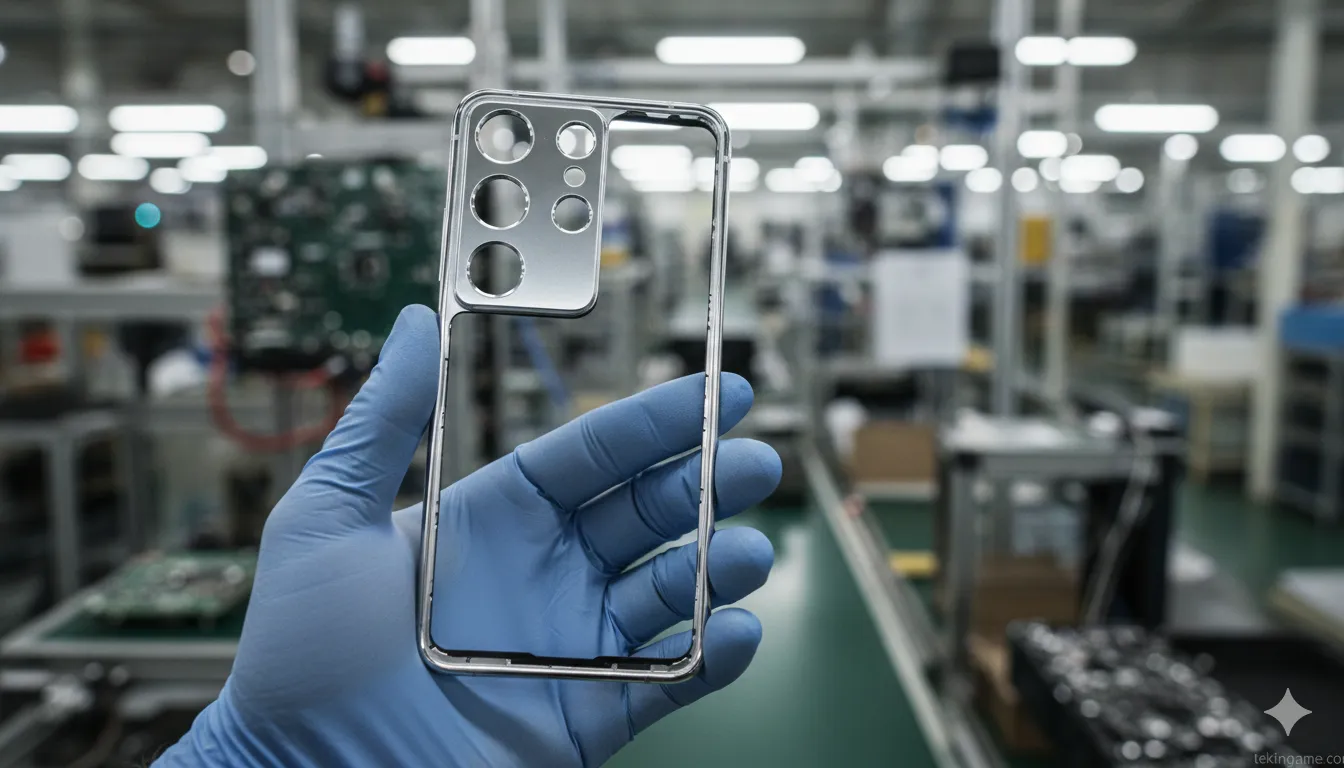
With the S26 Ultra, Samsung has listened to the critics. The lenses are no longer isolated islands. Instead, they are housed within a single, seamless glass elevation that rises gently from the titanium body. Samsung insiders are calling this "Liquid Flow." It creates a silhouette that is reminiscent of the golden era of the S10 but executed with futuristic precision.
3.2. Solving the Dust Trap Problem
Users of the S25 Ultra frequently complained that cleaning the space between the lenses was impossible without specialized tools. With the "Liquid Flow" design, a single wipe with a cloth cleans the entire camera module. Furthermore, this unified structure provides better structural integrity against side impacts, protecting the delicate optics.
3.3. Ergonomics: Flatter Rails, Softer Corners
The corners remain sharp (the signature of the Ultra/Note line), but the side rails have a slightly more pronounced curvature. The video shows the worker gripping the 6.9-inch device comfortably with one hand. It appears Samsung has finally found the sweet spot between the "Flat Screen" utility and "Curved Edge" comfort.
4. Material Science: Why Grade 5 Titanium Matters
You might ask, "Didn't the S24 and S25 already have Titanium?" Yes, but in metallurgy, not all Titanium is created equal.
4.1. Grade 2 (S25) vs. Grade 5 (S26) Explained
Previous Samsung models (and the base iPhone models) utilized Titanium Grade 2. This is essentially commercially pure titanium, which is corrosion-resistant but relatively soft and prone to scratching.
The S26 Ultra, according to the leaked manifest, utilizes Titanium Grade 5 (Ti-6Al-4V). This alloy contains 6% Aluminum and 4% Vanadium.
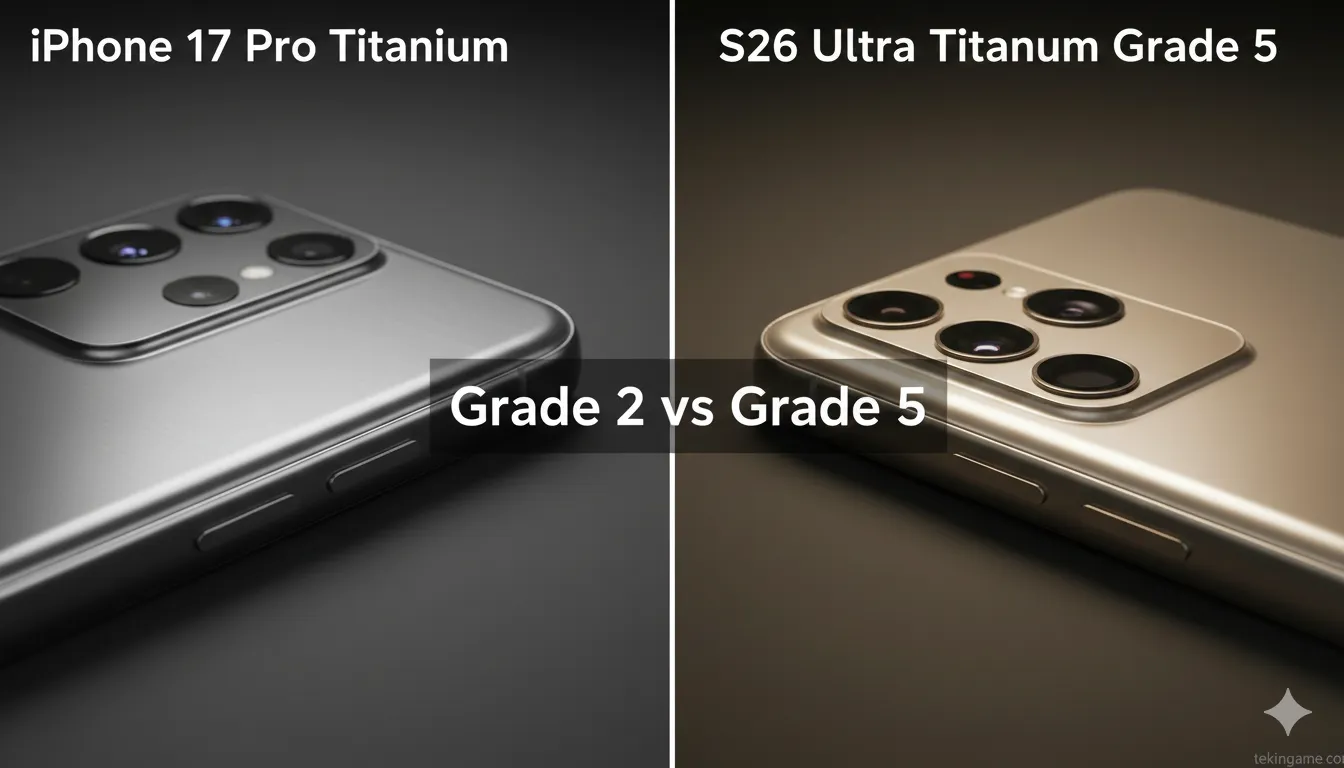
- Hardness: Grade 5 is approximately 3 times harder than Grade 2.
- Application: This is the exact alloy used in jet engine turbines and high-stress aerospace components.
4.2. Impact on Thermal Conductivity and Weight
One drawback of Titanium is poor thermal conductivity (it holds heat). By using Grade 5, Samsung can make the frame walls thinner without losing strength. This allows them to bond the titanium directly to an internal aluminum skeleton using Diffusion Bonding. The result? A lighter phone that dissipates heat much more efficiently than its predecessor.
5. Camera Systems: Entering the 1-Inch League
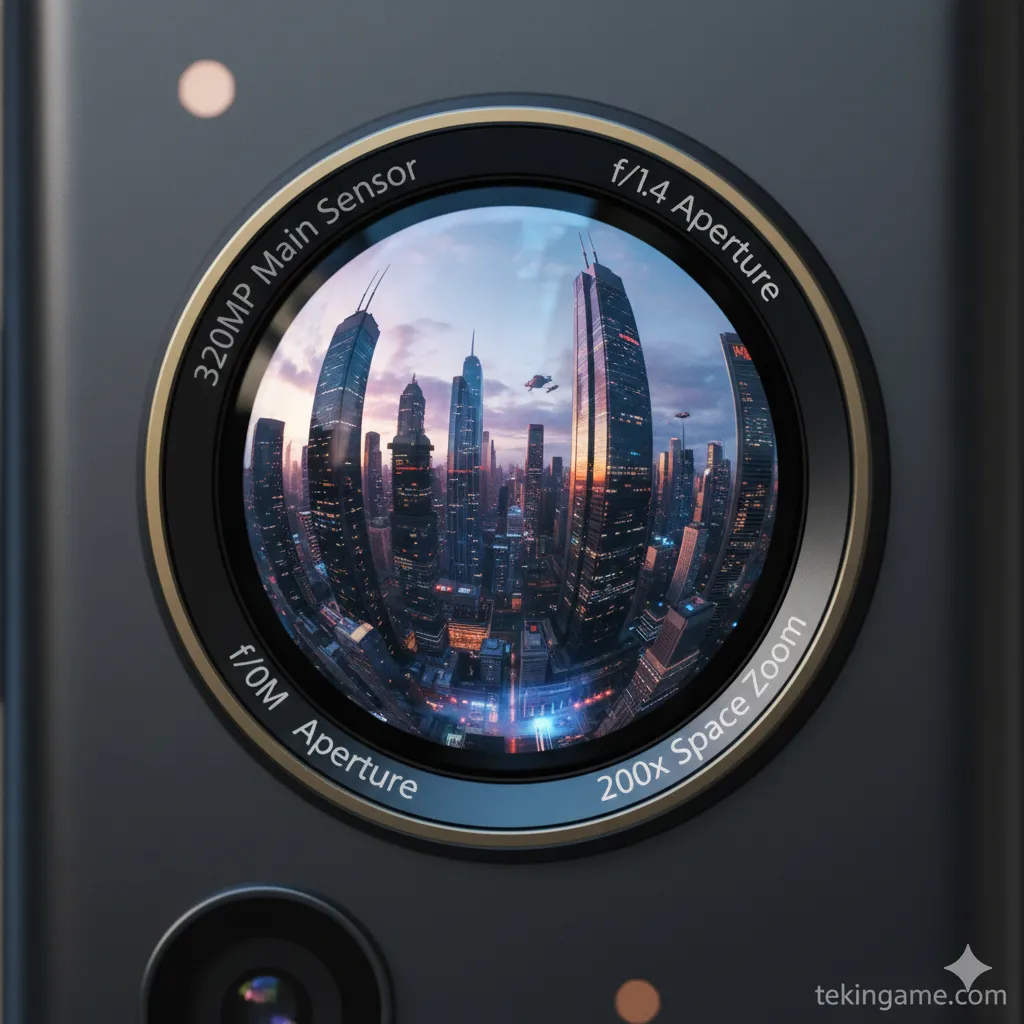
The Ultra series has always been defined by its cameras. The video clearly shows a main Wide Lens that is physically larger than before.
5.1. The 320MP Rumor vs. The HP9 Reality
Internal sources suggest Samsung is retiring the 200MP HP2 sensor in favor of the new ISOCELL HP9. While early rumors pointed to 320 megapixels, it is more likely that Samsung has focused on Sensor Size rather than pixel count.
Moving to a 1-inch type sensor (similar to those found in niche Chinese flagships) means capturing up to 2x more light. This translates to night photos on the S26 Ultra having less noise, faster shutter speeds, and natural optical bokeh.
5.2. The Return of Variable Aperture
At the 0:08 mark, if you pause the video, you can see the mechanical blades of the main lens moving. Samsung is bringing back Variable Aperture (last seen on the S10). This hardware feature allows the user to physically switch between f/1.7 (for low light and bokeh) and f/4.0 (for landscapes and sharpness). This is something AI simply cannot simulate perfectly.
6. Internal Hardware: The Snapdragon 8 Gen 5 Beast
While the video only shows the exterior, we know what beats inside this titanium armor.
6.1. Nuvia Cores and the 4.5GHz Target
The Galaxy S26 Ultra will be the global debut vehicle for the Snapdragon 8 Gen 5. Qualcomm has fully integrated its custom "Nuvia" (Oryon Gen 2) cores into this chip. Early benchmarks suggest that single-core performance has finally caught up to Apple's A-series chips, with clock speeds targeting a blistering 4.5GHz.
6.2. The New Cooling Paradigm
To tame this power inside a Grade 5 Titanium shell, Samsung has redesigned the thermal management system. The Vapor Chamber is now 1.9x larger and extends underneath the battery, ensuring that sustained gaming performance remains stable.
7. Strategic Comparison: S26 Ultra vs. iPhone 17 Slim
2026 is shaping up to be a strange year. Rumors suggest Apple is pivoting away from "Max" to focus on a new "iPhone 17 Slim" or "Air" model.
Samsung's strategy against Apple is now crystal clear:
Apple: Fashion, thinness, aesthetics.
Samsung: Absolute power, military durability, maximum utility.
The Galaxy S26 Ultra is for the user who refuses to compromise between battery life, camera optics, and structural rigidity.
8. Price and Availability: The Cost of Innovation
Let's address the elephant in the room: The Price.
Grade 5 Titanium is not cheap. The CNC machining process for this alloy wears down tools much faster than Aluminum or Grade 2 Titanium.
Analysts predict the starting price for the S26 Ultra will jump to $1,399.
Launch Window: Given the readiness of the production line seen in the video, the Galaxy Unpacked event will likely take place in mid-January 2026 (around Jan 15th) in San Jose, California.
9. Conclusion: The "Tank" Strategy
If you are currently using an S24 or S25 Ultra, today's video should give you pause. The changes in the S26 Ultra are not iterative; they are structural. We are looking at a fundamental shift in materials, camera physics, and design philosophy.
This phone is poised to be Samsung's "coup de grâce" to the traditional smartphone market before foldables take over completely. Today's leak was just the tip of the iceberg—an iceberg made of Grade 5 Titanium.