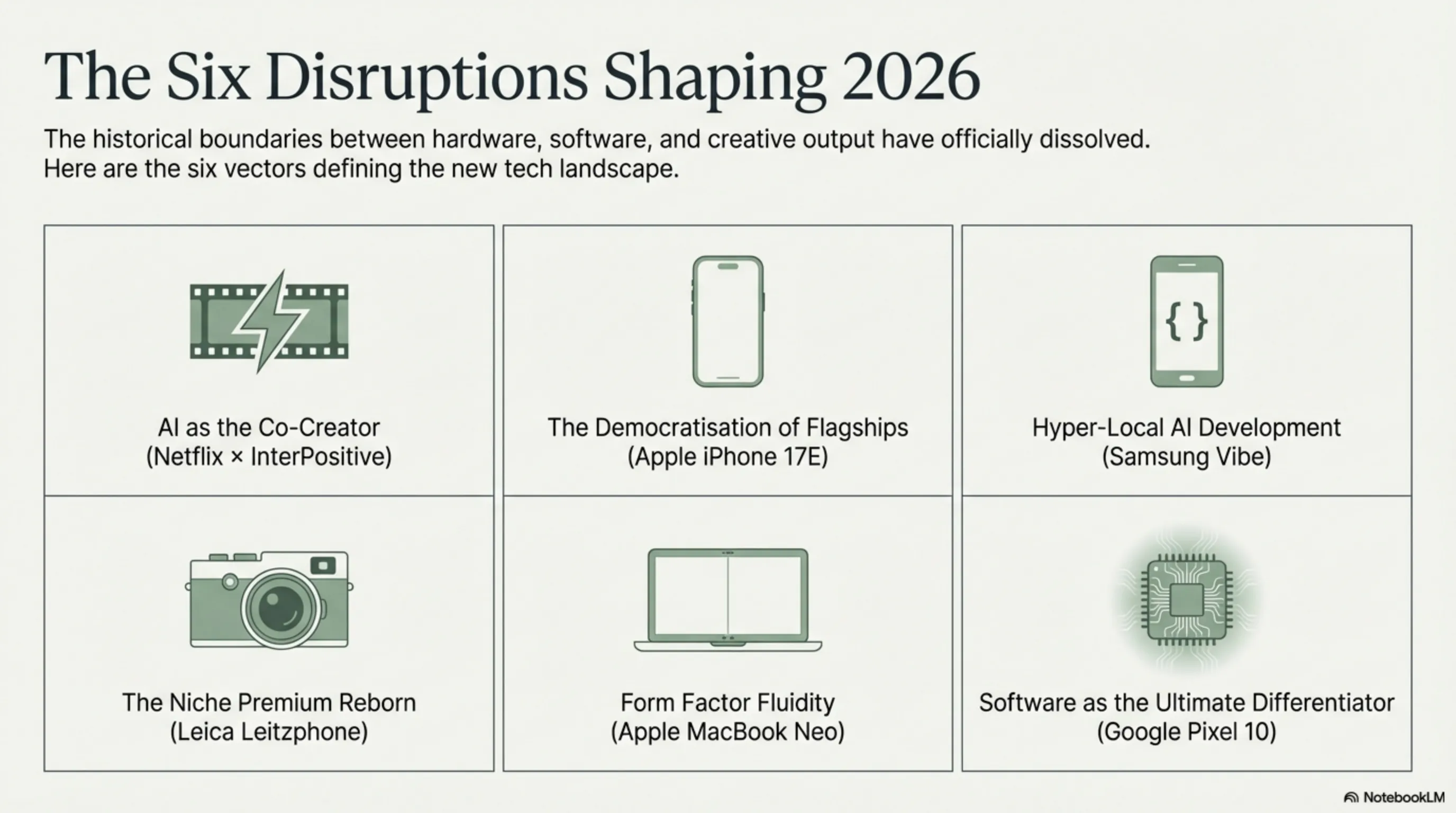
Good morning, Tekin Legion! Monday, March 10, 2026 kicks off with six bombshell stories that are shaking the tech world. From Netflix and Ben Affleck's historic partnership to create the first AI-assisted feature film to Apple's $599 iPhone that's crashing the mid-range market — today is a day that could redefine the industry's future. Netflix and Ben Affleck announced last night they're partnering with startup InterPositive to produce the first feature-length film made with AI assistance. This isn't just an experiment; it's a $120 million movie with real actors, human screenwriters, and AI technology that can cut production costs by 40%. Hollywood is changing, and this is just the beginning. The question is: is this the salvation of cinema or the end of real art? Apple also shocked everyone today by unveiling the iPhone 17E — the cheapest flagship-class iPhone ever made. At $599, this phone packs the A18 Pro chip, a 48MP camera, and aluminum design. Apple isn't just for the wealthy anymore; now it wants to conquer the mid-range market. This means Samsung, Xiaomi, and Google should be worried — because Tim Cook just entered the price war. Samsung didn't sit idle either, introducing Samsung Vibe — an intelligent coding platform that can write, debug, and even build complete apps directly on Galaxy phones. This is a direct competitor to GitHub Copilot, but with one difference: Vibe runs on your device, not in the cloud. This means complete privacy, high speed, and coding even without internet. Mobile developers, get ready — your world is changing. Leica — the legendary camera brand — also unveiled its first standalone phone today: the Leitzphone. This isn't just a phone with a Leica logo; it's a professional camera that happens to make calls. With a 1-inch sensor, APO Summilux lenses, and LeitzOS designed for photographers, the Leitzphone wants to prove there's still room for real quality in a world of meaningless megapixels. The price? $2,499 — but for professional photographers, this is an investment, not an expense. Apple has another surprise: MacBook Neo — Apple's first foldable laptop with a 17-inch OLED screen that can transform into two 13.5-inch displays. This isn't a MacBook; it's a dual-purpose device that can be a laptop, tablet, or even two independent devices. With the M4 Pro chip, 32GB RAM, and 100Whr battery, MacBook Neo wants to prove Apple can innovate in the foldable market too. Launch in Q4 2026 with an estimated price of $3,499 — expensive, but for those who want to experience the future today, it's worth it. And finally, Google with Pixel 10 and the Tensor G5 chip wants to prove that computational photography is still king. With features like Night Sight 2.0 that can shoot in complete darkness, Magic Eraser Pro that can remove large objects, and Video Boost that can process 8K videos in real-time, Pixel 10 shows that hardware matters, but software is king. Pricing starts at $799 — competitive, smart, and exactly what Google needs to compete with Apple and Samsung. These six stories aren't just news — they're signs of bigger changes coming. Hollywood is embracing AI. Apple is targeting the mid-range market. Samsung is entering developer tools. Leica is making phones. Apple is making foldables. And Google is proving it's still in the game. 2026 has just begun, but we already know this year will be different. So grab your coffee, sit back, and let's explore these six stories together. Because today is a morning you don't want to miss. Welcome to Tekin Morning March 10, 2026 — where the future happens today.
Good morning, Tekin Legion! From Netflix and Ben Affleck's historic AI film partnership to Apple's $599 iPhone that's changing the game — your March 10, 2026 tech breakfast is ready.
Netflix × Ben Affleck × AI: When Hollywood Marries Artificial Intelligence
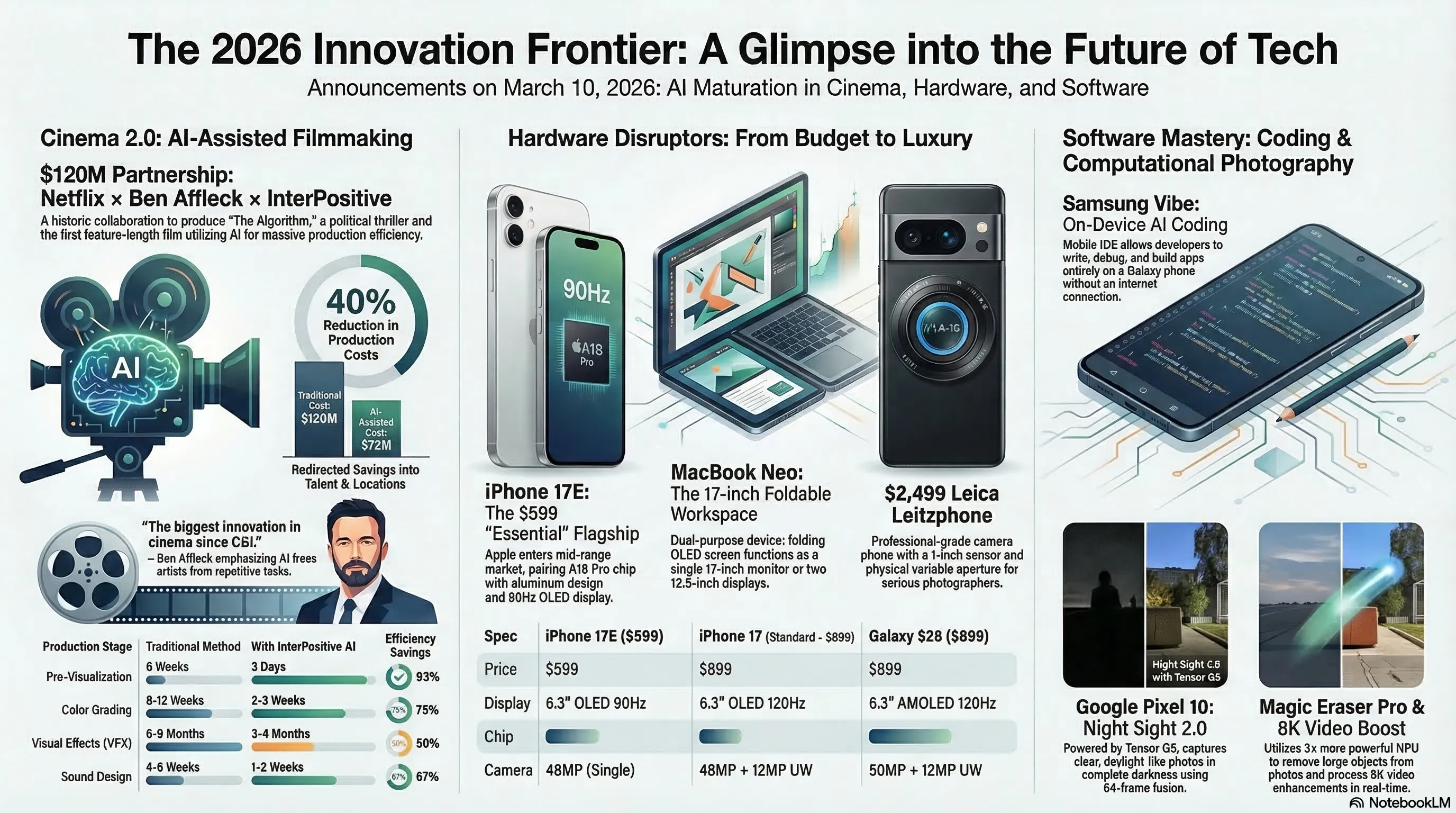
Last night — March 9, 2026 — one of the biggest announcements in cinema history happened: Netflix, Ben Affleck, and startup InterPositive announced they're partnering to produce the first feature-length film made with AI assistance. This isn't just a small experiment; it's a $120 million movie with real actors, human screenwriters, and AI technology that could change the film industry forever.
InterPositive is a San Francisco startup that's been working on "AI-Assisted Filmmaking" technology since 2024. But this AI doesn't write screenplays or replace actors. InterPositive's main job is something else: automating behind-the-scenes processes that usually take months. For example, pre-visualization — the process directors use to design scenes before filming. With AI, this work drops from 6 weeks to 3 days.
Or color grading — the process that adjusts a film's colors and lighting. Usually a professional colorist works on a film for months. But AI can learn from thousands of films and do this work in days — with the same professional quality. Or visual effects — the special effects that hundreds of people usually work on. AI can automate many of these tasks, including rotoscoping, motion tracking, and even simple CGI.
"We don't want to replace artists. We want to free them to focus on creative work, not repetitive tasks." — Sarah Chen, CEO InterPositive
Ben Affleck — the Oscar-winning director and actor — said "this is the biggest innovation in cinema since CGI." He'll direct the first film in this project: a political thriller called "The Algorithm" that tells the story of a journalist who discovers an AI is manipulating elections. The screenplay was written by Chris Terrio (writer of Sicario), and the main cast hasn't been announced yet — but rumors say Scarlett Johansson and Michael B. Jordan are in negotiations.
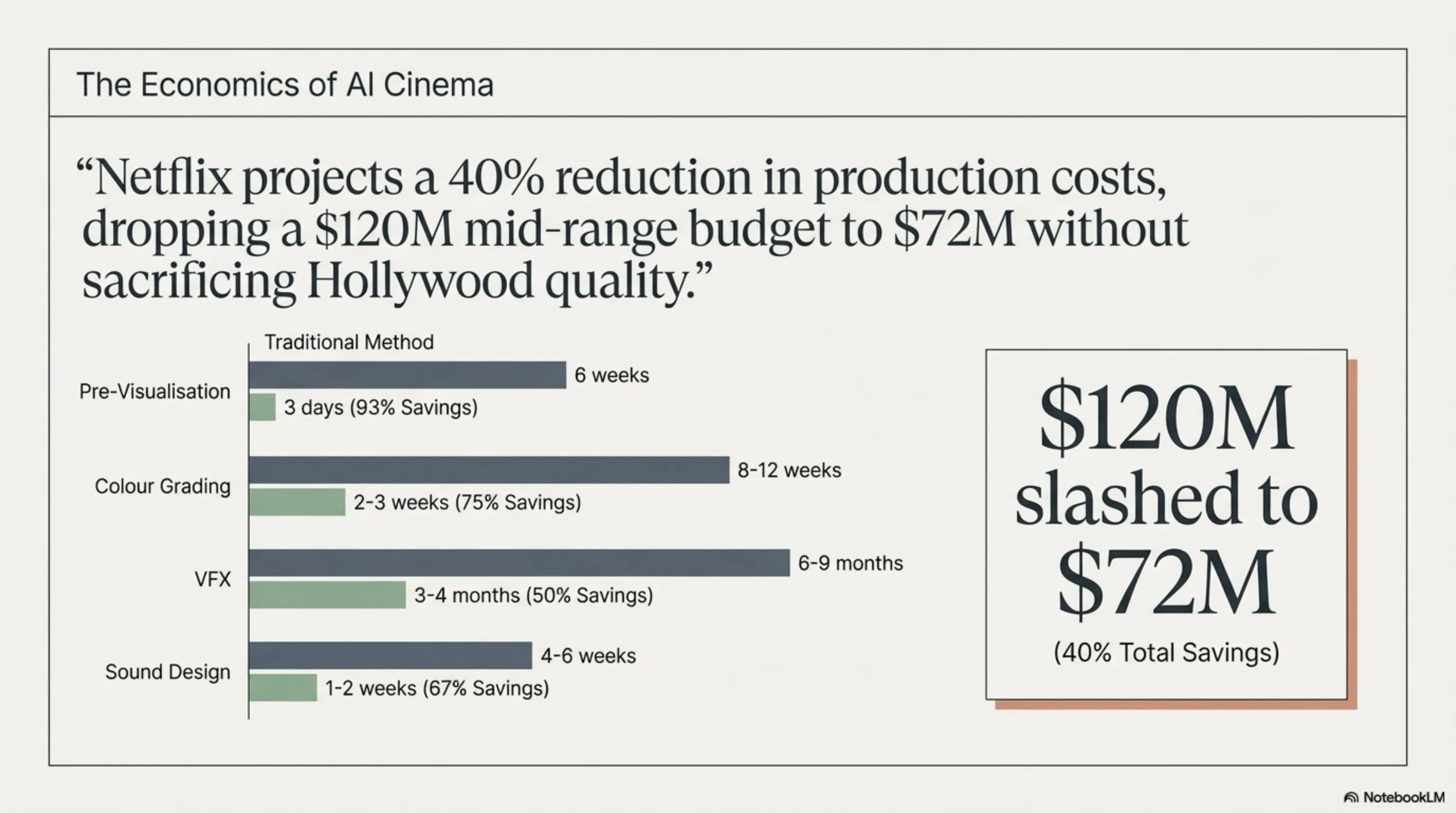
Netflix also plays a crucial role. The company will invest $120 million to produce this film — which by Hollywood standards is a mid-range budget. But here's the interesting part: Netflix says using InterPositive's technology, it can achieve the same quality with a 40% reduction in production costs. This means a $120 million film could be made for $72 million. And that saved money could go toward better actors, better locations, or even more films.
| Production Stage | Traditional Method | With AI (InterPositive) | Savings |
|---|---|---|---|
| Pre-Visualization | 6 weeks | 3 days | 93% |
| Color Grading | 8-12 weeks | 2-3 weeks | 75% |
| VFX (Visual Effects) | 6-9 months | 3-4 months | 50% |
| Sound Design | 4-6 weeks | 1-2 weeks | 67% |
| Total Cost | $120M | $72M | 40% |
Of course, there are challenges. Hollywood unions — especially the Writers Guild and Directors Guild — are worried that AI could eliminate jobs. But Netflix and Affleck emphasize that "no jobs will be eliminated." Instead, workers can focus on more creative tasks. For example, a colorist no longer needs to spend hours adjusting the color of one scene — AI does that, and the colorist can focus on the film's overall look.
The impact on the film industry could be massive. If this project succeeds, other studios will follow. Disney, Warner Bros, and Universal are all exploring similar technologies. And this is just the beginning. In the future, independent films with small budgets might also be able to use AI and make Hollywood-quality films. This could democratize cinema — or it could be the end of real art. Only time will tell.
Filming of "The Algorithm" is set to begin in May 2026, and the film will be released on Netflix in early 2027. As we saw in the Agentic AI Revolution article, artificial intelligence is becoming an integral part of creative industries — and Hollywood is no exception.
📊 Summary: Netflix × Affleck × AI
✅ Project: First AI-assisted Hollywood feature film
✅ Budget: $120M (40% savings)
✅ Director: Ben Affleck
✅ Technology: InterPositive AI
📅 Filming: May 2026

iPhone 17E: When Apple Says "Let's Sell Cheap!"
Tim Cook today — March 10, 2026 — unveiled one of the most surprising products in Apple's history: the iPhone 17E — the cheapest flagship-class iPhone ever made. At $599, this phone packs the A18 Pro chip, a 48MP camera, and aluminum design. Apple isn't just for the wealthy anymore; now it wants to conquer the mid-range market.
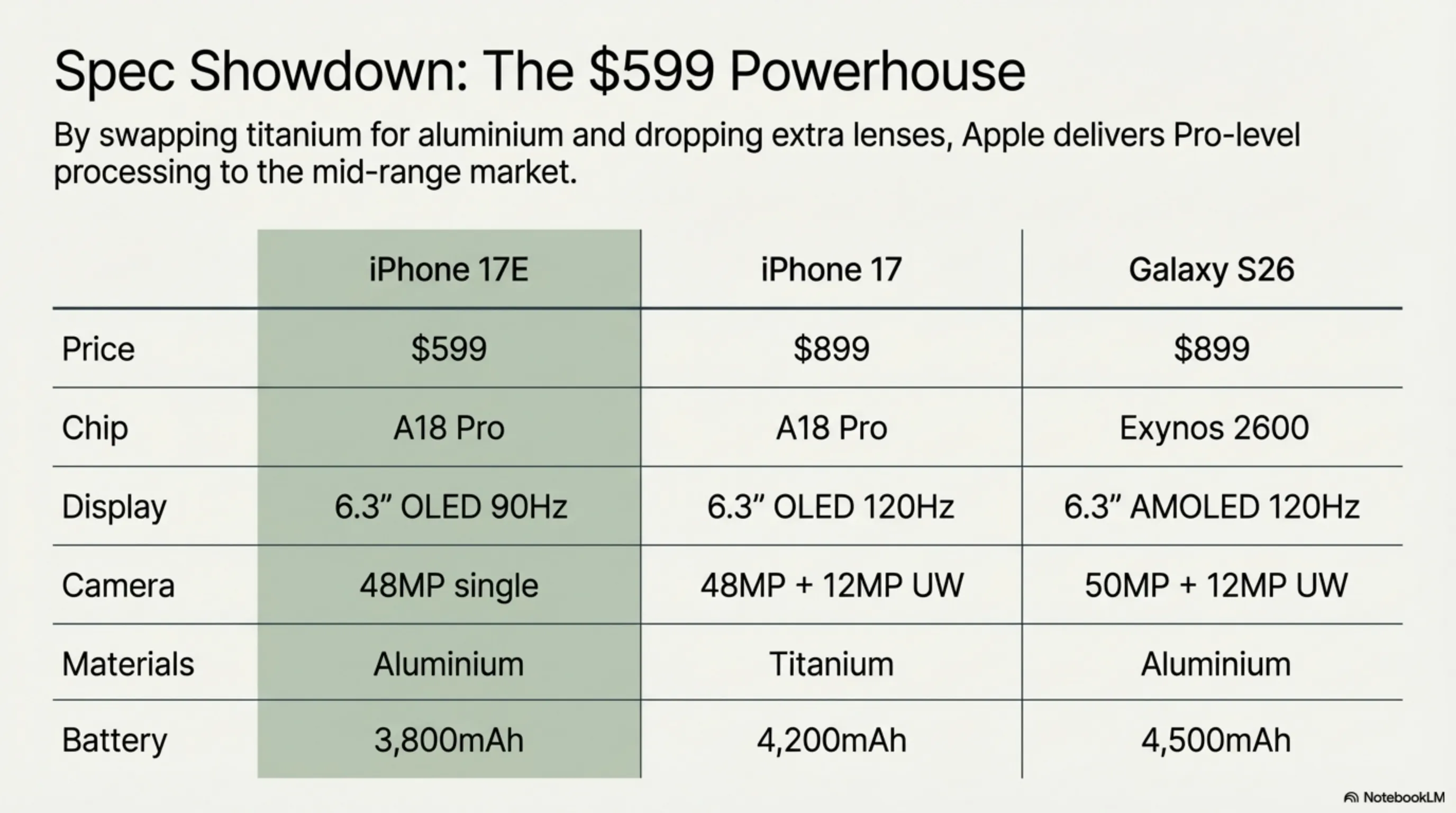
The iPhone 17E — where "E" stands for "Essential" — isn't your typical mid-range phone. It's a full flagship that just removed a few premium features to bring the price down. For example, instead of titanium, it uses aluminum. Instead of three cameras, it has just one 48MP main camera. Instead of ProMotion 120Hz, it has a 90Hz display. But its beating heart — the A18 Pro chip — is exactly the same chip used in the iPhone 17 Pro.
This means the iPhone 17E can run the same games, the same apps, and the same AI features that the iPhone 17 Pro can. The difference is only in the details: build materials, extra cameras, and a few premium features. But for most users, these differences don't matter. They just want a fast, reliable iPhone at a reasonable price — and the iPhone 17E is exactly that.
"We want to make the iPhone experience accessible to everyone, not just those who can afford $1,200." — Tim Cook, Apple CEO
The iPhone 17E's specs are incredible for a $599 phone: a 6.3-inch OLED display with 90Hz refresh rate and 1,800 nits peak brightness. The A18 Pro chip with 6-core CPU and 5-core GPU that can run AAA games at 60fps. A 48MP main camera with quad-pixel sensor and Photonic Engine that can take stunning photos in any light. And a 3,800mAh battery that can last a full day.
| Spec | iPhone 17E | iPhone 17 | Galaxy S26 |
|---|---|---|---|
| Price | $599 | $899 | $899 |
| Chip | A18 Pro | A18 Pro | Exynos 2600 |
| Display | 6.3" OLED 90Hz | 6.3" OLED 120Hz | 6.3" AMOLED 120Hz |
| Camera | 48MP (single) | 48MP + 12MP UW | 50MP + 12MP UW |
| Materials | Aluminum | Titanium | Aluminum |
| Battery | 3,800mAh | 4,200mAh | 4,500mAh |
But why is Apple doing this? There are several reasons. First, competition: Samsung, Xiaomi, and Google are all selling powerful mid-range phones that are pulling users away from Apple. Second, the market: the mid-range market is the largest segment of the smartphone market — about 60% of total sales. Apple has ignored this market until now, but now it wants its share. Third, the ecosystem: everyone who buys an iPhone will likely also buy AirPods, Apple Watch, and Apple subscriptions. This means more long-term revenue.
The market impact could be massive. Samsung, which sells the Galaxy S26 for $899, now has to compete with a $599 iPhone. Xiaomi and Google have the same problem. And for consumers, this is great news — because more competition means lower prices and better products. As we saw in the ChatGPT Exodus article, consumers have power — and when they have more options, brands are forced to compete.
The iPhone 17E is available for pre-order starting today — March 10 — and will officially launch on March 20. Available colors: Midnight (black), Starlight (white), Blue, and Product RED. Storage: 128GB and 256GB. And the good news is that Apple says the iPhone 17E will receive at least 5 years of iOS updates — just like the Pro models.
📊 Summary: iPhone 17E
✅ Price: $599 (cheapest flagship)
✅ Chip: A18 Pro (same as Pro)
✅ Display: 6.3" OLED 90Hz
✅ Camera: 48MP single
📅 Launch: March 20, 2026
Samsung Vibe: When Your Phone Writes Code!
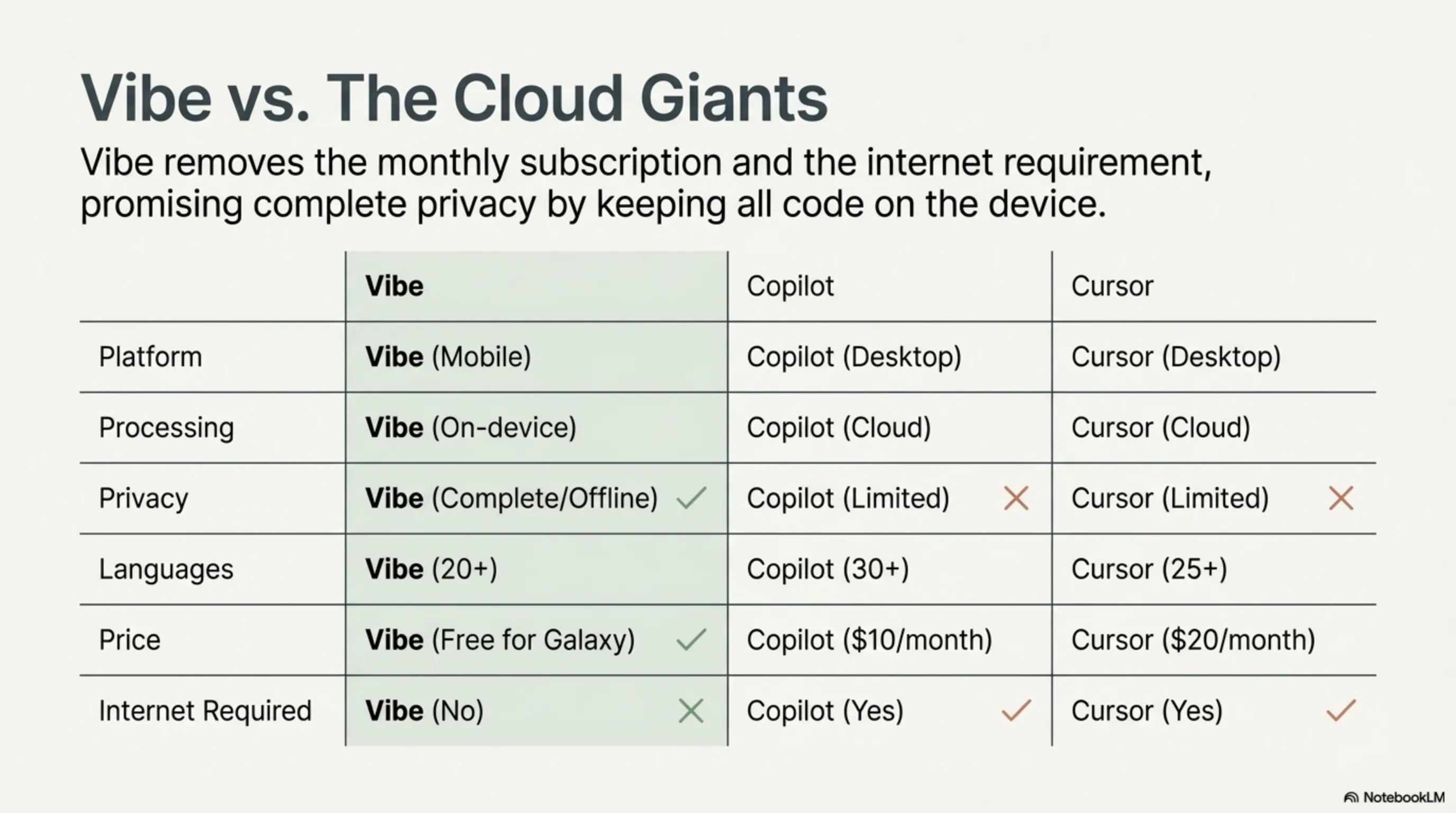
Samsung made an unexpected announcement today at MWC 2026: Samsung Vibe — an intelligent coding platform that can write, debug, and even build complete apps directly on Galaxy phones. This is a direct competitor to GitHub Copilot and Cursor, but with one big difference: Vibe runs on your device, not in the cloud. This means complete privacy, high speed, and coding even without internet.
Samsung Vibe is a complete IDE (Integrated Development Environment) designed for mobile. You can write code using the virtual keyboard or a Bluetooth keyboard, and Vibe gives real-time suggestions. But this isn't just autocomplete — Vibe can write entire functions, classes, and even complete files. Just describe what you want, and Vibe writes the code for you.
For example, you can say: "Write a function that takes a list of numbers and returns only the even ones." Vibe immediately writes the code — in Python, JavaScript, Kotlin, or whatever language you want. Or you can say: "Build a simple To-Do app with add, delete, and edit functionality." Vibe can build the entire project — from UI to logic to database.
"We want to make coding accessible to everyone, not just those sitting behind a computer desk." — TM Roh, Head of Samsung Mobile
The technology behind Vibe is interesting. Samsung uses a custom language model that runs on the Exynos 2600 — Samsung's new chip with a powerful NPU. This model was trained on millions of lines of code from GitHub and can write code in 20+ programming languages. But unlike GitHub Copilot which runs in the cloud, Vibe does everything on-device. This means your code never leaves your phone — complete privacy.
| Feature | Samsung Vibe | GitHub Copilot | Cursor |
|---|---|---|---|
| Platform | Mobile (Galaxy) | Desktop | Desktop |
| Processing | On-device | Cloud | Cloud |
| Privacy | Complete (offline) | Limited | Limited |
| Languages | 20+ | 30+ | 25+ |
| Price | Free (Galaxy) | $10/month | $20/month |
| Internet Required | No | Yes | Yes |
Vibe's capabilities go beyond writing code. The platform can debug code — meaning if there's an error, Vibe finds it and suggests solutions. It can optimize code — making your code faster and more efficient. It can write documentation — meaning it writes explanations for your code. And it can even write tests — meaning code that checks whether your program works correctly.
One of Vibe's most interesting features is "Learn from Your Code." Vibe can learn from your coding style and write code that looks like yours. For example, if you always use camelCase, Vibe does too. Or if you prefer to write short functions, Vibe does that too. This means code generated by Vibe feels like "you," not like a robot.
Vibe is available starting today — March 10 — as a beta for Galaxy S26, S25, and S24 phones. The full version will be released in May 2026. And the good news is that Vibe is completely free — no monthly subscription. Samsung says "we want to democratize coding, not profit from it." As we saw in the Agentic AI Revolution article, AI tools are becoming an integral part of developer work — and Vibe shows these tools aren't necessarily on desktop.
📊 Summary: Samsung Vibe
✅ Platform: Mobile IDE with AI
✅ Processing: On-device (offline)
✅ Languages: 20+ programming languages
✅ Price: Free (Galaxy)
📅 Beta: Today, full version May 2026
Leica Leitzphone: When the Camera Legend Makes a Phone
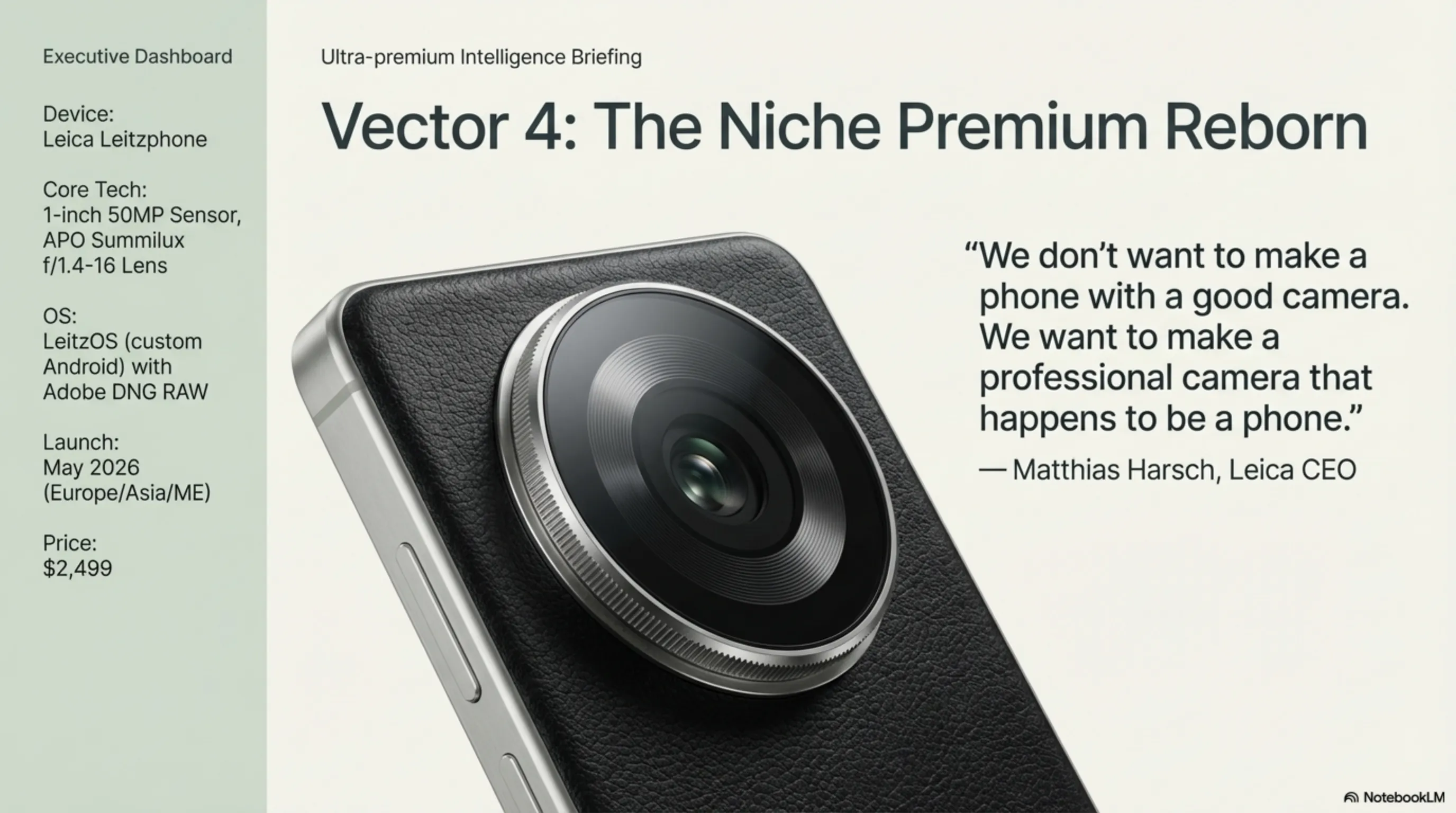
Leica — the legendary camera brand that's been making professional cameras since 1914 — unveiled its first standalone phone today: the Leitzphone. This isn't just a phone with a Leica logo; it's a professional camera that happens to make calls. With a 1-inch sensor, APO Summilux lenses, and LeitzOS designed for photographers, the Leitzphone wants to prove there's still room for real quality in a world of meaningless megapixels.
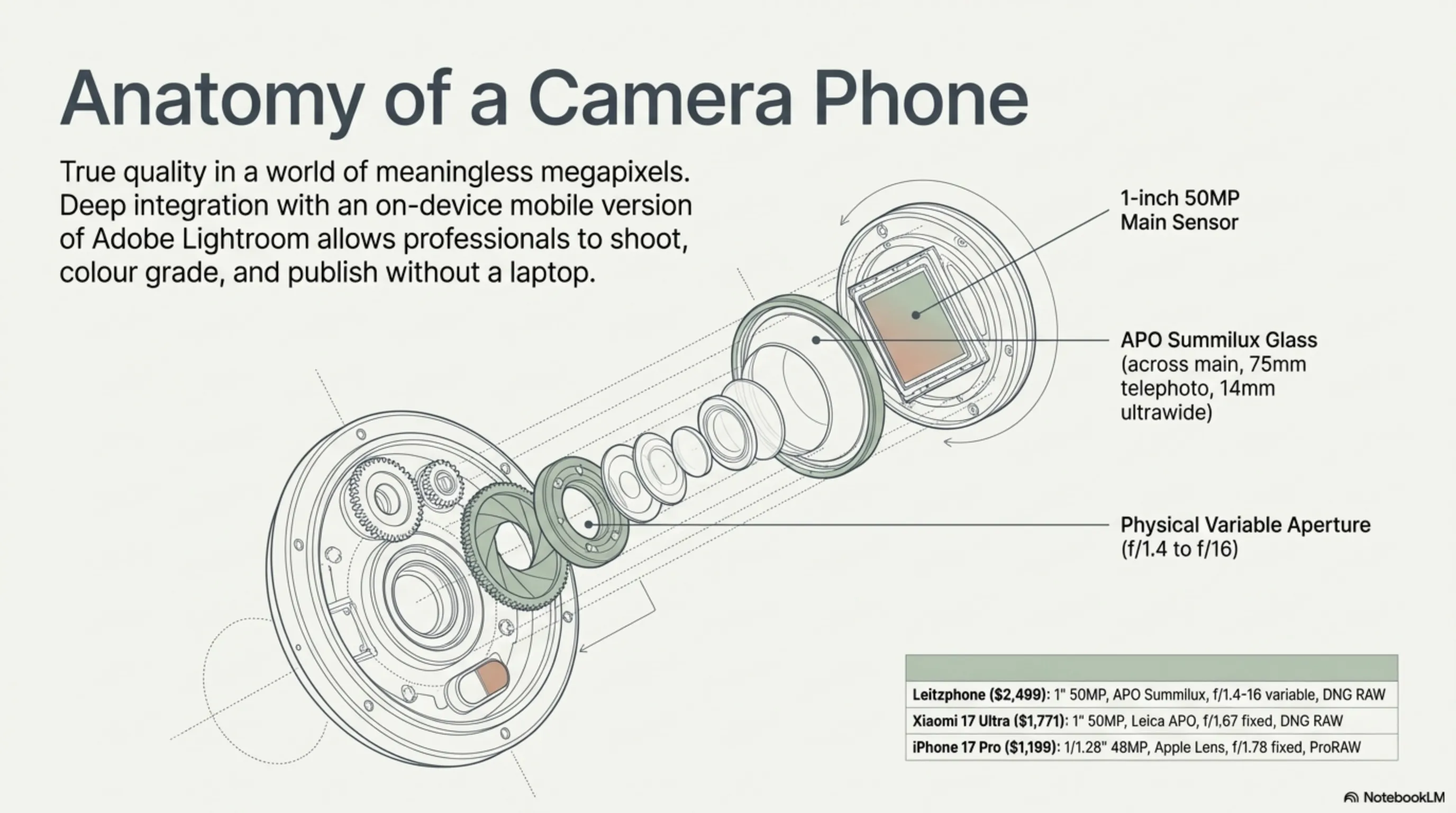
The Leitzphone is the result of Leica's years of experience making professional cameras. The main sensor is a 1-inch 50MP sensor — one of the largest mobile sensors on the market. This sensor is paired with an APO Summilux f/1.4 lens — the same lenses used in Leica cameras. APO (Apochromatic) means a lens that minimizes chromatic aberration — meaning more accurate colors, higher contrast, and sharper images.
But the Leitzphone doesn't have just one camera. This phone has three cameras: a 50MP main camera with 23mm f/1.4 lens, a 50MP telephoto camera with 75mm f/2.0 lens, and a 50MP ultrawide camera with 14mm f/2.2 lens. All lenses are made from APO Summilux glass — meaning consistent quality across all three cameras. And interestingly, Leica added a physical variable aperture — meaning you can change the aperture from f/1.4 to f/16, just like a real camera.
"We don't want to make a phone with a good camera. We want to make a professional camera that happens to be a phone." — Matthias Harsch, Leica CEO
The Leitzphone's operating system is also interesting. Leica built a custom version of Android called LeitzOS designed for photographers. This OS has a professional camera app that gives complete control over all settings: ISO, shutter speed, white balance, focus, and even color curves. And interestingly, LeitzOS can save photos in DNG RAW format — meaning you can edit photos in Lightroom or Photoshop, just like DSLR camera photos.
| Spec | Leitzphone | Xiaomi 17 Ultra | iPhone 17 Pro |
|---|---|---|---|
| Main Sensor | 1" 50MP | 1" 50MP | 1/1.28" 48MP |
| Lens | APO Summilux | Leica APO | Apple |
| Aperture | f/1.4-16 variable | f/1.67 fixed | f/1.78 fixed |
| RAW Format | DNG + JPEG | DNG + JPEG | ProRAW + HEIF |
| OS | LeitzOS (Android) | MIUI (Android) | iOS |
| Price | $2,499 | $1,771 | $1,199 |
The Leitzphone's specs are also notable: a 6.8-inch OLED display with 120Hz refresh rate and 2,000 nits peak brightness. Snapdragon 8 Elite Gen 5 processor — Qualcomm's latest chip. 16GB RAM and 512GB or 1TB storage. 5,500mAh battery with 65W fast charging. And aluminum and leather design — just like Leica cameras. Weight is 245 grams — heavier than most phones, but light for a professional camera.
One of the Leitzphone's most interesting features is its partnership with Adobe. Leica and Adobe built a mobile version of Lightroom specifically for the Leitzphone that can edit RAW photos directly on the phone. This means you can shoot, edit, and publish — all without needing a computer. For professional photographers who are always on the move, this is a game-changer.
The Leitzphone costs $2,499 — more than twice the iPhone 17 Pro. But Leica says "this is an investment, not an expense." For professional photographers who usually pay $5,000 to $10,000 for Leica cameras, $2,499 for a professional camera that's also a phone makes sense. Launch in May 2026 only in Europe, Asia, and the Middle East — North America isn't in the plans yet. As we saw in the Vision Pro Failure article, premium products aren't always for everyone — but for those who value quality, they're worth it.
📊 Summary: Leica Leitzphone
✅ Sensor: 1-inch 50MP
✅ Lens: APO Summilux f/1.4-16
✅ OS: LeitzOS (custom Android)
✅ RAW: DNG + Adobe Lightroom
📅 Launch: May 2026, $2,499
MacBook Neo: When Your Mac Can Fold!
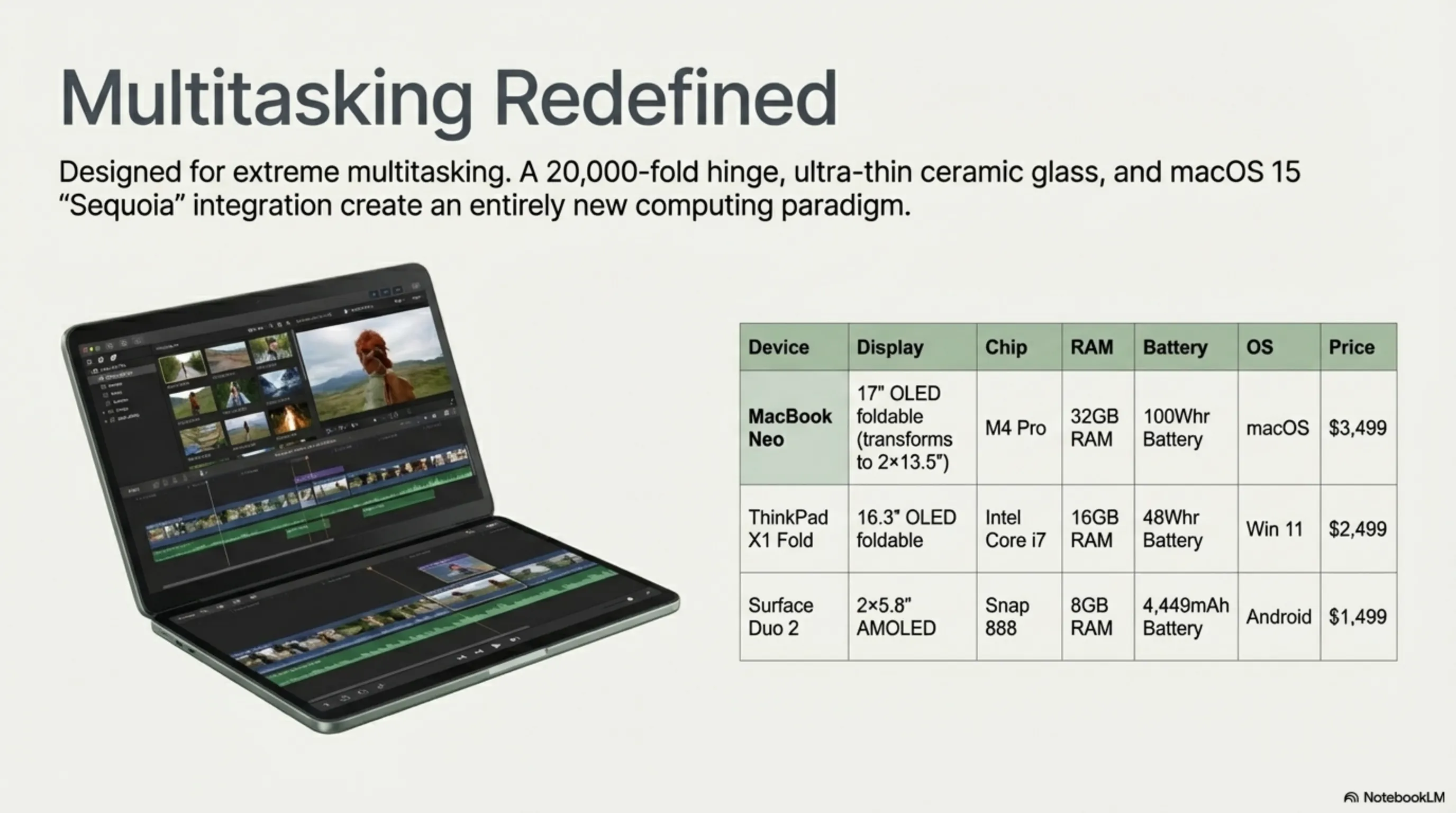
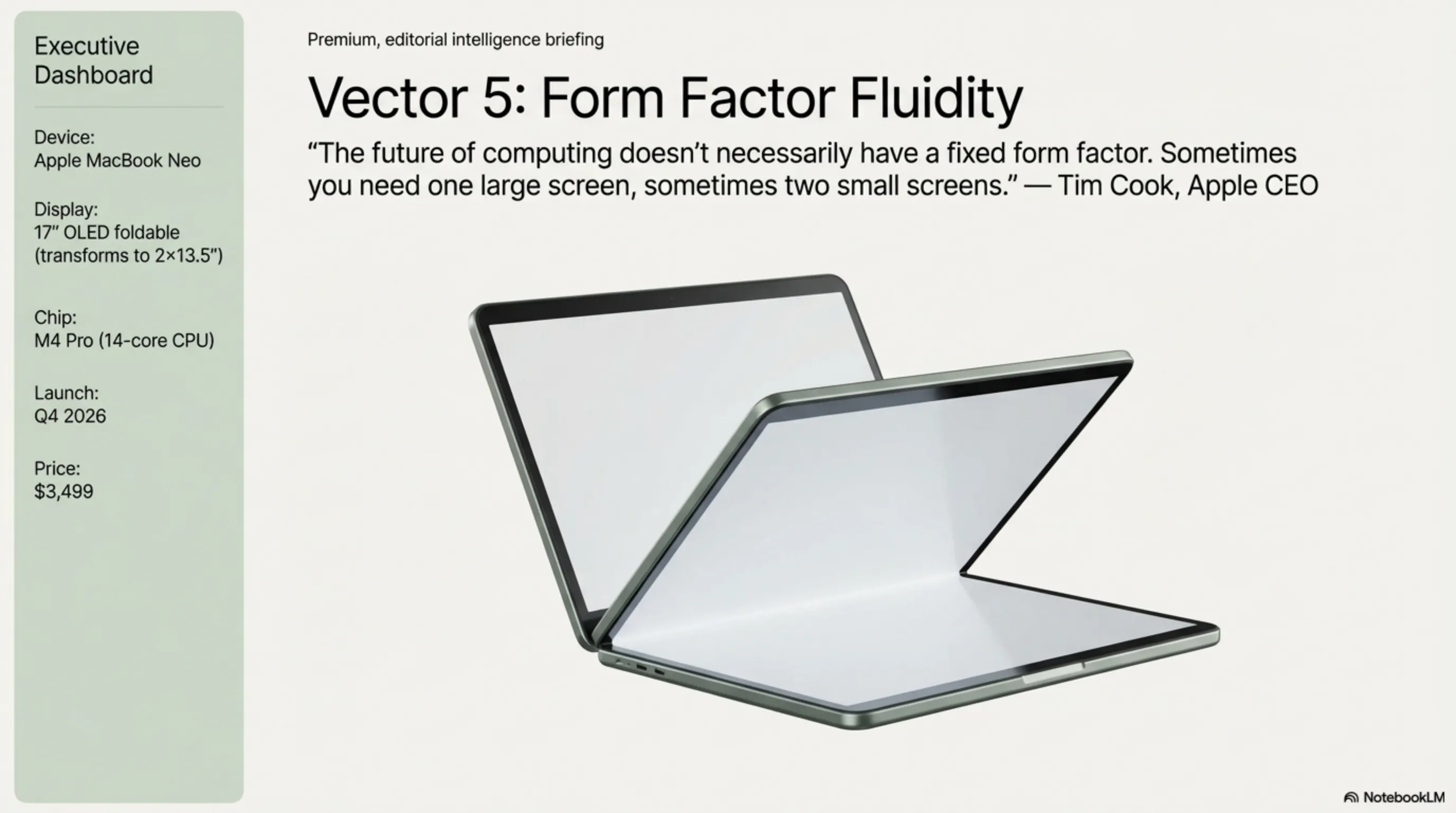
Apple unveiled another surprise today: MacBook Neo — Apple's first foldable laptop with a 17-inch OLED screen that can transform into two 13.5-inch displays. This isn't a MacBook; it's a dual-purpose device that can be a laptop, tablet, or even two independent devices. With the M4 Pro chip, 32GB RAM, and 100Whr battery, MacBook Neo wants to prove Apple can innovate in the foldable market too.
MacBook Neo has a 17-inch OLED screen that can fold vertically and transform into two 13.5-inch displays. In open mode, it's a regular laptop with a large 17-inch screen — great for productivity work like video editing, graphic design, or coding. In folded mode, you can use the bottom half as a virtual keyboard and the top half as a display — just like a regular laptop, but with a touchscreen.
But the most interesting mode is "Dual Screen Mode." In this mode, you can run two independent apps on two screens. For example, Final Cut Pro on the top screen and timeline on the bottom screen. Or Xcode on the top screen and simulator on the bottom screen. Or even two completely independent projects — like a work project on the top screen and a personal project on the bottom screen. This is a level of multitasking that no other laptop can offer.
"MacBook Neo shows that the future of computing doesn't necessarily have a fixed form factor. Sometimes you need one large screen, sometimes two small screens." — Tim Cook, Apple CEO
MacBook Neo's beating heart is the M4 Pro chip — Apple's latest chip with 14-core CPU, 20-core GPU, and 16-core Neural Engine. This chip can edit 8K videos in real-time, render complex 3D models, and even run large AI models. And with 32GB unified memory RAM, you can run multiple heavy apps simultaneously without the system slowing down.
| Spec | MacBook Neo | ThinkPad X1 Fold | Surface Duo 2 |
|---|---|---|---|
| Display | 17" OLED foldable | 16.3" OLED foldable | 2×5.8" AMOLED |
| Processor | M4 Pro (14-core) | Intel Core i7 | Snapdragon 888 |
| RAM | 32GB | 16GB | 8GB |
| Battery | 100Whr | 48Whr | 4,449mAh |
| OS | macOS | Windows 11 | Android |
| Price | $3,499 | $2,499 | $1,499 |
MacBook Neo's battery is also notable: 100Whr — the largest battery allowed on airplanes. Apple says this battery can provide 12 hours of regular use — or 8 hours of heavy work like 4K video editing. And with 140W fast charging, you can charge the battery from 0 to 80% in 45 minutes. This means even if the battery runs out, you can quickly charge and continue working.
MacBook Neo's design is also interesting. Apple uses a new hinge that can fold 20,000 times — meaning if you fold it 10 times a day, it will last 5 years. The display is made from ultra-thin ceramic glass that's 50% stronger than regular glass. And the body is made from recycled aluminum — meaning it's environmentally friendly. Weight is 1.8 kilograms — heavier than MacBook Air but lighter than the 16-inch MacBook Pro.
One of MacBook Neo's challenges is software. macOS needs to be optimized for the foldable display — and Apple said macOS 15 "Sequoia" releasing in fall 2026 will have full MacBook Neo support. This means apps can automatically switch between different modes, and developers can build dual-screen specific apps. As we saw in the Neuralink article, innovative hardware without proper software is useless — and Apple knows this.
MacBook Neo starts at $3,499 — the most expensive MacBook ever. But for those who need a powerful and flexible device, this price makes sense. Launch in Q4 2026 — likely October or November. Pre-orders start in June. And Apple said a limited number will be produced in the first year — so if you want one, you need to act fast.
📊 Summary: MacBook Neo
✅ Display: 17" OLED foldable (2×13.5")
✅ Chip: M4 Pro (14-core CPU)
✅ RAM: 32GB unified memory
✅ Battery: 100Whr (12 hours)
📅 Launch: Q4 2026, $3,499
Google Pixel 10: When Software Becomes King
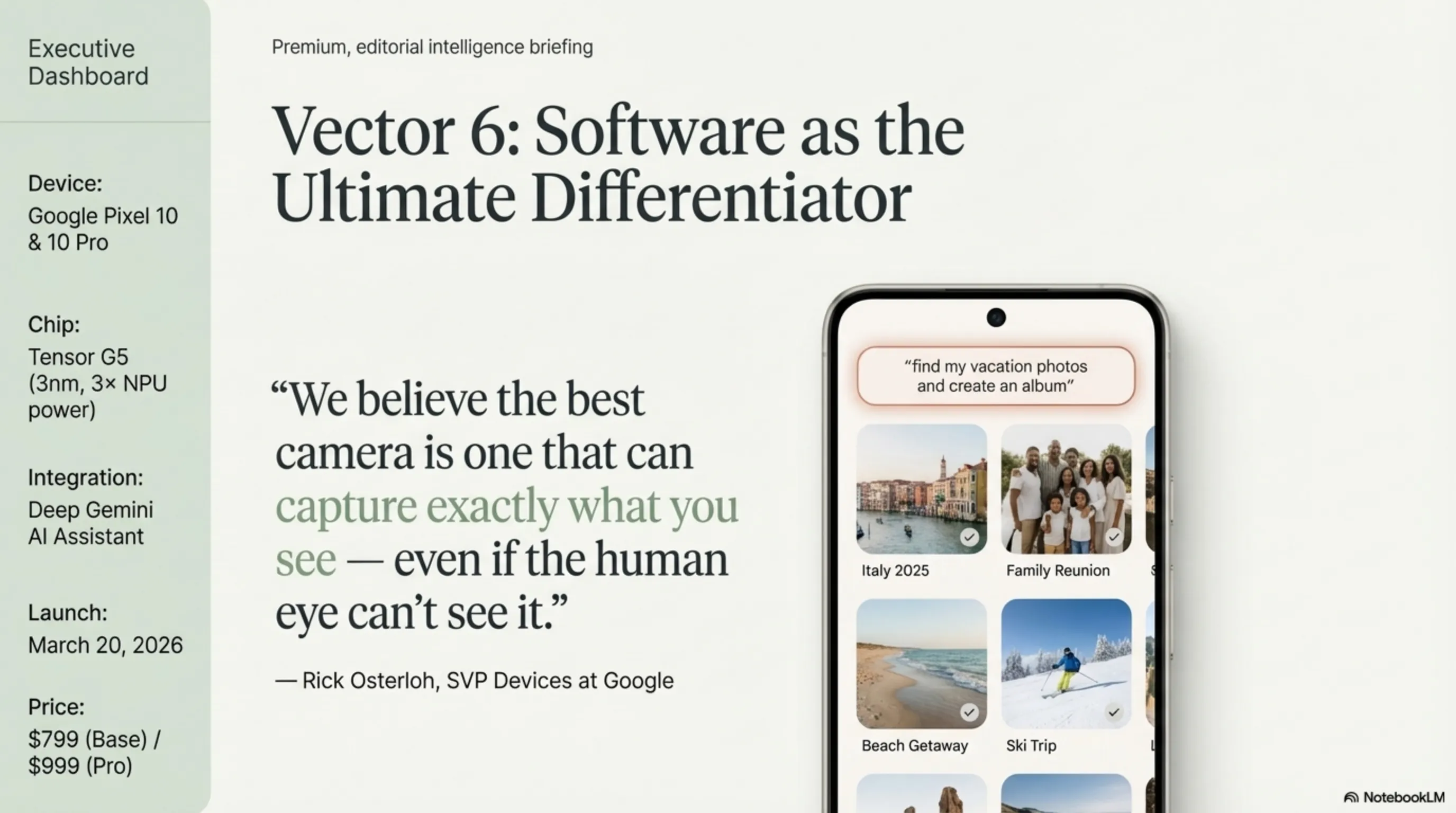
Google unveiled the Pixel 10 with the Tensor G5 chip today and wants to prove that computational photography is still king. With features like Night Sight 2.0 that can shoot in complete darkness, Magic Eraser Pro that can remove large objects, and Video Boost that can process 8K videos in real-time, Pixel 10 shows that hardware matters, but software is king.
Tensor G5 — Google's fifth-generation custom chip — is the beating heart of Pixel 10. This chip was built in partnership with Samsung and uses a 3nm process — meaning better energy efficiency and higher performance. But the important thing about Tensor G5 is its NPU (Neural Processing Unit) which is 3× more powerful than Tensor G4. This means it can run more complex AI models — and that's exactly what Google needs for computational photography.
Night Sight 2.0 is one of Pixel 10's most exciting features. The previous version of Night Sight could shoot in low light, but Night Sight 2.0 can shoot in complete darkness — even when there's no light source. This works using a new technique called "Multi-Frame Fusion" that captures 64 frames in 8 seconds and combines them to create a bright, clear photo. The result? Photos that look like they were taken in daylight, even if it's midnight.
"We believe the best camera is one that can capture exactly what you see — even if the human eye can't see it." — Rick Osterloh, SVP Devices at Google
Magic Eraser Pro is also a major upgrade. The previous version of Magic Eraser could remove small objects, but Magic Eraser Pro can remove large objects — even people — and intelligently fill in the background. For example, if you have a group photo and there's an unwanted person in the background, Magic Eraser Pro can remove that person and fill in the background so it looks like they were never there. This works using a new diffusion model trained on millions of photos.
| Feature | Pixel 10 | Pixel 9 | iPhone 17 |
|---|---|---|---|
| Chip | Tensor G5 (3nm) | Tensor G4 (4nm) | A18 Pro (3nm) |
| NPU | 3× more powerful | Baseline | Neural Engine |
| Night Sight | 2.0 (complete darkness) | 1.0 (low light) | Night Mode |
| Magic Eraser | Pro (large objects) | Small objects | None |
| Video Boost | 8K real-time | 4K | 4K ProRes |
| Price | $799 | $699 | $899 |
Video Boost is also a new feature that can process 8K videos in real-time. This means when you're recording video, Pixel 10 automatically adjusts lighting, color, and stabilization — all during recording, not after. The result? Videos that look like they were shot by a professional videographer, even if you just held the phone and recorded. And interestingly, Video Boost can even improve audio — removing noise and making your voice clearer.
Pixel 10's hardware specs are also notable: a 6.4-inch OLED display with adaptive 1-120Hz refresh rate and 2,400 nits peak brightness. 50MP main camera with 1/1.3-inch sensor and OIS. 48MP ultrawide camera with 125-degree field of view. 48MP telephoto camera with 5× optical zoom. And 12MP selfie camera with autofocus. 5,000mAh battery with 45W fast charging and 23W wireless. And recycled aluminum design with Gorilla Glass Victus 3.
One of Pixel 10's most interesting features is deep integration with Gemini. Google said Pixel 10 can act as a complete "AI Assistant" — not just for answering questions, but for doing tasks. For example, you can say "find my vacation photos and create an album" and Pixel 10 does it. Or "summarize today's important emails" and Pixel 10 writes a summary. Or even "write a birthday message for my friend" and Pixel 10 writes a personalized message.
Pixel 10 starts at $799 — $100 more than Pixel 9 but still cheaper than iPhone 17. The Pro version with a 6.8-inch display and 10× telephoto camera starts at $999. Launch on March 20, 2026 — same as iPhone 17E. And Google said Pixel 10 will receive at least 7 years of Android updates — more than any other phone. As we saw in the Deepfake Elections article, camera technology is becoming a tool for truth and transparency — and Pixel 10 with its AI capabilities is leading the way.
📊 Summary: Google Pixel 10
✅ Chip: Tensor G5 (3nm, 3× NPU)
✅ Night Sight 2.0: Complete darkness photos
✅ Magic Eraser Pro: Remove large objects
✅ Video Boost: 8K real-time
📅 Launch: March 20, $799
And that was your March 10, 2026 tech breakfast — six stories showing how exciting the future of technology is. From Hollywood embracing AI to Apple targeting the mid-range market, from Samsung entering developer tools to Leica making phones, from Apple making foldables to Google proving software is king — all of this shows that 2026 will be a different year.
Join us tomorrow for five top articles of the day — and tonight for Tekin Night bringing you the evening news. Until then, Tekin Legion, here's to a day full of innovation and discovery! 🚀
Supplementary Image Gallery: Tekin Morning March 10, 2026: From Netflix AI Film to $599 iPhone