
1. Introduction: Reclaiming the Action-Adventure Throne
For nearly seven years, the action-adventure genre has been relatively quiet regarding its matriarch. After the conclusion of the Survivor Trilogy in 2018 with Shadow of the Tomb Raider, Crystal Dynamics went dark. While Naughty Dog's Uncharted series had seemingly retired, Lara Croft was left in a state of limbo.
Was she the gritty, traumatized survivor? or the teflon-coated superhero of the 90s?
Last night, December 16, 2025, we got our answer. In a blistering 12-minute gameplay demo, Crystal Dynamics—now backed by the publishing might of Amazon Games—unveiled Tomb Raider: The Unified Myth (working title). The demo didn't just show a game; it showed a statement. Lara Croft is back, she has her confidence back, and she has never looked this good.
2. Technical Analysis: The Power of Unreal Engine 5.4
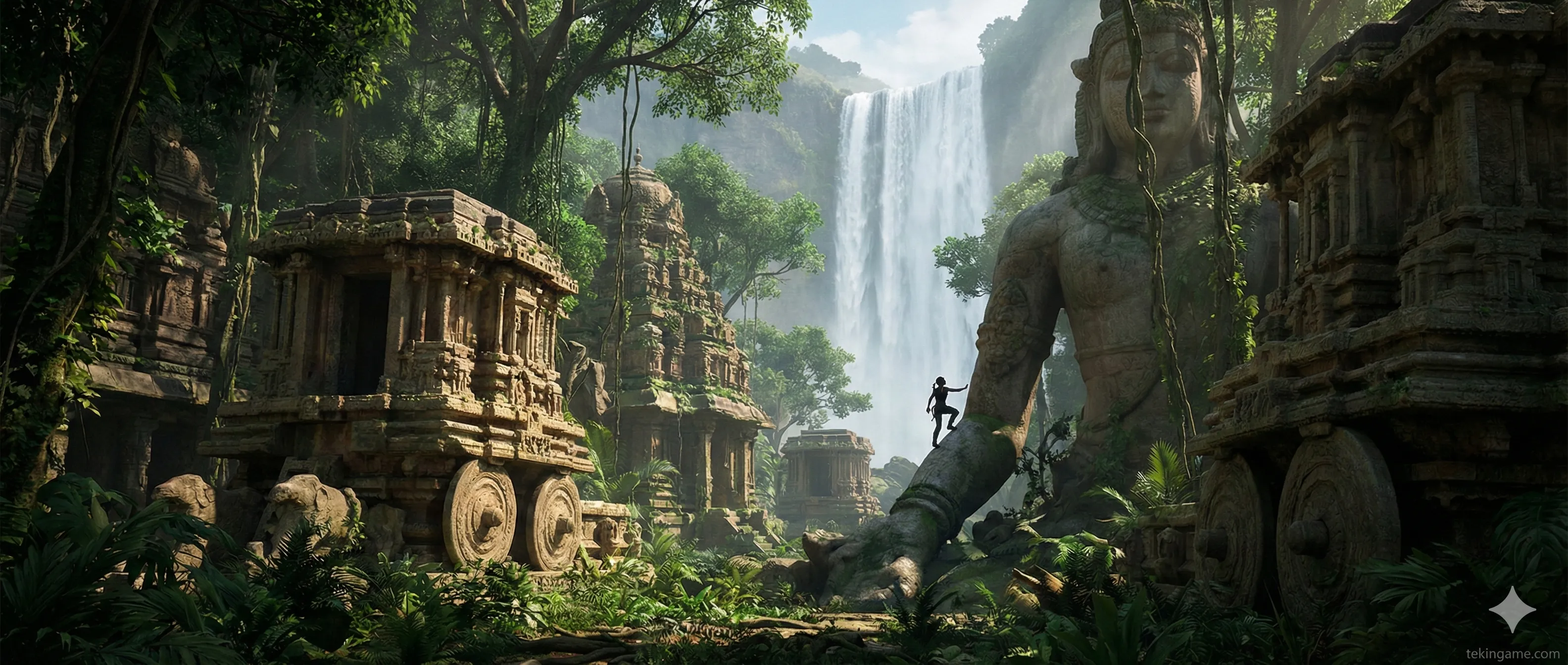
The most immediate takeaway from the reveal is the visual fidelity. Crystal Dynamics has officially abandoned its proprietary Foundation Engine in favor of Epic Games' Unreal Engine 5.4. This shift has allowed the team to push graphical boundaries that were previously impossible.
2.1. Nanite Geometry: The End of "Fake" Detail
The demo opened with Lara navigating a dense, ancient temple complex in what appeared to be Southern India. The detail on the stone carvings was not a texture trick; it was geometric reality.
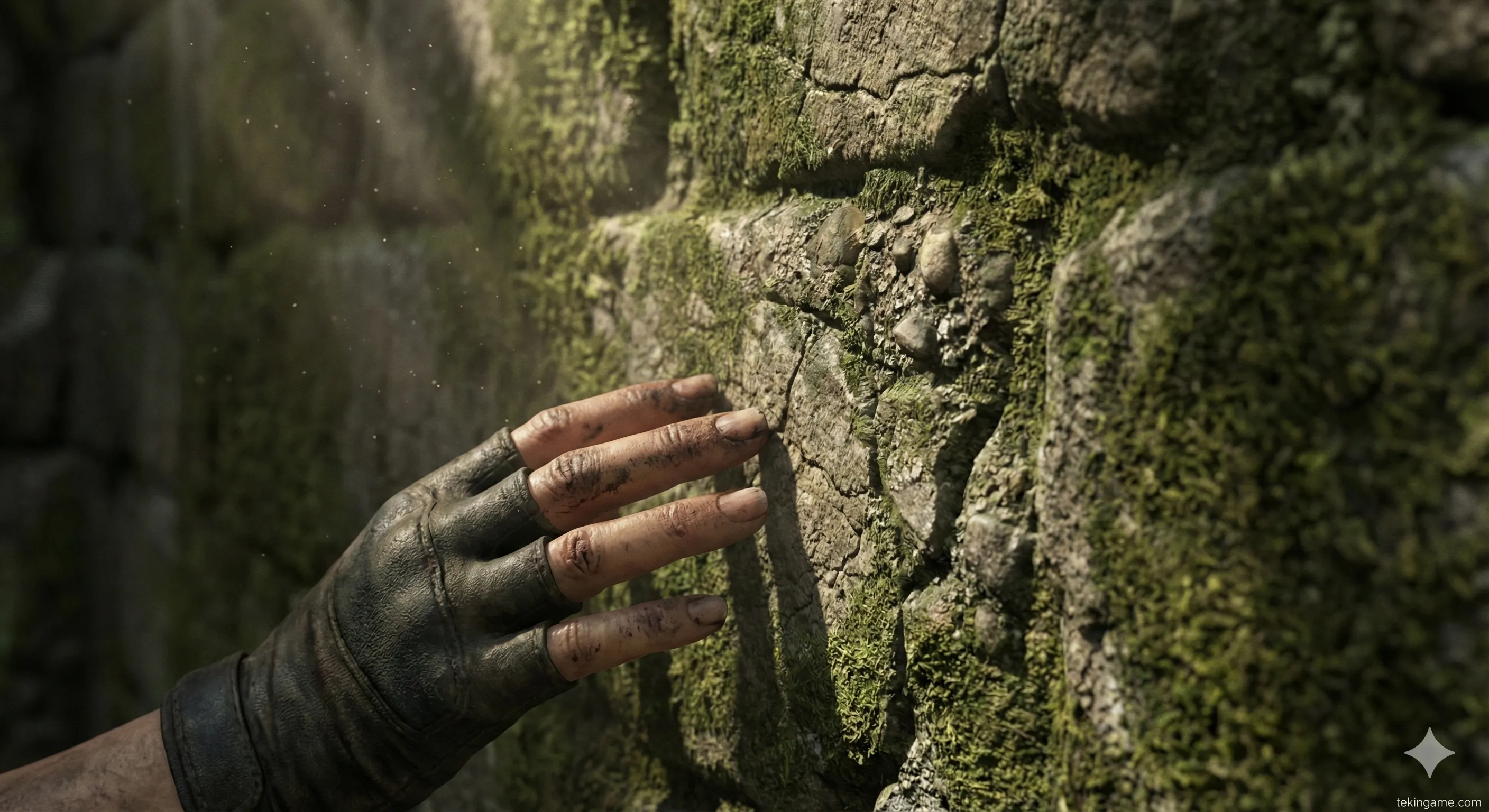
Thanks to UE5's Nanite technology, the developers are importing movie-quality assets directly into the game. In previous generations, developers used "Normal Maps" to fake the look of bumps and cracks on a flat surface. In this new Tomb Raider, every crack in the wall, every pebble on the ground, and every intricate carving on the pillars is made of real polygons.
We paused the trailer frame-by-frame during a close-up where Lara brushes her hand against a mossy wall. There was no texture pop-in, no low-res blurring. Just infinite geometric detail.
2.2. Lumen Lighting: Conquering the Darkness
Tomb Raider has always been a game about exploring the dark. This makes it the perfect showcase for Lumen, UE5's dynamic global illumination system.
In the demo, Lara lights a flare and throws it down a deep chasm.
In older games, this light source would be a simple "point light." Here, the light bounced realistically. The red hue of the flare illuminated the wet cave walls, bounced off a pool of water, and indirectly lit up the ceiling stalactites.
When Lara later opened a puzzle mechanism to let sunlight flood into a dusty chamber, the "Auto-Exposure" adjusted just like a human eye. The transition from pitch black to blinding light was seamless, creating an atmosphere of dread and wonder that felt tangibly real.
2.3. Chaos Physics and Destruction
Perhaps the most gameplay-affecting change is the physics engine. The environment is no longer static.
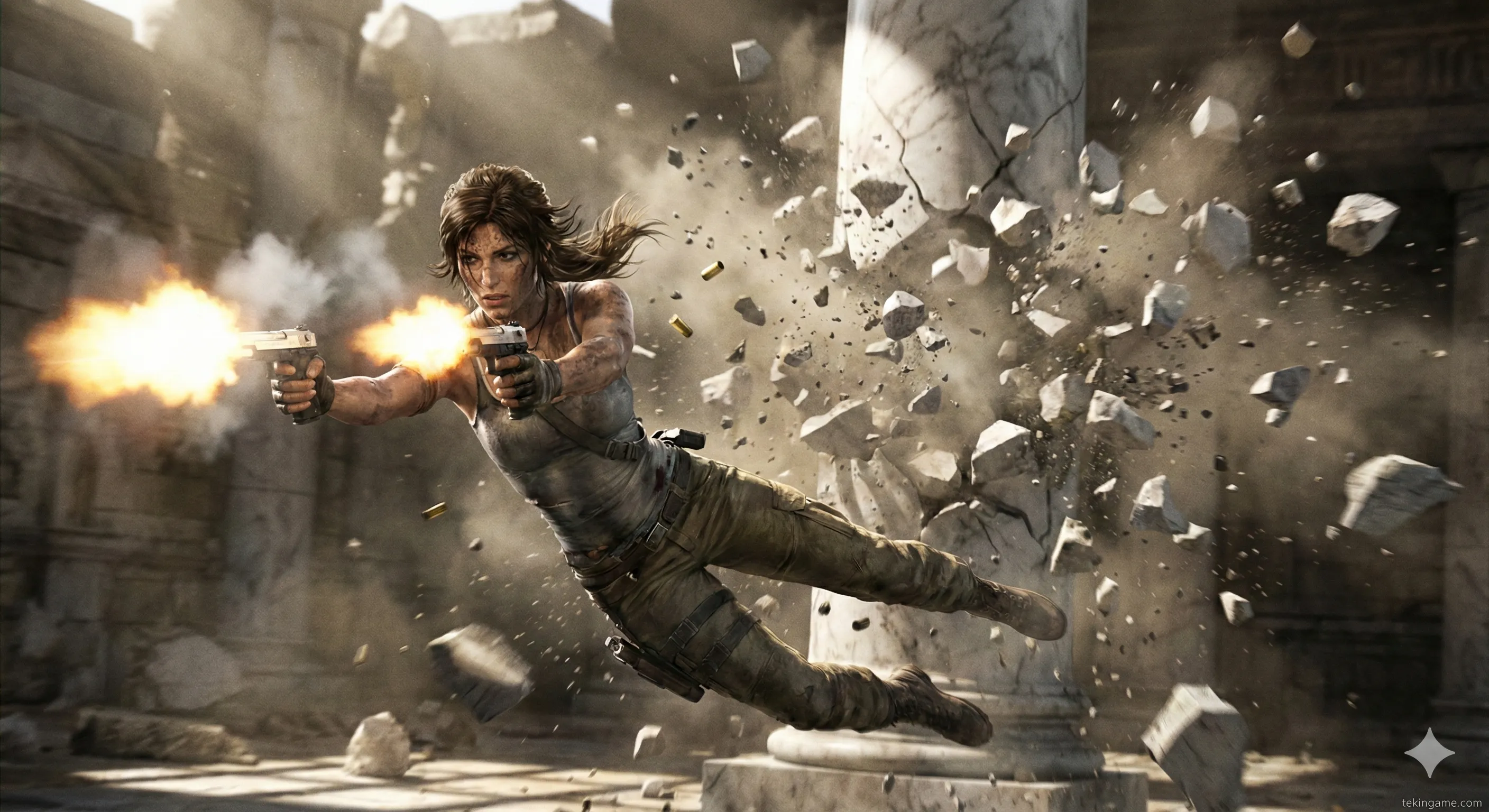
During a firefight sequence, enemies used heavy weaponry that chipped away at the marble columns Lara was using for cover. This wasn't a scripted event; it was the Chaos Physics system at work.
Chunks of stone broke off dynamically based on the angle of impact. This forces the player to keep moving. You cannot camp behind a single wall forever, because that wall will eventually disintegrate. This adds a layer of urgency to the combat that the previous trilogy lacked.
3. The Unified Timeline: Who is this Lara Croft?
Narratively, this is the most ambitious project in the franchise's history. The developers are attempting to execute the "Unified Timeline"—a canonical merger of the gritty "Survivor" Lara (2013-2018) and the confident "Classic" Lara (1996-2008).
3.1. Merging the Survivor with the Superhero
The Lara we saw in the trailer is not a scared girl learning to kill. She is a seasoned predator.
Her voice acting (still kept under wraps, though it sounds remarkably like a more mature Camilla Luddington mixed with the poshness of Keeley Hawes) exudes confidence. She doesn't gasp in horror when she sees a skeleton; she analyzes it.
Visually, the character design is a love letter to fans. She wears a modernized version of the classic turquoise tank top and brown tactical shorts (replacing the cargo pants of the recent games). Her hair is pulled back into the iconic single braid, moving with incredibly realistic hair physics (likely utilizing the new UE5 Groom system).
3.2. The Return of the Dual Pistols
The moment that broke the internet happened at the 08:45 mark of the trailer.
Cornered by three mercenaries, Lara didn't reach for her climbing axe or a bow. She reached to her hips and drew Dual HK USP Match Pistols.
The combat style immediately shifted. It wasn't the desperate scrambling of the 2013 game. It was a ballet of bullets. Lara performed a backflip off a wall while firing both guns simultaneously in different directions. This confirms that the gameplay is moving away from "grounded survival" back toward "stylized action hero," bridging the gap between generations.
4. Gameplay Evolution: Weight, Speed, and Tactics
While the guns are classic, the movement is distinctly next-gen.
4.1. Visceral Parkour and Stamina
Platforming has been overhauled to feel "heavy" and physical. When Lara makes a long jump, you can feel the impact as she grabs a ledge.
The Stamina System seems to play a larger role. While climbing a crumbling facade, a stamina bar appeared. This suggests that players will need to plan their route up a cliff face rather than just holding 'Up' on the analog stick.
The Grapple Hook has also evolved. It is no longer context-sensitive (only usable on white-painted walls). It appears to be a fully physics-based tool that Lara can use to rappel down from any ledge, swing across gaps, or pull environmental objects to solve puzzles.
4.2. Combat Loop: Acrobatics over Cover-Shooting

The demo emphasized mobility. While there is a cover system, the game rewards movement.
We saw Lara slide under an enemy's legs, spin around, and deliver a melee kick that sent him flying into a trap. This "Environmental Combat" suggests that the tombs themselves are your weapon.
Stealth remains an option, but it's faster. Lara can now use mud camouflage (a returning feature) more effectively, blending into the Nanite-rendered foliage to become invisible to thermal scopes.
5. Narrative & Setting: A Globe-Trotting Mystery
The story picks up several years after the fall of Trinity. Without a central villainous organization, a power vacuum has opened up, leading to a race between multiple factions of treasure hunters and private military corporations.
The trailer hinted at a globe-trotting adventure. We saw coordinates for:
- Hampi, India: The temple shown in the gameplay.
- Cairo, Egypt: A brief cinematic teaser of the Sphinx.
- Yucatan, Mexico: A return to the jungle biomes.
6. Release Window & Platforms
Amazon Games and Crystal Dynamics ended the showcase with a release window: Holiday 2026.
Crucially, the game is listed for PlayStation 5, Xbox Series X/S, and PC.
There is no mention of PS4, Xbox One, or the current Nintendo Switch. This confirms that Tomb Raider is a true next-gen exclusive, unburdened by the hardware limitations of decade-old consoles. This decision is what allows for the density of the Nanite geometry and the complexity of the physics systems.
7. Verdict: Uncharted Territory
For a long time, Uncharted held the crown for cinematic action. But with Nathan Drake retired, the throne is empty.
Based on what we saw last night, Lara Croft isn't just coming back to take her seat; she's building a new castle. The fusion of Unreal Engine 5's raw power with the nostalgic gameplay elements of the classic era seems to be the perfect formula.
Crystal Dynamics has managed to make Lara Croft look modern without losing the essence of what made her an icon in 1996. The Queen is back, and she brought her guns.
We want to hear from the die-hard fans.
Are you happy to see the return of the "Action Hero" Lara with dual pistols, or did you prefer the more grounded, emotional storytelling of the Survivor trilogy?
Let us know in the comments below!