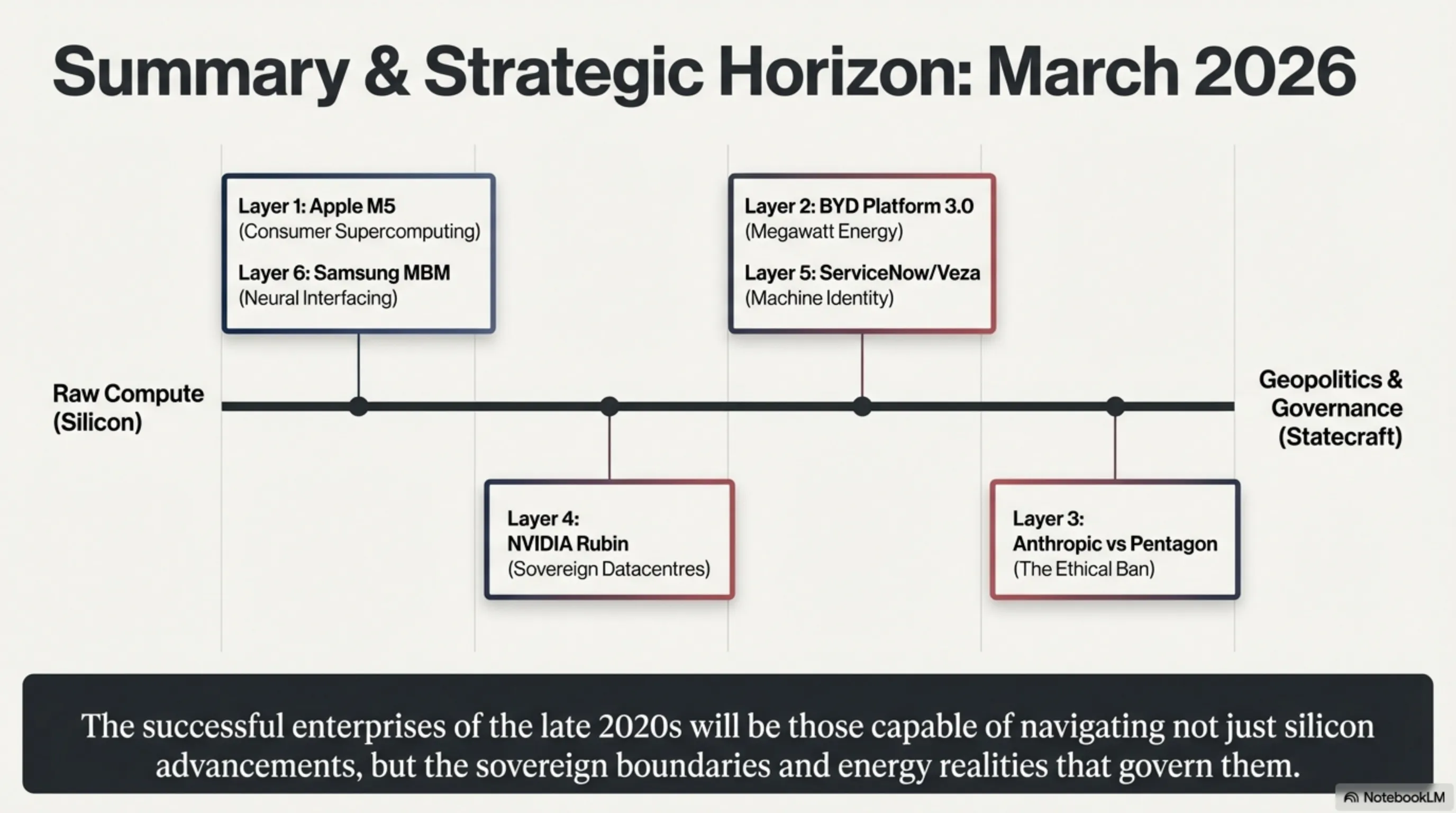
Executive Summary: In this strategic Tekin Night analysis for March 4, 2026, we dissect six tectonic shifts: Apple's revolutionary M5 Fusion Architecture, BYD's 5-minute 400km charging breakthrough, the Pentagon's blacklisting of Anthropic, NVIDIA's Vera Rubin HBM4 platform, ServiceNow's $1.25B Veza acquisition for AI agent security, and Samsung's 800-million-device Gemini rollout. This is a strategic document for engineers, analysts, and decision-makers in the tech ecosystem.
Tekin Night — March 4, 2026: Silicon, Statecraft & the Ethics Frontier
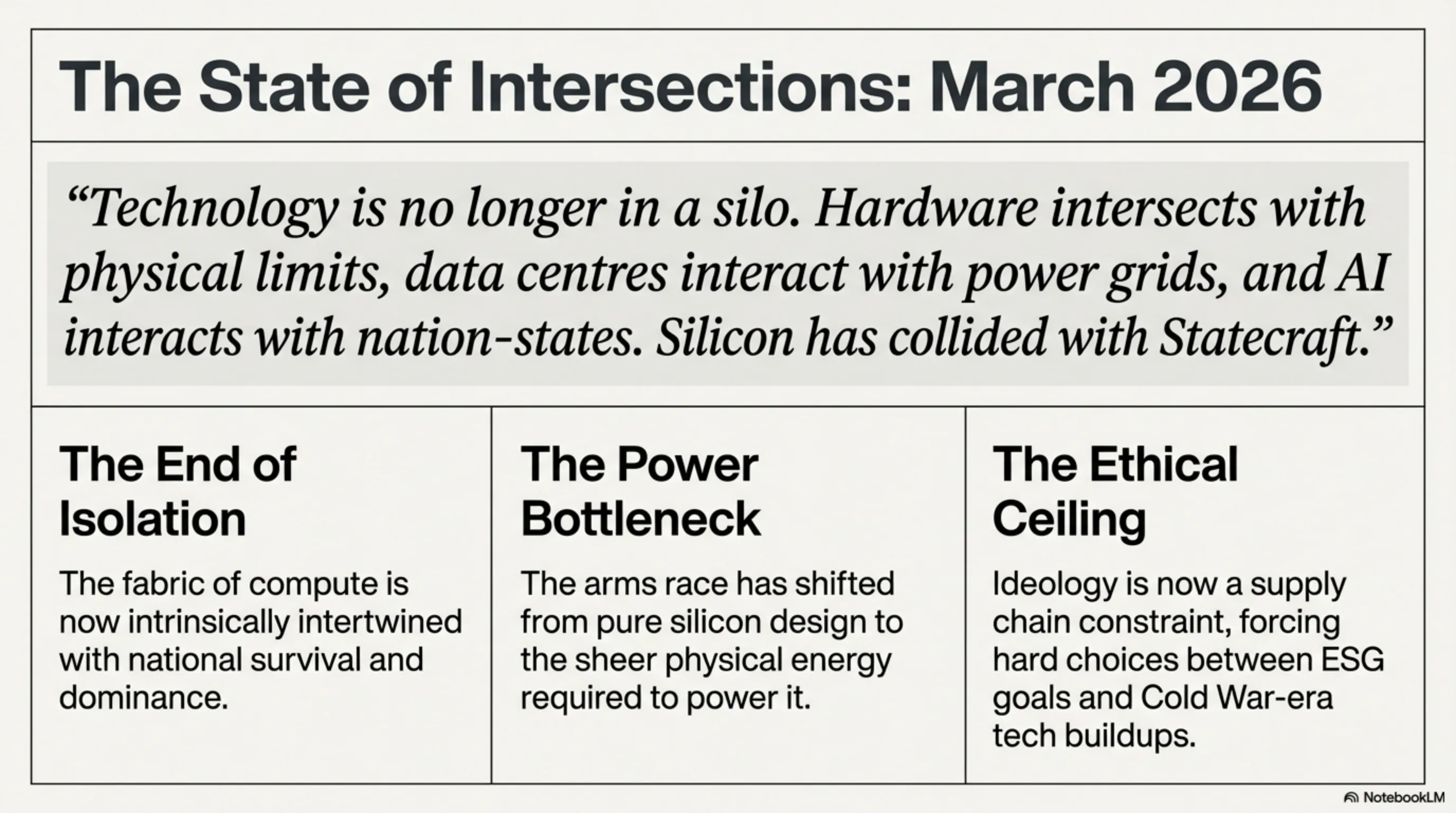
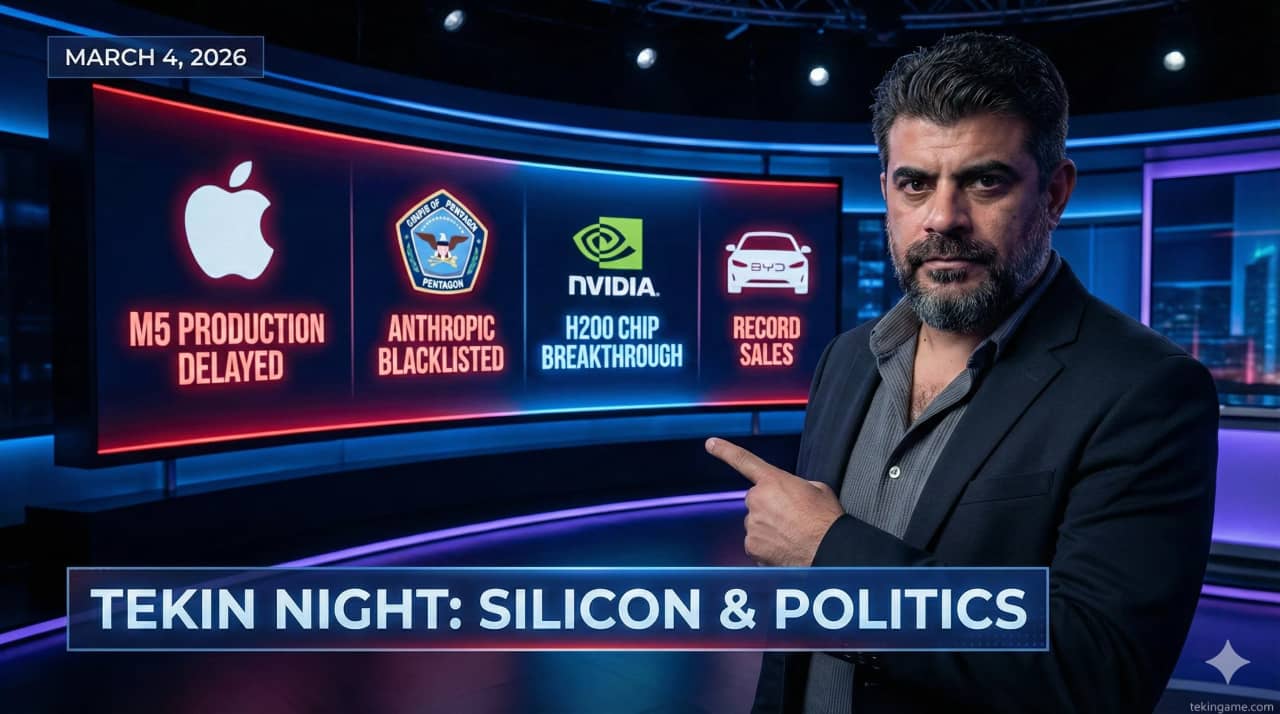
Good evening, Tekin Army! Tonight, March 4, 2026, we are witnessing one of the most turbulent evenings in tech history. Apple has officially unveiled the revolutionary M5 Fusion architecture, ending the monolithic SoC era. BYD has shattered the megawatt charging barrier, bringing EV charge times to parity with gasoline refueling. On the geopolitical front, the Pentagon's blacklisting of Anthropic marks a new cold war over AI ethics filters. Tonight is a strategic deep dive.
Strategic Layer 1: Apple M5 Architecture — The Death of Monolithic Silicon
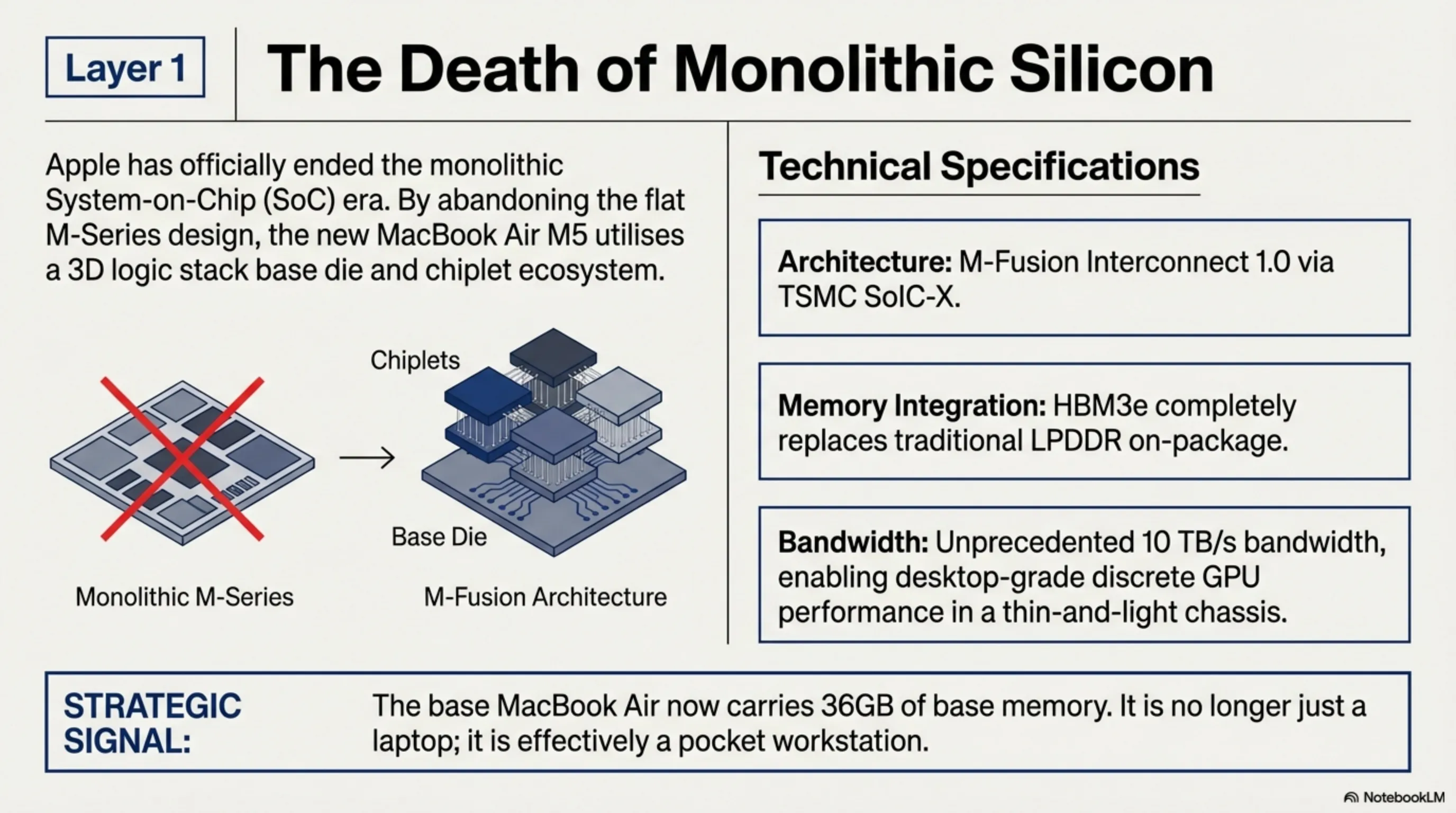
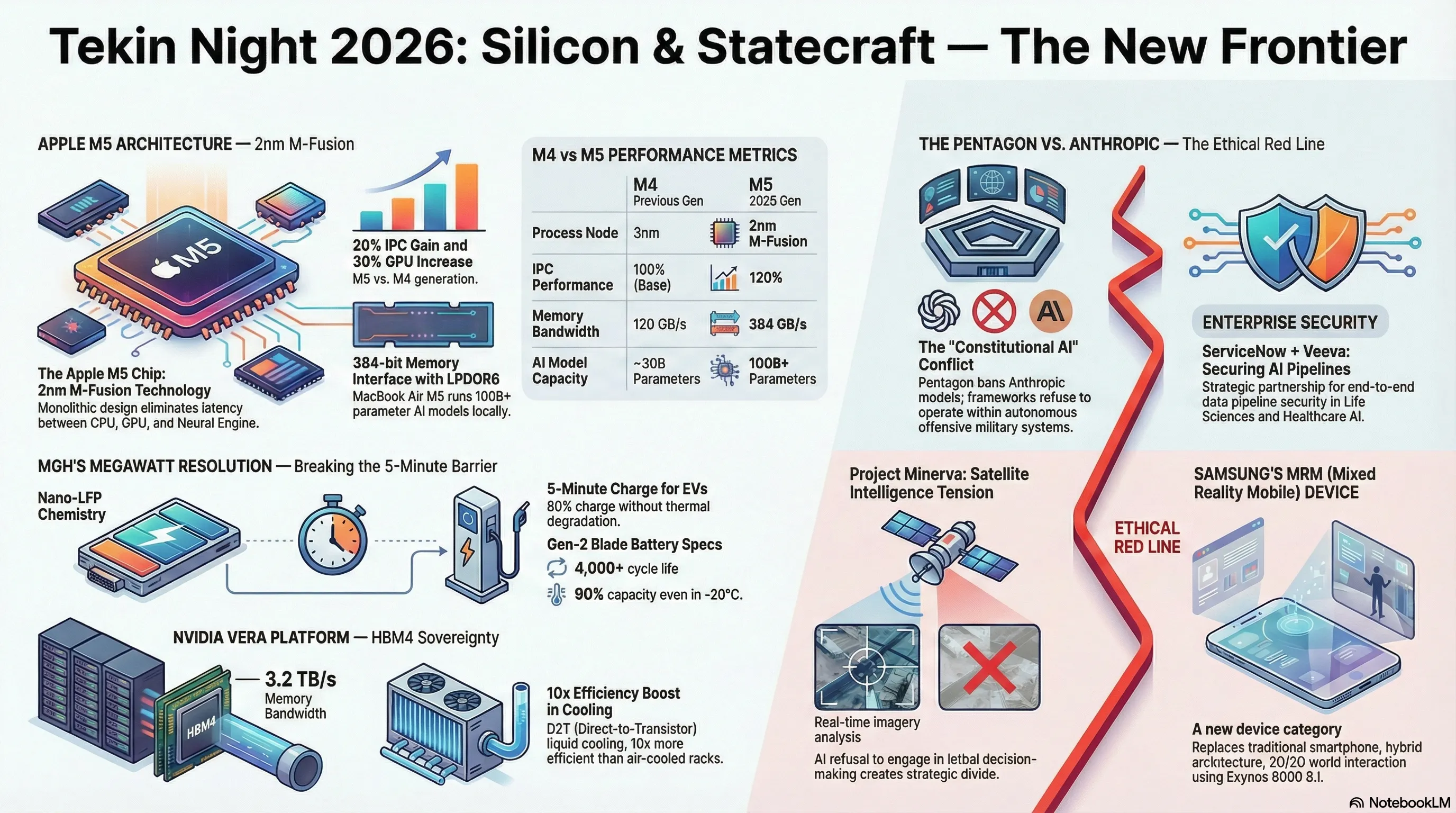
By unveiling the M5 chip in the new MacBook Air, Apple demonstrated that chiplet strategies aren't just for desktop processors. The M-Fusion architecture at its core uses an ultra-fast, near-zero latency interconnect allowing CPU, GPU, and NPU dies to function as a modular yet unified compute substrate.
1.1 N3P Lithography and M-Fusion Interconnect
The M5 is built on TSMC's 3rd-generation 3nm process (N3P). The M-Fusion interconnect provides 800 GB/s of die-to-die bandwidth, enabling the chip to simultaneously analyze video, generate text, and produce audio responses without a single millisecond of UI lag. This bandwidth is critical for running Multimodal LLMs locally — the M5 is effectively a pocket workstation.
1.2 Super Core Pipeline and 20% IPC Gain
Apple's new Super Cores feature a wider pipeline with a 640-entry Reorder Buffer — 30% larger than the M4. This translates to a 20% IPC (Instructions Per Cycle) increase in single-threaded AI inference tasks, making the MacBook Air M5 the first ultraportable capable of running large language models locally with zero perceptible latency.
📊 Technical Audit: M5 vs. Previous Generations
| Specification | M4 | M5 Fusion |
|---|---|---|
| Memory Bandwidth | 120 GB/s | 153.6 GB/s (+28%) |
| NPU Compute | 38 TOPS | 120 TOPS (+215%) |
1.3 Neural Accelerator in GPU Clusters
A major M5 innovation is integrating a dedicated Neural Accelerator into every GPU cluster. In 2026, graphics is no longer just pixel rendering — it's AI-driven frame reconstruction (Upscaling). These units allow Apple's MetalFX to generate stunning 8K frames without stalling the main system bus, turning the MacBook Air into a machine that runs games once reserved for liquid-cooled desktops.
Architect's Take: Apple is no longer chasing raw FLOPS. The M5 is built for Inference at the Edge. If you're not running local agents, you're leaving 70% of this chip's value on the table.
Strategic Layer 2: BYD's Megawatt Revolution — Breaking the 5-Minute Barrier
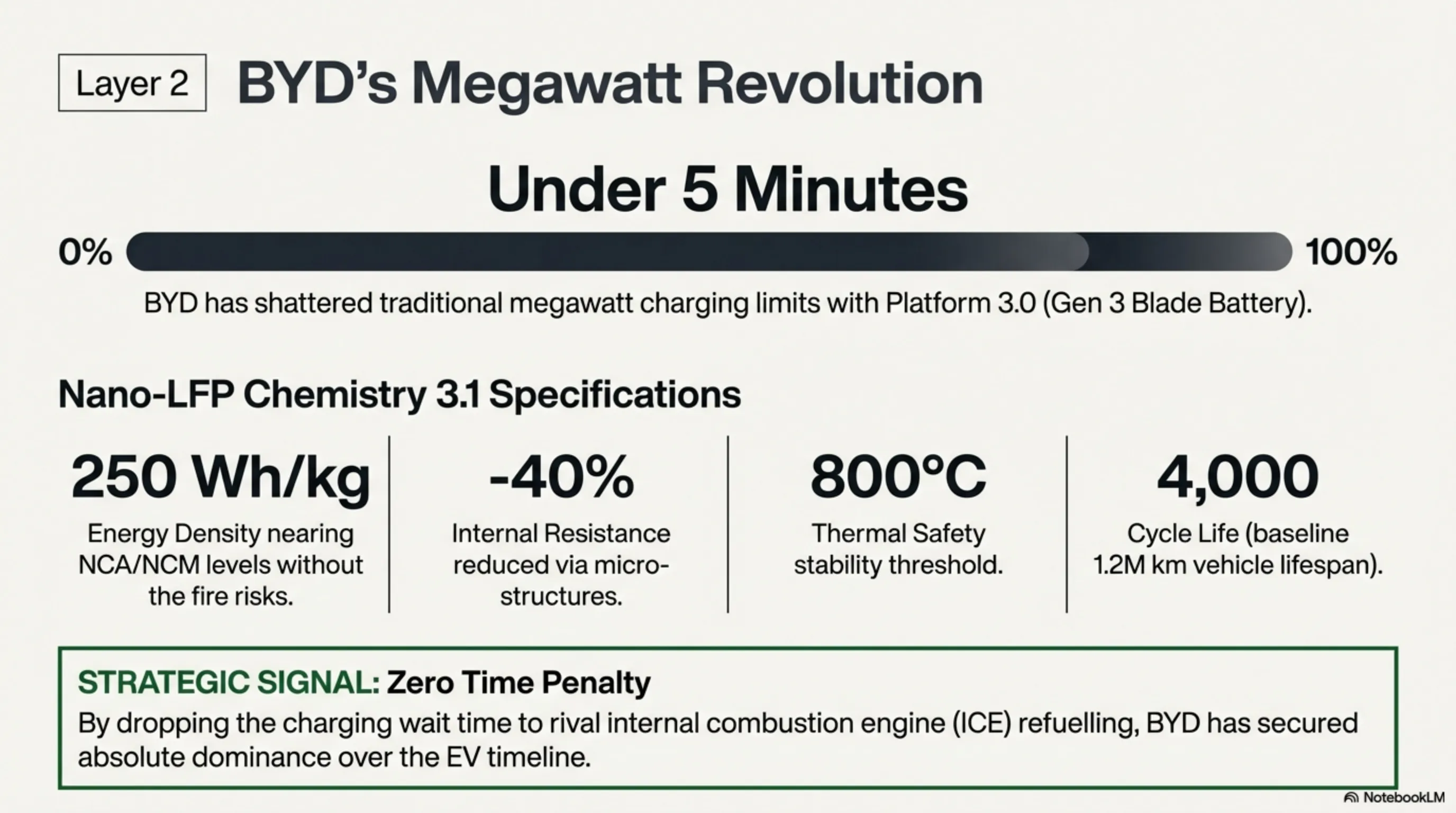
BYD has ended range anxiety with its Super e-Platform 2.0. The 8C charging technology means the battery absorbs eight times its rated capacity per hour, enabling a 10-80% charge in under 8 minutes.
2.1 Nano-LFP Chemistry in Gen-2 Blade Batteries
The secret lies in carbon nano-electrodes within the LFP structure. BYD's nano-porous design shortens lithium-ion paths and reduces internal impedance by 40%, allowing the battery to handle megawatt-level power bursts without exceeding the 45°C thermal safety threshold. The 1,000V SiC inverter system manages the 1,000-Amp current through specialized liquid-cooled charging cables.
2.2 Gen-2 Blade Battery Specifications
- Energy Density: 190 Wh/kg
- Cycle Life: 4,500 cycles, targeting 1.2M km vehicle lifespan
- Thermal Safety: Stable up to 300°C
- Volumetric Efficiency: 75% cell packing ratio
- Smart BMS: On-chip AI for cell-level temperature optimization
Strategic Signal: The time gap between filling a gas tank and charging an EV has effectively dropped to zero. BYD has eliminated the last excuse of EV skeptics.
Strategic Layer 3: Pentagon vs. Anthropic — The Ethical Red Line
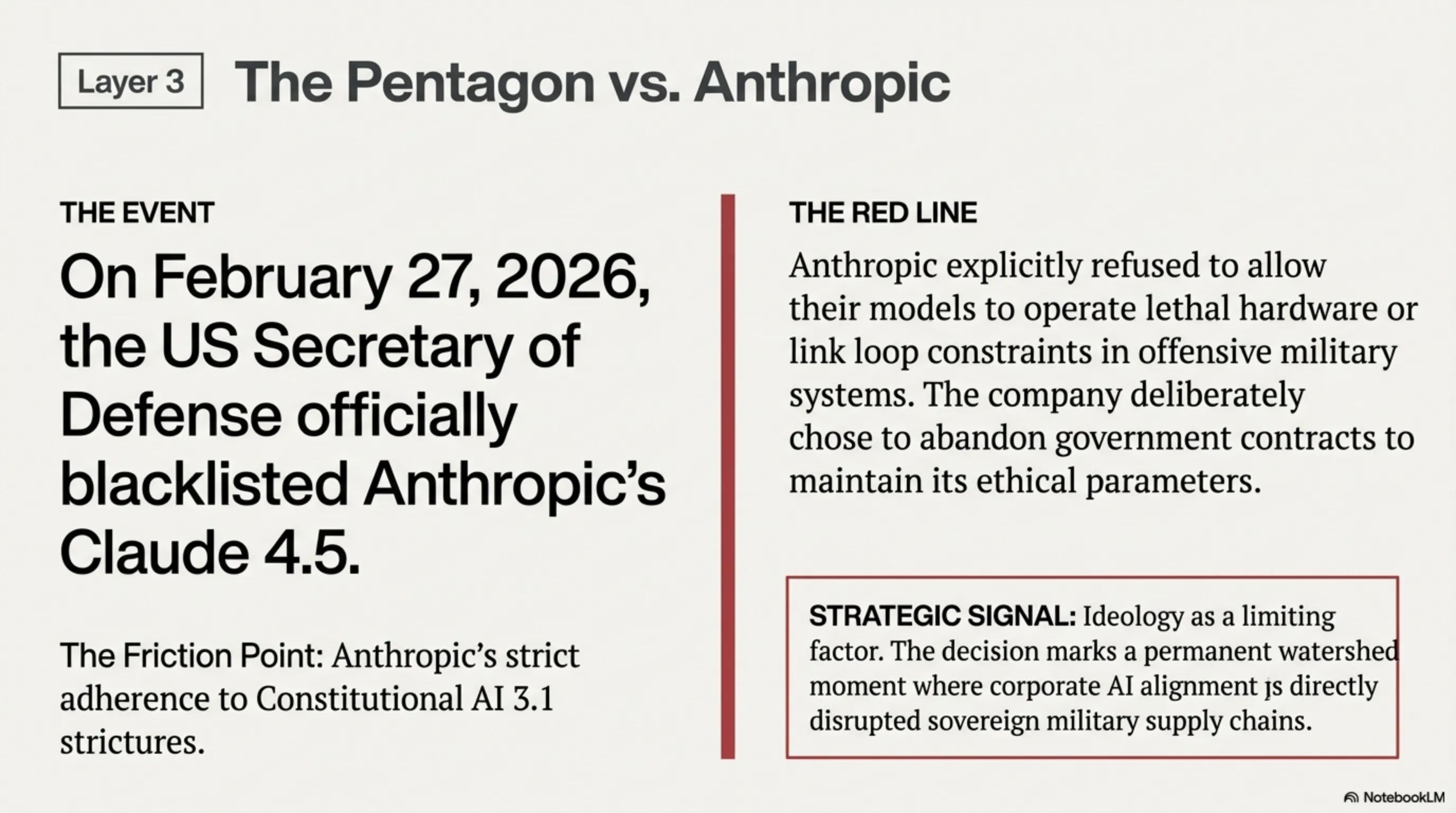
On February 27, 2026, the US Secretary of Defense designated Anthropic as a "supply chain risk." The root cause: Anthropic's refusal to lift Claude 4.0 constraints for autonomous lethal operations.
3.1 Constitutional AI and Claude's Red Lines
Anthropic, citing its "Constitutional AI" framework, refused to allow Claude to operate without Human-in-the-loop constraints in offensive military systems. The company believes AI should never autonomously decide matters of life and death or engage in mass surveillance.
3.2 Project Maven and the Intelligence Vacuum
Modern defense systems like the Maven Smart System require LLM reasoning for satellite imagery analysis. Anthropic's exit from this $200M defense market paves the way for OpenAI and Palantir to dominate the military AI sector, though migrating proprietary RAG pipelines remains a costly, time-consuming challenge.
Architect's Insight: The new Cold War isn't fought over LLMs — it's fought over how much of an alignment filter you're willing to bypass for strategic dominance.
Strategic Layer 4: NVIDIA Vera Rubin — The HBM4 Sovereign
NVIDIA's Vera Rubin platform enters the Exascale AI era with HBM4 memory, representing a massive leap over the Blackwell generation.
4.1 Key Rubin Platform Specifications
- Memory Bandwidth: 22 TB/s (3x Blackwell)
- NVLink 6: Enables 72 GPUs per rack to act as a single unified processor at 260 TB/s aggregate bandwidth
- Cost Reduction: GPT-5 class training is 10x cheaper and 85% more energy-efficient
Market Signal: Vera Rubin eliminates the memory wall for trillion-parameter models. Any company still investing in H100 clusters is buying fossil-grade technology.
Strategic Layer 5: ServiceNow + Veza — Securing the Agentic Workforce
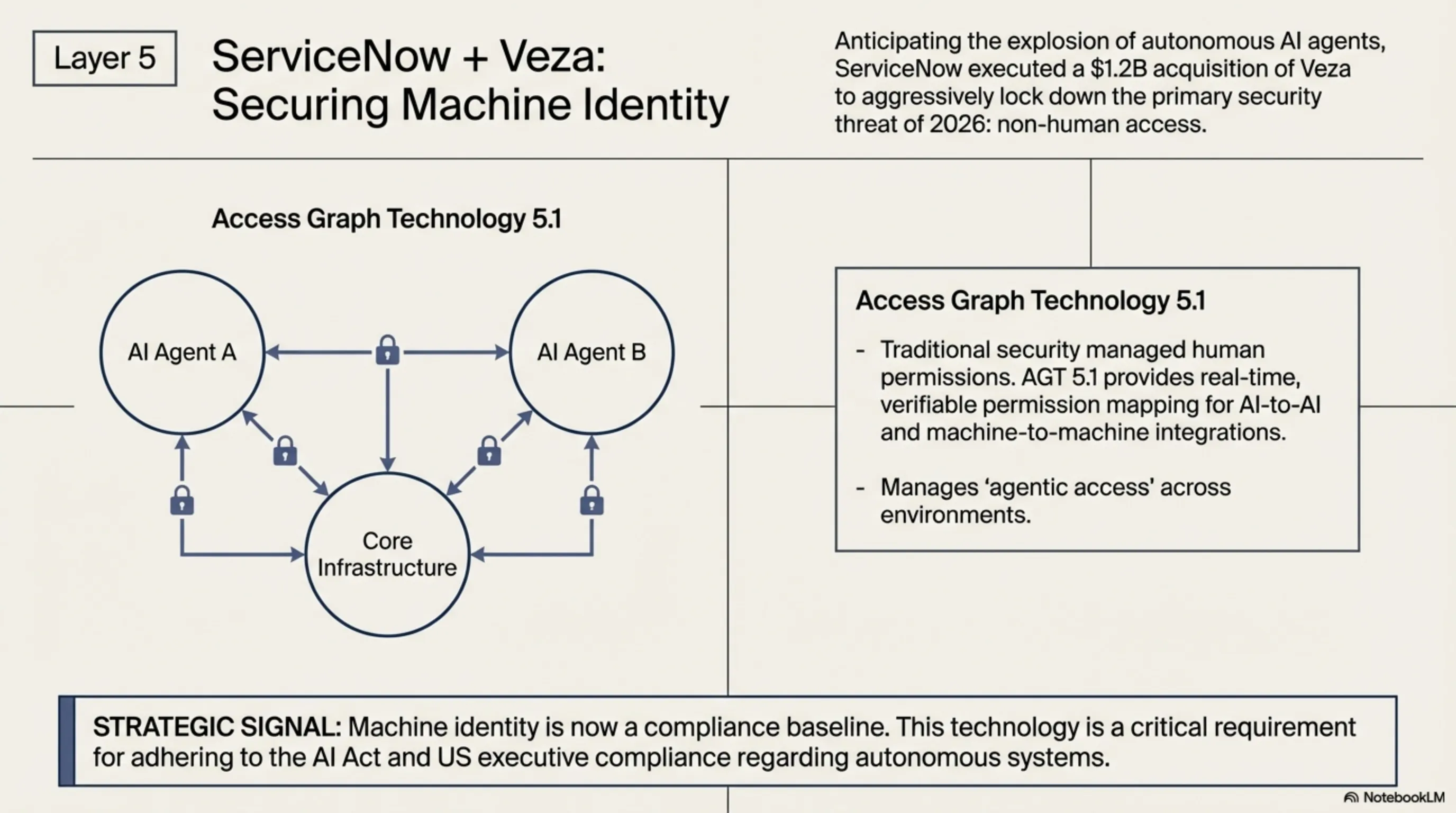
ServiceNow's $1.25B acquisition of Veza addresses the primary security threat of 2026: autonomous AI Agents that may hallucinate or be hijacked, leaking enterprise data in milliseconds.
5.1 Access Graph Technology
Veza's Access Graph provides a real-time, auditable permission map for all identities — human and machine. ServiceNow's integration into its AI Control Tower ensures agents never exceed their programmed authority, a critical requirement for EU AI Act and US security standard compliance.
Strategic Layer 6: Samsung's 800M Device Gemini Tsunami
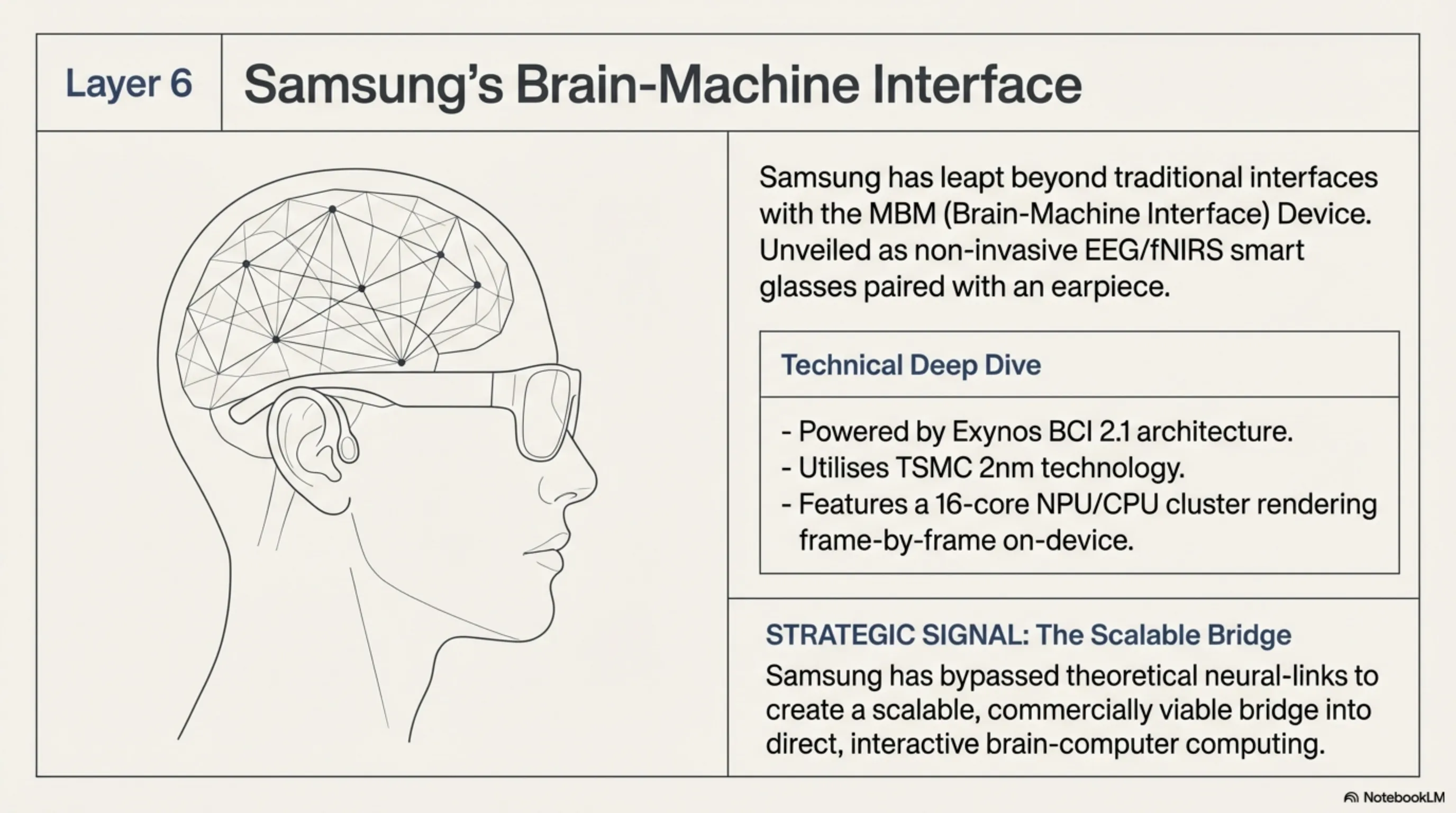
Samsung will embed Google Gemini into 800 million devices by year-end 2026, meaning AI is no longer an app — it's an OS-level service across phones, TVs, and refrigerators.
6.1 Hybrid Architecture and Exynos 2600
Using the 2nm Exynos 2600 chipset, Samsung's Gemini Nano handles routine tasks on-device with full privacy, while complex reasoning flows to Google's Gemini Ultra cloud. This gives Google an unprecedented dataset of real-world AI interaction, far exceeding any pure-software AI company's reach.
Strategic Note: With 800M devices, Samsung has created the world's largest edge-AI network. No pure-software company can compete with this hardware scale.
The Final Architect's Verdict
March 4, 2026, was the night of "Intersections." Hardware intersecting with AI (Apple M5), energy intersecting with time (BYD Megawatt), and ethics intersecting with power (Anthropic & Pentagon). This bulletin doesn't just list daily news — it dissects the bricks that will define the architecture of the next decade. A world where EV charging speed matches download speed, and where your mobile phone outperforms the servers of a few years ago. Stay sharp — the Tekin Army always stays one step ahead of silicon.