
Good night, Commander. As the sun sets on Feb 25, 2026, the Tekin Night report dives into the deep silicon infrastructure. Tonight, we analyze Samsung’s mass production of HBM4, the Niobium project for secure cloud processing, and the Silicon Valley manifesto signaling the end of traditional operating systems. This is not about tools; it's about the new silicon order where agents replace interfaces.
Welcome to the night shift at Tekin Garage. When the festive noise of the market and the neon glow of retail fades, the true signals of power in the silicon world begin to resonate. Tonight, on February 25, 2026, we are witnessing seismic shifts in global computing infrastructure that go far beyond the release of mere gadgets. In tonight’s Tekin Night, we dive into the layers that define future digital sovereignty.
If our morning report was about choosing the best weapon for your desk, the night report is about dissecting the forges that build these weapons and the strategies that determine who will win the AI war. We have moved past the era of Instructional Computing—where humans sat behind systems to issue commands—and entered the age of Goal-Oriented Computing. This is a paradigm where hardware thinks, plans, and manages execution autonomously. Put your systems in night-mode; tonight’s mission is to understand the new silicon order.
> MISSION_DOSSIER_SLOTS:
- [01] Ending the Memory Wall: Dissecting Samsung HBM4
- [02] Silicon-Level Security: Project Niobium and FHE Processing
- [03] The Giant's Manifesto: NVIDIA and AMD’s Strategy at CES 2026
- [04] Death of the OS: Why Agents have Occupied the Hardware
- [05] Dissecting Rubin Architecture: The Heart of the Data Center
- [06] Final Brief: The Inspector’s Analysis of the New Power Order
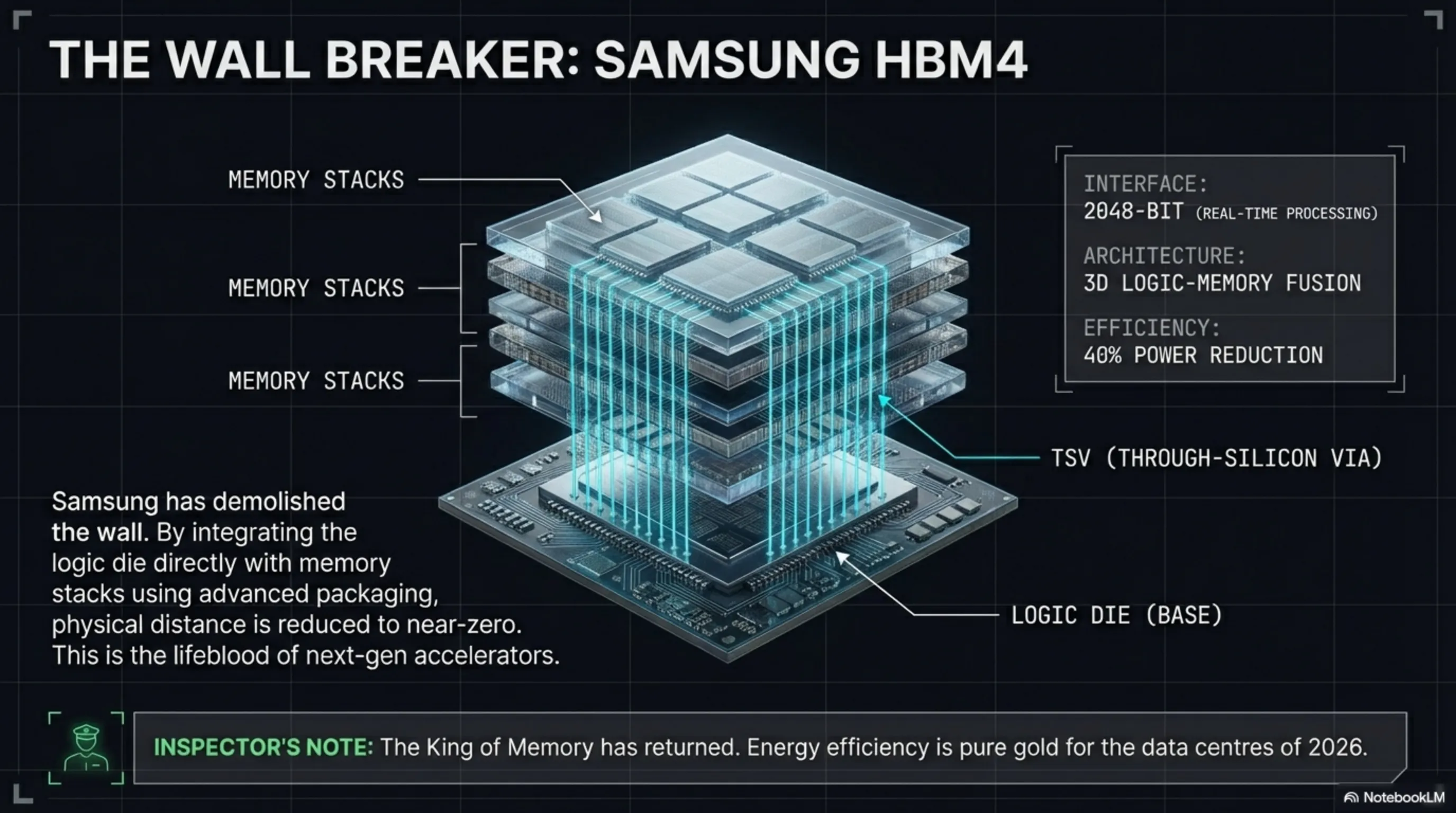
1. The End of the Memory Wall: Samsung HBM4 and the Data Center Revolution
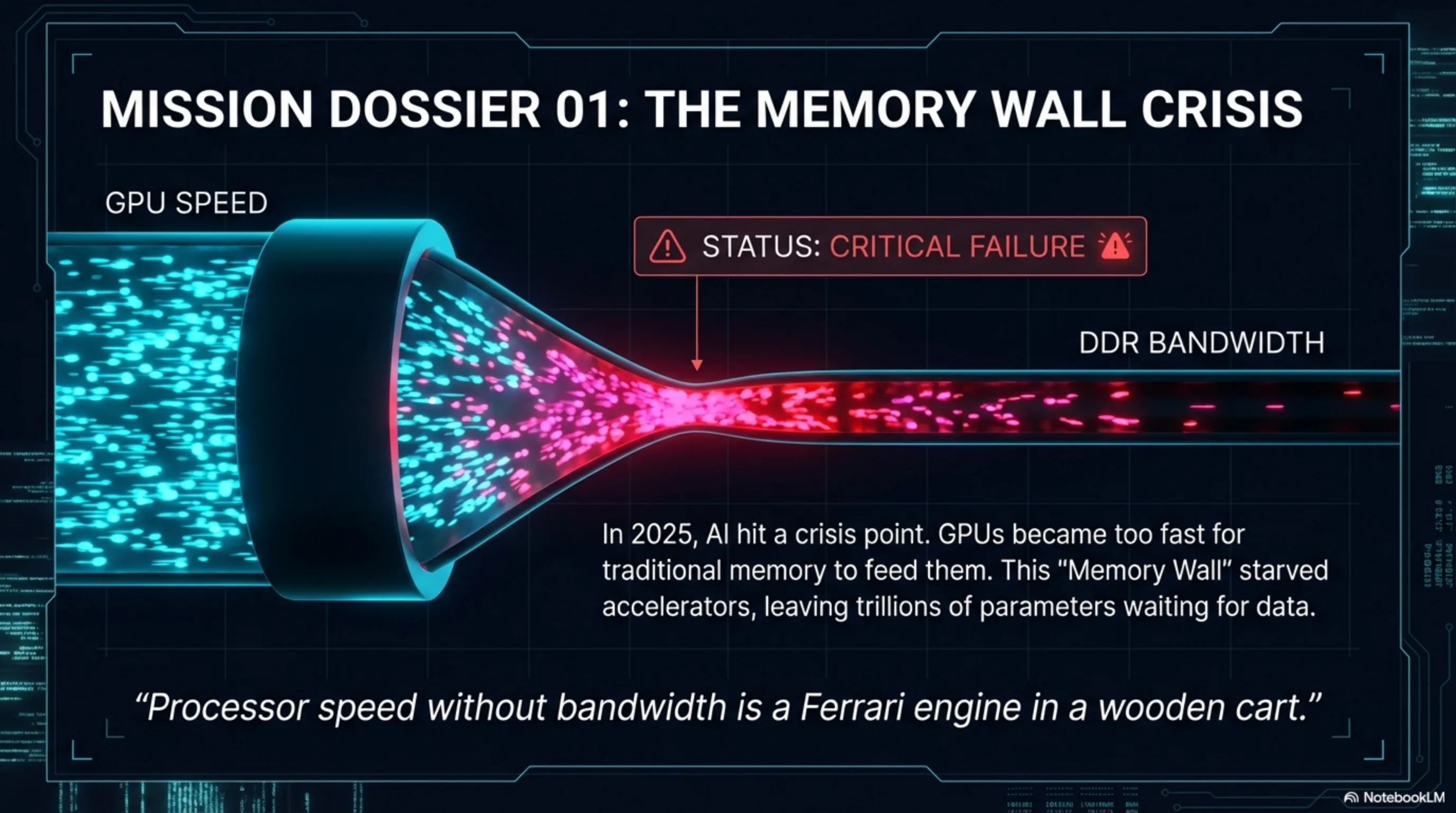
At Tekin Garage, we believe in one core principle: "Processor speed without memory bandwidth is like a Ferrari engine in a wooden cart." The greatest crisis facing AI in 2025 was what engineers called the "Memory Wall." GPUs had become so fast that traditional memory could not feed them data quickly enough. However, today, Samsung has officially demolished that wall with the mass production of HBM4.
HBM4 (High Bandwidth Memory 4) is not just a capacity upgrade; it is a revolution in metallurgy and silicon packaging. Samsung has integrated the Logic Die directly with the memory stacks using advanced 3D packaging. By utilizing TSV (Through-Silicon Via) technology, the physical distance between the brain (processor) and the memory has been reduced to near-zero. The result? A 2048-bit interface that allows AI models with trillions of parameters to be processed in real-time. Samsung has now secured the lifeblood for all next-generation accelerators, including NVIDIA’s Rubin series.
🕵️♂️ INSPECTOR’S STRATEGIC DEBUG:
The shipment of HBM4 by Samsung is a clear signal to competitors: "The King of Memory has returned." This technology doesn't just double the speed; it reduces power consumption by up to 40%—a feature that is pure gold for the energy-starved data centers of 2026.
2. Project Niobium: The 8nm Counter-Strike to Cloud Data Leaks
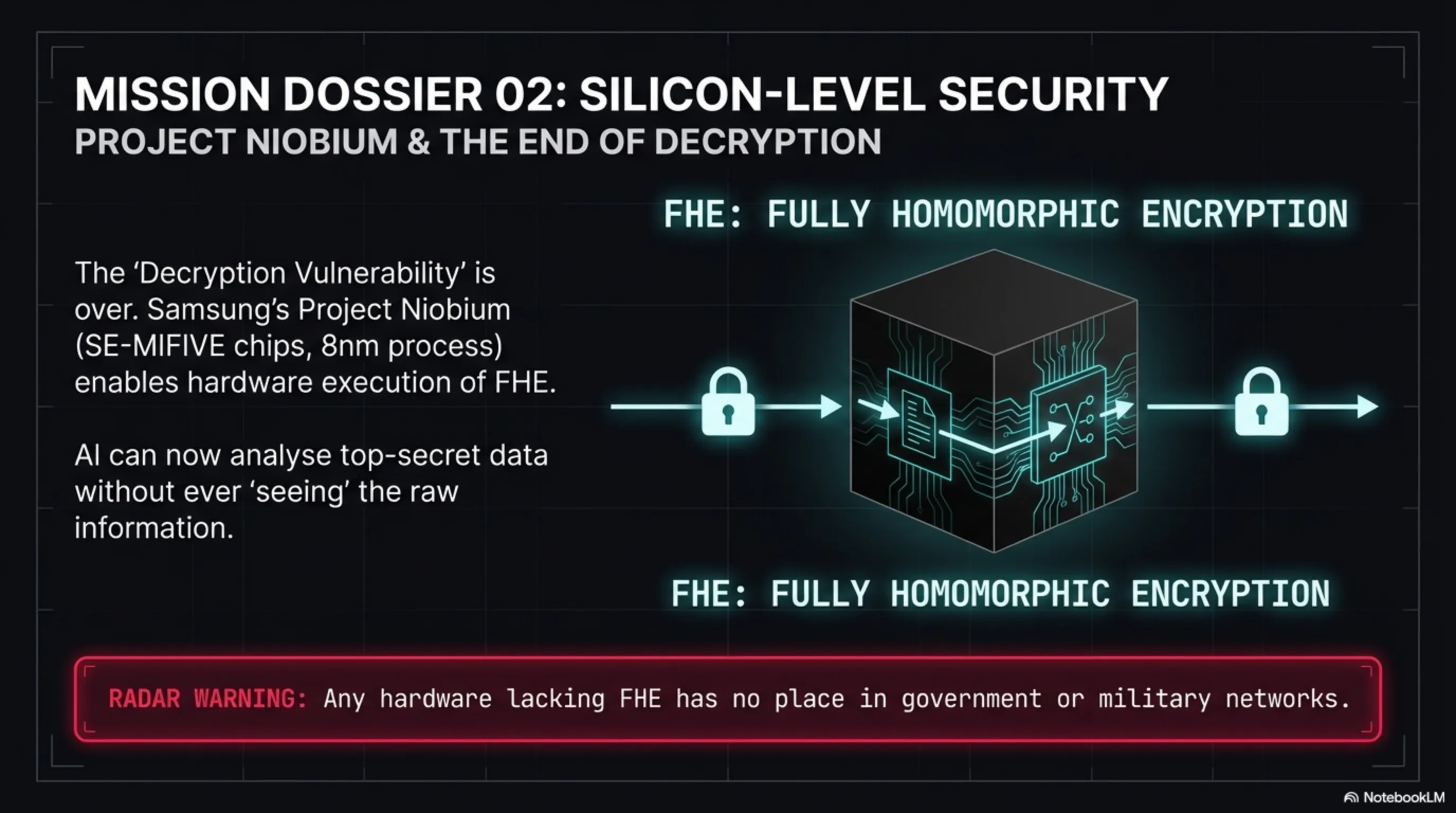
In the darkness of the digital night, the greatest fear for global corporations is data leakage during processing. Until now, an unwritten law existed: "Data is safe when encrypted, but to be analyzed by AI, it must be decrypted—and that’s when hackers strike." Samsung has ended this era of vulnerability with the official unveiling of Project Niobium and the SE-MIFIVE chips.
The Niobium chips, built on Samsung’s advanced 8nm process, have a single mission: the hardware execution of FHE (Fully Homomorphic Encryption). This technology allows AI to perform complex computations on encrypted data without ever needing to decrypt it. Imagine a hospital sending top-secret patient records to a cloud AI for analysis, while the AI itself has no way of "seeing" the raw data. This is the strongest barrier ever built against industrial espionage and cloud breaches.
🛡️ TEKIN NIGHT SECURITY RADAR:
Project Niobium isn't just a chip; it’s a redefinition of "Trust." Samsung has moved security from the fragile software layer to the impenetrable silicon. In 2026, any hardware lacking FHE security will have no place in government or military projects.
3. The CES 2026 Manifesto: When NVIDIA and AMD Signed the Death Warrant of Traditional OS
Reports emerging from the strategic corridors of CES 2026 indicate that we are no longer watching a mere "gadget show"; we are witnessing a "Silicon Coup." The trinity of power—NVIDIA, AMD, and Amazon—has signed a coordinated manifesto that fundamentally alters our definition of a computer. At Tekin Garage, we call this the Transition from Instructional to Goal-Oriented Computing.
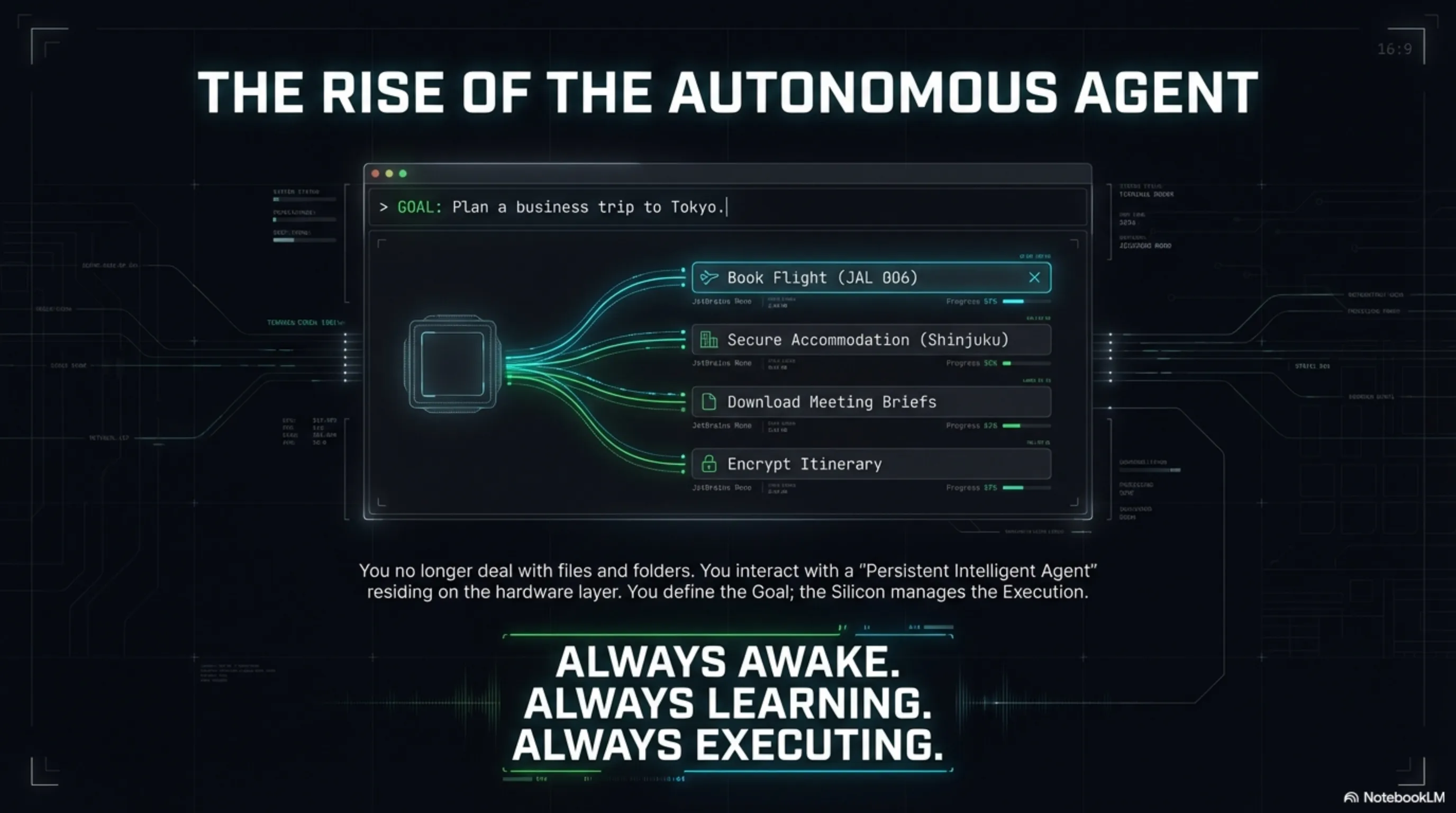
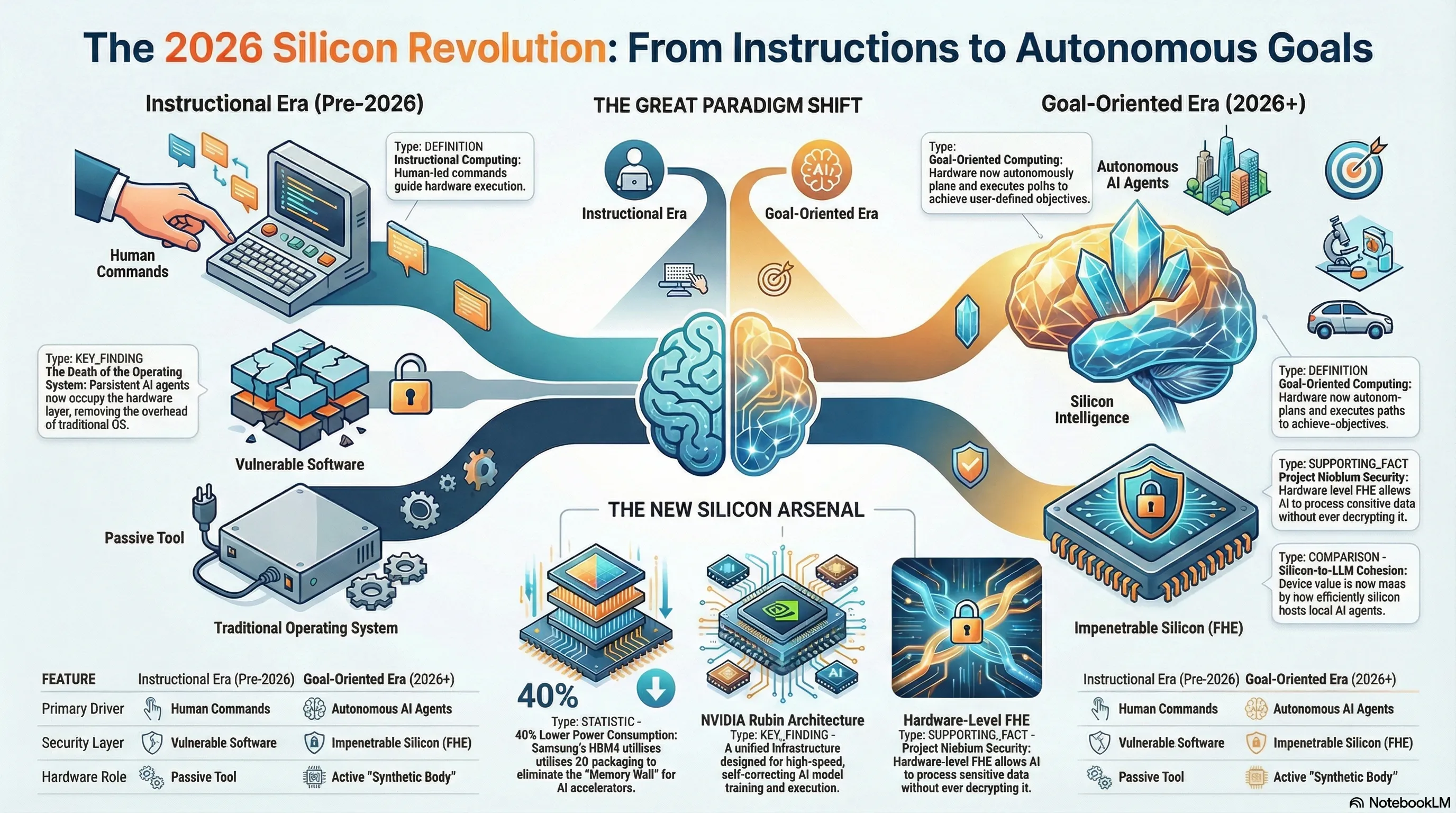
Historically, the human-computer relationship was based on "Instructions"—you clicked menus, wrote code, or typed commands for the system to execute. In the 2026 Manifesto, hardware no longer waits for your input. NVIDIA, with its Rubin architecture roadmap, and AMD, with its "AI-First PC" platforms, have declared that next-gen hardware is the physical host for "Autonomous Agents." In this new paradigm, you only define the "Goal" (e.g., "Plan a business trip to Tokyo and prepare all necessary documentation"), and the silicon manages the execution across all layers without human micro-management. Hardware has evolved from a passive tool into an active partner.
🎯 STRATEGIC RADAR (PARADIGM SHIFT):
The role of hardware in 2026 is to provide "Local Compute Density" for synthetic brains. The goal is independence; ensuring AI agents do not rely on the cloud for every micro-decision. Silicon autonomy is the key to privacy and speed in the new world order.
4. The Death of the OS: Why Agents Have Occupied the Hardware
Classic analysts are still looking for the next version of Windows or macOS, but the cold truth at Tekin Garage is this: The Operating System is dying. We are observing a phenomenon where the "Persistent Intelligent Agent" is replacing traditional interfaces. In 2026, you are no longer dealing with files, folders, and desktops; you are interacting with a digital entity that resides directly on the hardware layer.
Why is this happening? Traditional OS were designed for "Humans" to communicate with hardware. But when AI can speak directly to the silicon, the heavy overhead of an OS becomes a bottleneck. Modern hardware from Samsung and NVIDIA is now optimized for "Native Agent Execution," allowing the AI to access system resources with zero abstraction. We are moving toward a future where humans dictate goals, and the silicon eliminates the underlying digital bureaucracy. Future computers won't "boot" into a GUI; they are always awake, always learning, and always executing.
💀 INSPECTOR’S DISSECTION:
The end of the OS means the end of heavy software licensing. In the new world, a device's value is measured by its "Silicon-to-LLM Cohesion." If your hardware cannot host a local agent, it is merely a piece of expensive, inert metal in 2026.
5. Dissecting Rubin Architecture: The Heart of the 2026 Data Center
With the introduction of the Rubin architecture (the successor to Blackwell), NVIDIA has officially pivoted from being a "GPU manufacturer" to a "Synthetic Body Constructor." Rubin is not just a jump in CUDA core counts; it is the first architecture designed to natively integrate with Samsung’s HBM4 memory stacks. This union between NVIDIA and Samsung has effectively dissolved the latency wall in global data centers.
Rubin features the next generation of NVLink interconnects, allowing thousands of GPUs to communicate as if they were a single, massive "Super-Processor." This is exactly what is required for training "Self-Correcting AI" models. In tonight’s Tekin Night, we emphasize that Rubin is no longer a component for rendering game frames; it is the infrastructure that allows autonomous agents to analyze data and make decisions at speeds beyond human comprehension.
5. Goal-Oriented Computing: Why 2026 Hardware is No Longer a Passive Tool
At Tekin Garage, we have identified a thin but critical line: the difference between a "Tool" and a "Host." Until 2026, hardware was a passive tool waiting for explicit human commands (Instructional Computing). You had to know which software to open and how to navigate it. However, with the rise of autonomous agents, we have entered the era of Goal-Oriented Computing.
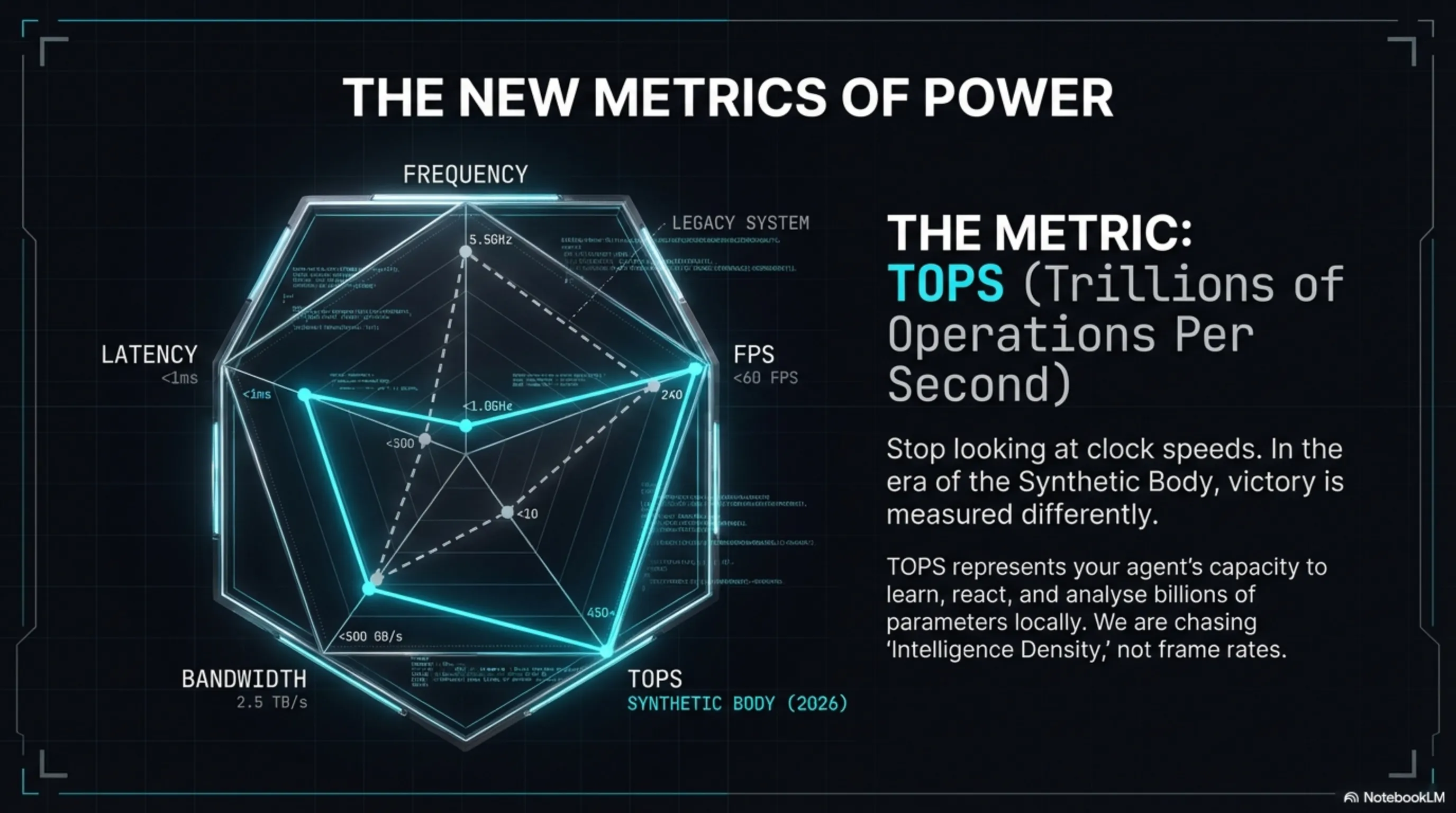
In this new paradigm, the hardware must possess the ability to "Understand the Goal" and "Design the Execution Path." This is where the importance of Neural Processing Units (NPU) and TOPS (Trillions of Operations Per Second) becomes undeniable. 2026 hardware must analyze billions of parameters locally, without relying on external servers, to allow the agent to make decisions on your behalf. We are no longer chasing higher clock frequencies; we are chasing "Intelligence Density" at the silicon level.
🌐 STRATEGIC RADAR (GOAL-ORIENTATION):
Smart hardware in the new era is not a peripheral; it is a "Living Infrastructure." Being goal-oriented means your device knows when to encrypt data for your safety and when to release resources for high-priority management tasks. This is the difference between a traditional PC and a synthetic body.
6. Survival Strategy in the Age of Autonomous Agents: Building Your Arsenal
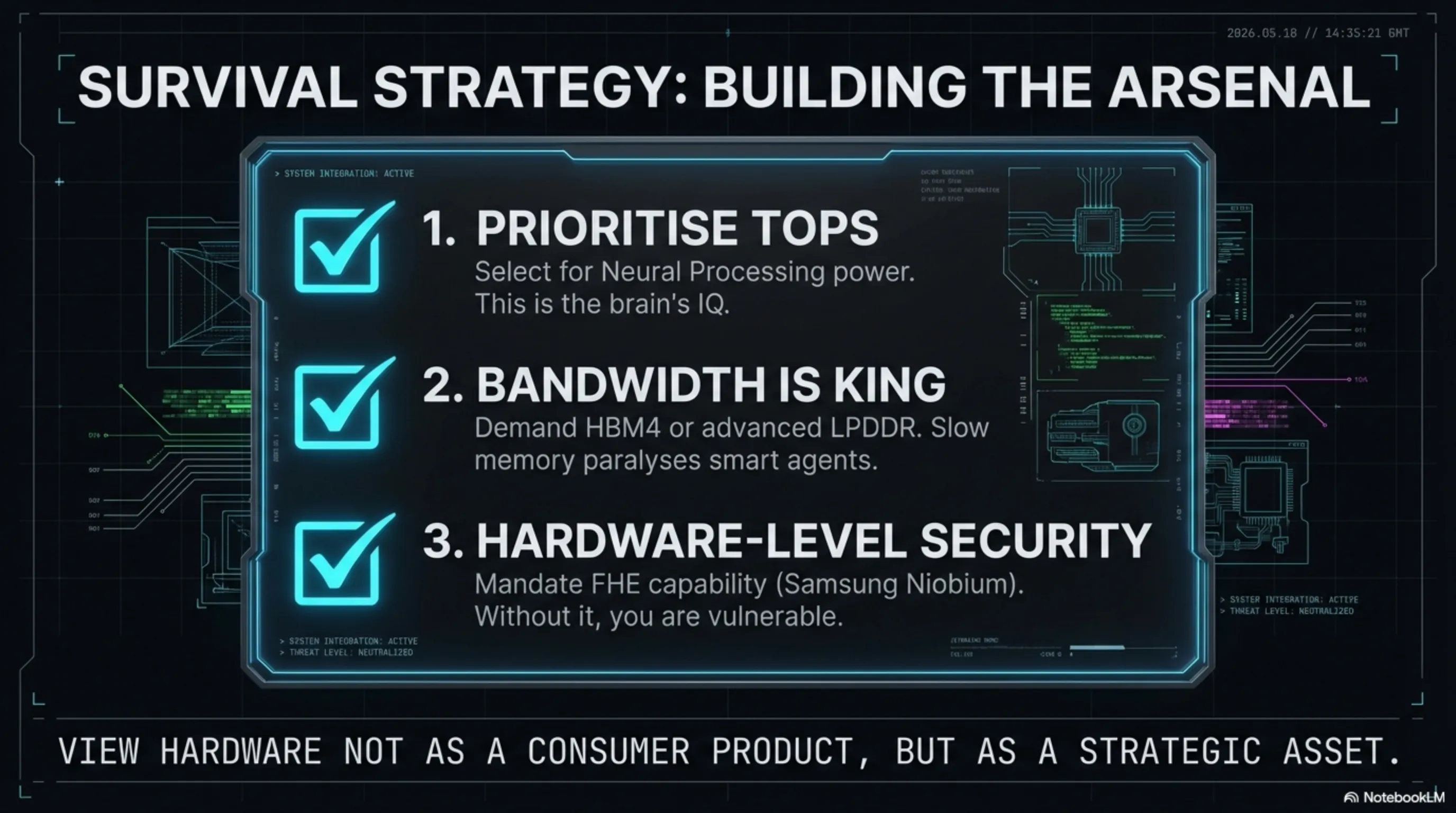
As we conclude this night mission, the ultimate question remains: In an order where agents occupy the hardware and operating systems are dying, what must we do? The answer lies in changing how we view "Benchmarks." In 2026, traditional gaming FPS is no longer the sole metric of a system’s value. Victory in this era is built on three strategic pillars:
- Prioritize TOPS over Frequency: Always choose systems with higher Neural Processing power. This number represents your agent's capacity to learn and react.
- Memory Bandwidth is King: Look for hardware utilizing HBM4 or advanced LPDDR standards. Slow memory will paralyze even the smartest agents.
- Hardware-Level Security: Chips lacking protocols like FHE (Samsung’s Niobium Project) will soon be phased out of sensitive professional networks.
At Tekin Garage, we believe the future belongs to those who view their hardware not as a consumer product, but as a "Strategic Asset." Your agents will only be as intelligent as the silicon beneath them allows them to be.
🌒 THE TEKIN NIGHT VERDICT
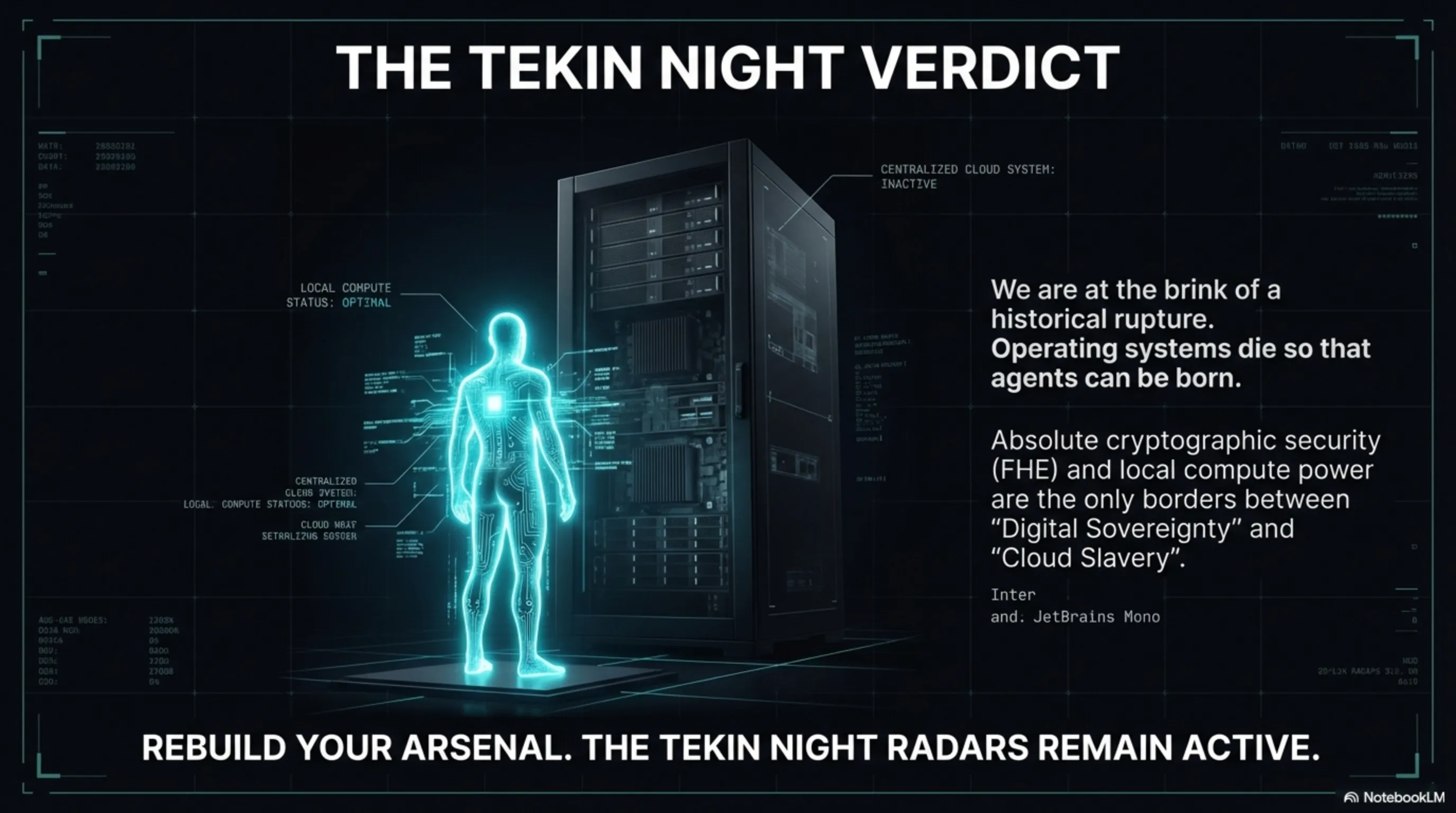
Commander Majid, we close the dossier on February 25, 2026, with a definitive conclusion: We are at the brink of the greatest historical rupture in computing. Silicon is no longer inert; with the arrival of Samsung’s HBM4 and NVIDIA’s Rubin architecture, we are building the physical bodies for entities that will soon manage all our digital bureaucracy. Operating systems die so that agents can be born. In this new world, absolute cryptographic security (FHE) and local compute power are the only borders between "Digital Sovereignty" and "Cloud Slavery." Rebuild your arsenal based on TOPS and Bandwidth. The Tekin Night radars remain active until the next dawn. Mission Accomplished.
⚖️ نتیجهگیری معمار سیستم (Tekin Verdict)
بررسیهای عمیق دپارتمان تحقیقات ارتش تکین نشان میدهد که موضوع Tekin Night Feb 25: Dissecting Samsung’s Synthetic Brains and the Manifesto of the Dead OS 🌒🛡️ صرفاً یک اتفاق گذرا نیست، بلکه تکه پازلی از یک تغییر معماری بزرگتر در صنعت تکنولوژی و سرگرمی است. ما در تکینگیم همواره این تحولات را زیر نظر داریم تا شما را در خط مقدم اخبار تحلیلی و بدون فیلتر نگه داریم.