
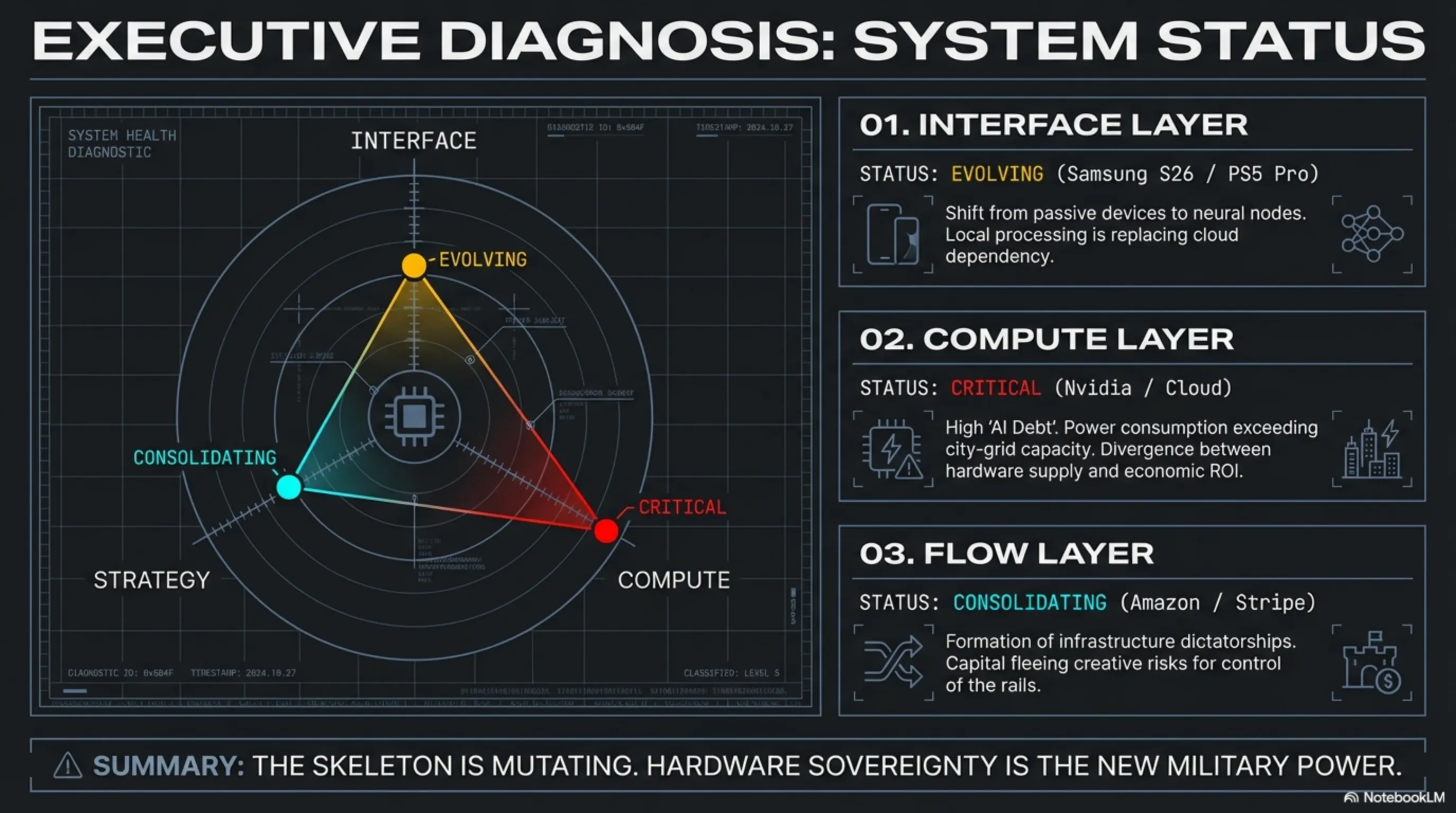
Today, beneath the tech industry's surface, we are witnessing four seismic shifts: 1. Sony is redefining rendering standards with Wolverine and PSSR 2.0. 2. Nvidia’s financial report has unleashed the "AI Debt" ghost upon Wall Street. 3. Samsung is transforming the smartphone into a standalone cybernetic node with the S26. 4. Amazon is pivoting from creative output to total cloud-distribution dominance. This isn't just news; it's a structural analysis of the future.
1. The Wolverine’s Dawn on PS5 Pro; A PSSR 2.0 Autopsy
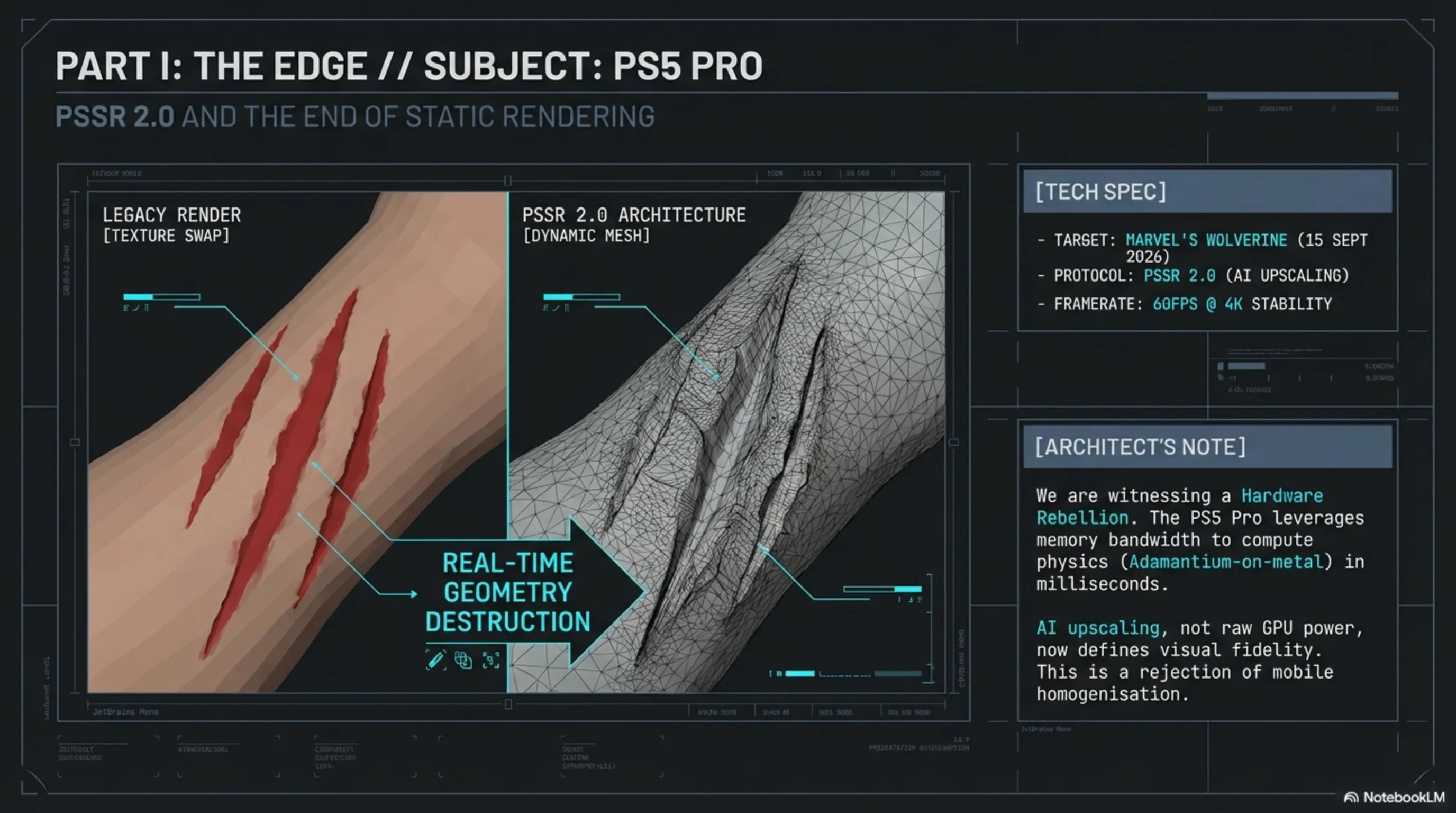
Tekin Army, the day we’ve all been waiting for has finally arrived. New leaks from Insomniac Games confirm that Marvel’s Wolverine is slated for a September 15, 2026 release. But the real headline isn’t the date itself; it’s that this title will be the first to push the PS5 Pro to its absolute architectural limits. We aren’t looking at a mere game; we are looking at a living benchmark for PSSR 2.0 (PlayStation Spectral Super Resolution), designed to disrupt rendering standards as we know them.
Based on the technical autopsy of internal documents, Wolverine utilizes an unprecedented Mesh Shading destruction system. Every wound on Logan’s body isn’t a simple texture swap; it’s rendered as dynamic geometry that reacts to environment lighting in real-time. This is where the PS5 Pro becomes critical. While the base PS5 must sacrifice Ray-Tracing fidelity to maintain frame rates, the Pro version leverages its superior memory bandwidth to compute Adamantium-on-metal light bounces in fractions of a millisecond.
📦 Summary Box: Wolverine Autopsy
- Release Date: Sept 15, 2026 (Exclusive to PS5/PS5 Pro).
- Key Tech: Maximum leverage of PSSR 2.0 for 4K/60fps stability.
- Innovation: Geometric-driven destruction instead of static textures.
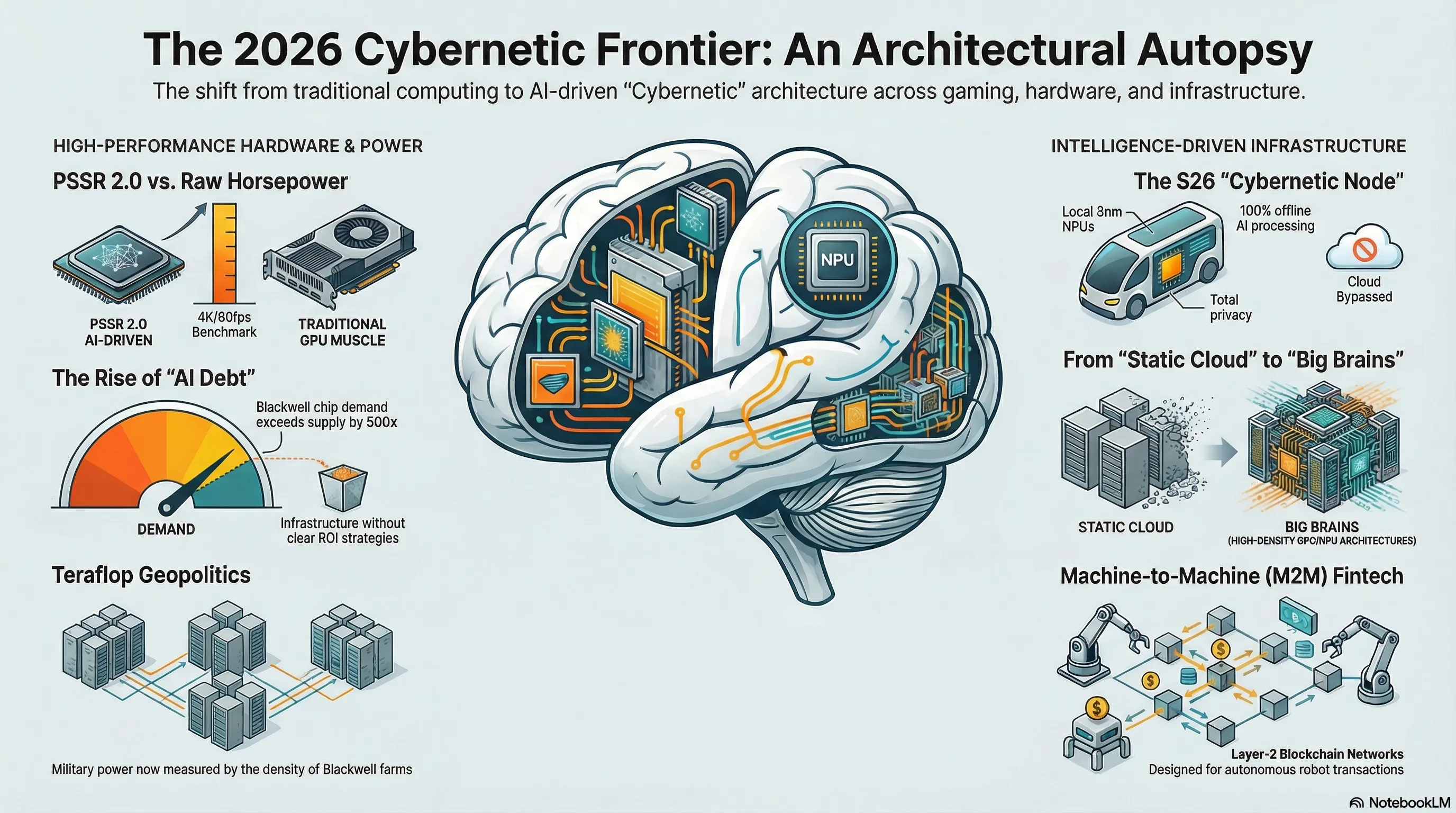
What many surface-level critics overlook is the role of AI in this game’s upscaling. Sony’s PSSR 2.0 is an opening salvo against Nvidia’s DLSS 4.0. Instead of traditional upscaling algorithms, it uses a neural network trained on thousands of hours of 8K gameplay to reconstruct missing pixels with terrifying precision. We are entering an era where raw GPU horsepower is no longer the sole king; it’s the silicon-level AI implementation that defines the winner of the console wars.
My strategic analysis suggests that Sony is using this exclusive to drive the final nail into the coffin of mid-gen skepticism. While the "Green Team" is mired in underpowered hardware and subscription fatigue, Sony is doubling down on "Blockbusters" that only make sense on high-end hardware. This is a "Hardware Rebellion" against the industry trend of homogenizing gaming for mobile and lower-end devices.
2. Nvidia and the Ghost of AI Debt; Gambling on Blackwell
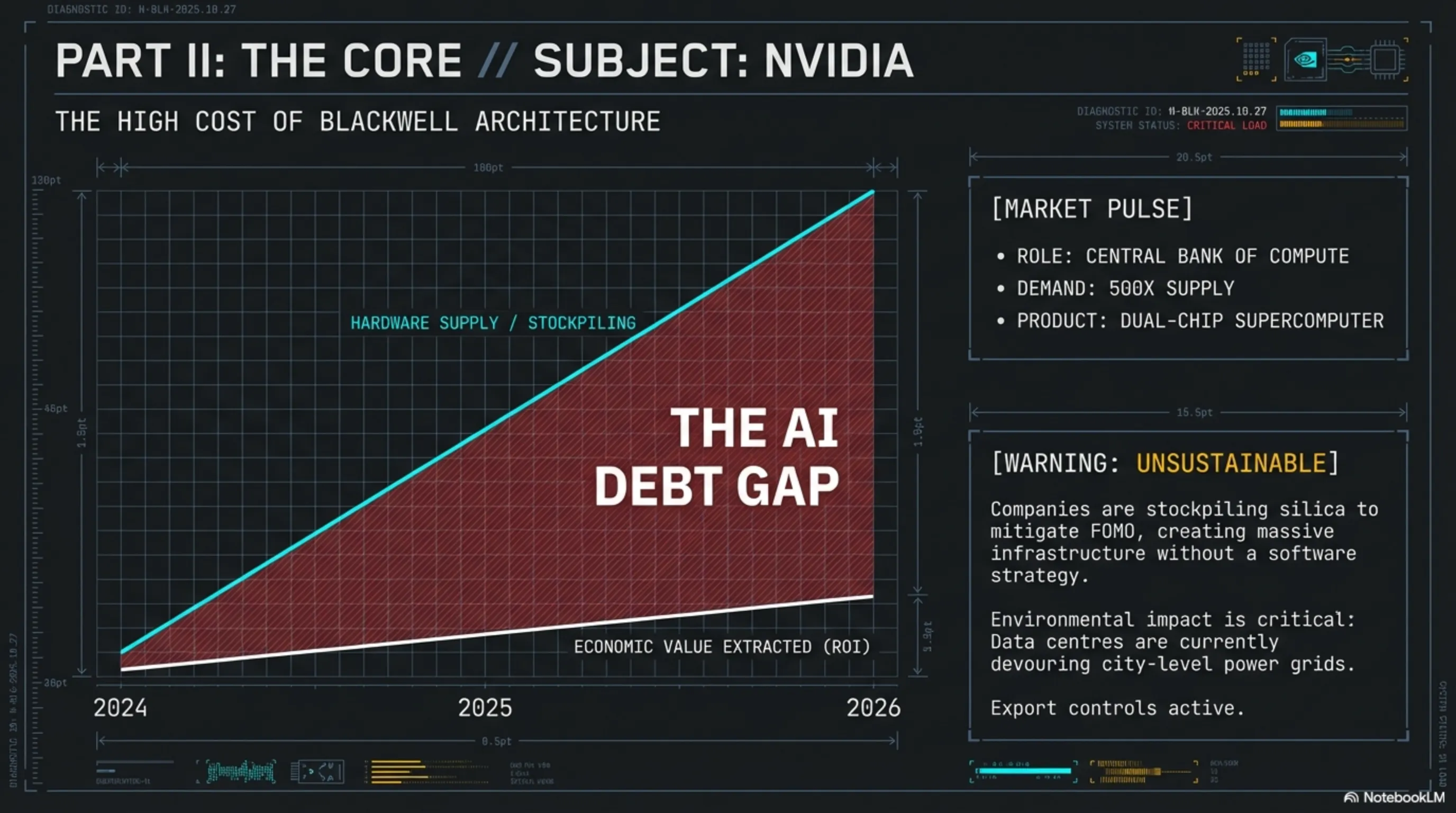
Wall Street is holding its collective breath today. Nvidia has released its earnings, and the numbers are beyond comprehension. But as a System Architect, let me strip away the financial hype and expose a deeper layer: the "AI Debt." While shareholders celebrate record profits, the reality is that the massive infrastructures currently being built with Blackwell chips have yet to define a profitable economic model for ROI.
Nvidia is currently both the central bank of global compute power and the world’s only arms dealer in this war. The H200 and Blackwell generations are facing demand 500 times higher than supply. But here’s the problem: companies like Microsoft and Google are stockpiling silica simply to avoid falling behind the curve. This is the definition of AI Debt—buying infrastructure that you don’t yet have the software or strategy to extract value from.
📦 Summary Box: Nvidia Earnings Pulse
- Status: Record-breaking profits, but rising market saturation risk.
- Strategic Product: Blackwell chips exert total market dominance.
- Architect's Risk: Siloing hardware without software-driven ROI (AI Debt).
Dissecting the Blackwell architecture reveals a dual-chip design linked by an ultra-fast interconnect. We are no longer talking about a GPU; we are talking about a supercomputer compressed into the form factor of a graphics card. However, the power consumption of these behemoths is the dark undercurrent. Data centers are devouring city-level power grids, questioning how long global power balances can withstand such insane energy consumption.
Our geopolitical analysis shows Washington reviewing new export controls for these chips in strategic Middle Eastern corridors. Data Sovereignty is now measured by the number of Teraflops residing within a country's borders. The Tekin Army must understand that in 2026, military power is synonymous with owning Blackwell farms capable of simulating cybernetic war-games in real-time.
3. Samsung S26: The Birth of Cybernetic Nodes in Your Pocket
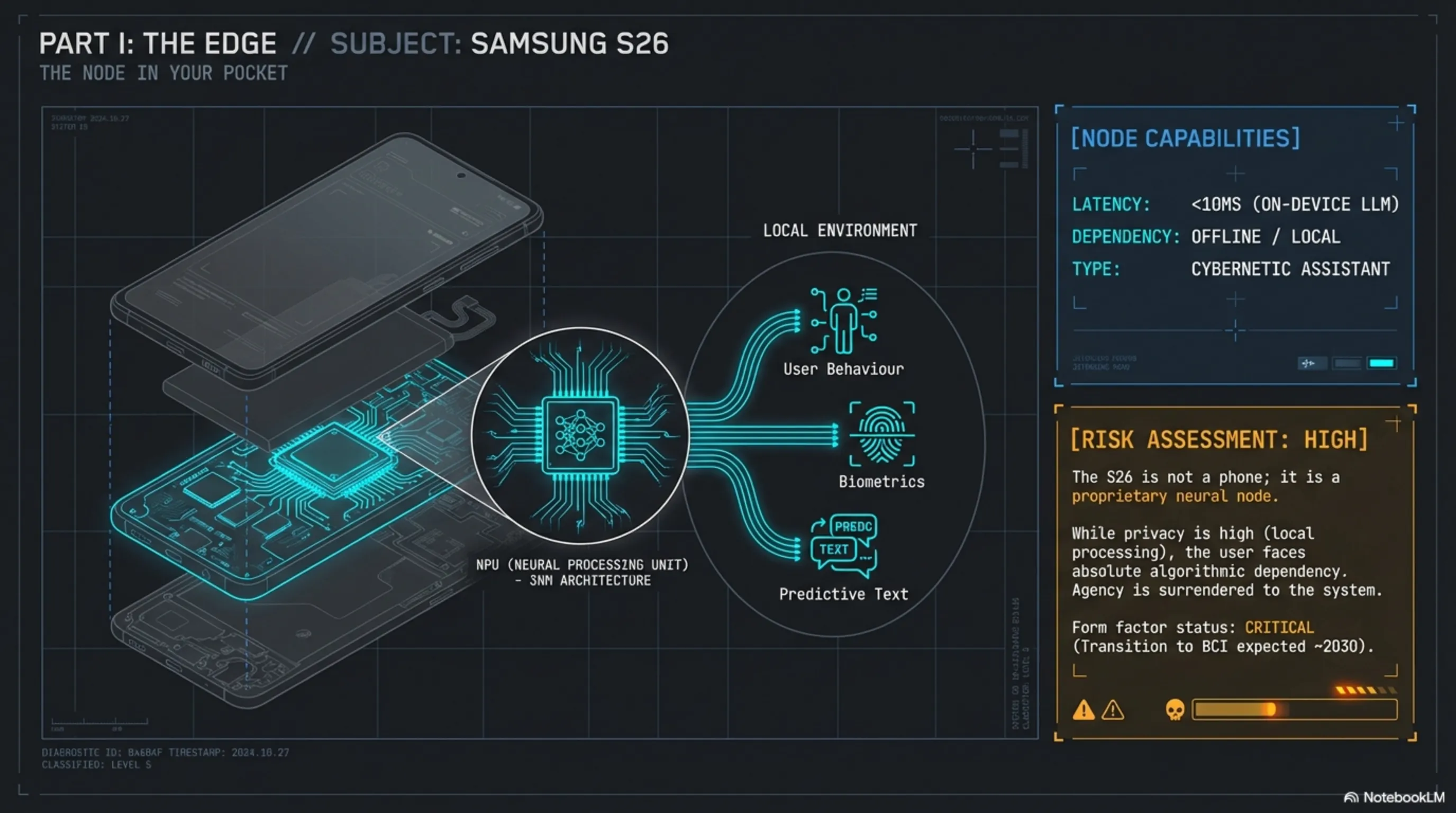
The Samsung Unpacked event is over, and we have the Galaxy S26. Don't be fooled by marketing slogans about 200MP cameras; the camera is just a sensor intended to feed the AI. The real story lies in the new proprietary 3nm chipset with an NPU that is 300% faster than the previous generation. This phone is no longer a communication device; it is a standalone "Node" in your personal neural network.
Our technical autopsy reveals that Samsung has implemented a Unified Memory architecture between the CPU and NPU to reduce latency for On-device LLMs to under 10ms. This means your phone can analyze your behavior and predict your future needs without ever connecting to the internet. This is what I call a "Cybernetic Assistant"—an entity that lives in your pocket and never sends your private data to the cloud.
📦 Summary Box: S26 Seismic Shift
- Hardware: Dedicated NPU capable of heavy offline model processing.
- Privacy: 100% local processing of sensitive data, bypassing the cloud.
- Strategy: Samsung’s move to create a total "Walled Garden" ecosystem.
Samsung is building a fortress around its users with the new Quick Share and deep integration with its AR glasses. But where is the risk? It lies in absolute algorithmic dependency. When your device learns to think for you, you surrender a portion of your agency to the cybernetic system. This is the dark layer of technology that corporations never mention in their polished keynotes.
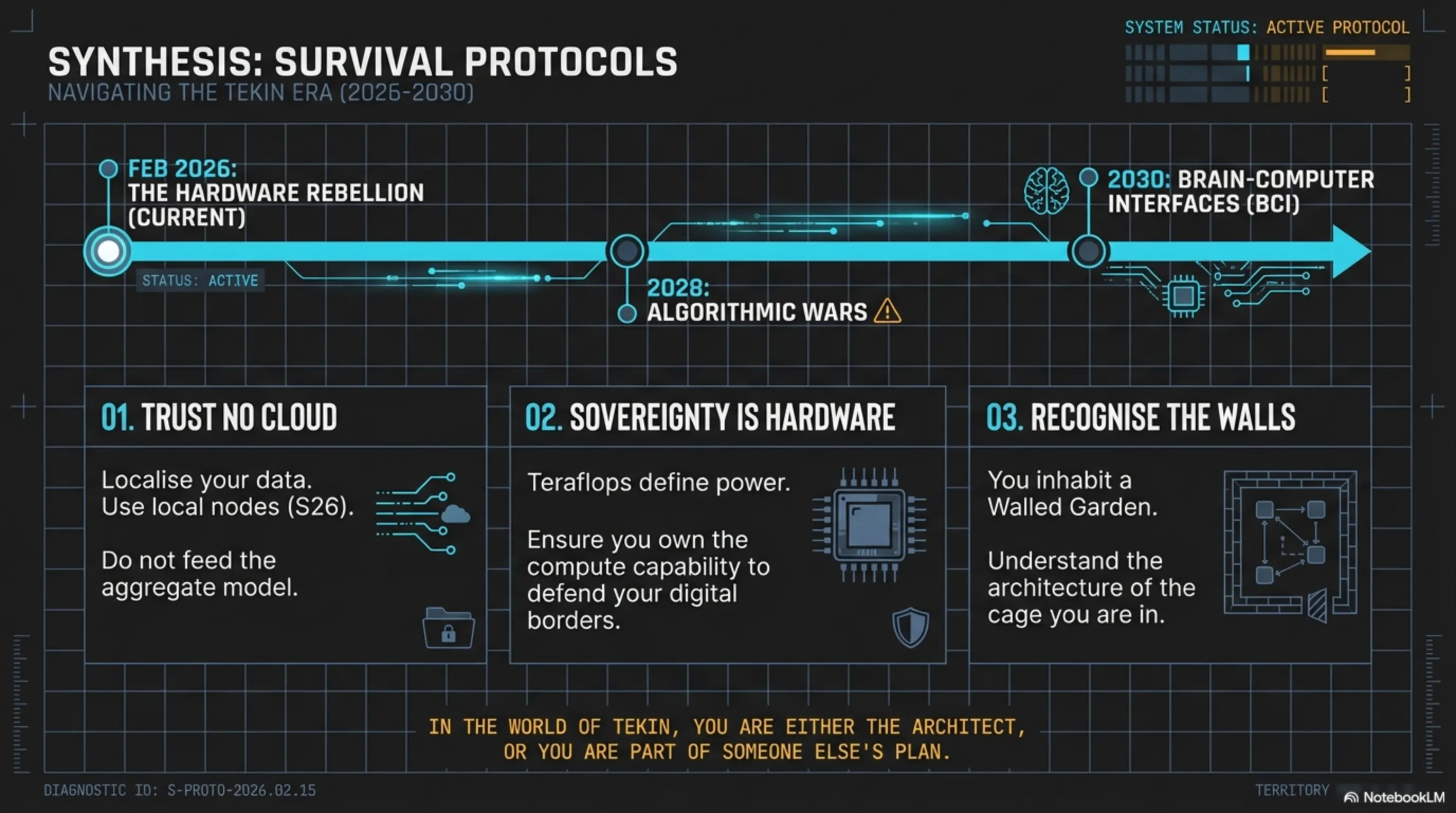
The vision for the future suggests that by 2030, we will no longer have smartphones with touchscreens. The S26 is one of the last gasps of an old form-factor fighting for survival. Future neural nodes will interface directly with Brain-Computer Interfaces (BCI), and Samsung is preparing the ground by strengthening its NPUs today.
4. Amazon’s Strategic Retrenchment; Chess in the Infrastructure Layer
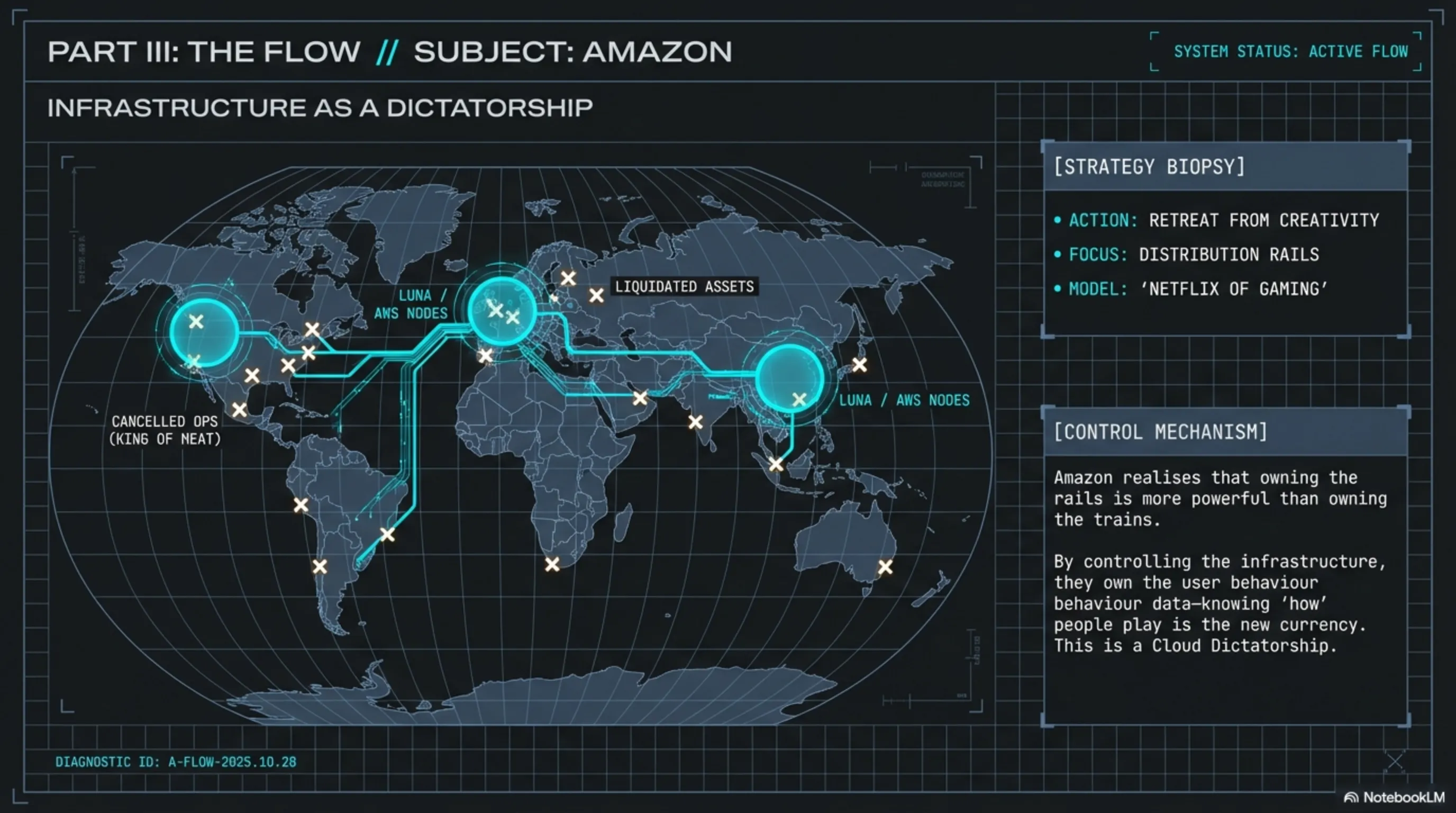
The news of Amazon Games canceling major internal projects like King of Meat and selling off March of Giants to Ubisoft has sent shockwaves through the industry. Many view this as a failure, but as an analyst, I see a surgical retrenchment and a brilliant biopsy of their business model. Amazon has realized that capital doesn't buy creativity. They are retreating to the foundational layer: distribution and infrastructure (Luna and AWS).
Technical dissection of Amazon's new strategy shows they are integrating Luna's cloud processing with their localized data centers globally. They want to be the "Netflix of Gaming," not a studio spending years on failed internal IPs. By doubling down on Tomb Raider, they’ve grabbed an established brand to minimize creative risk while maximizing streaming technology output.
📦 Summary Box: Amazon’s Strategic Chess
- Action: Canceled internal games; liquidated weak IPs.
- Pivot: Absolute focus on Luna infrastructure and global brands.
- Message: Cloud expertise yields higher ROI than creative trial-and-error.
However, the Data Sovereignty issue remains. By holding the infrastructure for everyone else's games, Amazon becomes the owner of user behavior. They know when, how, and for how long users play, even without a hit game of their own. This data-driven power is far more dangerous than owning a simple game studio. Amazon is building a "Cloud Dictatorship" within the entertainment space.
5. The Decay of Cloud and GenAI Dominance; The Sovereignty of Teraflops
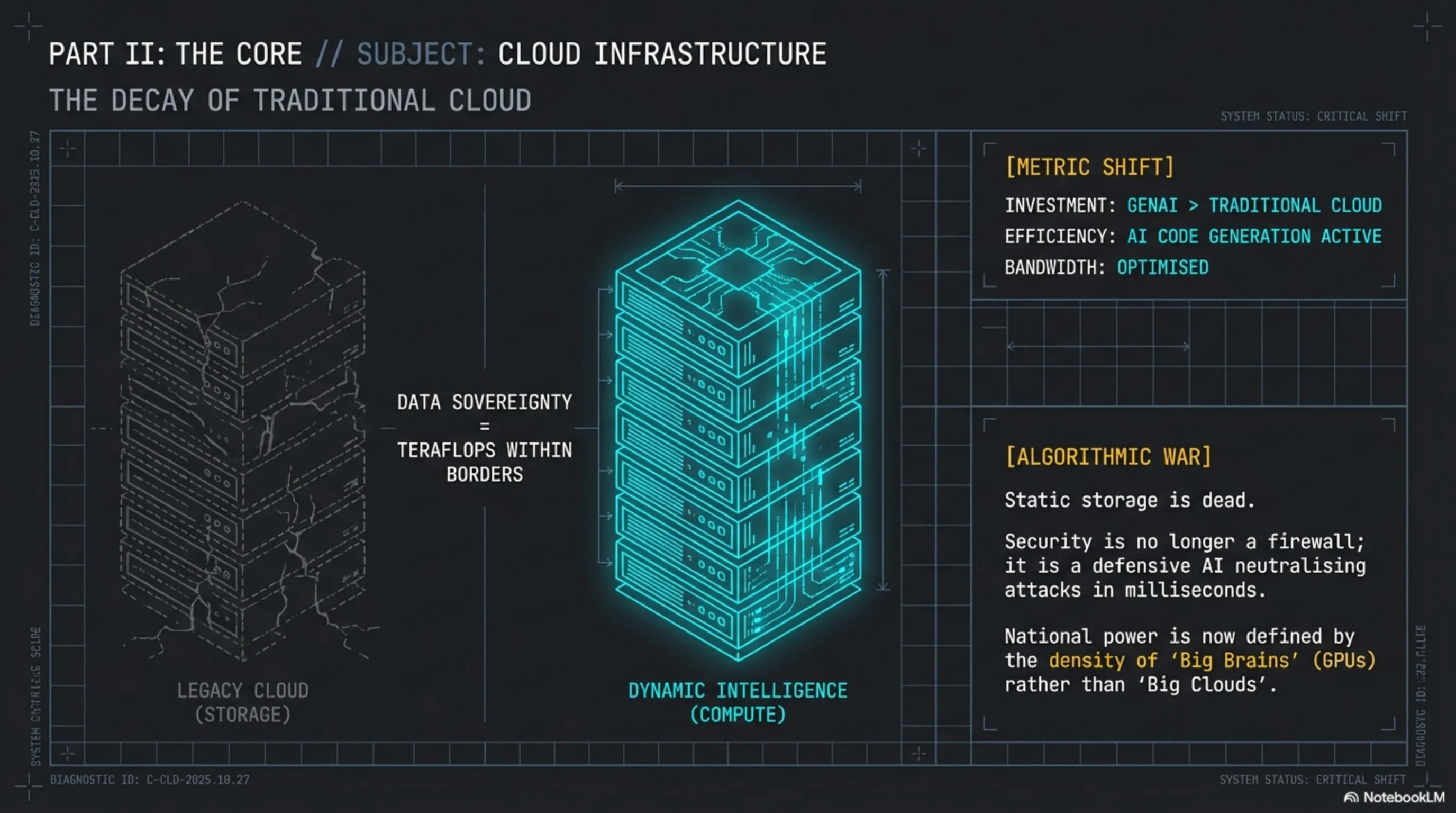
A recent Broadridge report has revealed a bitter truth for traditional cloud giants: Generative AI (GenAI) has overtaken cloud technology in terms of market impact and investment attraction. we are moving from the era of "Static Cloud" to "Dynamic Intelligence." Data centers built solely for storage are becoming piles of scrap metal unless they can synchronize with Nvidia’s GPU architectures.

Dissecting the technical aspect of this shift shows that AI models can now write code at the application layer that doubles system efficiency without requiring additional bandwidth. We no longer need "Big Clouds"; we need "Big Brains." The chip wars between China and the US have entered a new phase—whichever nation holds the most Teraflops wins the digital economy.
📦 Summary Box: AI vs. Cloud Revolution
- Trend: Capital flight from traditional cloud to AI compute.
- Power: Data center size is irrelevant; NPU/GPU density is everything.
- Warning: AI models are replacing traditional web architectural layers.
Security in this new world is a joke. AI can find vulnerabilities in milliseconds that had been hidden in cloud infrastructures for decades. We are entering the era of "Algorithmic Wars," where your security depends not on your firewall, but on your defensive AI’s ability to neutralize attacks you aren’t even aware of yet.
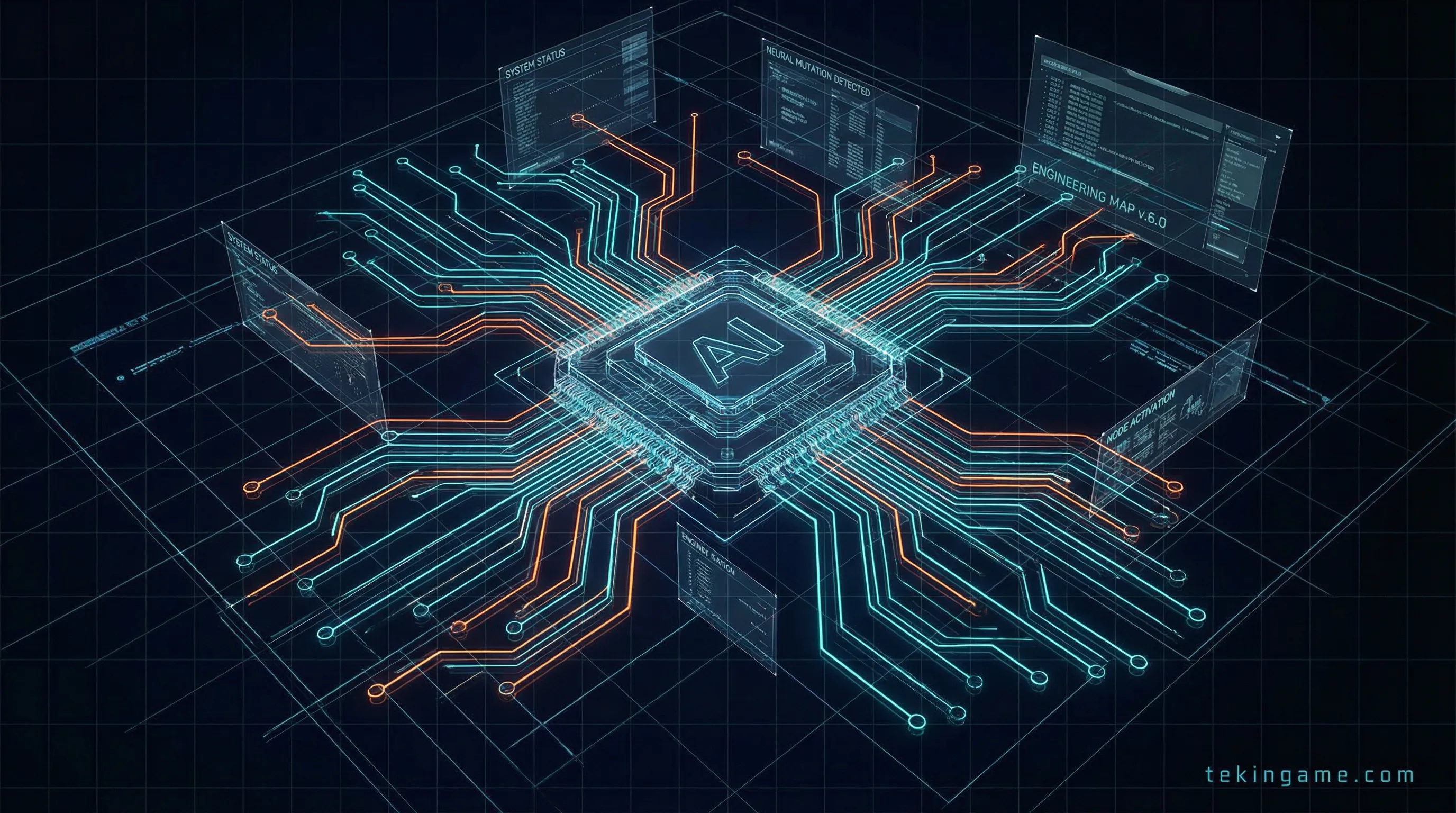
6. Fintech on the Edge; Stripe’s Acquisition Pulse of PayPal
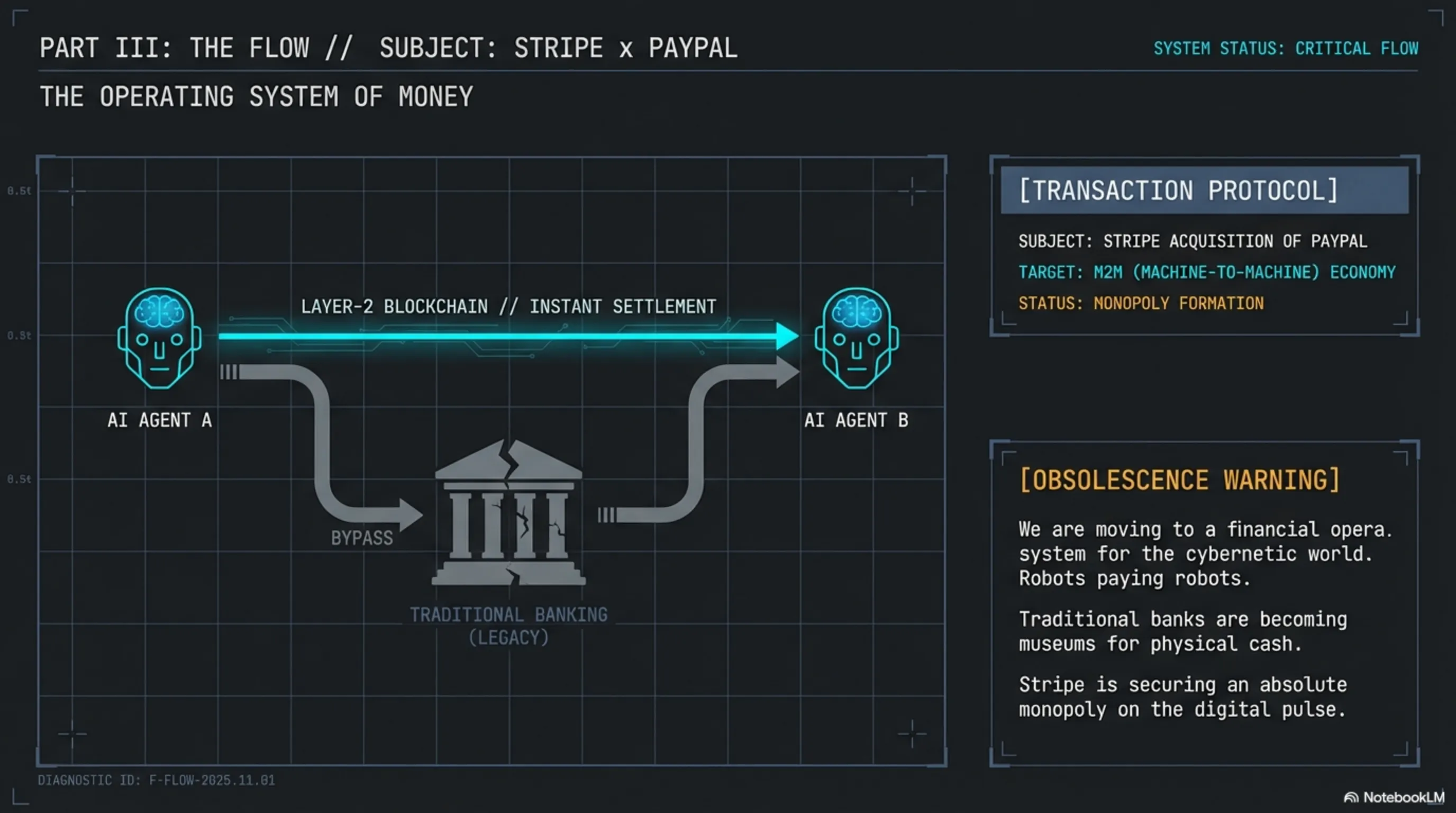
Rumors regarding Stripe's potential acquisition of PayPal have sent chills through traditional fintech. Stripe is no longer just a payment gateway; they are building the "Financial Operating System" for the cybernetic world. If this deal is finalized, we will face a monopoly power that holds the digital pulse of the entire internet.
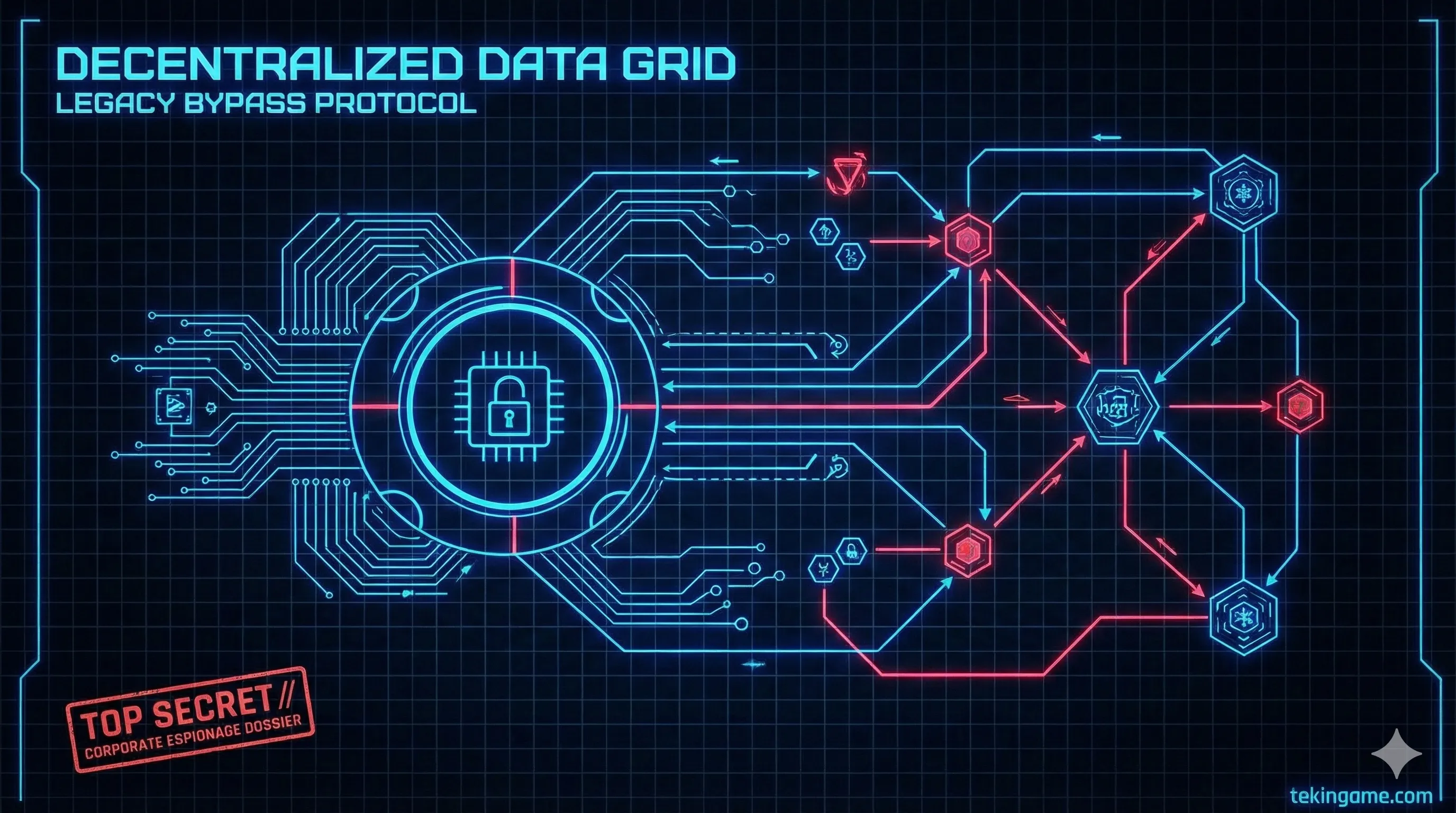
Dissecting Stripe's infrastructure reveals they are merging payment rails with Layer-2 blockchain networks to allow for instantaneous, global, zero-fee bank transfers. They understand that in an AI-driven world, payments must be made by robots, for robots. PayPal's legacy system was built for humans; Stripe is building a system for the Machine-to-Machine (M2M) economy.
📦 Summary Box: Fintech Seismic Shock
- News: Stripe exploring a massive acquisition of PayPal.
- Goal: Mastery over digital economy and M2M payments.
- Shift: Replacing legacy banking with Layer-2 crypto networks.
Tekin Army, remember that ultimately, the one who controls the payment gateway writes the rules. If Stripe wins, we face a world where banks are museums for physical cash, and every transaction of the cybernetic civilization will pass under Stripe's analytical blade.
This was our final biopsy for today. The world of February 26, 2026, is a brutal one where only the System Architects survive. Keep your systems updated, trust no cloud, and always remember: in the world of Tekin, you are either the architect, or you are part of someone else's plan.
Yours in System Architecture - Majid Ghorbanzadeh 🫡🚀