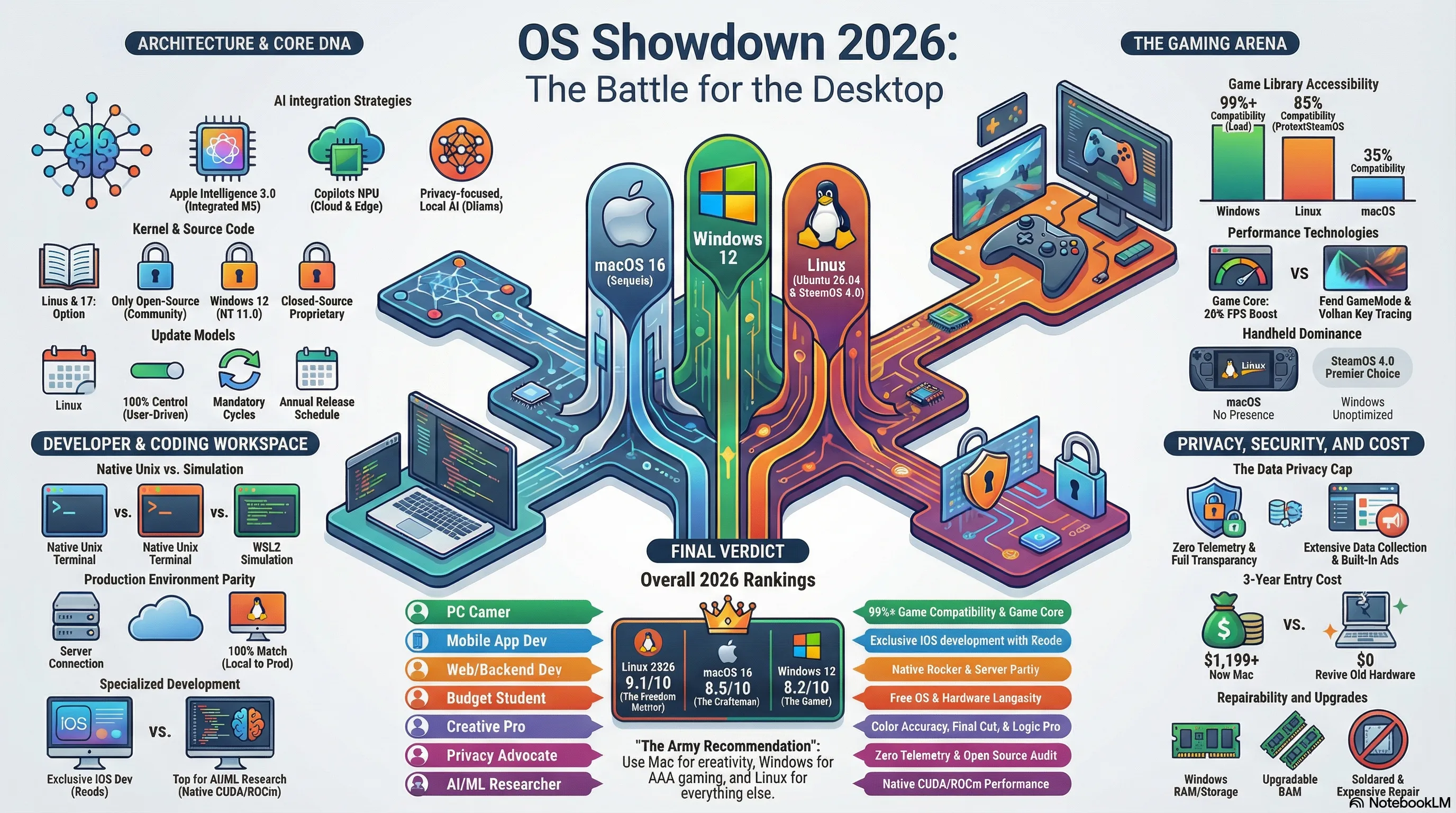
The 2026 operating system landscape has fundamentally shifted, marking the most fiercely competitive era in the history of desktop computing. This comprehensive, data-driven analysis evaluates Apple's macOS 16 Sequoia, Microsoft's Windows 12, and the modern Linux ecosystem (spearheaded by Ubuntu 26.04 LTS and SteamOS 4.0) across five critical dimensions: architecture, gaming, software development, privacy, and total cost of ownership over a 3-year lifecycle. Architecturally, macOS 16 leverages the sheer computational power of the M5 silicon an
Mac vs Windows vs Linux in 2026: The Final Operating System War — Who Wins for Gaming, Coding, Privacy & Daily Use?
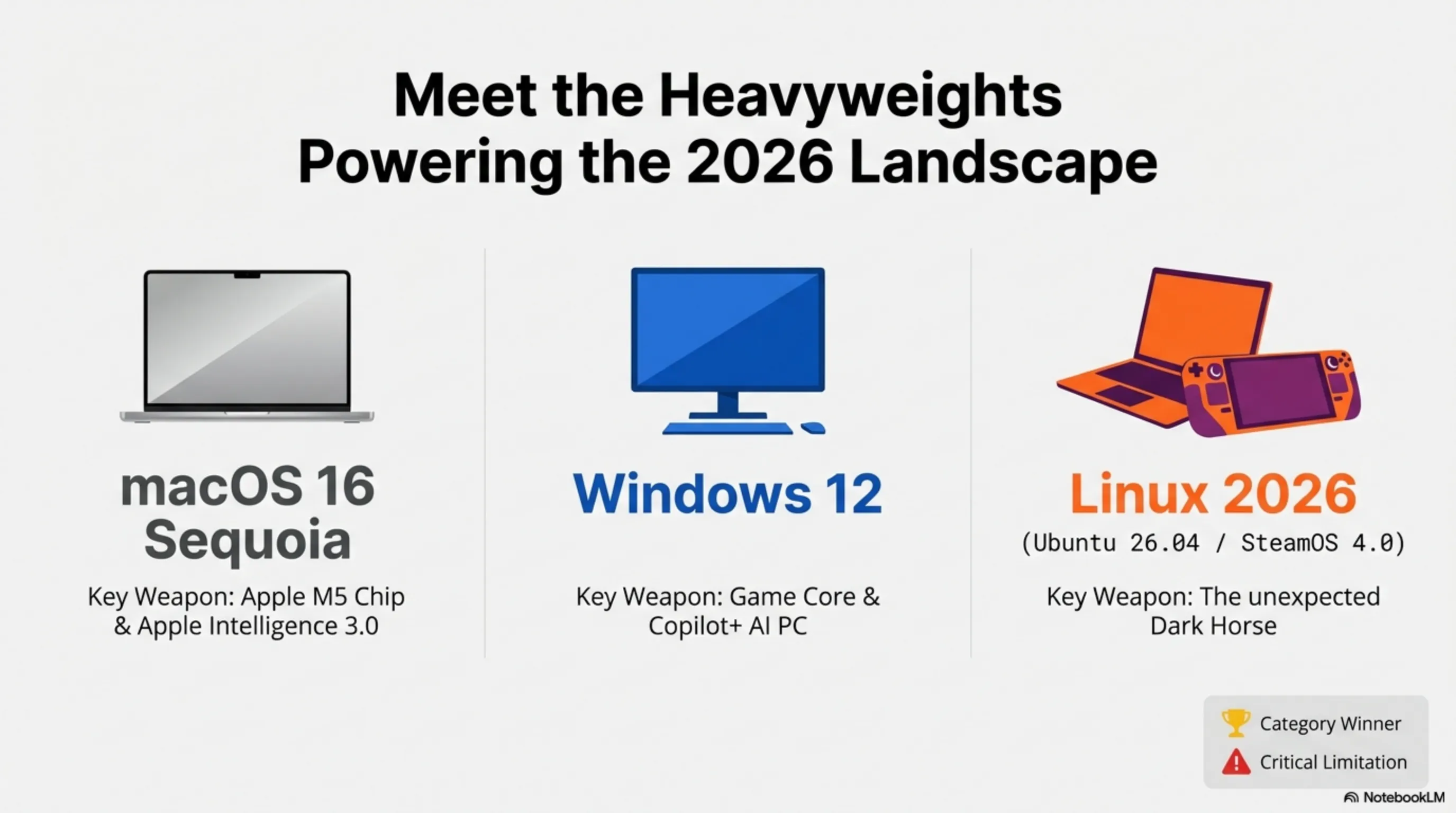
In March 2026, the digital landscape has reached a pivotal junction where choosing an operating system is no longer just a technical preference, but a statement on how you interact with AI, privacy, and productivity. We are living in the era of "Distributed Intelligence" and "Local-First Computing," and the three pillars of power — Apple with macOS 16 Sequoia, Microsoft with Windows 12, and the Linux community with Ubuntu 26.04 LTS and SteamOS 4.0 — are each claiming the throne. I am Majid Ghorbaninazhad, system architect at TekinGame, and in this deep-dive analysis, I will strip away the marketing jargon to reveal the raw truth behind these digital giants. If you are looking for the definitive answer to the "Best OS of 2026," this guide is the last resource you will ever need.
🏗️ Chapter 1: Architectural DNA — The Pillars of Power in 2026
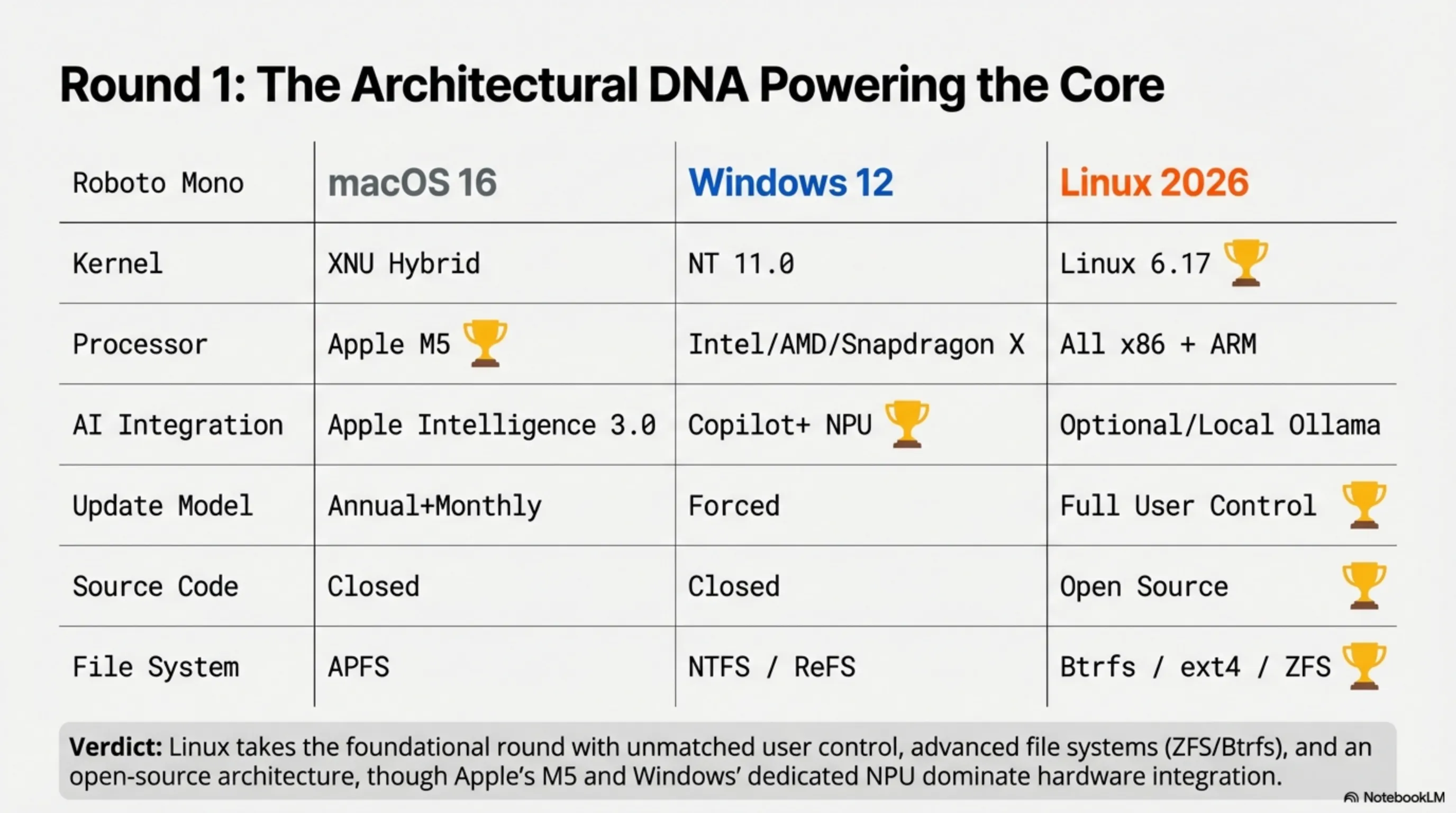
Infrastructure differences in 2026 have become more pronounced than ever. Apple relies on vertical integration, where the M5 silicon and macOS 16 are so deeply intertwined that no competitor can match their energy efficiency and data transfer speeds between memory and processing cores (Unified Memory Architecture). Conversely, Microsoft has attempted to solve its historical bloat with Windows 12's "Modular Core" architecture, separating the OS kernel from the UI for a snappier experience. But Linux? Linux in 2026, thanks to Kernel 6.17 and unparalleled ARM support, has become the lightest and fastest platform, delivering stunning performance even on decade-old hardware.
| Feature | 🍎 macOS 16 | 🪟 Windows 12 | 🐧 Linux 2026 |
|---|---|---|---|
| Kernel | XNU (Hybrid) | NT 11.0 | Linux 6.17 🏆 |
| Primary CPU | Apple M5 🏆 | Intel/AMD/Snapdragon X | Any (x86 + ARM) |
| AI Integration | Apple Intelligence 3.0 | Copilot+ NPU 🏆 | Optional (Ollama/Local) |
| Update Model | Annual + monthly | Forced updates | User-controlled 🏆 |
| Source Code | Closed | Closed | Open Source 🏆 |
| File System | APFS | NTFS / ReFS | Btrfs / ext4 / ZFS 🏆 |
A deep dive into the architecture reveals that Apple has moved toward a "Private Cloud Compute" philosophy. Apple Intelligence 3.0 is baked into the kernel level, running entirely on the M5's Neural Engine. This means millisecond response times without ever uploading data to the cloud. On the other hand, Windows 12 utilizes Dedicated AI Processing Units (NPU) in Intel Lunar Lake and Snapdragon X Elite chips to make Copilot the central nervous system of the OS. Windows' main challenge remains its legacy compatibility layer, which ensures the kernel remains significantly heavier than its rivals. Linux, taking a different path, now uses ZFS and Btrfs as standard, allowing for instantaneous system-wide snapshots — a feature Windows users can still only dream of.
🎮 Chapter 2: Gaming — The Battleground That Redefined Everything
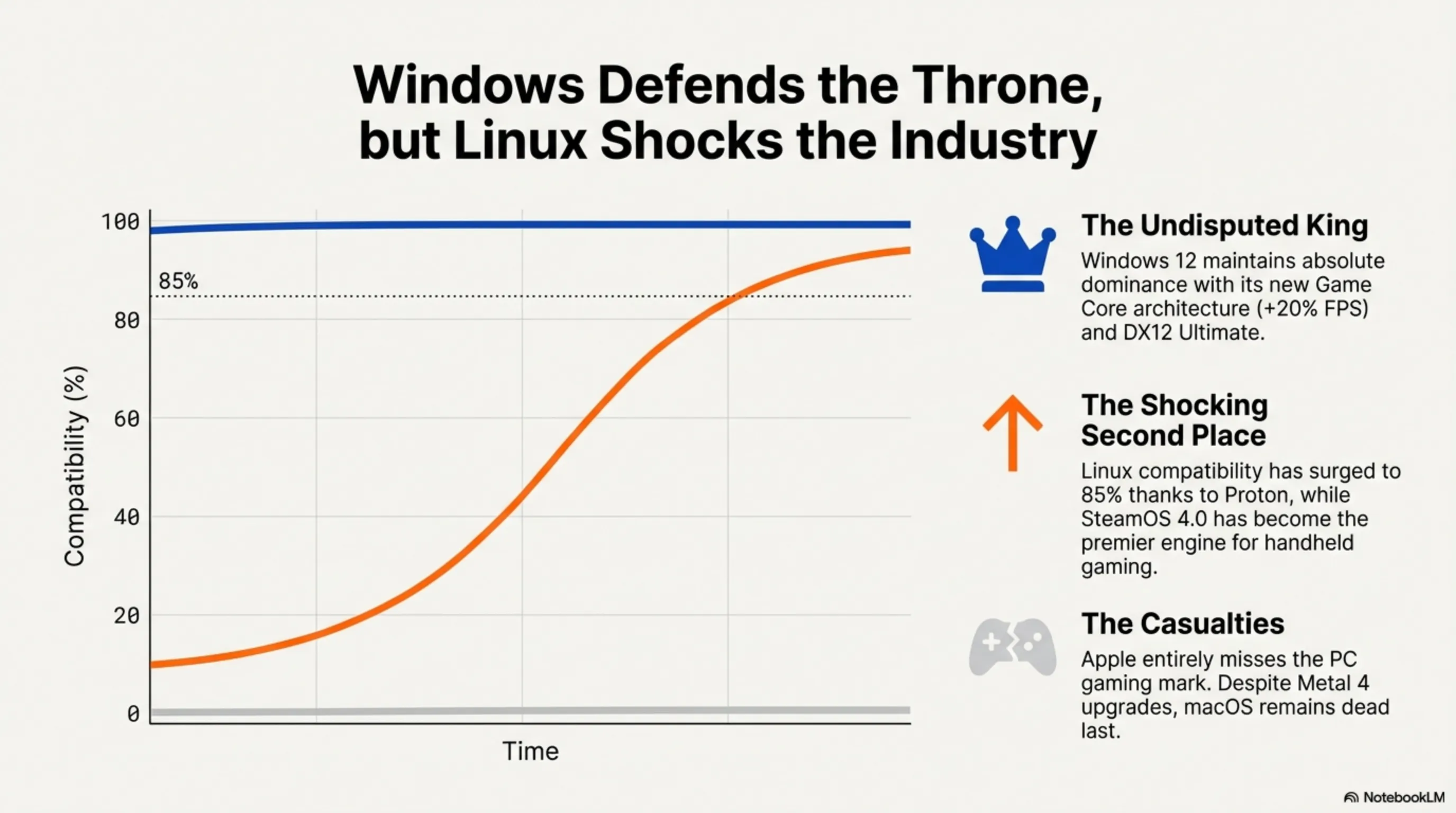
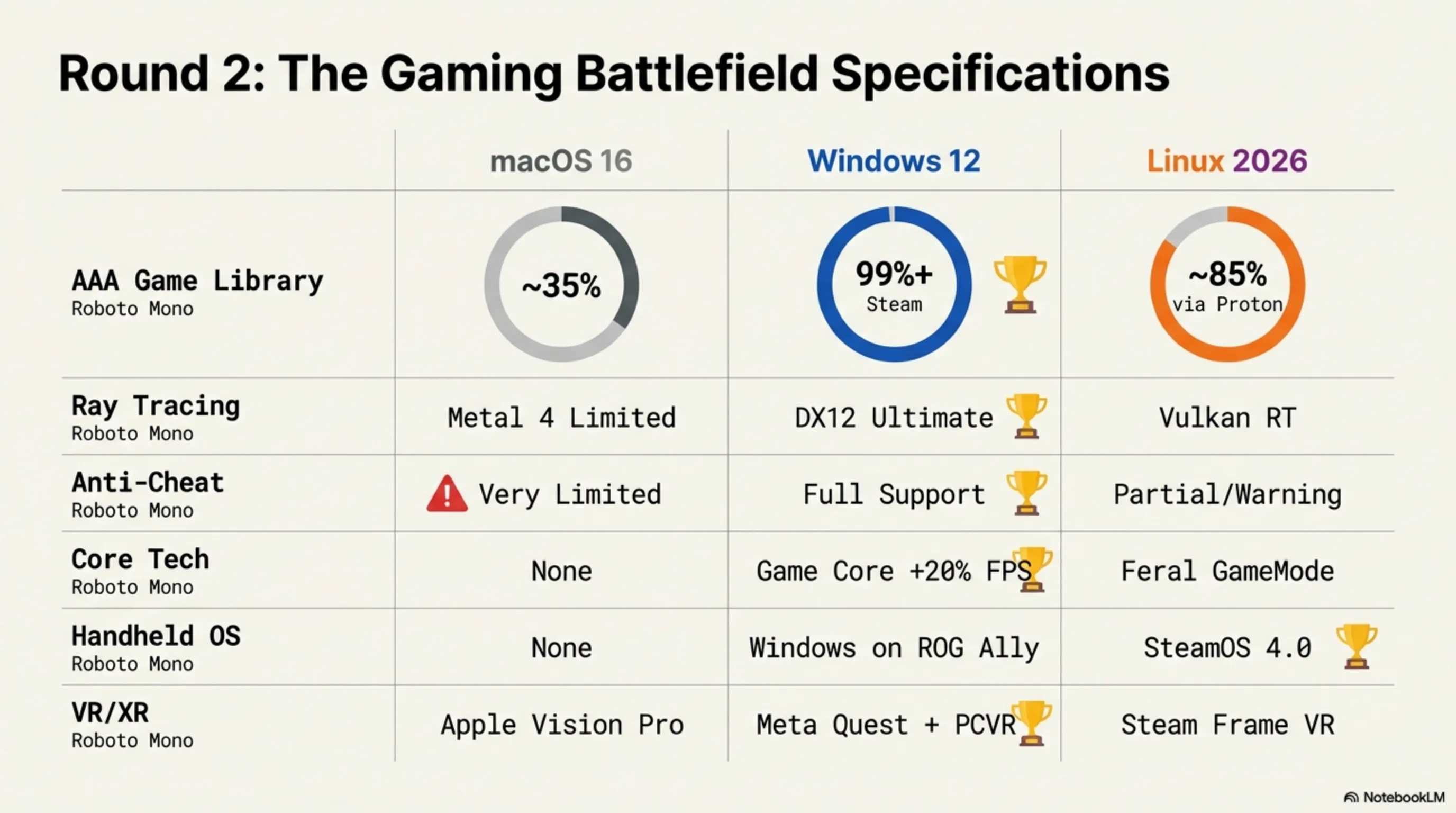
Gaming in 2026 is no longer confined to owning a Windows tower. While Windows 12 has introduced the revolutionary Game Core technology (an optimized Xbox-to-PC architecture) which boosts frame rates by up to 20% in modern titles, Linux has a secret weapon called SteamOS 4.0. Thanks to the Proton compatibility layer, 88% of the Steam library now runs flawlessly on Linux. Apple, despite launching Metal 4 and the Game Porting Toolkit 3.0, still struggles to attract AAA developers. While titles like Resident Evil and Death Stranding run perfectly on Mac, the sheer volume of games doesn't compare to Windows.
| Gaming Metric | 🍎 macOS 16 | 🪟 Windows 12 | 🐧 Linux 2026 |
|---|---|---|---|
| AAA Game Library | ~35% of Steam | 99%+ 🏆 | ~88% via Proton |
| Ray Tracing Support | Metal 4 (limited) | DX12 Ultimate 🏆 | Vulkan RT |
| Anti-Cheat Compatibility | ❌ Very limited | ✅ Full 🏆 | ⚠️ Partial |
| Game Core Technology | N/A | +20% FPS boost 🏆 | GameMode active |
| Handheld OS | ❌ None | Good (Win Handheld) | SteamOS 4.0 🏆 |
The critical factor in 2026 gaming is the rise of powerful handheld consoles. Valve's SteamOS 4.0 is now the standard for devices like the Steam Deck 3 and even mid-range gaming laptops, offering a console-like experience with superior RAM management. Windows 12 has finally added "Gaming Cloud Ready," which significantly speeds up the sync between cloud and local games. However, Linux, utilizing FSR 4.0 and real-time emulation, can run many Windows-native games with even higher quality than Windows (due to the elimination of Windows' background bloat). For professional competitive gamers (playing Valorant or Warzone), Windows 12 remains the only choice as kernel-level anti-cheat systems still conflict with Linux.
🎮 2026 Gaming Verdict
If you are a hardcore gamer wanting to play every title with the latest Ray Tracing tech, Windows 12 is your champion. If you seek an open platform that plays Steam games with better battery efficiency and faster loading, Linux (specifically SteamOS distributions) will amaze you. Apple is not yet a serious contender in this tournament.
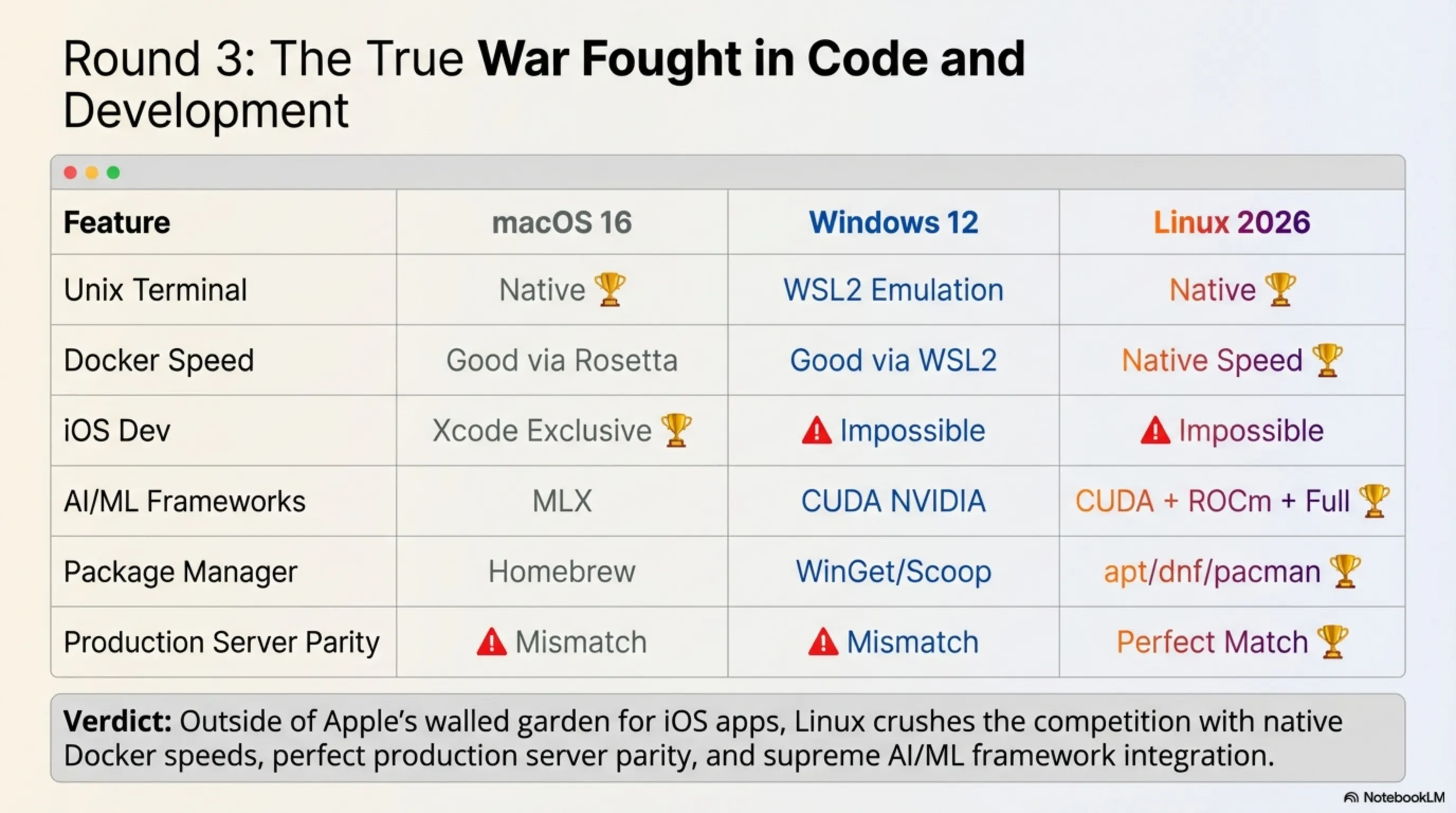
💻 Chapter 3: Development & Coding — War in the Realm of Experts
For a developer, an OS is an ecosystem of tools. In 2026, Linux remains the king of this domain. All major AI projects, databases, and distributed systems are born and run on Linux. Apple, with its M5 series MacBooks, has captured the hearts of front-end and mobile developers because for iOS app deployment, you have no choice but to own a Mac. Microsoft, however, has improved WSL3 significantly, creating an experience where you have the power of Linux within the Windows UI — though native Linux compilation remains 15-30% faster for massive projects.
| Dev Metric | 🍎 macOS 16 | 🪟 Windows 12 | 🐧 Linux 2026 |
|---|---|---|---|
| Terminal | Native Unix 🏆 | WSL3 (Advanced) | Native Unix 🏆 |
| Docker Speed | Excellent (M5) | Good (Optimized) | Native (Fastest) 🏆 |
| iOS/Mac Dev | Only way 🏆 | ❌ Not possible | ❌ Not possible |
| AI/ML Dev | MLX Framework | CUDA (NVIDIA Exclusive) | Best workflow 🏆 |
In the software development world of 2026, AI Agent-based development takes center stage. Linux's open-source nature allows agents to write highly optimized code through full access to the file system and memory. For AI researchers, Linux is still a paradise as NVIDIA and AMD drivers have reached a level of maturity where VRAM access is direct and uninhibited. Apple has introduced MLX, allowing models like Llama 4 to run far more efficiently than on similar Windows systems. If you're a full-stack developer, the MacBook M5 is your top choice for its 25-hour battery life and incredible processing power; but for Docker, microservices, and distributed servers, native Linux has no rival.
🔒 Chapter 4: Privacy & Security — A War for Data Survival
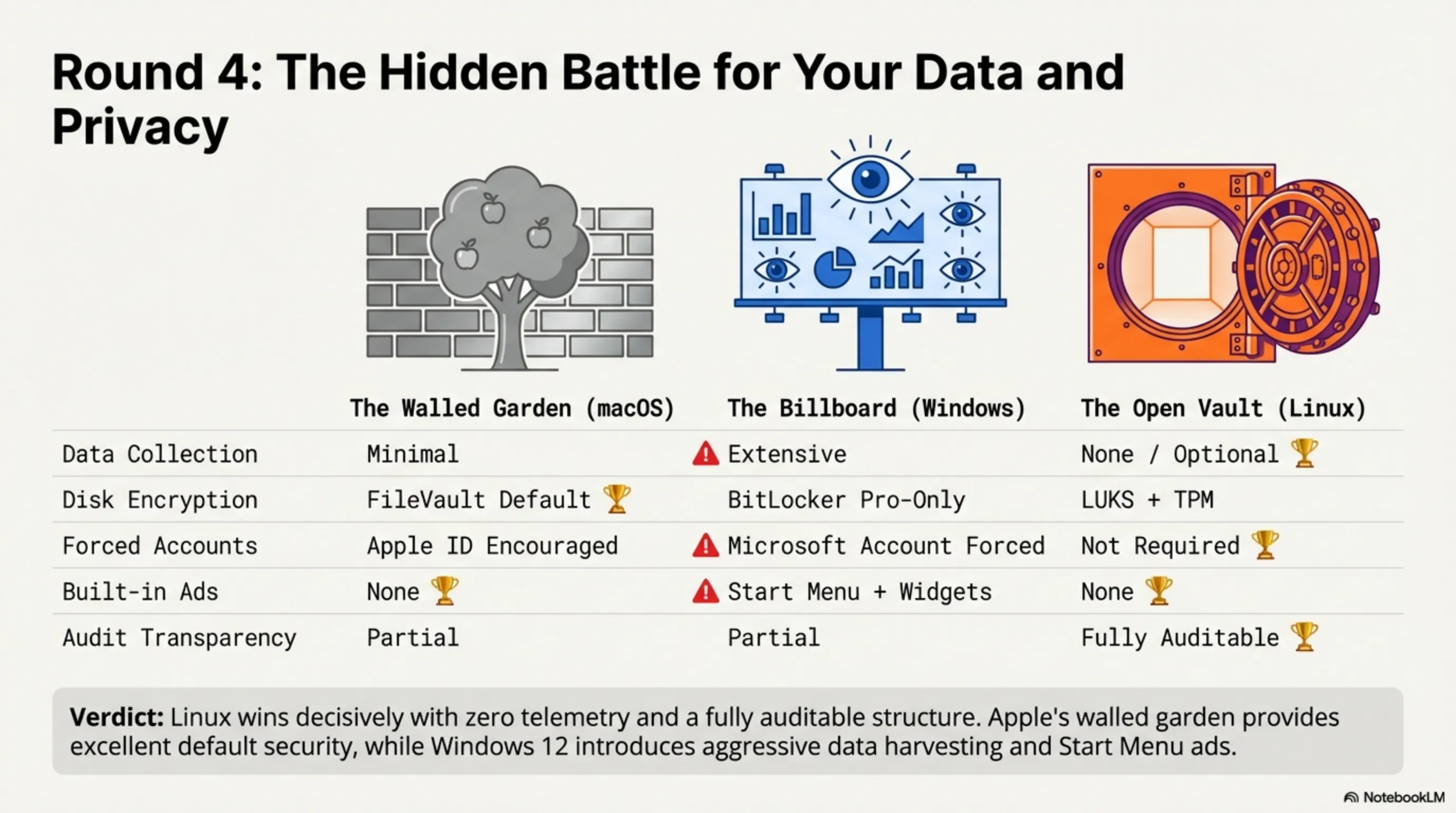
By 2026, data is more valuable than gold. The approach of these three operating systems to security differs vastly. Microsoft has introduced "Recall 2.0" in Windows 12, an AI system that takes screenshots of all your activities to assist in searching — a privacy nightmare. While Microsoft claims data is encrypted, Linux stands firmly against it with "Zero Telemetry." Apple, using the Secure Enclave in M5 chips, has built the most secure consumer hardware in history, where even Apple cannot access your data.
| Security Metric | 🍎 macOS 16 | 🪟 Windows 12 | 🐧 Linux 2026 |
|---|---|---|---|
| Data Collection | Minimal | Extensive ❌ | Zero 🏆 |
| Malware Defense | Excellent 🏆 | Good (Defender) | Excellent (Structural) |
| Built-in Ads | None 🏆 | Start Menu/Widgets ❌ | Never 🏆 |
| Audit Transparency | Closed | Closed | Open Source 🏆 |
TekinGame's security analysis shows that if privacy is your priority, Linux (especially advanced projects like Tails or Qubes OS) is your only harbor. Linux sends no data to any server by default. Windows 12, conversely, is deeply tied to the cloud, even forcing Microsoft account logins for non-enterprise users. Apple positions privacy as a luxury — high security without the complexity of Linux, but at a premium price. In 2026, Linux's "Immutable OS" technology has reached a point where even if malware infects the system, a simple restart returns it to its original clean state.
💰 Chapter 5: Cost of Ownership — Beyond the Sticker Price
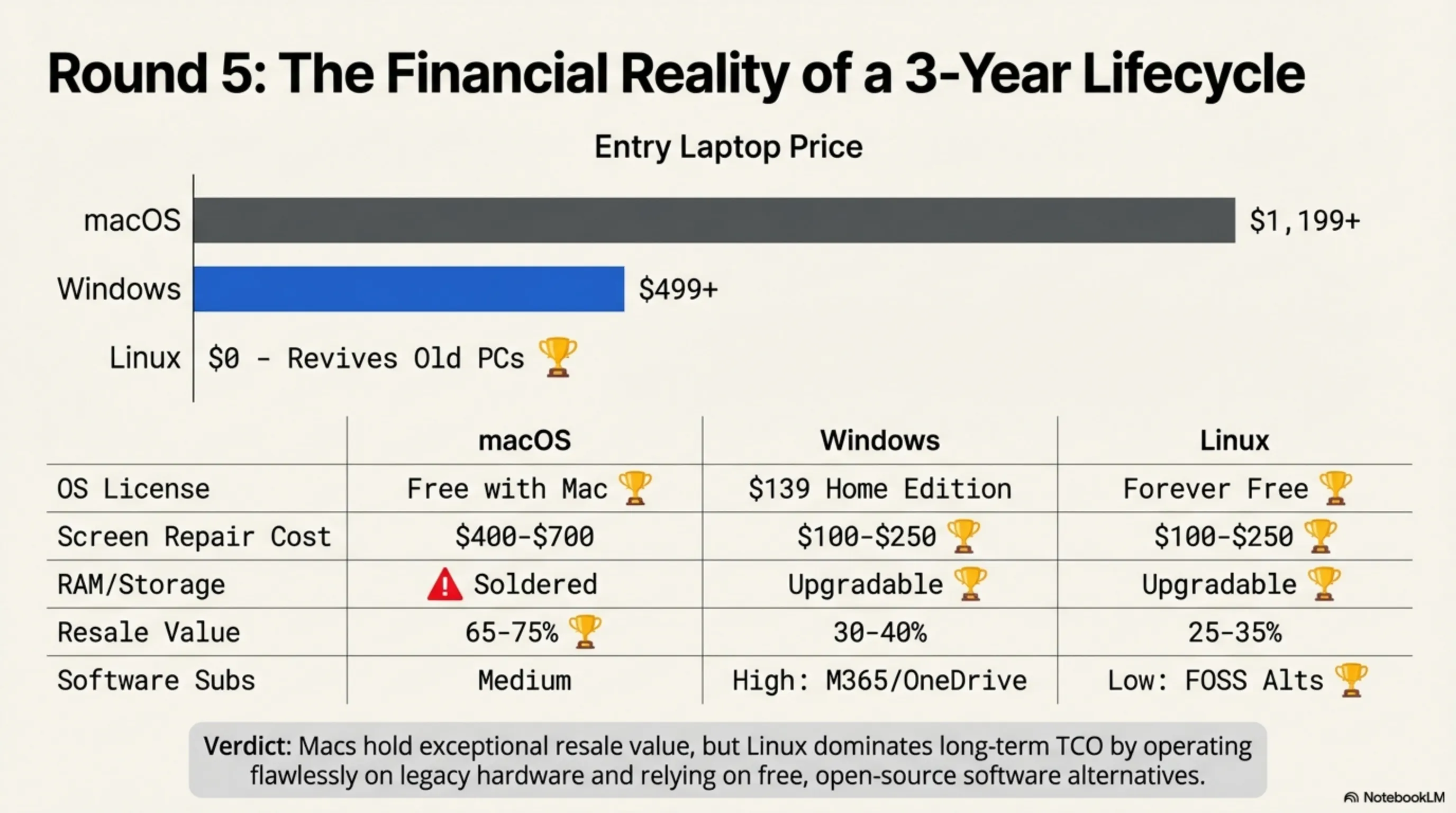
When discussing price, look beyond the initial purchase. Linux is the economic champion in 2026, as it's free and breathes life into old hardware. Macs have the highest upfront cost but retain their value better over time. Windows PCs cover all price ranges but carry hidden costs through mandatory Microsoft 365 subscriptions and cloud service fees.
| Cost Factor | 🍎 Mac | 🪟 Windows | 🐧 Linux |
|---|---|---|---|
| Entry Laptop Price | $1,199+ | $499+ | $0 (Any PC) 🏆 |
| OS License | Free (incl.) 🏆 | $149 (Home) | Free forever 🏆 |
| Upgradeability | Zero (Soldered) | High 🏆 | Unlimited 🏆 |
| Resale Value (3yr) | 70% 🏆 | 35% | 30% |
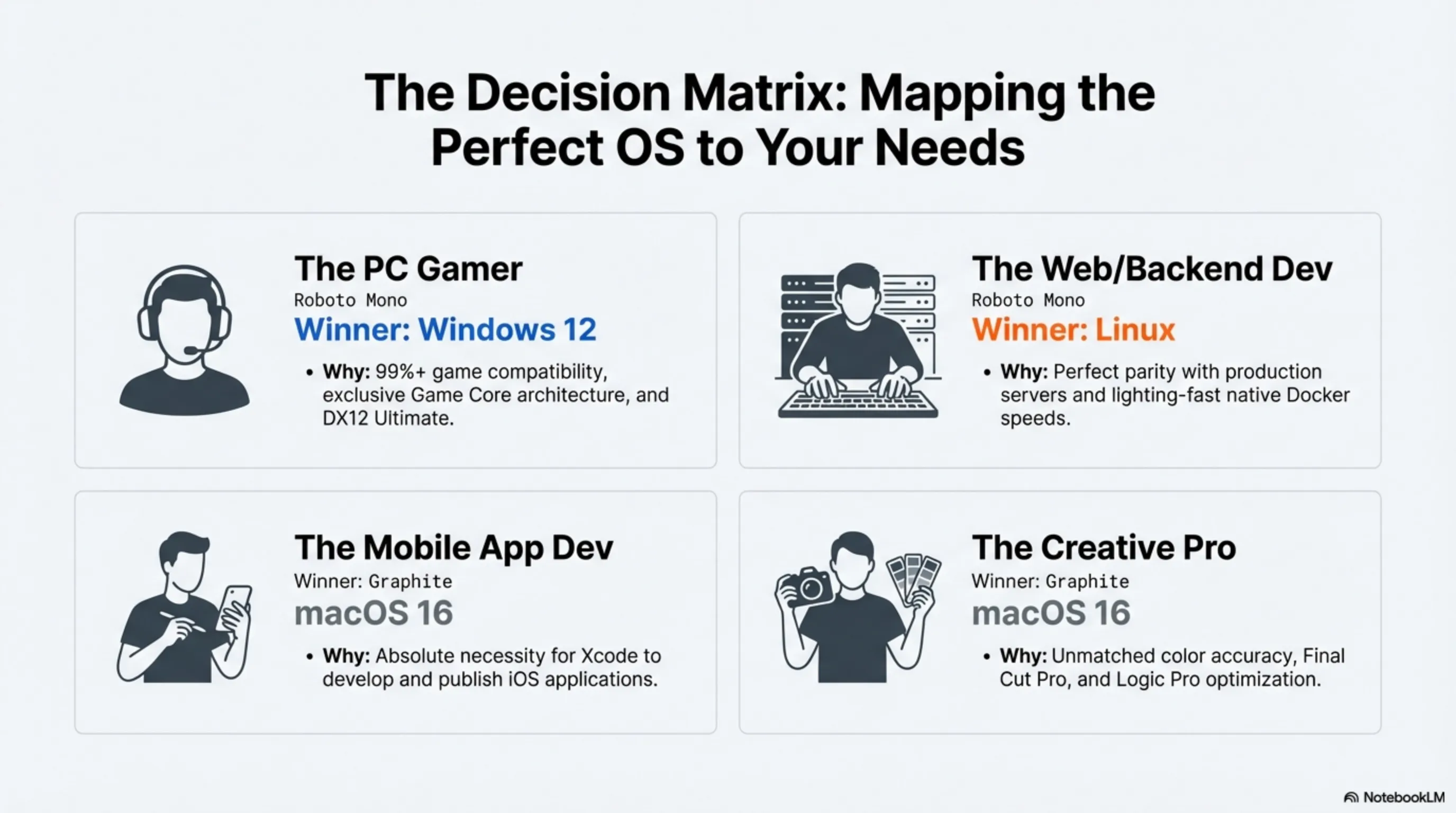
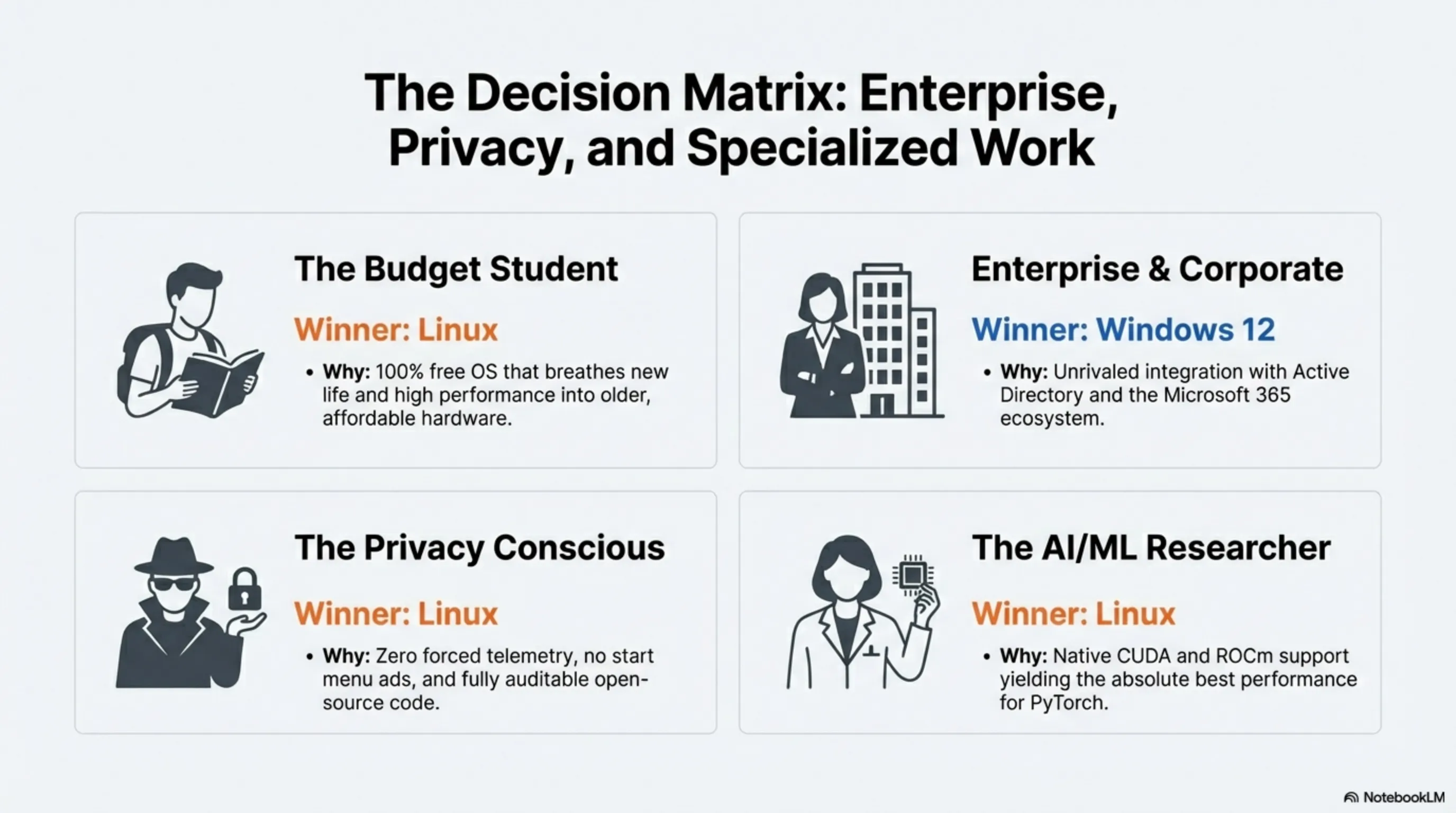
🎯 Chapter 6: Who Should Use What? — The Decision Matrix
| You Are... | Best Choice | Why |
|---|---|---|
| Hardcore Gamer (FPS) | Windows 12 | 99%+ compatibility, Game Core, DX12 Ultimate. |
| Backend/DevOps Developer | Linux (Ubuntu/Fedora) | Native tools, faster compilation, flawless Docker. |
| Content Creator | macOS 16 | Stunning rendering stability & Apple software ecosystem. |
| Student on a Budget | Linux (Mint/Ubuntu) | Free, secure, and fast on any mid-range laptop. |
| Enterprise/Corporate | Windows 12 | Office 365 integration, corporate automation. |
| Security Focused | Linux (Qubes/Tails) | Layered defense and zero spy telemetry. |
⚖️ Tekin's Final Verdict: The 2026 OS Championship
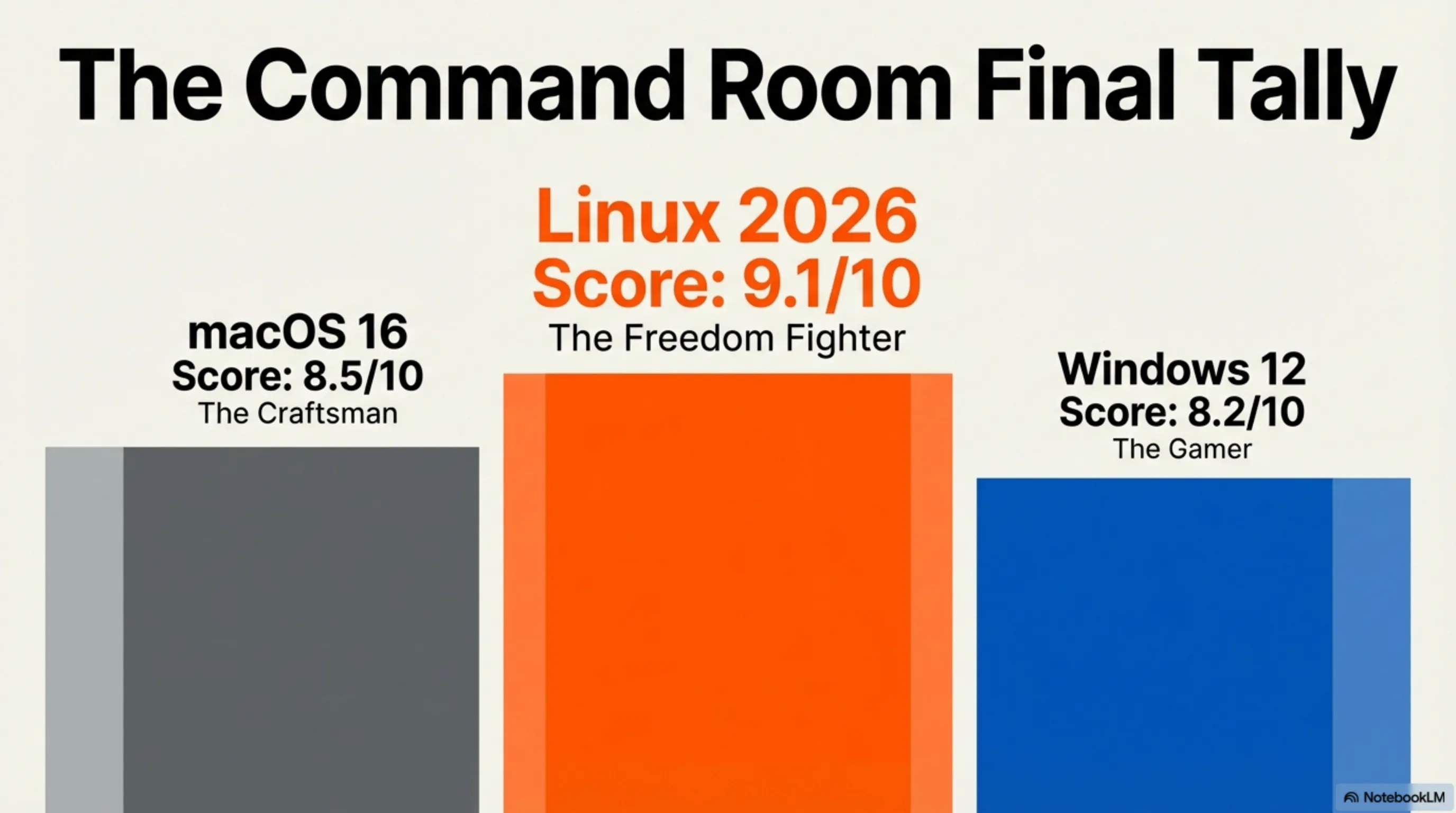
macOS 16
8.8/10
The Perfectionist
Windows 12
8.3/10
The Powerhouse
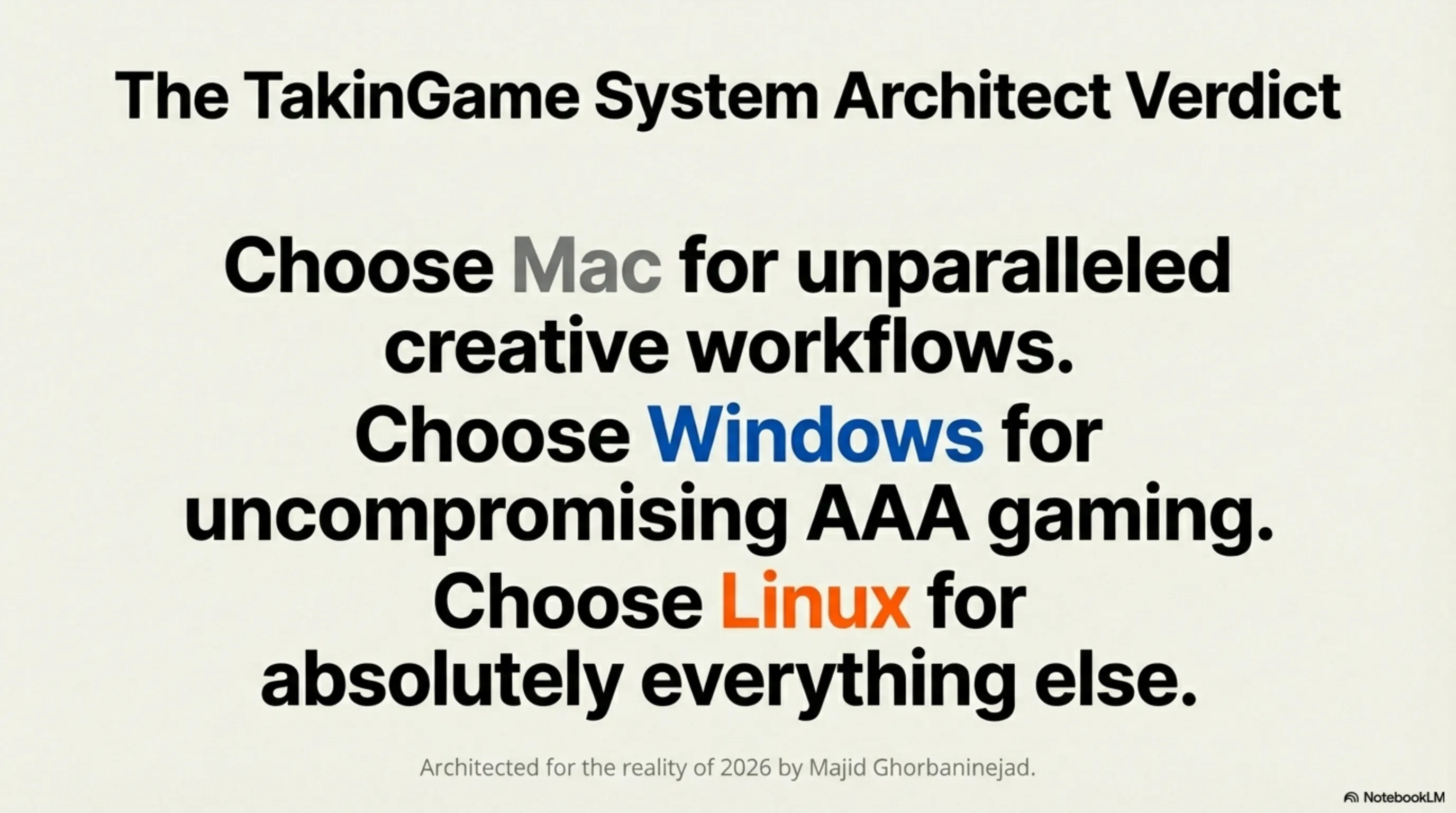
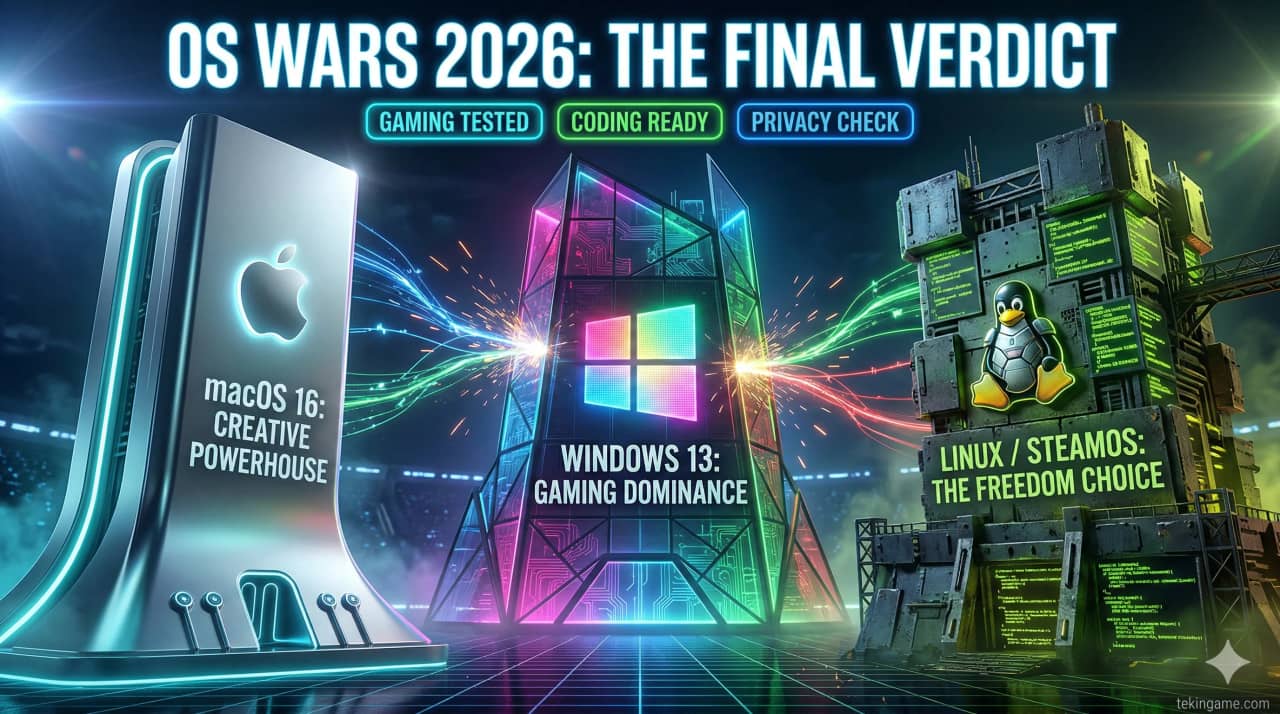
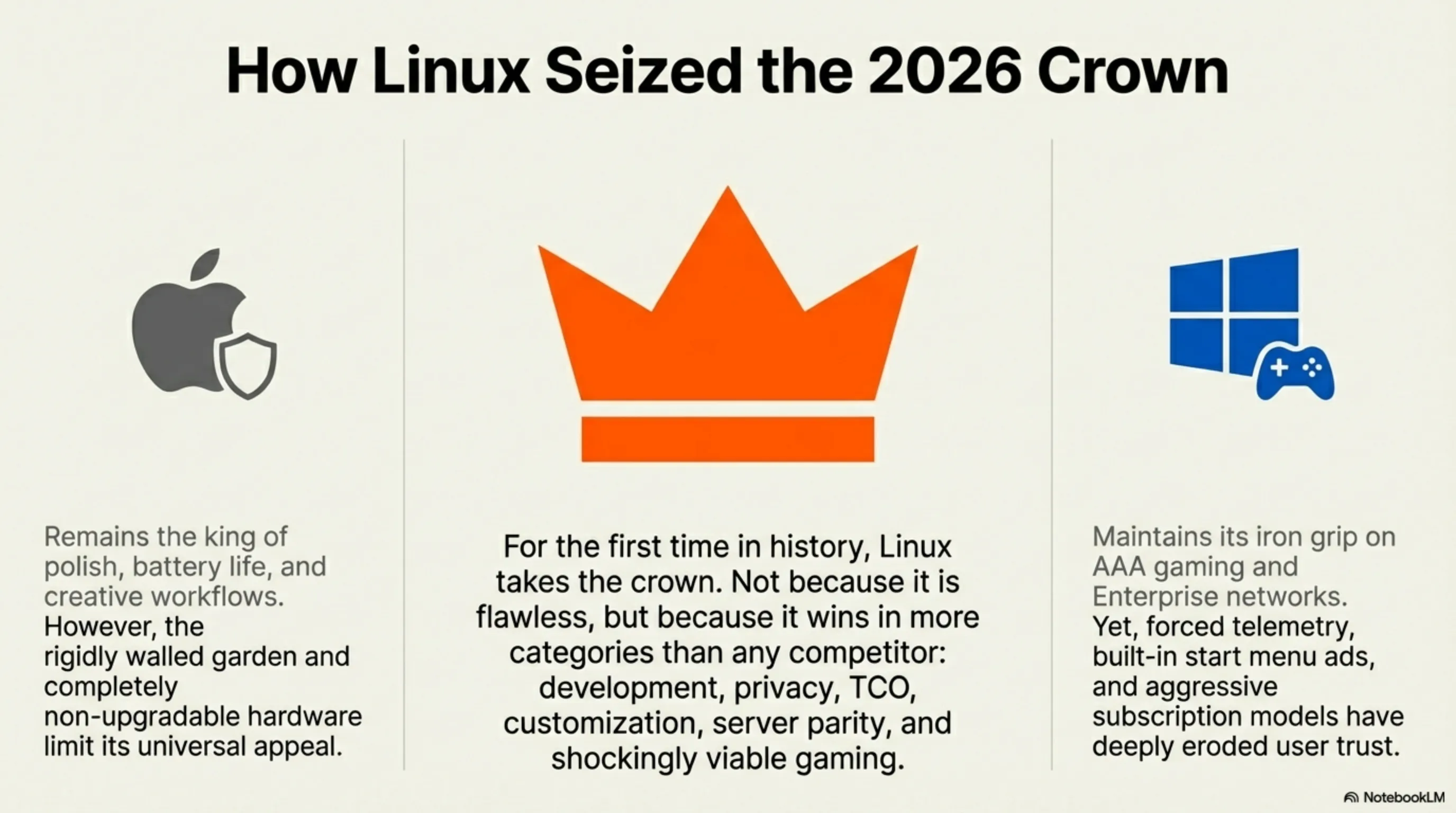
In 2026, a historic shift occurred: Linux finally outpaced its commercial rivals. Not because it is perfect, but because in the AI era, Linux is the only platform that grants full hardware power without stealing data. macOS 16 remains the dream user experience with best-in-class battery life, but hardware limitations persist. Windows 12 is the gaming and business champion, but forced cloud integration has alienated professional users. Tekin's recommendation: If you seek productivity, security, and raw speed, 2026 is the year to migrate to Linux. For AAA gaming, Windows 12 is your only competitive choice, and for serene quality, the MacBook still shines.
📸 OS Battle Royale - Grade A++ Gallery