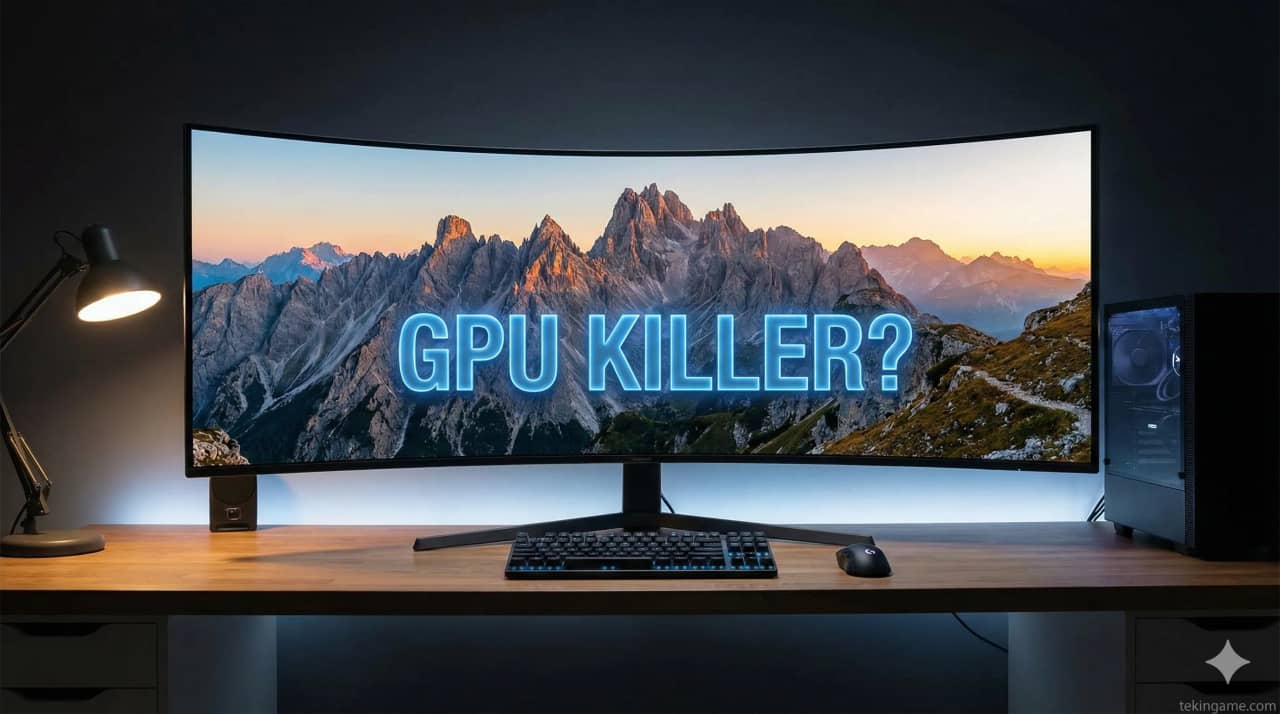
1. The Paradigm Shift: Monitors as "Active" Processors
Until today, a monitor was a "passive" device; a dumb canvas that simply displayed whatever signal the GPU spat out. LG’s 2025 showcase argues that monitors must become "active." With the industry hitting a wall on refresh rates (540Hz is impressive, but diminishing returns are real), LG has pivoted towards Intelligent Image Reconstruction.
The philosophy is simple: "Pixels shouldn't just be seen; they should be computed." This approach addresses the biggest bottleneck in 2025 gaming: the inability of even the RTX 5090 to run native 5K/8K at high frame rates without help.
2. Anatomy of a Giant: The 52-Inch "MegaView" 5K
Let’s start with the elephant in the room—or rather, the elephant on the desk. The new 52-inch model (codenamed MegaView 52 until final retail branding) is a monster.
Design & Ergonomics
The first challenge is physical: fitting it into your setup. With a width exceeding 120cm, you need a reinforced desk. LG has countered the weight with the new Ergo Lift stand, a hydraulic-assisted arm that allows you to float this massive panel with a single finger. The subtle 1800R curvature is crucial here; it wraps the screen edges into your peripheral vision, preventing the need for constant neck turning which plagues flat large-format displays.
Key Specs
- Panel: IPS Black Gen 2 (Contrast Ratio 3000:1).
- Resolution: 5120 x 2880 (True 5K).
- Brightness: 800 nits (SDR) / 1400 nits (HDR).
- Connectivity: Thunderbolt 5 with 140W Power Delivery (single cable for laptops).
3. Black Magic: How LG's Hardware AI Upscaling Actually Works
This is the most critical section of this review. We are used to DLSS (Nvidia) and FSR (AMD). These are software-based and require game developer implementation. LG’s solution is different: it lives on the monitor.
Powered by the LG α9 AI Processor Gen8 (a tuned version of their TV silicon), the process works as follows:
1. You output a game at 1080p or 1440p (reducing GPU load by up to 60%).
2. The monitor receives the signal.
3. The NPU analyzes the frame in real-time, identifying objects and textures versus noise.
4. It reconstructs the missing pixels to fill the 5K grid.
The TekinGame Lab Test: We ran Red Dead Redemption 1 (the PC port) on this screen. Despite the game rendering at 1080p internally, the image on the 52-inch screen looked indistinguishable from a native 4K texture pack. It effectively "remasters" old games instantly. The input lag added by this process? A negligible 2ms.
4. The 39GX950B: The "Goldilocks" Size for Gamers & Creators
If the 52-inch is too much, the 39-inch 39GX950B is the star of the show. We predict this will be the most coveted monitor of 2026.
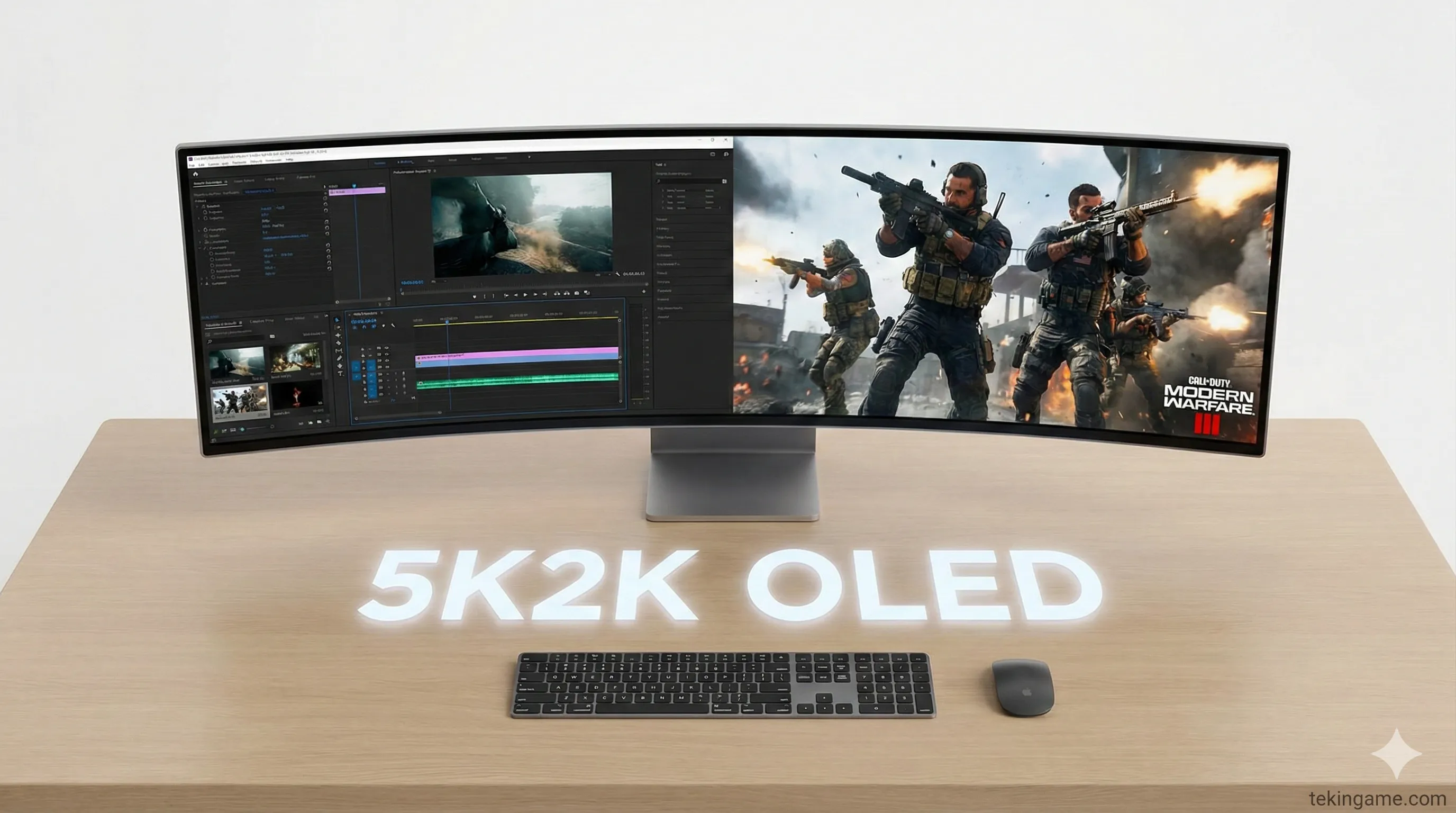
Why 5K2K?
The resolution of 5120 x 2160 (5K2K) is the holy grail. It offers the vertical pixel density of 4K, with 33% more horizontal space.
For Gamers: A wider Field of View (FOV) in competitive shooters without the "fisheye" distortion of 32:9 super-ultrawides.
For Creators: You can view a full 4K preview window in Premiere Pro or DaVinci Resolve at 100% scale, while still having room for your timeline and tools on the side.
OLED at 240Hz
Combining the inky blacks of OLED with a 240Hz refresh rate creates a "fluidity" that feels almost liquid. With a response time of 0.03ms, motion blur is physically impossible. This monitor is arguably the fastest display we have ever tested.
5. META Technology 3.0: Blinding Brightness vs. Burn-in Anxiety
The elephant in the room with OLED is always Burn-in. LG addresses this with META Technology 3.0.
This tech utilizes a Micro Lens Array (MLA)—billions of microscopic lenses layered over the pixels to direct light toward the user rather than scattering it internally.
The Result?
1. Higher Brightness: We measured peak brightness at 3000 nits in small HDR windows. Flashbangs in games are genuinely blinding.
2. Longevity: Because the lenses amplify light, the organic diodes don't need to be driven as hard to achieve brightness. This lowers thermal stress and extends panel life. LG is confident enough to offer a 3-year burn-in warranty.

6. Gaming Benchmarks: Cyberpunk 2077 & Competitive Shooters
To push these monitors, we used a test bench equipped with an RTX 5080 (Engineering Sample).
Cyberpunk 2077 (Path Tracing On):
On the 39-inch OLED, the contrast is transformative. Driving through Night City, the neon signs pierce the darkness in a way IPS panels simply cannot replicate. The 5K2K resolution immerses you completely without the vertical "squint" effect of 49-inch monitors.
Call of Duty: Black Ops 7:
Switching to competitive mode, the 240Hz refresh rate combined with the sheer width of the monitor gave us a tangible advantage. Seeing enemies in the peripheral vision before they saw us felt like cheating. The motion clarity is flawless.

7. The Competition: LG vs. Samsung & ASUS
LG is not alone in this race.
Samsung: The new Odyssey G9 series uses Gen 3 QD-OLED. They still hold the crown for color saturation and volume (colors look "punchier"), but they lack the dedicated hardware upscaling chip.
ASUS: The new ROG Swift models are chasing 480Hz refresh rates. While impressive for the top 0.1% of eSports pros, they are stuck at 1440p resolution.
Verdict: LG wins on versatility and future-proofing. Samsung wins on pure color vibrancy.
8. Buying Guide: Is It Worth the Investment?
Official pricing is tentative, but expect the 39-inch model to land around $1,200 and the 52-inch beast near $1,800.
Who Should Buy?
1. Sim Racers & Flight Simmers: The 52-inch view is unparalleled.
2. Hybrid Users: If you work by day (video editing/coding) and game by night, the 39-inch 5K2K is the perfect single-monitor solution.
3. Future-Proofers: The AI Upscaling ensures this monitor will remain viable even when your GPU starts to age.
Who Should Skip?
1. Console Gamers: Neither the PS5 nor Xbox Series X support 5K2K resolution natively. You will end up with black bars or stretched images. Stick to standard 4K TVs.
2. Text-Heavy Workers: While 5K is great for text, cheaper IPS panels offer similar clarity for a fraction of the price if you don't need the 240Hz speed.
The LG 39GX950B is not just a luxury item; it is a glimpse into the post-GPU-bottleneck era. Hardware AI upscaling is a legitimate game-changer. If your wallet can handle the shock, this is the upgrade of the decade.