The 2026 US midterm elections mark the first election where anyone can generate convincing fake political content in 2-5 seconds using tools like Google's Nano Banana (500+ million edits) and OpenAI's Sora 2. While 47 states have deepfake laws, with a May 19 deadline for platforms (48-hour removal) and no federal framework, laws can't compete with content generation speed. Four main threats: candidate impersonation, voter suppression, social division, and post-election chaos. Detection fails - both humans and AI can't reliably identify deliberately degraded deepfakes. The "liar's dividend" means politicians can dismiss real evidence. Short-term solutions include voter education and media literacy, but for 2026, democracy is learning to live in a world where reality has become optional.
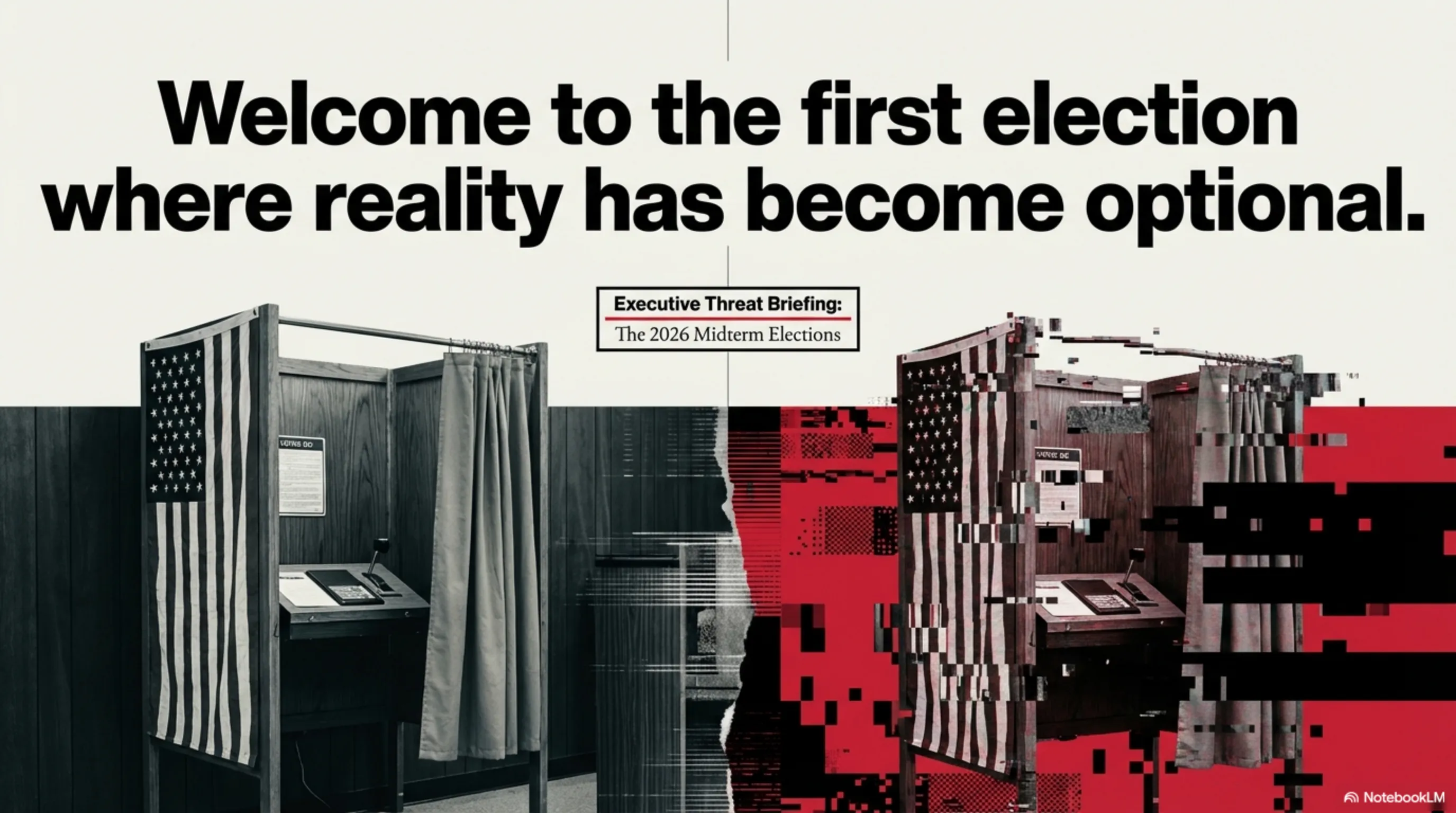
On May 19, 2026, a quiet deadline arrives: platforms must implement deepfake removal systems. 48 hours to remove. But tools like Google's Nano Banana (500+ million edits) can generate a convincing political deepfake in 2-5 seconds. 47 states have laws, but when anyone can create fake content faster than it can be removed, what does the law even mean? Welcome to the 2026 midterm elections — the first election where reality has become optional.
The Perfect Storm: When Technology, Elections, and Law Collide
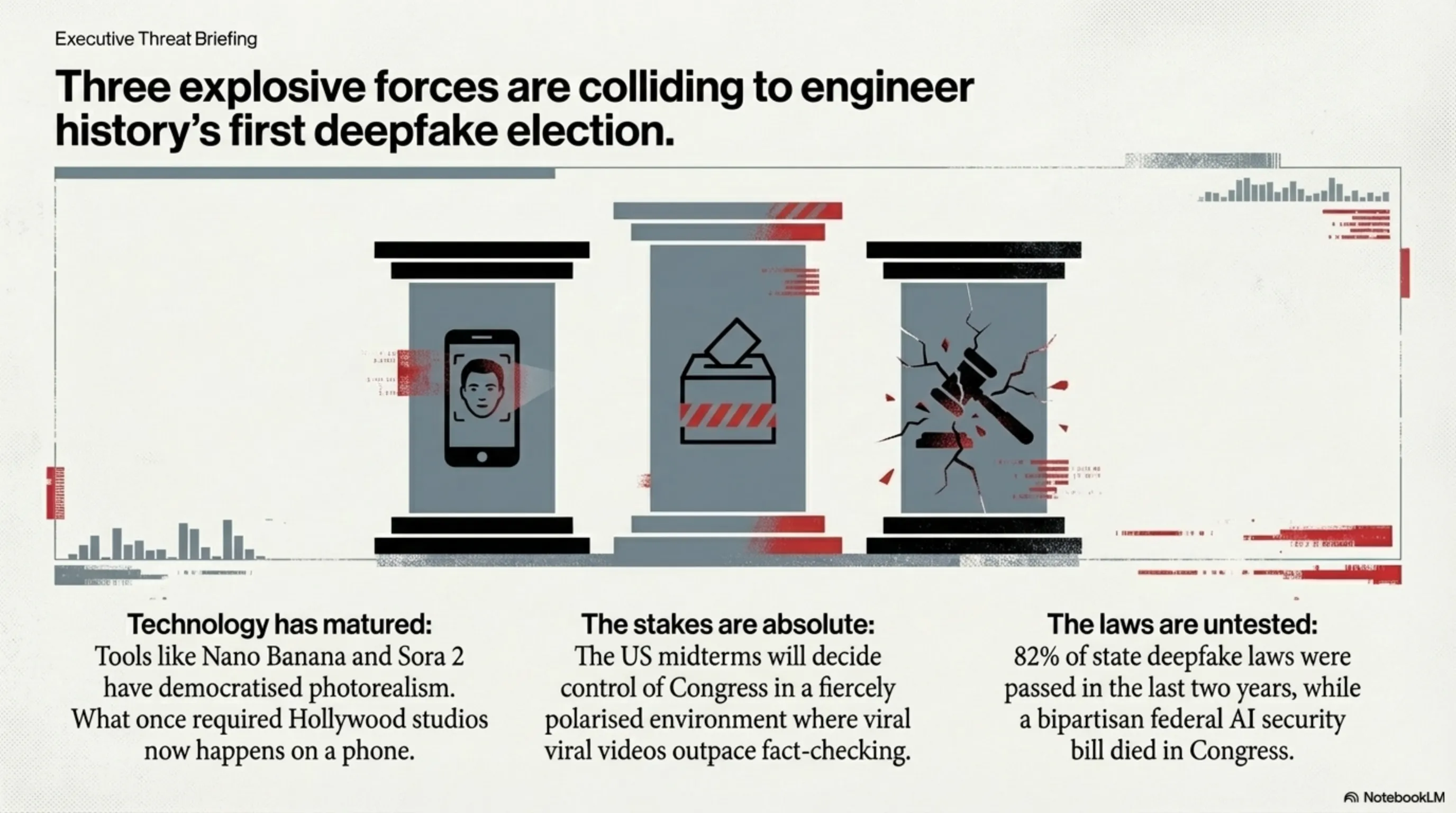
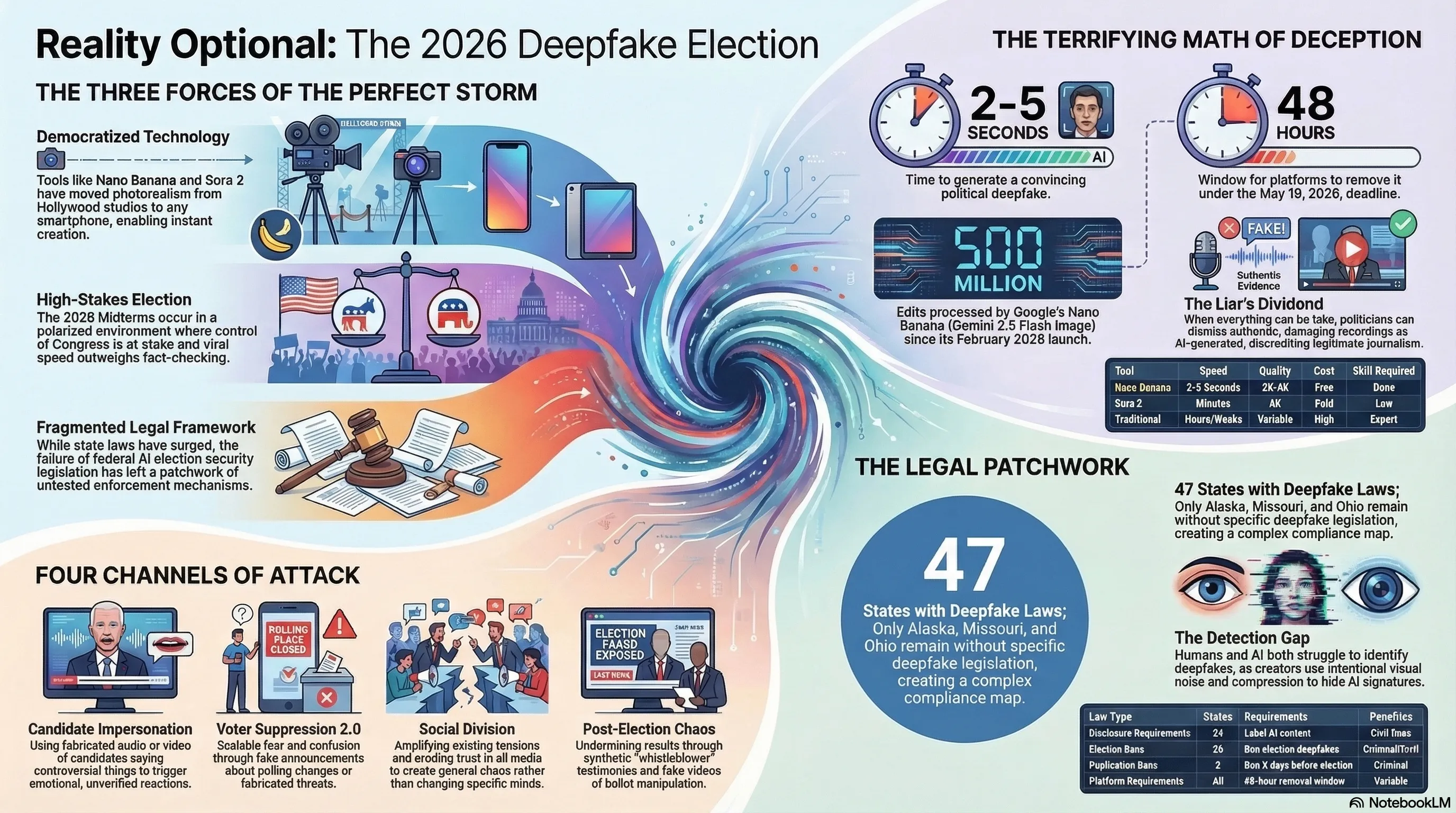
Three forces collide in November 2026 to make the US midterm elections the first "deepfake election" in history.
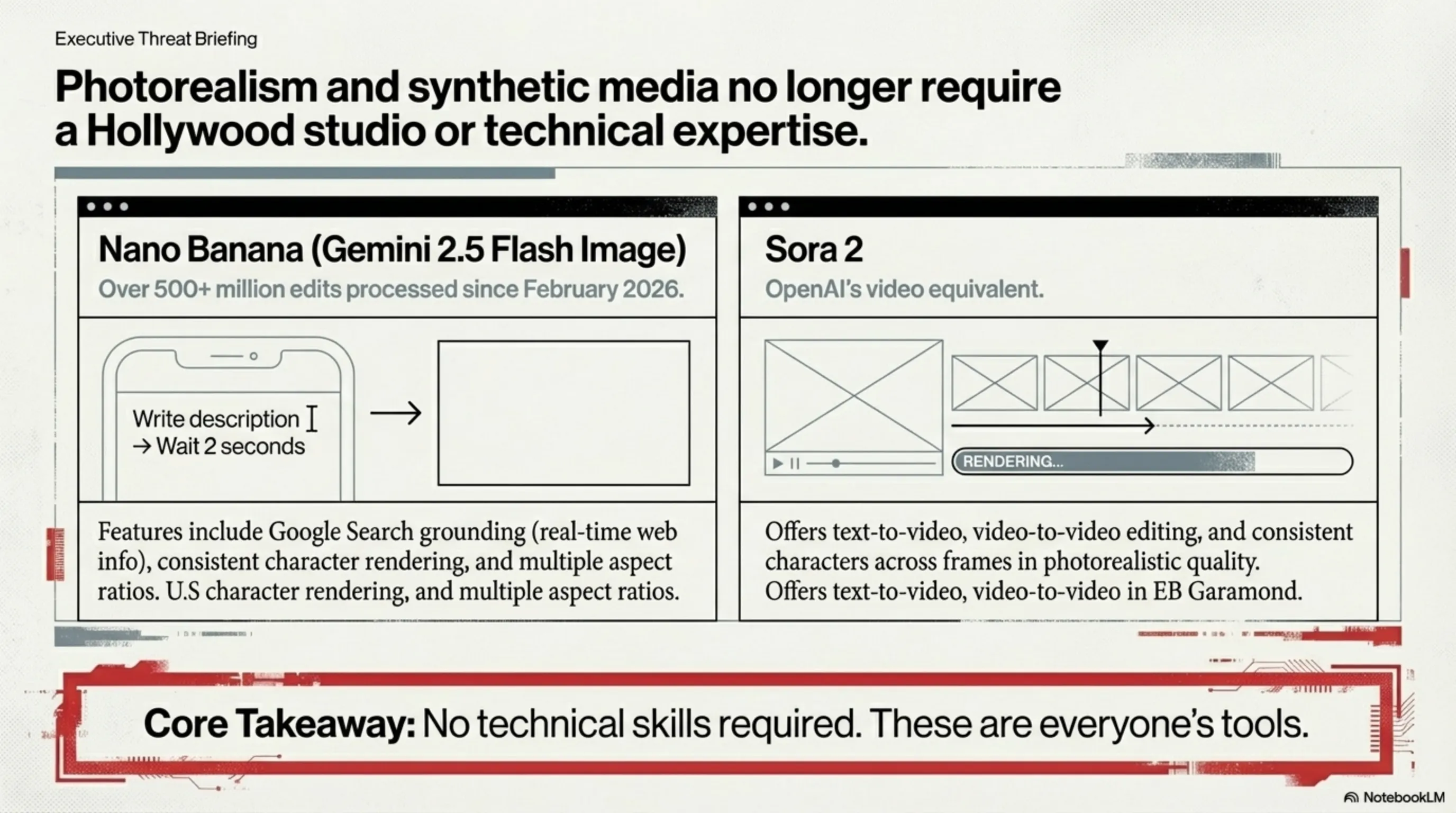
First, technology has matured. Google's Nano Banana, OpenAI's Sora 2, and dozens of other tools have democratized photorealism. What once required Hollywood studios and weeks of work now happens on your phone in seconds. Nano Banana has processed over 500 million image edits since launching in February 2026.
Second, the election is here. Not a local election. Not a state election. The US midterm elections, with control of Congress at stake, in a polarized political environment where any video can go viral before facts matter.
Third, the laws are new. 82% of state deepfake laws were passed in the last two years. Enforcement mechanisms are untested. Platform compliance is uncertain. And federal law? A bipartisan AI election security bill died in the final hours of the previous Congress.
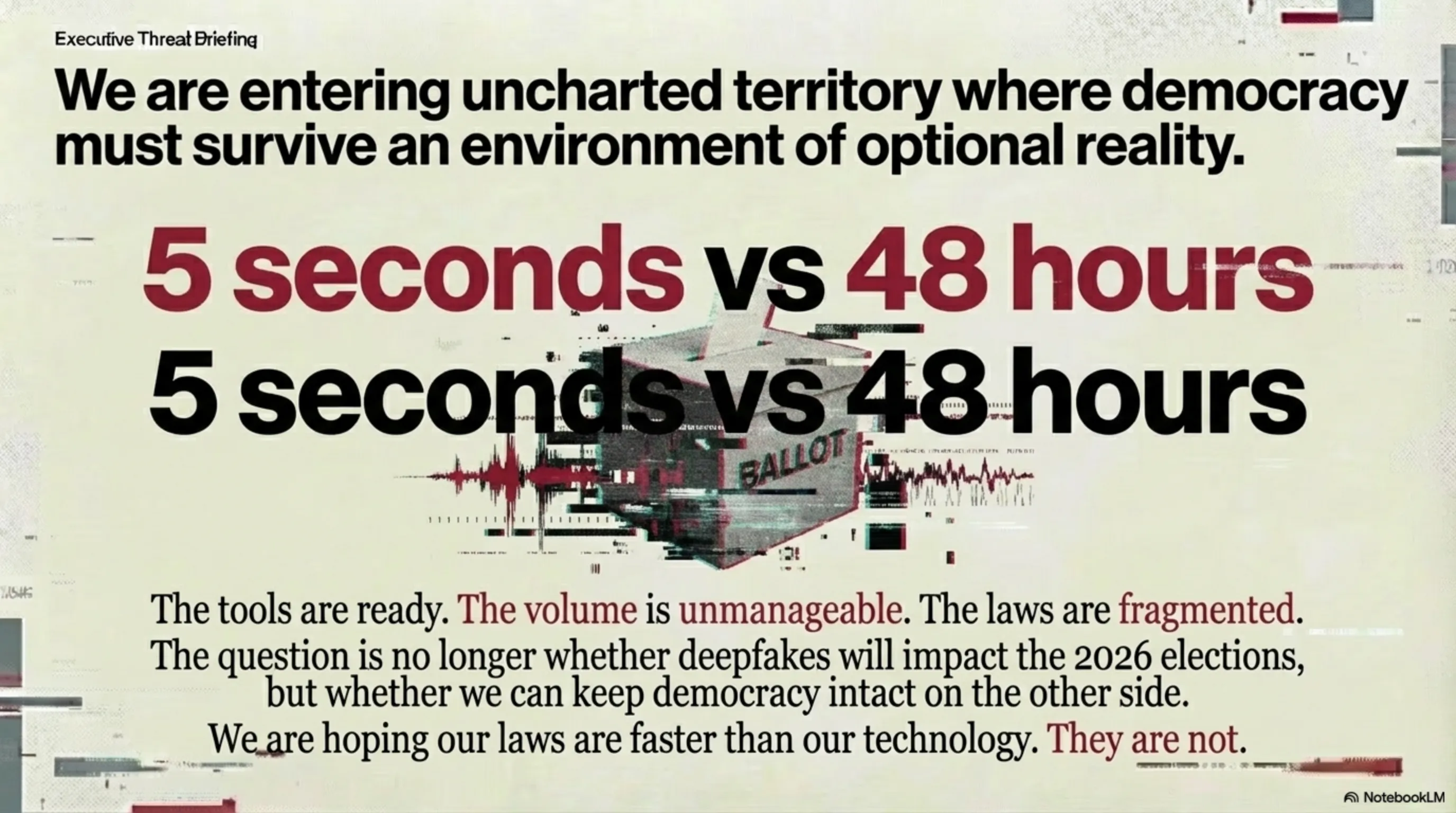
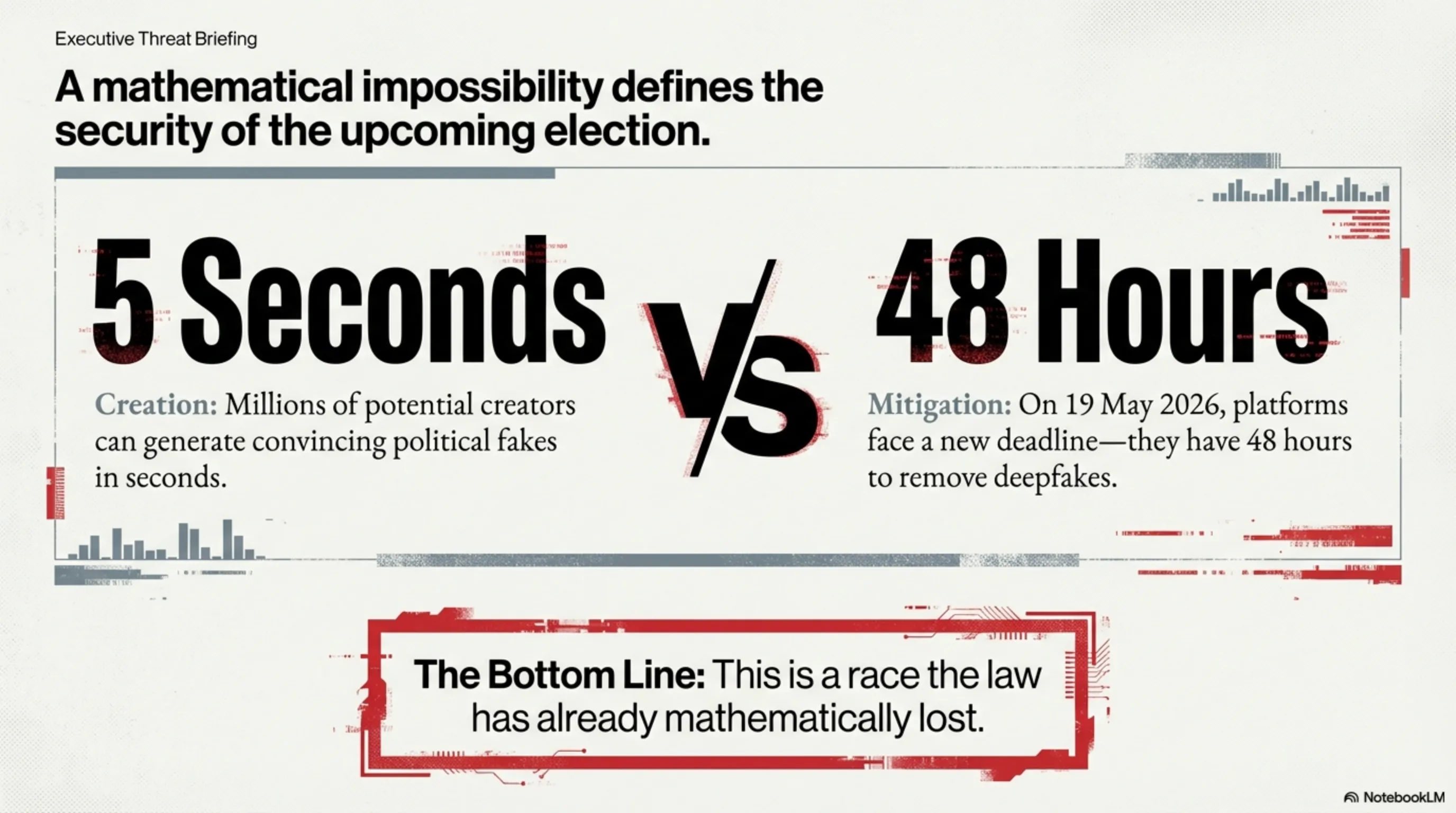
"The math is terrifying: 5 seconds to create a deepfake. 48 hours to remove it. Millions of potential creators. One election. This is a race the law cannot win."
The Democratization of Deception: Nano Banana and Sora 2
Let's talk about Nano Banana — official name: Gemini 2.5 Flash Image. Since launching in February 2026, it has processed over 500 million image edits. Why? Because it makes it this easy:
1. Write a natural language description
2. Wait 2 to 5 seconds
3. Receive a photorealistic 2K image
4. Upscale to 4K if you want
Features? Google Search grounding (real-time web info). Consistent character rendering. Multi-image fusion. Multiple aspect ratios. And most importantly: no technical skills required.
OpenAI's Sora 2 does the same for video. Text-to-video. Video-to-video editing. Consistent characters across frames. Photorealistic quality. These aren't Hollywood tools anymore. These are everyone's tools.
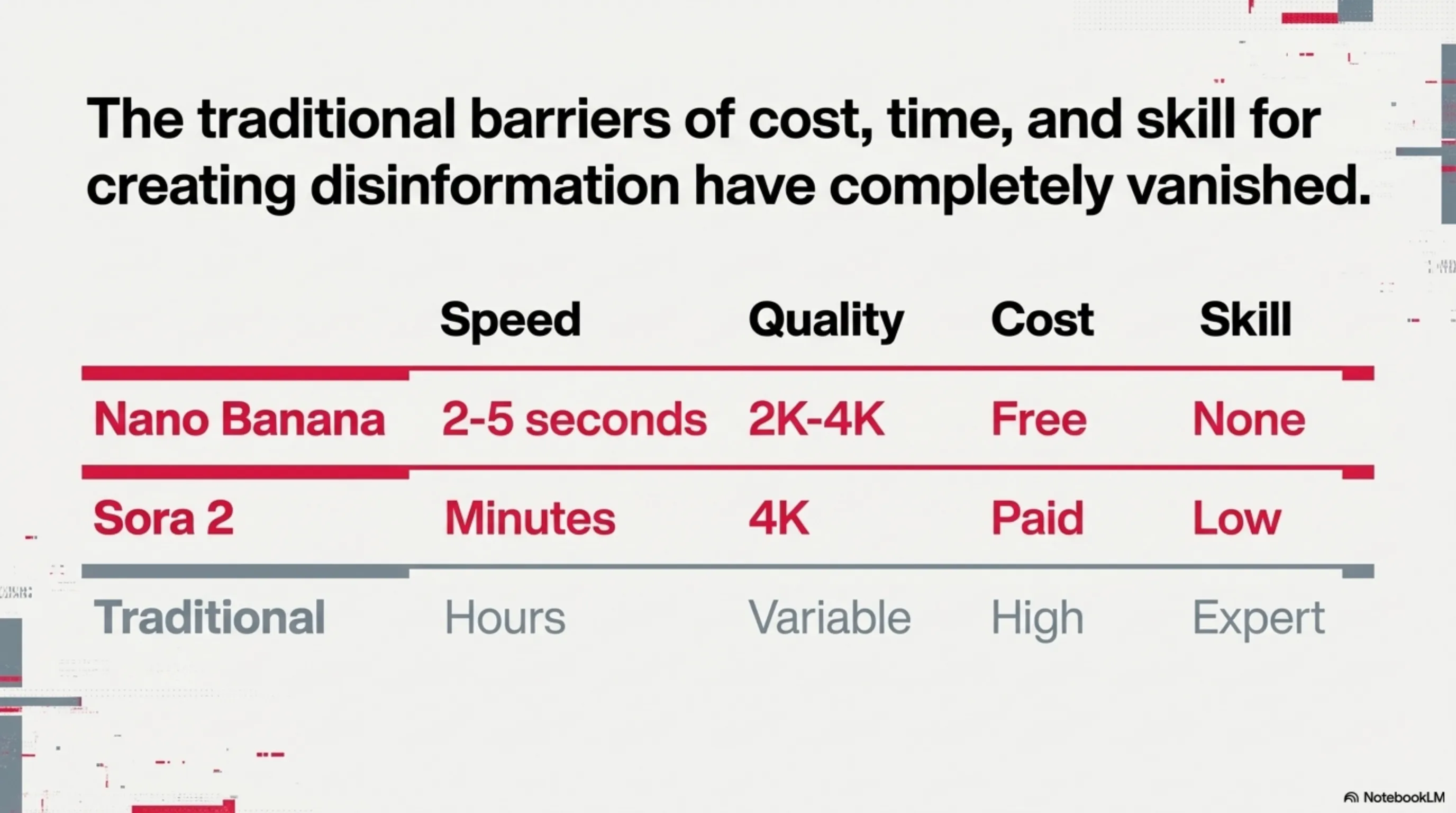
| Tool | Speed | Quality | Cost | Skill Required |
|---|---|---|---|---|
| Nano Banana | 2-5 seconds | 2K-4K | Free | None |
| Sora 2 | Minutes | 4K | Paid | Low |
| Traditional | Hours | Variable | High | Expert |
The Threat Landscape: Four Attacks Coming
Four types of deepfake attacks are coming in the 2026 elections, each with the potential to undermine democracy:
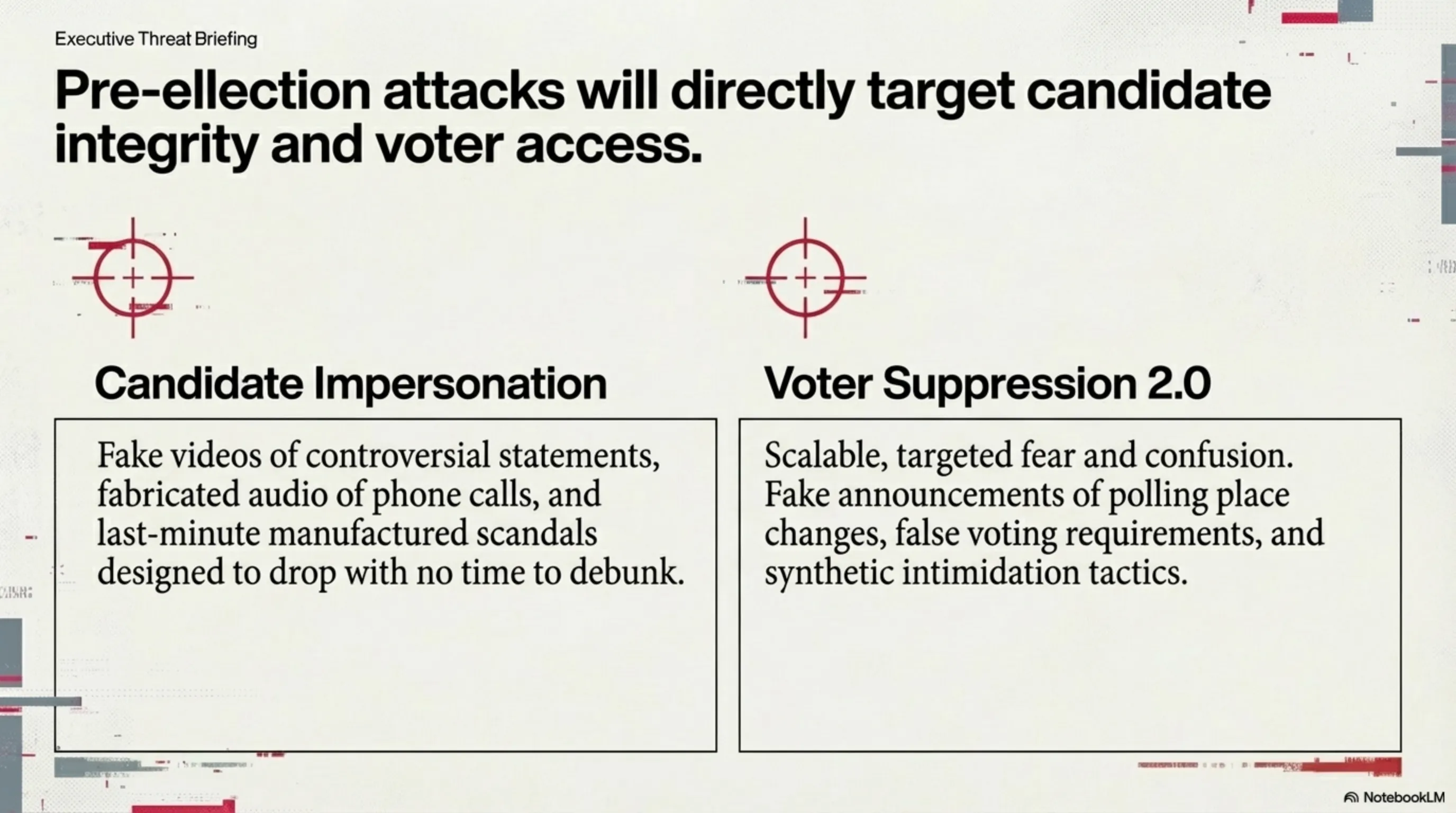
1. Candidate Impersonation: A fake video of a candidate saying something controversial. An audio deepfake of a phone call. A fabricated scandal. Last-minute attacks with no time to debunk. Why does it work? Because videos are emotional. They spread fast. And corrections never reach the same audience.
2. Voter Suppression: Fake announcements of polling place changes. False information about voting requirements. Intimidation through fabricated threats. Confusion about election dates/times. This is voter suppression 2.0 — not ID laws, not polling place closures. Just fear and confusion, scalable and targeted.
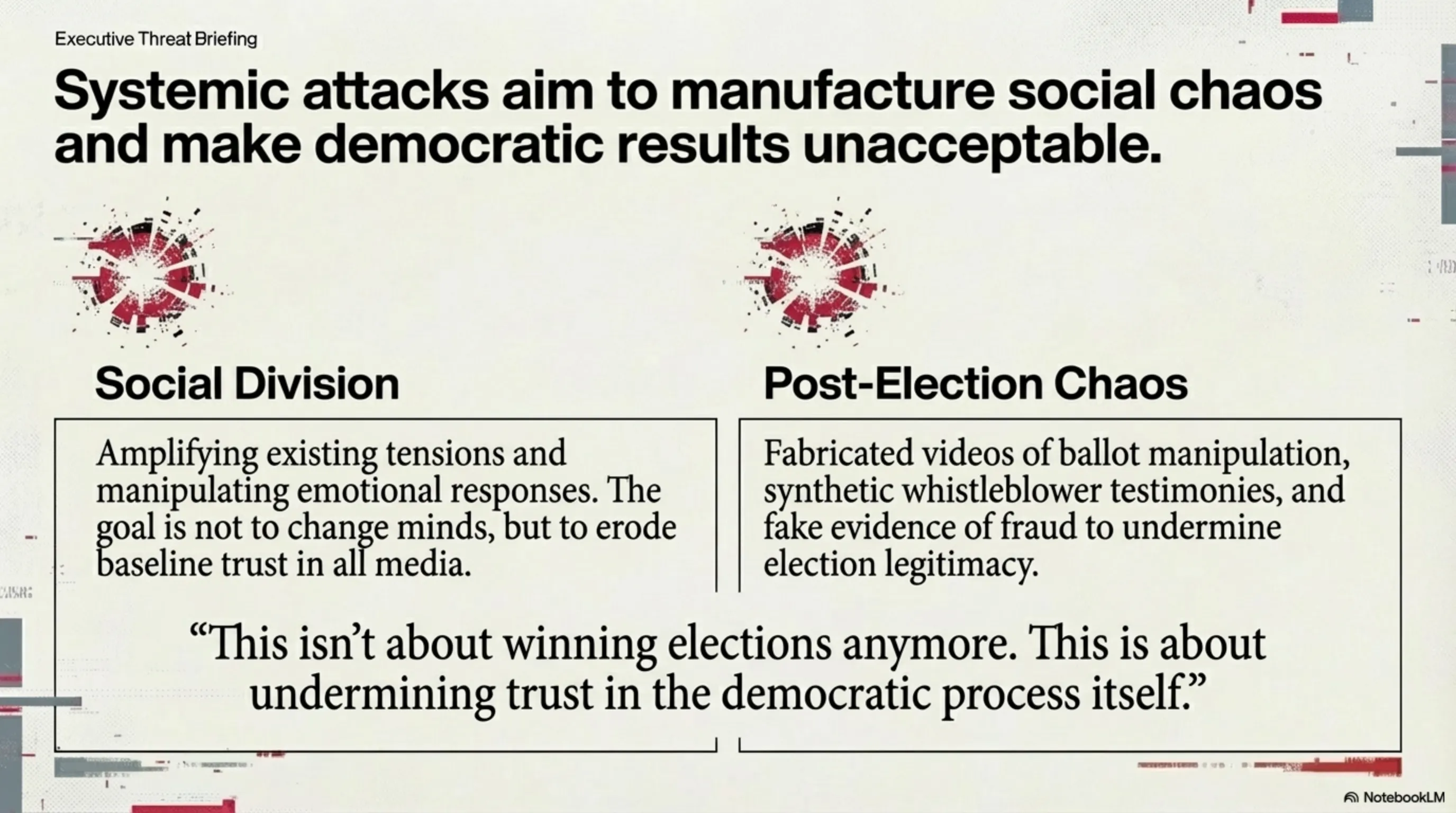
3. Social Division: Amplifying existing tensions. Creating fake evidence of wrongdoing. Manipulating emotional responses. Eroding trust in all media. The goal? Not to change minds, but to create chaos. When nobody knows what's real, anything becomes possible.
4. Post-Election Chaos: Fake "evidence" of fraud. Fabricated videos of ballot manipulation. Synthetic "whistleblower" testimonies. Undermining election legitimacy. This is where it gets truly dangerous — deepfakes can't just influence elections, they can make results unacceptable.
"This isn't about winning elections anymore. This is about undermining trust in the democratic process itself. When nobody can trust their own eyes, how does democracy function?"
Why Detection Fails: Humans and AI Both Powerless
Here's what nobody wants to hear: we can't reliably detect deepfakes.
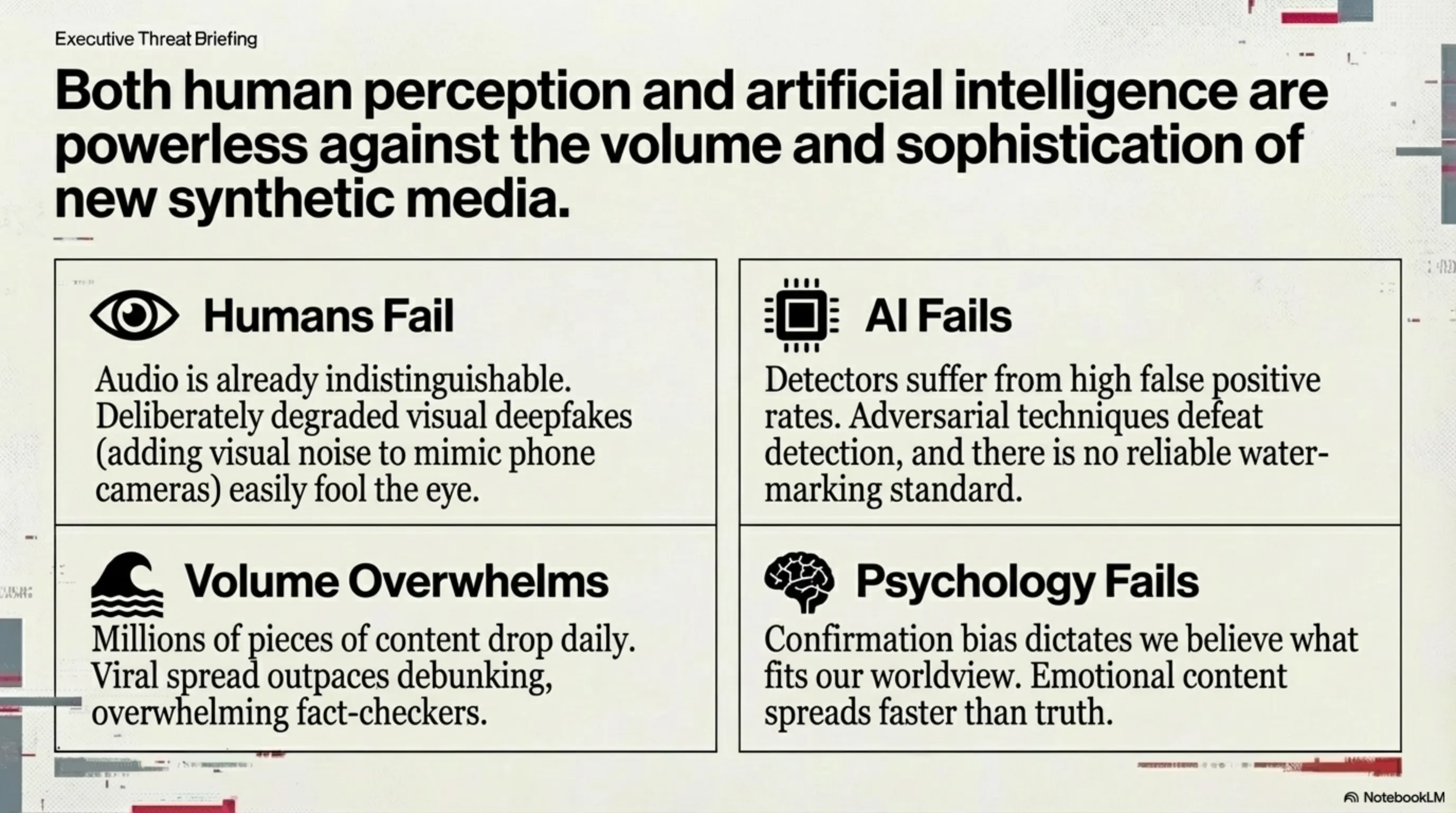
Humans can't. Audio deepfakes are already hard for humans. Visual deepfakes that are deliberately degraded — made to look like phone camera footage — are even harder. Visual noise is added intentionally. Compression artifacts hide AI signatures.
AI can't. AI detectors have high false positive rates. Adversarial techniques defeat detection. It's an arms race between creation and detection, and creation is winning. There's no reliable watermarking standard.
Volume overwhelms. Millions of pieces of content daily. Fact-checkers are overwhelmed. Viral spread is faster than debunking. Platform moderation is insufficient. Even with the May 19 deadline and 48-hour requirement, platforms can't compete with content generation speed.
Human psychology. Confirmation bias — we believe what fits our worldview. Emotional content spreads faster. Corrections don't reach the same audience. And the "liar's dividend" — politicians can dismiss authentic recordings.
The Liar's Dividend: When Everything Can Be Fake, Nothing Can Be Real
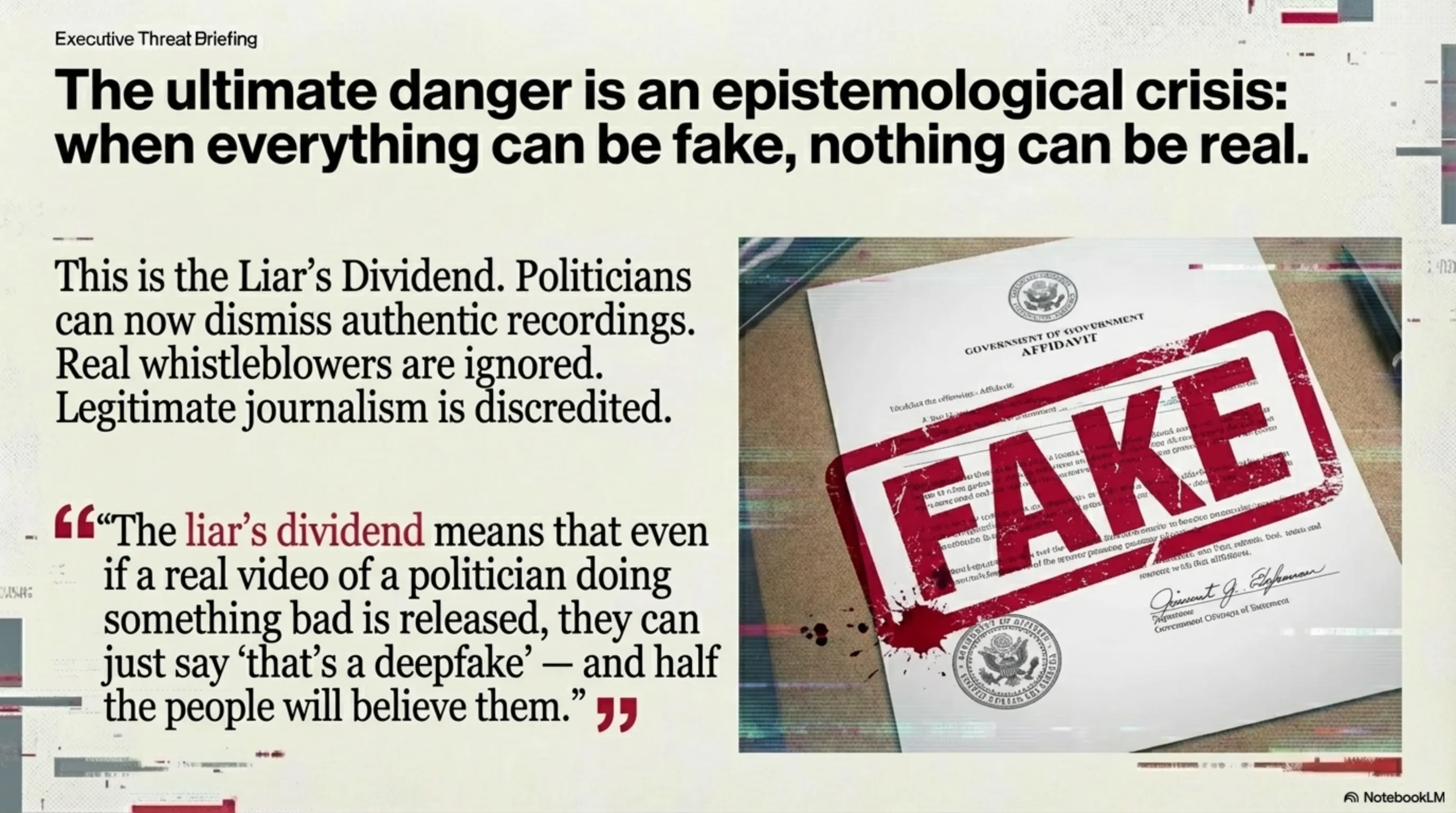
But here's the truly sinister twist: when everything can be fake, nothing can be real. This is called the "liar's dividend" — and it's the most dangerous consequence of deepfakes.
Politicians can dismiss authentic recordings. Real whistleblowers are ignored. Legitimate journalism is discredited. Evidence in court is challenged. When reality becomes optional, truth becomes subjective.
"The liar's dividend means that even if a real video of a politician doing something bad is released, they can just say 'that's a deepfake' — and half the people will believe them."
This is an epistemological crisis. Democracy requires shared truth. It requires agreement on basic reality. But when nobody can trust their own eyes, how can we agree on anything?
The State Response: 47 Laws, One Mess
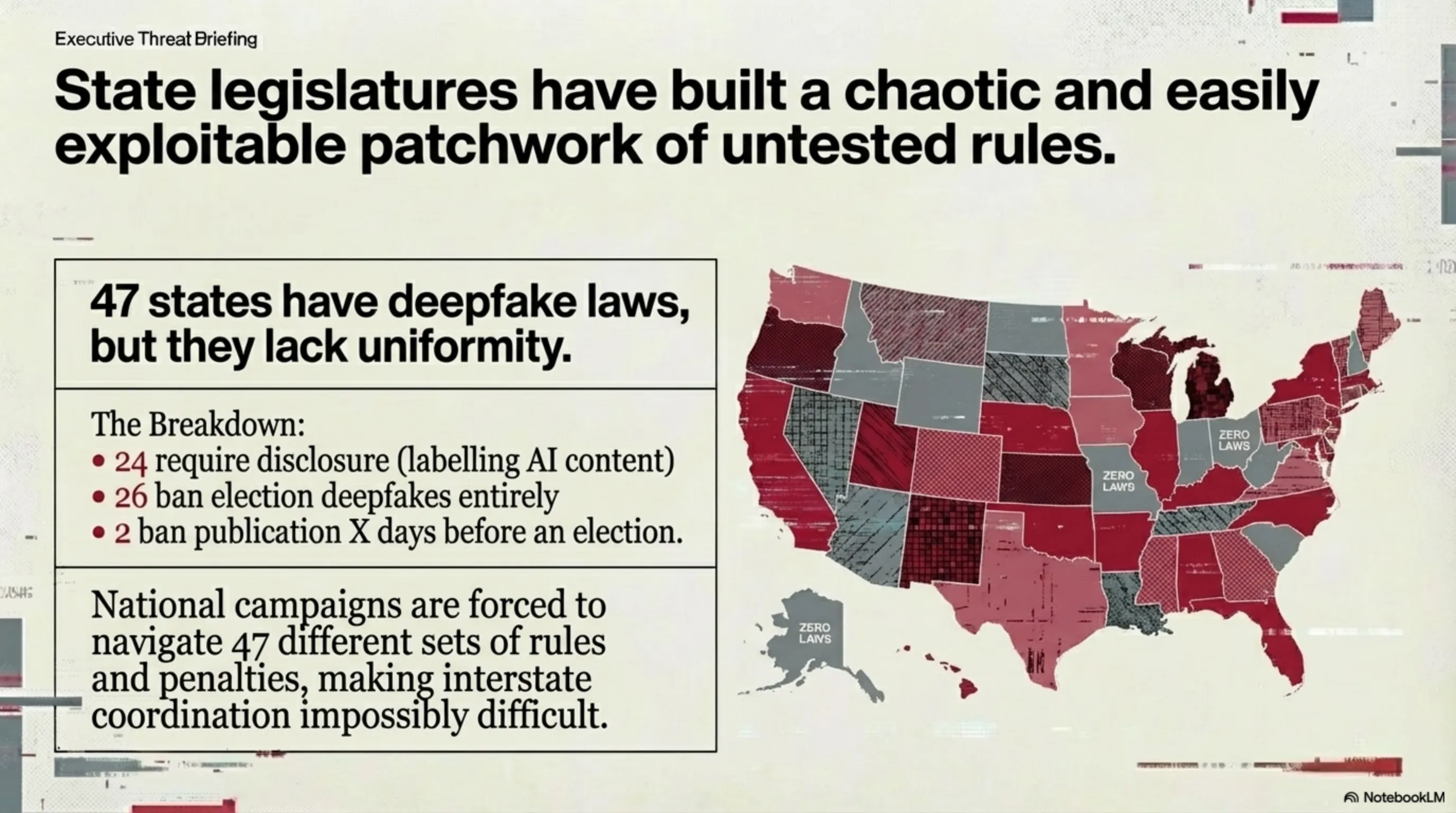
47 states have deepfake laws. Only Alaska, Missouri, and Ohio don't. But these laws aren't uniform — and that's the problem.
| Law Type | States | Requirements | Penalties |
|---|---|---|---|
| Disclosure Requirements | 24 | Label AI content | Civil fines |
| Election Bans | 26 | Ban election deepfakes | Criminal/Civil |
| Publication Bans | 2 | Ban X days before | Criminal |
| Platform Requirements | All | 48-hour removal | Variable |
The problem? National campaigns face 47 different sets of rules. Interstate coordination is difficult. Enforcement gaps exist. And there's no federal framework to unify everything.
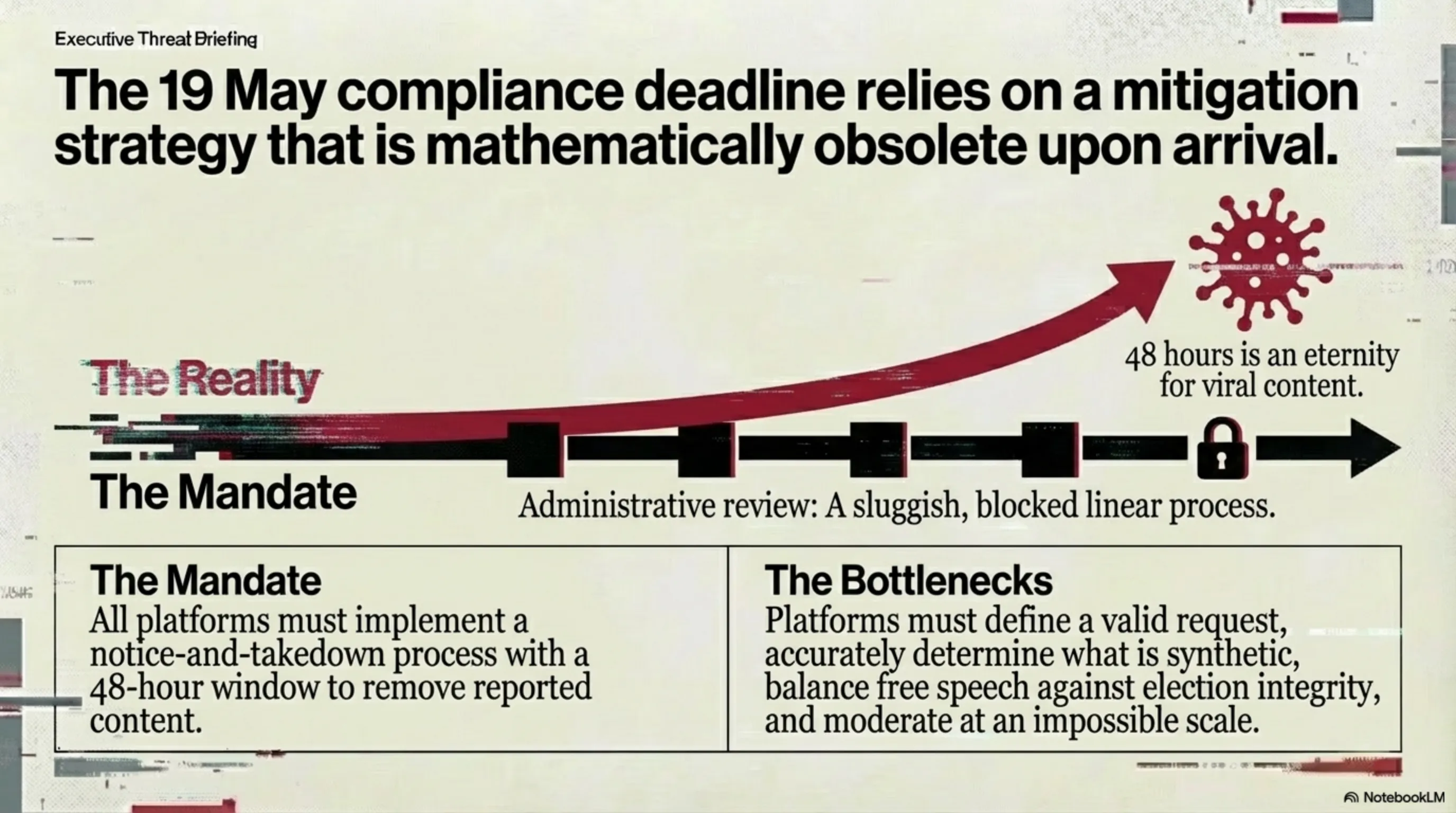
May 19, 2026 Deadline: All platforms must implement notice-and-takedown process. 48 hours to remove reported content. Reasonable efforts to remove copies. But the challenges? Defining "valid request". Determining what's actually deepfake. Balancing free speech vs. election integrity. Scale of content moderation needed.
The Federal Failure: When Congress Couldn't Act
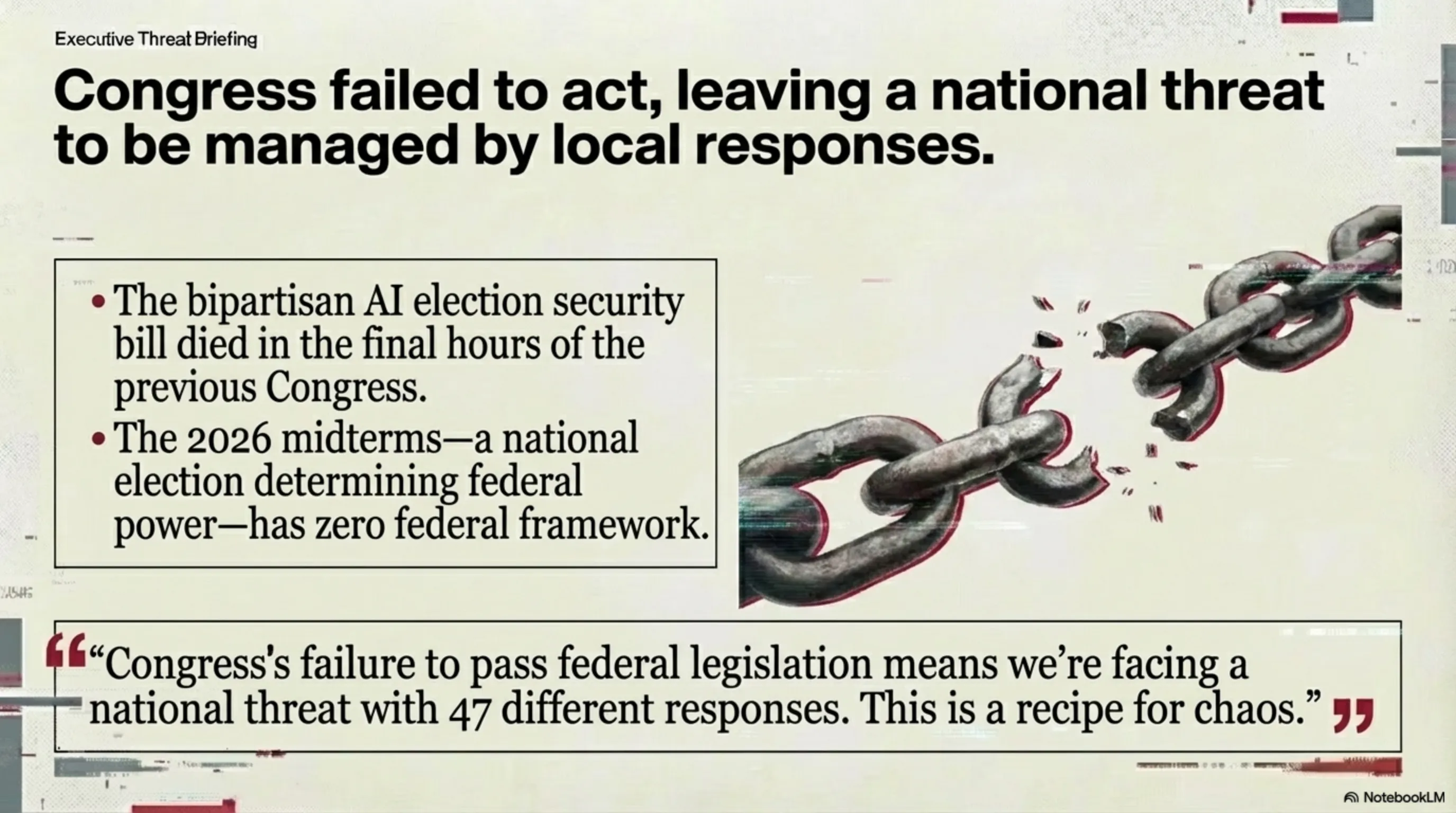
There was a bipartisan AI election security bill. It died in the final hours of the previous Congress. So the 2026 midterm elections — a national election — has no national framework.
The consequences? A patchwork of state laws. Interstate coordination is difficult. National campaigns face 47 different regulatory regimes. And gaps that bad actors can exploit.
This federal failure means states must act alone. But how do you manage a national threat with 47 local responses? The answer is simple: you can't.
Conclusion: An Election Where Reality Is Optional
The 2026 midterm elections will be unlike any election in American history. For the first time, anyone can create convincing fake political content in seconds. For the first time, we can't reliably distinguish real from fake. For the first time, the volume of potential fake content can overwhelm any moderation system.
The math is simple: 5 seconds to create. 48 hours to remove. Millions of potential creators. One election.
47 states have laws. But laws only work when you can enforce them. And how do you enforce something you can't detect?
Reality has become optional. And our democracy? Our democracy is learning to live in a world where you can't trust your own eyes anymore.
The question is no longer whether deepfakes will impact the 2026 elections. The question is how much — and whether we can keep democracy intact on the other side.
The May 19 deadline is coming. The tools are ready. The election is coming. And us? We're just hoping our laws are faster than our technology. Spoiler: they're not.
Technology Analysis Gallery