
1. The Medusa Philosophy: Killing the Bottleneck
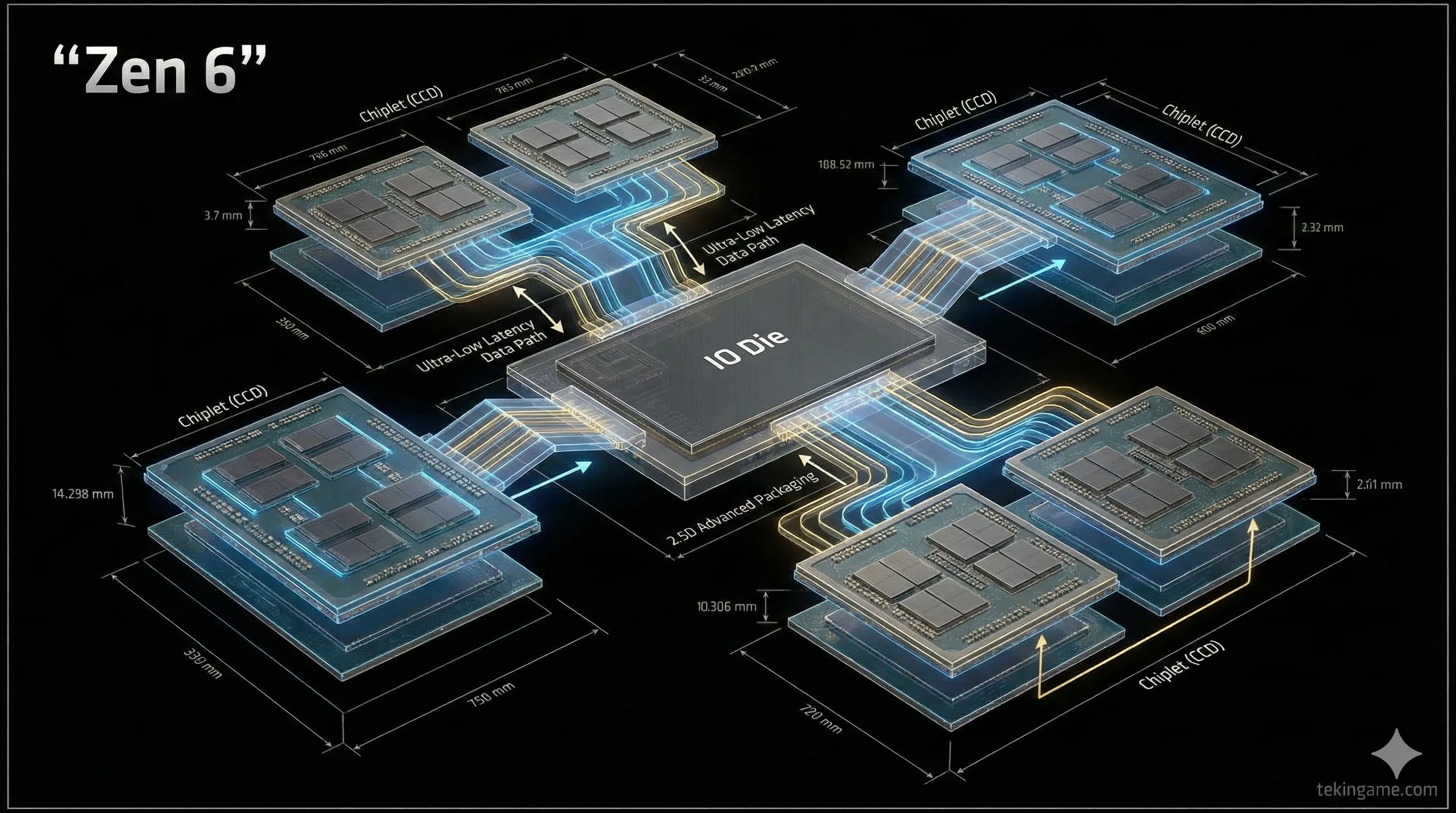
For years, the trade-off for AMD’s chiplet design was latency. When a core in CCD1 needed to talk to a core in CCD2, data had to travel via the Infinity Fabric across the substrate. This added nanoseconds of delay that Intel’s monolithic chips didn't have.
With Zen 6 (Codename: Medusa), AMD is changing the physics. By moving to a new interconnect topology, leaked diagrams suggest AMD effectively eliminates the penalty of cross-CCD communication. This makes the 16-core Ryzen 9 10950X behave less like "two 8-core CPUs glued together" and more like a unified 16-core monster.
2. Lithography: The N2 Advantage
The heart of the 10950X is forged by TSMC on the N2 (2nm) process node. This is a massive manufacturing risk, but the rewards are substantial.
N2 vs. N3: The Numbers
- Transistor Density: A projected 15-30% increase over the N3 node used in Zen 5. This allows for larger caches without increasing the die size.
- Power Efficiency: A 25-30% reduction in power consumption at the same speed. This headroom allows AMD to push clock speeds aggressively. We are hearing reports of boost clocks hitting 6.2GHz out of the box.
3. The 2.5D Revolution
This is the technical highlight. AMD is adopting 2.5D Advanced Packaging for the consumer desktop line.
Instead of routing wires through the organic substrate (the green PCB), the Chiplets (CCD) and the I/O Die (IOD) sit on top of a silicon interposer or utilize high-density bridges. This offers:
- Higher Bandwidth: Data moves between memory and cores significantly faster.
- Lower Energy: Moving data over shorter, denser connections consumes less power (pJ/bit).
This technology was previously reserved for expensive server CPUs (EPYC) and AI GPUs (MI300), but Medusa brings it to your gaming rig.
4. Integrated Graphics: RDNA 5
The days of "display adapter" integrated graphics are over. The Ryzen 9 10950X features an iGPU based on the RDNA 5 architecture.
With 4 to 8 Compute Units (CUs) clocked at high frequencies, this iGPU isn't designed to replace an RTX 5090, but it is powerful enough to run modern titles at 1080p/Medium settings. More importantly, it supports the latest media encoders (AV1/H.266), making this CPU a beast for video editors who need Quick Sync-style acceleration.
5. The AI Engine: 60 TOPS or Bust
In the era of Windows 12 and "AI PCs," the CPU alone isn't enough. The 10950X integrates a dedicated XDNA 3 NPU (Neural Processing Unit).
Targeting 60 TOPS (Trillions of Operations Per Second), this NPU handles background tasks like noise cancellation, webcam background blur, and local LLM inference (like running a private chatbot on your PC) without waking up the power-hungry GPU. This is crucial for future-proofing the system against Microsoft's increasing AI requirements.

6. Gaming Performance: The X3D Factor
Standard Zen 6 is fast, but the Ryzen 9 10950X3D (with 3D V-Cache) is the endgame.
By stacking a new generation of L3 cache directly over the cores using the 2.5D packaging, AMD has further reduced latency. Early projections suggest a 25% gain in CPU-bound titles like Factorio, Valorant, and Microsoft Flight Simulator 2024 compared to the 9950X3D. The "micro-stutter" often associated with multi-CCD chips is virtually gone.
7. Platform: AM5+ and CUDIMM
While AMD promised AM5 longevity, the physical limitations of the socket may require a revision. Enter AM5+.
While Zen 6 will likely fit in existing AM5 boards (with a BIOS update), unlocking its full potential requires new chipsets (X970). These boards will support CUDIMM (Clocked Unbuffered DIMM) DDR5 memory, allowing RAM speeds to exceed 10,000 MT/s stable. If you want the full bandwidth Medusa offers, you will need high-speed memory.
8. Final Verdict: The New King?
The Ryzen 9 10950X represents the maturity of the chiplet concept. AMD has finally solved the latency puzzle.
If you are currently on a Ryzen 7000 or Intel 13th Gen system, the jump to Zen 6 will be massive—not just in raw speed, but in platform efficiency and AI readiness. Intel has a mountain to climb if they want to compete with Medusa.
Inspector's Advice: Start saving. The combination of 2nm manufacturing and 2.5D packaging will likely make this the most expensive "mainstream" CPU AMD has ever launched. But it will be worth every penny.