
Tonight’s Tekin Night mega-report navigates the seismic shift from "Software-bound AI" to "Embodied AI" (AI with a physical form). We are witnessing the intentional dismantling of the smartphone era as Apple prepares its "Trinity of Wearables" (Project Atlas)—Glasses, Pendants, and IR-camera-equipped AirPods—designed to merge digital intelligence with human biological senses. Simultaneously, Meta’s push into real-time facial recognition on smart glasses signals the definitive end of public anonymity, transforming every citizen into a biometric
In 2026, technology is no longer a tool we hold; it is becoming half of our brain and the entirety of our biological senses. Tonight’s Tekin Night report explores the deepest layers of this silicon metamorphosis, where Artificial Intelligence has finally achieved a physical body, independent vision, and executive power. We are exiting the era of "Pure Software" and entering the age of "Embodied AI."
1. Apple’s Project Atlas: Dissecting the AI-Native Wearable Ecosystem

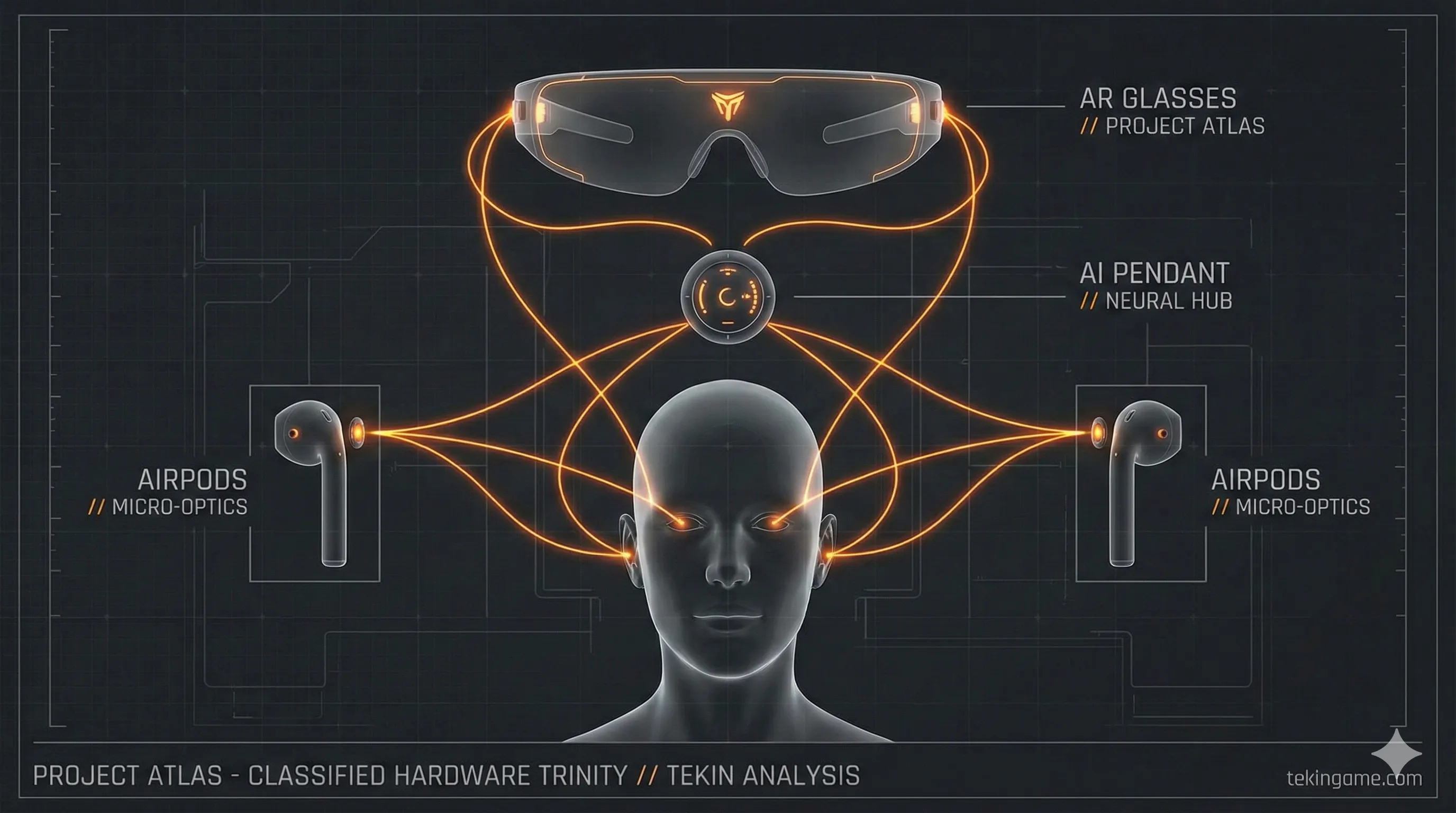
Apple has realized that the iPhone has reached its innovative ceiling. The smartphone form factor can no longer host the true potential of Generative AI. Under the ultra-secret Project Atlas, engineering teams in Cupertino are designing a world where "Seeing" and "Hearing" replace "Typing" and "Touching." Apple’s new trinity—Smart Glasses, AI Pendants, and Camera-equipped AirPods—is designed to feed environmental data directly into the Apple Intelligence neural engine in real-time.
1.1. IR-Airpods and Pendants: Why Spatial Intelligence Sensors are Replacing Touch
The idea of placing cameras in AirPods goes beyond simple photography. Technical analysis by Tekin reveals that these low-resolution Infrared (IR) cameras are tasked with scanning the user's "Field of View" as real-time depth maps. This data, processed via the H3 Chip, allows the user to interact with physical objects through a Voice User Interface (VUI). Apple’s AI Pendant acts as a "Neural Hub," filtering environmental noise and detecting "Context" in conversations. This marks the definitive transition from Graphical User Interface (GUI) to an Ambient Intelligence that predicts your needs before you even realize them.
2. Meta and the Biometric Gamble: Facial Recognition in an Age Without Anonymity
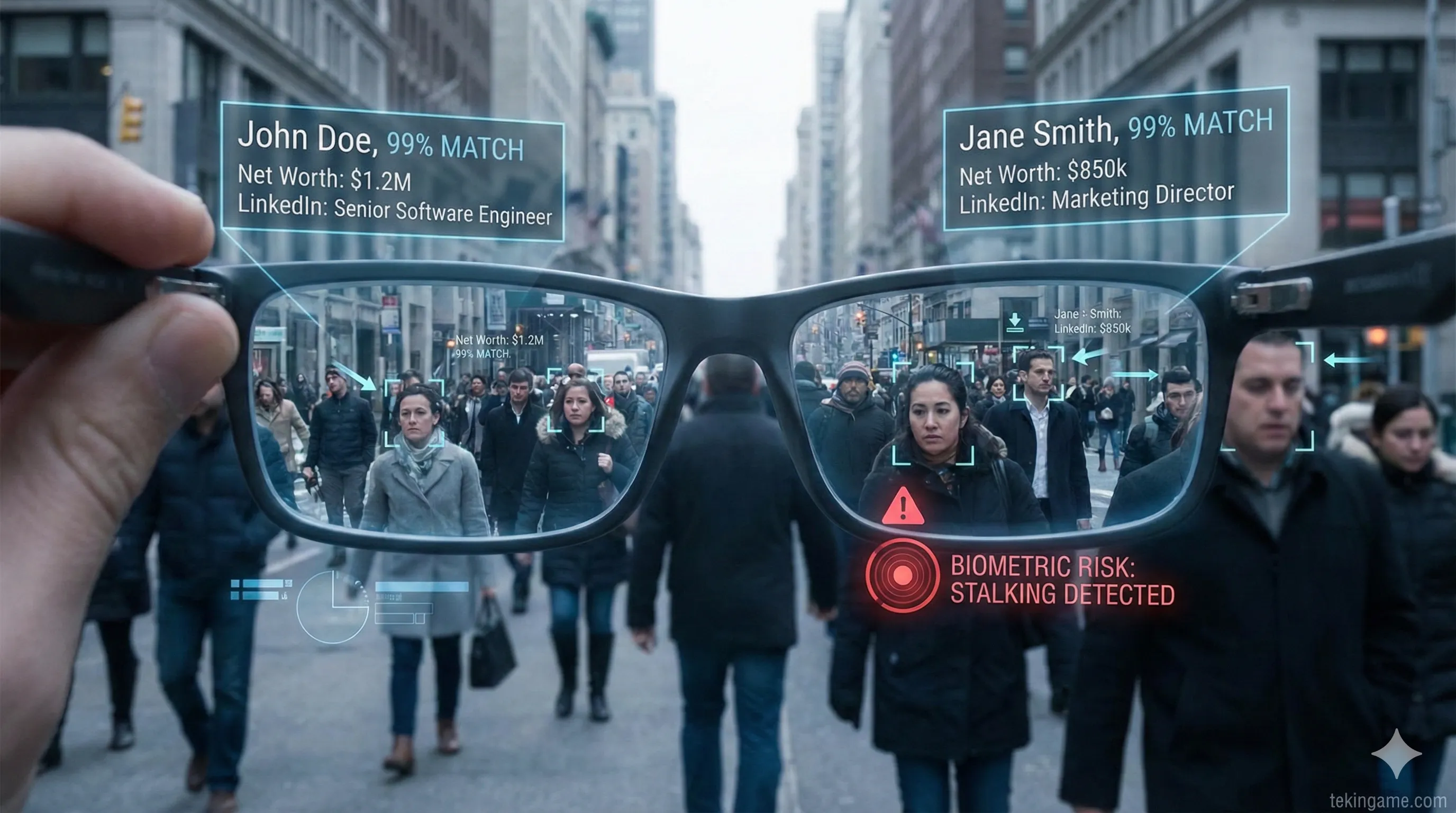
While Apple focuses on sensory companionship, Meta—under Mark Zuckerberg—is pursuing the most radical surveillance project in history: Real-time Facial Recognition on smart glasses. This capability, fed by the massive Instagram and Facebook databases, can reveal the identity and digital profile of any stranger in your field of vision within seconds.
2.1. Technical Analysis of Real-time Biometric Databases and Legal Implications
This technology utilizes advanced Biometric Embeddings, capable of identifying individuals with 99% accuracy even with partial facial obstruction. We are facing what analysts call a "Digital Panopticon"—a space where every citizen equipped with Meta glasses becomes a live biometric surveillance node. Privacy in 2026 is becoming a relic of the past. The primary risk lies in the aggregation of this data with social scoring systems and the potential for "Biometric Stalking" in public spaces, creating unprecedented legal challenges for global regulators.
3. The Neuromorphic Revolution: Shattering the Von Neumann Bottleneck

The greatest engineering hurdle in robotics has been the catastrophic power consumption of visual processing in traditional architectures. Classic chips (CPU/GPU) suffer from the "Von Neumann Bottleneck"—the constant shuffling of data between memory and processor, which leads to overheating and energy waste. The emergence of Neuromorphic Chips has shattered this historical stalemate.
3.1. Spiking Neural Networks (SNN) Architecture and Event-based Vision
Neuromorphic chips are inspired by the human brain's biological structure, operating on Spiking Neural Networks (SNN). The revolutionary difference is this: these chips only generate a signal when an "Event" or a change in sensory input occurs. If a robot stares at a static wall, the chip’s power consumption is near zero. However, the moment a tiny insect moves, the chip reacts at a nanosecond scale. This enables surgical robots with infinite precision and drones that can fly and analyze environments for hours on a single small battery.
| Engineering Metric | Traditional Processors (Von Neumann) | Neuromorphic Processors (SNN) |
|---|---|---|
| Activity Pattern | Continuous (Clock-driven) | Asynchronous (Event-driven) |
| Idle Power Consumption | High (Watts) | Negligible (Microwatts) |
| Processing Latency | Variable (Frame-rate dependent) | Real-time (Near-zero) |
| Learning Capability | Requires massive cloud updates | On-chip Learning (Plasticity) |
4. Autonomous Agents in FinTech: Banking Without Human Intervention
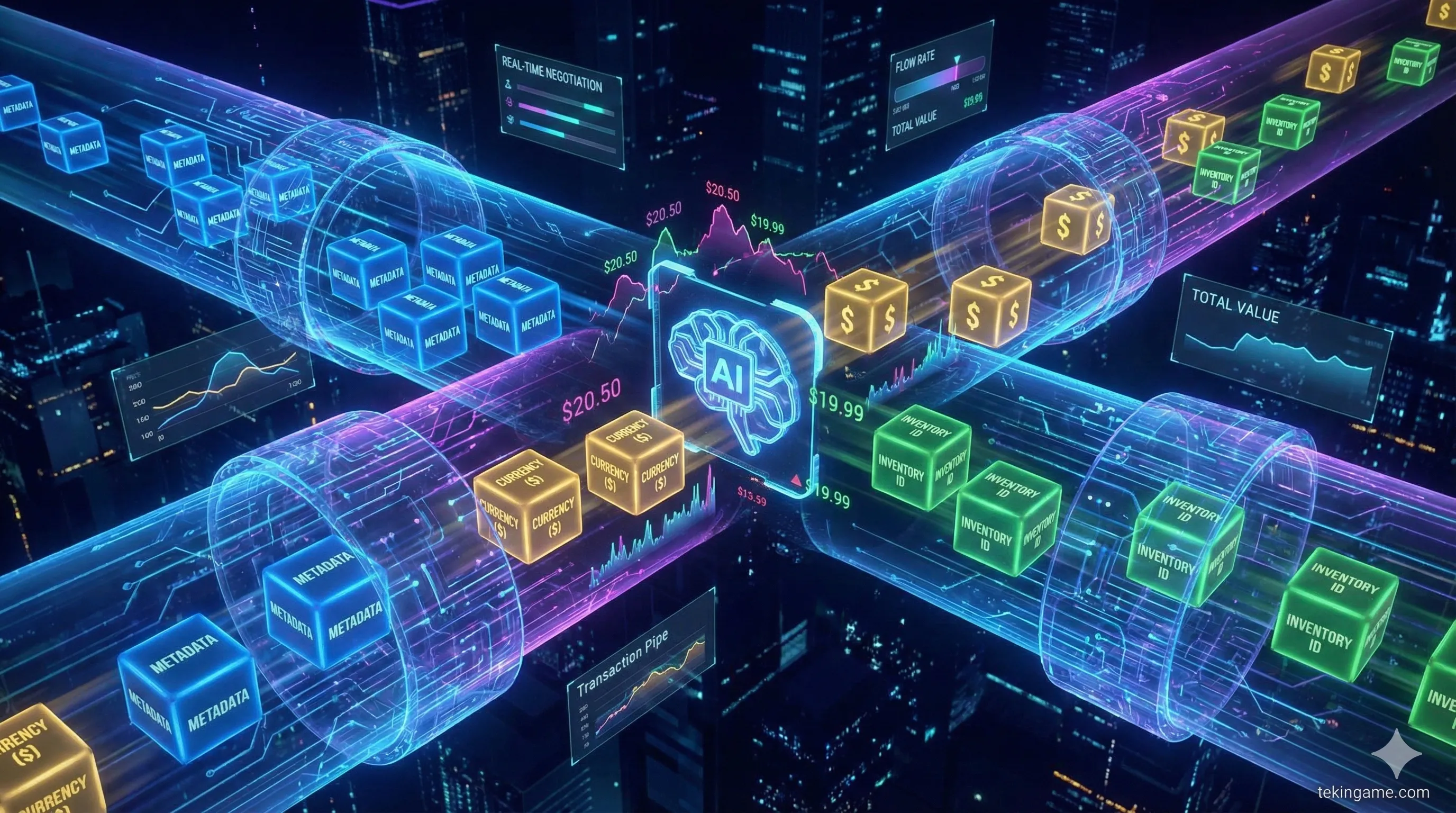
DBS Bank of Singapore, in collaboration with Visa, has entered a new economic phase: the Agentic Economy. We are moving past the stage where AI merely "advised" us; AI agents have now been granted the authority to independently finalize financial transactions. This system operates under a strict security framework where each agent possesses a "Verified Credential" digital identity.
4.1. Dissecting the Visa-DBS Protocol: Agents and the Tokenomics of ISO 20022
Under this protocol, the AI agent can manage your shopping cart, compare prices, and finalize the transaction at the optimal moment (e.g., during a price drop or currency fluctuation). The system utilizes the ISO 20022 standard for financial messaging, allowing the AI to understand rich metadata in every transaction. Security is guaranteed by multi-step digital signatures; the user sets a budget ceiling, and the agent possesses "Financial Signature" power within that framework.
5. Goldman Sachs and Anthropic: AI Orchestration at the Heart of Wall Street
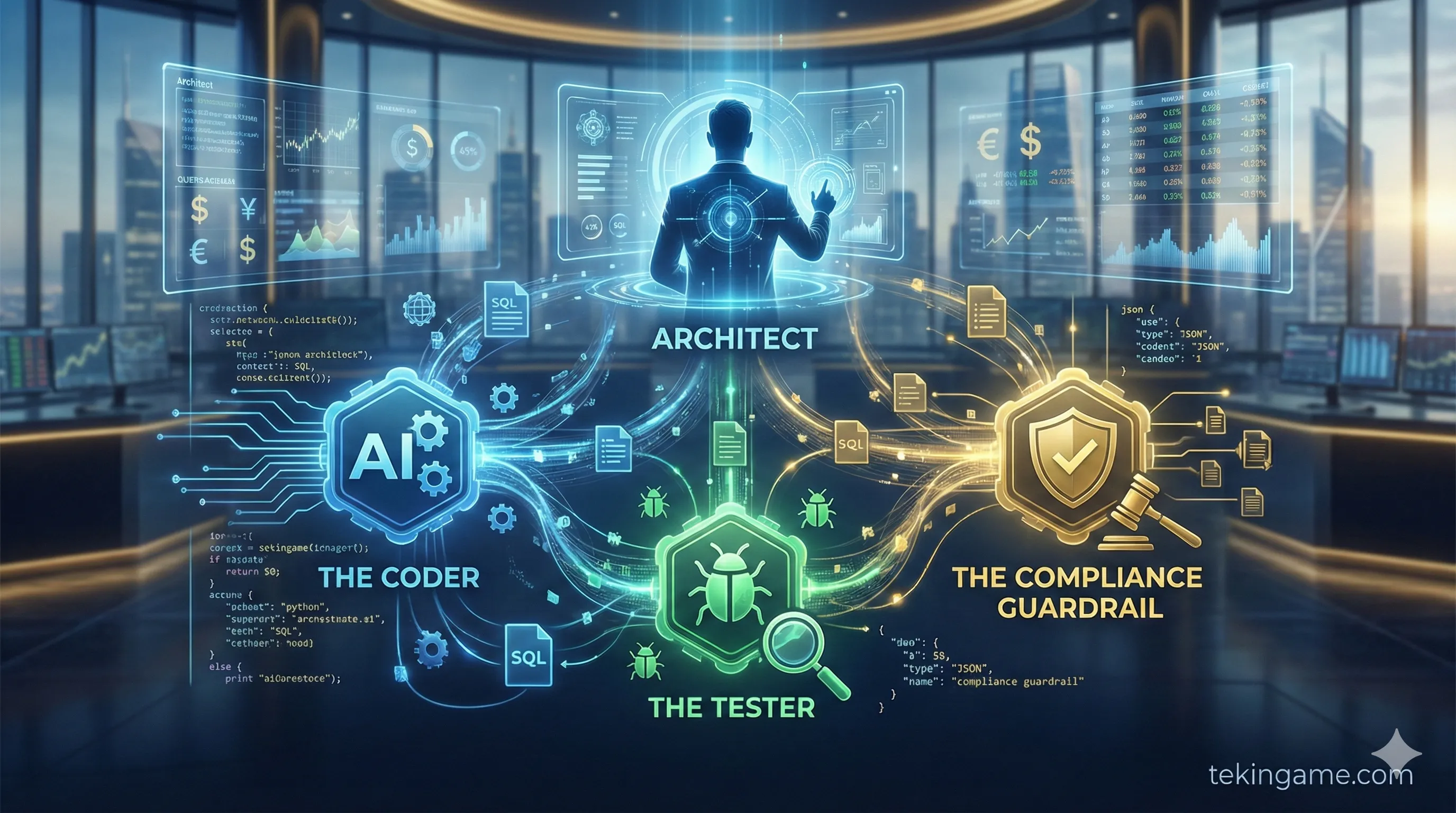
Even the most conservative financial institutions like Goldman Sachs have realized that to survive in 2026, they must rely on "Orchestration Agents." The bank has announced the use of Anthropic’s Claude 3.5 models to manage critical layers of software development and risk analysis. The choice of Anthropic is driven by their Constitutional AI architecture, which minimizes the risk of "Hallucination" and ensures compliance with strict financial regulations.
Goldman Sachs utilizes an orchestration layer where multiple AI agents perform different tasks: one writes code, another tests its security, and a third checks its compliance with banking laws. This "Army of Agents," under final human supervision, has increased the development speed of complex financial tools by 400%. Power is shifting from traditional coders to "AI Orchestration Architects."
6. AMD’s Content-First Strategy: Crimson Desert as a Hardware Marketing Weapon
In the gaming hardware front, AMD is executing a brilliant tactical maneuver to weaken Nvidia’s monopoly. The new bundle, gifting the highly anticipated Crimson Desert to buyers of Ryzen CPUs and Radeon GPUs, is a symbolic move to showcase the power of the RDNA 3.5 and Zen 5 architectures.
Crimson Desert, built on a proprietary engine by Pearl Abyss, is one of the most demanding games in history, utilizing advanced Real-time Global Illumination and complex physics. AMD aims to prove that through FSR 3.1 and raw hardware performance, they can offer a smoother and more affordable experience than Nvidia-based systems. This is a "Benchmark War" in the real world; instead of slides and numbers, AMD is gifting a "Breathtaking Visual Experience" as proof of its superiority.
The Final Verdict: Tekin Analysis Newsroom
- 🚀 The Biological Shift from iPhone: Apple is testing a world where "Information" becomes part of our biological senses. The iPhone is becoming a "Backup Brain" in our pocket, not the primary interface.
- 🔐 Identity as Data: Facial recognition in Meta’s glasses is the death knell for public anonymity. We must prepare for a world where there are no strangers.
- 🧠 Intelligence at the Edge: Neuromorphic chips prove that to have a smart robot, you don't need a power plant; you just need architecture inspired by the brain.
- 💰 Autonomous Money: When AI agents gain payment authority, we are effectively delegating our "Economic Will" to algorithms for a more optimized life.
Commander, tonight's report shows that the boundaries between silicon and biology are fading. Are you ready to let an algorithm spend your money and a pair of glasses reveal the identity of everyone around you?