
1. The Lenovo Controversy: When a Monitor Gives You "Wall-Hacks"
Let's start with the most explosive story of the last 24 hours, one that has set Twitter and Reddit on fire. At their CES booth, Lenovo unveiled a new monitor concept dubbed the Legion AI Frame. At first glance, it looks like a premium 360Hz OLED panel, but the secret lies inside: a dedicated Neural Processing Unit (NPU) that "watches" your gameplay.
What is "Auto-Target Highlight"?
This monitor analyzes the raw video output from your GPU. Using computer vision, it identifies character models (enemies). The controversial feature, "Auto-Target Highlight," draws a high-contrast red box around enemies, even if they are camping in dark shadows or barely visible on the minimap. It essentially gives you superhuman vision.
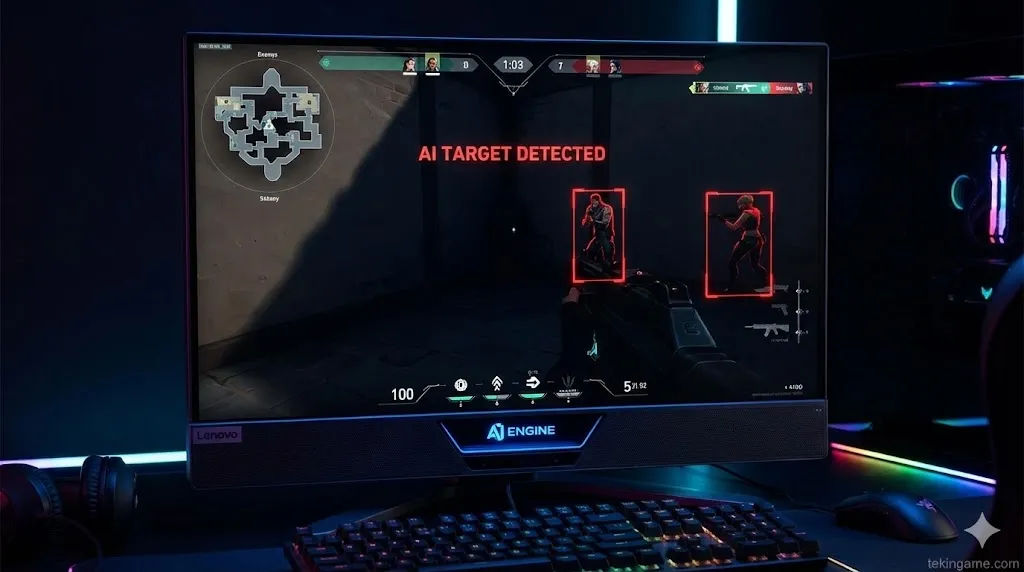
Why is this considered "Cheating"?
Traditional anti-cheat software like Ricochet (Call of Duty) or Vanguard (Valorant) operates at the Operating System level, scanning for software injections. The Legion AI Frame, however, is purely hardware-based. It doesn't touch the game files; it only processes the final image. Therefore, anti-cheat systems are blind to it. It is undetectable.
Top streamers are calling this the "Death of Competitive Gaming." Lenovo claims this feature is for "Accessibility" to help visually impaired gamers, but let's be honest: this is a tool that turns "noobs" into "pros" for a $1,200 price tag. Are you willing to pay for such an unfair advantage? Or would you rather sharpen your actual skills with standard pro-grade gaming gear and practice?
2. Razer Project Ava: Goodbye Alexa, Hello Hologram in a Glass Tube
Razer is known for bringing the craziest concepts to CES (remember the RGB face mask?). But this year, they have transcended gadgets and entered the realm of emotional connection with Project Ava.
Project Ava is a sleek, smoked-glass cylinder standing about 30cm tall. Inside lives a fully 3D, full-color holographic avatar. This character, powered by a localized Generative AI model, is not just a smart speaker; she is a "Gaming Companion."
What can Ava do?
- Emotional Sync: By connecting to your game client, Ava knows if you are winning or losing. If you die in Elden Ring for the 50th time, she will offer sympathy (or sarcastic encouragement).
- Environment Control: Ava acts as the brain of your Razer Chroma ecosystem. Playing a horror game? She dims the room lights to a blood red. Win a match? She throws a victory light show.
- Stream Assistant: For streamers, Ava can read chat, thank subscribers, and even clip highlights in real-time.
The tech uses transparent Micro-LED displays and head-tracking to create the illusion of depth. It hasn't been priced yet, but it will undoubtedly be the ultimate flex for gaming setups in 2026.

3. Intel Panther Lake: The Handheld Console War Just Got Real
Following the massive success of the Steam Deck and ROG Ally, the "Blue Team" is finally making its move. Intel CEO Pat Gelsinger officially confirmed that the Panther Lake series processors, designed specifically for handheld devices, will hit the market by mid-2026.
This news signals the end of AMD's monopoly (Z1 Extreme series) in this sector. Intel's new chips promise to reduce battery consumption by 50% while doubling graphical performance via the new Xe3 architecture. In practical terms: instead of playing Cyberpunk 2077 for 1 hour on battery, you could get 2 to 2.5 hours.

Simultaneously, leaks regarding the Lenovo Legion Go 2 suggest it will feature an OLED screen and likely use this very Intel chip. If you, like us, are waiting for the next generation of handheld consoles, this year is going to be a bloodbath of hardware competition.
4. Form Factor Revolution: Motorola's Rolling Phone & Expanding Laptops
It seems the era of "Folding" is ending, and the era of "Rolling" has begun. Motorola (a Lenovo subsidiary) showcased the Razr Fold 2026 concept, where the screen physically extends from the bottom of the device, changing the phone's aspect ratio on the fly.

Even more impressive is Lenovo's laptop concept. Imagine a standard 13-inch laptop that, with the push of a physical button, mechanically expands its screen sideways to become a 21-inch Ultra-Wide monitor! This technology utilizes flexible POLED panels from Samsung Display.
The Advantage? No more "Crease"! Current foldable phones always have a visible line in the middle, but with rollable screens, the surface remains perfectly smooth. While the internal motor mechanics raise durability concerns regarding dust, this is undeniably the future form factor of mobile computing.
5. Nvidia G-Sync Pulsar: The Official End of Motion Blur

Shooter fans (CS2, Valorant, Rainbow Six), listen up. Nvidia has introduced a new technology called G-Sync Pulsar, which might be the most significant monitor advancement in five years.
Motion Blur has always been the enemy of precision. Previous technologies like ULMB (Ultra Low Motion Blur) worked by strobing the backlight, but this often reduced brightness or caused flickering. Pulsar uses a new Variable Frequency Strobe (VRR) algorithm to reduce image blur to absolute zero, without sacrificing brightness or fluidity. This results in motion clarity equivalent to a 1000Hz monitor!
Nvidia also teased the Vera Rubin supercomputer platform, powering the next generation of physical AI. While this is enterprise-grade tech, features like Pulsar will trickle down to the upcoming RTX 50 series GPUs. (For more on the RTX 5090, check out our Tekin Night coverage from yesterday).

6. Red Security Alert: DarkSpectre Malware Infects 8 Million Users
And now, the critical warning. Cybersecurity firm CrowdStrike has issued an urgent report regarding a new malware strain named DarkSpectre found in over 20 popular Chrome and Edge browser extensions.
What does it do?
These extensions—often masquerading as "Instagram/YouTube Downloaders," "Free VPNs," or "Dark Mode Themes"—function normally on the surface. However, in the background, they hijack your Session Cookies. This allows hackers to bypass passwords and 2FA codes, logging into your Google, Steam, or Crypto Exchange accounts as if they were you sitting at your computer.
Commander, what is the immediate protocol?
- Go to your Browser Extensions menu right now.
- Remove any extension you do not recognize or haven't used in months.
- If you notice any suspicious behavior (like auto-logouts), change all critical passwords immediately.
We previously warned in our Deep Dive on Google Jarvis that browsers are the primary attack vector for 2026. Please take your digital hygiene seriously!
🛑 Debate: Cheat or Tech?
Should Lenovo's new monitor that highlights enemies be banned from online play?
Or is this just "technological progress" that we must accept?
Drop your thoughts on "Legal Cheating" in the comments! 👇