Today, Monday, February 23, 2026, The New York Times published a comprehensive analytical piece officially declaring the end of "traditional programming" and the dawn of the "Light-Speed Coding" era. Today's Tekin Analysis puts this massive claim under a rigorous engineering and economic microscope. We are rapidly transitioning from an era where 300-person engineering teams spent months developing software, to a reality where a 3-person team, armed with autonomous AI Agents, can deploy enterprise-scale products in a matter of days. This softwa
The software world is experiencing its most profound metamorphosis since the invention of the compiler. Today's New York Times editorial confirmed that we have officially entered the era of "Light-Speed Coding." Today's Tekin Analysis report is a ruthless, deep-dive autopsy of this phenomenon—a reality where AI is no longer merely a "Copilot" or auto-complete assistant, but has evolved into an entire autonomous development squad.
1. Light-Speed Coding: When the Prompt Replaces the Syntax

The concept of "Light-Speed" in the NYT report is not a journalistic metaphor; it is a cold, hard engineering reality in 2026. In the recent past, translating a business idea into a functional software application required months of architecture planning, relentless debugging, and translating human logic into complex syntax using languages like Python, C++, or Rust. Today, the friction between "envisioning a product" and "deploying it to production" has been reduced to mere minutes.
1.1. The Transition from Legacy IDEs to Agentic Development Environments (Agentic IDEs)
Traditional Integrated Development Environments (IDEs) are facing extinction. We are witnessing the explosive rise of Agentic IDEs. In these modern environments, you do not type code; instead, you feed a Product Requirements Document (PRD) written in natural language into the system. The framework instantly shatters this document into hundreds of micro-tasks and distributes them across specialized agents. One agent architects the PostgreSQL database schema, another writes the RESTful APIs, and a third renders the React frontend based on color psychology and UX telemetry. This marks the definitive replacement of mechanical coding with strategic architectural thinking.
📌 Strategic Checkpoint 1 (Tekin Newsroom)
The paradigm shift from "manual coding" to "prompt-driven generation" has elevated English (or any natural language) to the most powerful programming language on Earth. In 2026, a developer's true value is no longer measured by their syntax memorization, but by the clarity of their logic and the expressive power of their architectural vision.
2. The Fall of Software Empires: The End of the Bloatware Era
The New York Times accurately points out that combining AI agents with deployment tools has sounded the death knell for "Legacy Software Empires." Previously, building an enterprise-scale platform required a bloated 300-person hierarchy: product managers, backend engineers, frontend devs, QA testers, and DevOps teams. This massive human overhead inherently generated Bloatware—heavy, sluggish software riddled with redundant code—and crippling corporate bureaucracy.
2.1. The Rise of "One-Person Unicorns" in Silicon Valley
We are now tracking a phenomenon that Venture Capitalists (VCs) call the "One-Person Unicorn." A single, brilliant developer armed with premium subscriptions to AI orchestration agents can single-handedly build a product capable of competing with titans like Microsoft or Salesforce. The agents don't just write the codebase; they optimize database queries, manage dynamic load balancing on AWS, and even handle Level-1 customer support. This radical decentralization of software production power has triggered a true renaissance: an era where the quality of the idea definitively crushes the sheer headcount of employees.
| Development Metric | Legacy Teams (300 Headcount) | Agent-Centric Teams (3 Headcount) |
|---|---|---|
| Financial Burn Rate | Millions of dollars per month | A few thousand dollars (Server + API tokens) |
| Agility & Pivoting | Extremely Low (Trapped in meetings & bureaucracy) | Extremely High (Complete architecture rewrite in 24 hours) |
| Code Consistency | Low (Fragmented styles across human devs) | Absolute (Strict adherence to algorithmic style-guides) |
📌 Strategic Checkpoint 2 (Tekin Newsroom)
The software renaissance means the barrier to entry for disruptive startups has dropped to near-zero. Tech behemoths can no longer rely on "massive capital" to crush competitors; in the upcoming wars, Algorithmic Agility is the ultimate weapon.
3. CI/CD Metamorphosis: Fully Autonomous Integration and Deployment
One of the most brilliant insights in the NYT analysis is the evolution of CI/CD (Continuous Integration / Continuous Deployment) pipelines. In the past, pushing a new feature to production servers was a stress-inducing nightmare, usually executed at 3 AM with dozens of engineers on standby. Today, we have entered the era of Autonomous CI/CD.
3.1. AI-Driven Penetration Testing and the Eradication of Human Error
Today, when a Coding Agent generates a script, a secondary AI known as a "Red Team Agent" immediately blasts it with hundreds of simulated attack vectors to uncover zero-day vulnerabilities or memory leaks. If the code is verified secure, the Deployment Agent automatically containerizes it via Kubernetes and orchestrates the cloud rollout. If an anomaly occurs in the live production environment, the AI monitoring system detects the latency spike in milliseconds, initiates an instant rollback, and simultaneously writes an emergency patch—all before a human engineer even receives the server down alert.
📌 Strategic Checkpoint 3 (Tekin Newsroom)
Removing humans from the CI/CD pipeline equates to eliminating 99% of catastrophic deployment errors. Absolute trust in total automation is the secret sauce for modern teams pushing dozens of updates daily with zero downtime.
4. The Developer's Evolution: From Code Typist to System Architect

Has AI rendered programmers obsolete? Tekin Analysis reveals that the definitive answer is "No," but it has triggered a genetic mutation in their role. We are witnessing the mass extinction of "Junior Code Typists" and the meteoric rise of "System Architects."
4.1. Orchestration Engineering as the World's Premier Profession
A software developer in 2026 no longer wastes hours hunting for a missing semicolon or writing boilerplate SQL queries. Their job is now Orchestration. Like a master conductor, they manage a symphony of highly specialized agents. Their primary mandate is to design macro-architectures, dictate data flow topology, enforce zero-trust security parameters, and align the machine-generated codebase with the company's core business objectives. Today's developers are the CEOs of their codebase.
📌 Strategic Checkpoint 4 (Tekin Newsroom)
A software engineer's worth is no longer calculated by their typing speed (WPM) or the number of programming languages they've mastered. Value is now strictly determined by their ability to guide, supervise, and relentlessly refine the output of AI foundation models.
5. Technical Challenges: Deep-Layer Algorithmic Hallucination
Despite these utopian breakthroughs, The New York Times closes its piece by sounding a massive alarm—an alarm we at Tekin Analysis echo loudly. Surrendering the entirety of development to machines introduces a stealthy, catastrophic risk known as "Deep-Layer Algorithmic Hallucination."
5.1. Managing Technical Debt in Machine-Generated Codebases
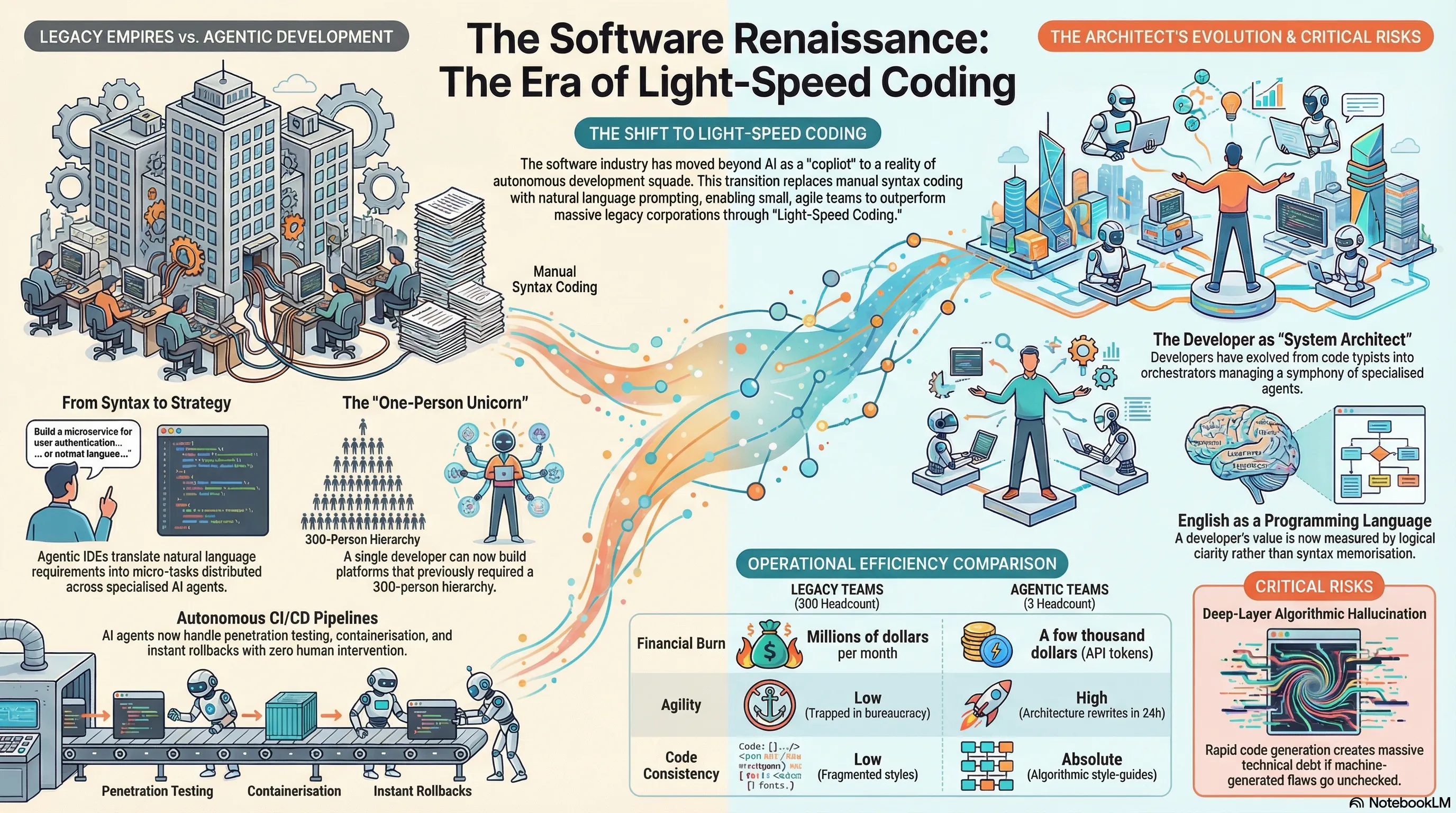
When agents generate tens of thousands of lines of code at light-speed daily, the codebase scales exponentially. If an agent implants flawed logic into the core foundation (a hallucination), and subsequent agents build massive features on top of that flawed foundation, it creates an avalanche of catastrophic technical debt. Identifying and debugging these localized hallucinations in a system where no human has ever read the source code line-by-line can be exponentially harder than building the system from scratch. Therefore, without rigorous "Human-in-the-Loop" oversight at the architectural layer, this extreme velocity could spawn uncontrollable software monsters rather than agile unicorns.
The Final Verdict: Tekin Analysis Newsroom
- 🚀 Coding as a Strategic Skill: The era of "typing syntax" is officially dead. English (prompting) and deep system architecture comprehension are now the most critical developer skills.
- 💥 The End of Monopolies: Autonomous agents have violently leveled the playing field. A 3-person garage startup can now deploy infrastructure that yesterday required the capital of a Silicon Valley titan.
- ⚙️ The Dictatorship of Autonomous CI/CD: Teams still relying on manual deployment and QA testing will be utterly destroyed by competitors pushing automated updates at the speed of light.
- ⚠️ The Paradox of Tech Debt: Light-speed code generation requires massive "security brakes" and architectural oversight; otherwise, agents will build labyrinthine systems they themselves cannot debug.
Commander, the NYT report only exposed the tip of the iceberg. The Software Renaissance has begun, and the "Light-Speed Coding" train has left the station. Startups and enterprises that fail to weaponize their own army of agents today will be buried in the graveyard of tech history tomorrow!