
The global technology ecosystem is colliding head-on with an insurmountable physical and macroeconomic barrier at breakneck speed: "The Memory Wall." While global attention and venture capital have been hyper-focused on the scarcity of raw Graphics Processing Units (GPUs), Demis Hassabis (CEO of Google DeepMind) recently dropped a bombshell revelation. The true, fatal bottleneck paralyzing the industry today is not compute power, but the severe shortage and astronomical pricing of high-speed memory chips, specifically advanced HBM (High Bandwid
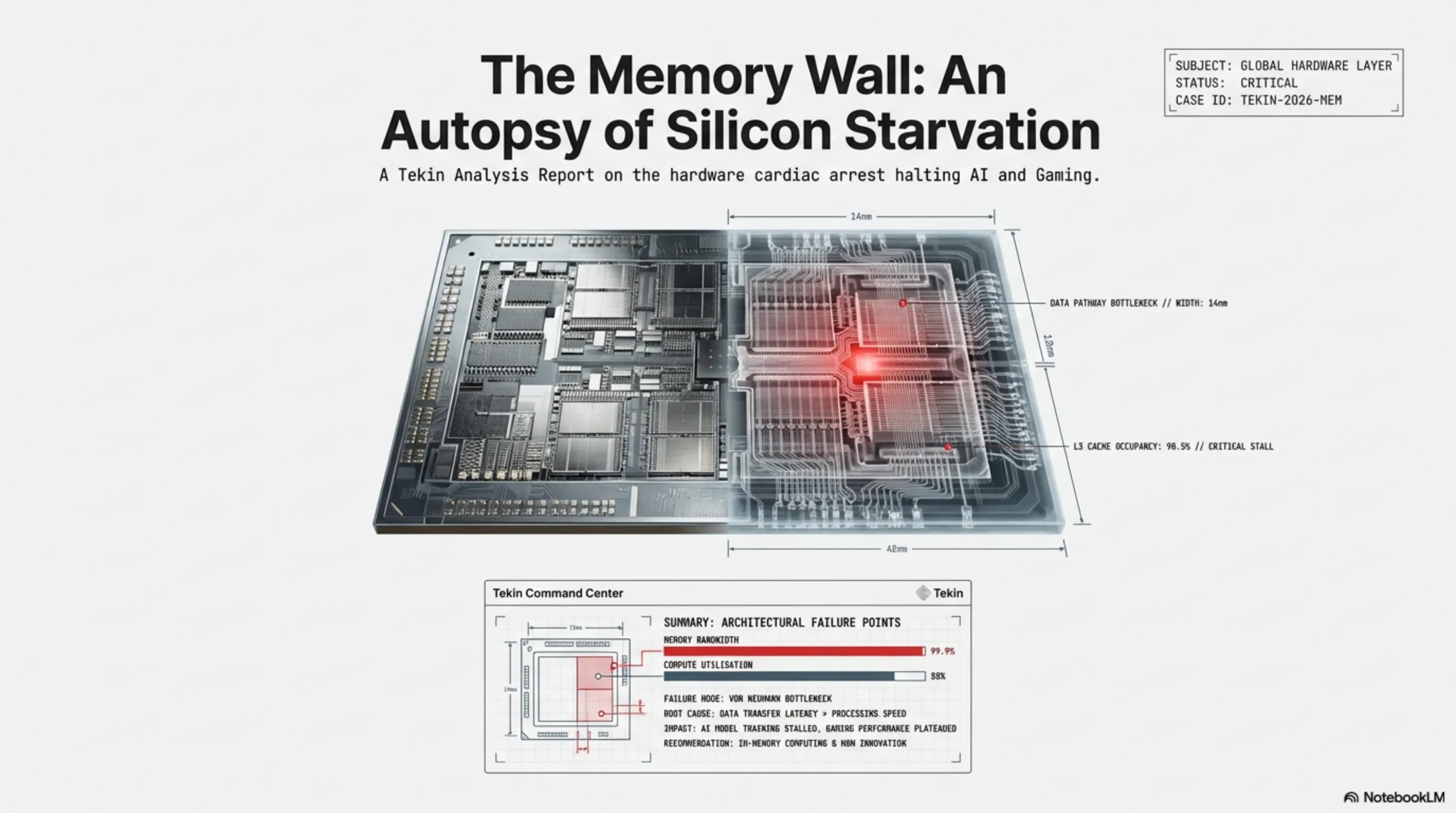
The technology industry is experiencing a silent, massive cardiac arrest at the foundational hardware layer. Today's Tekin Analysis report is a deep-dive autopsy of a systemic crisis that proves how a seemingly simple component known as memory can halt humanity's most ambitious projects—from achieving Artificial General Intelligence (AGI) to rendering true photorealistic, path-traced graphics in next-gen gaming.
1. Debugging the Crisis: When Silicon Monsters Starve
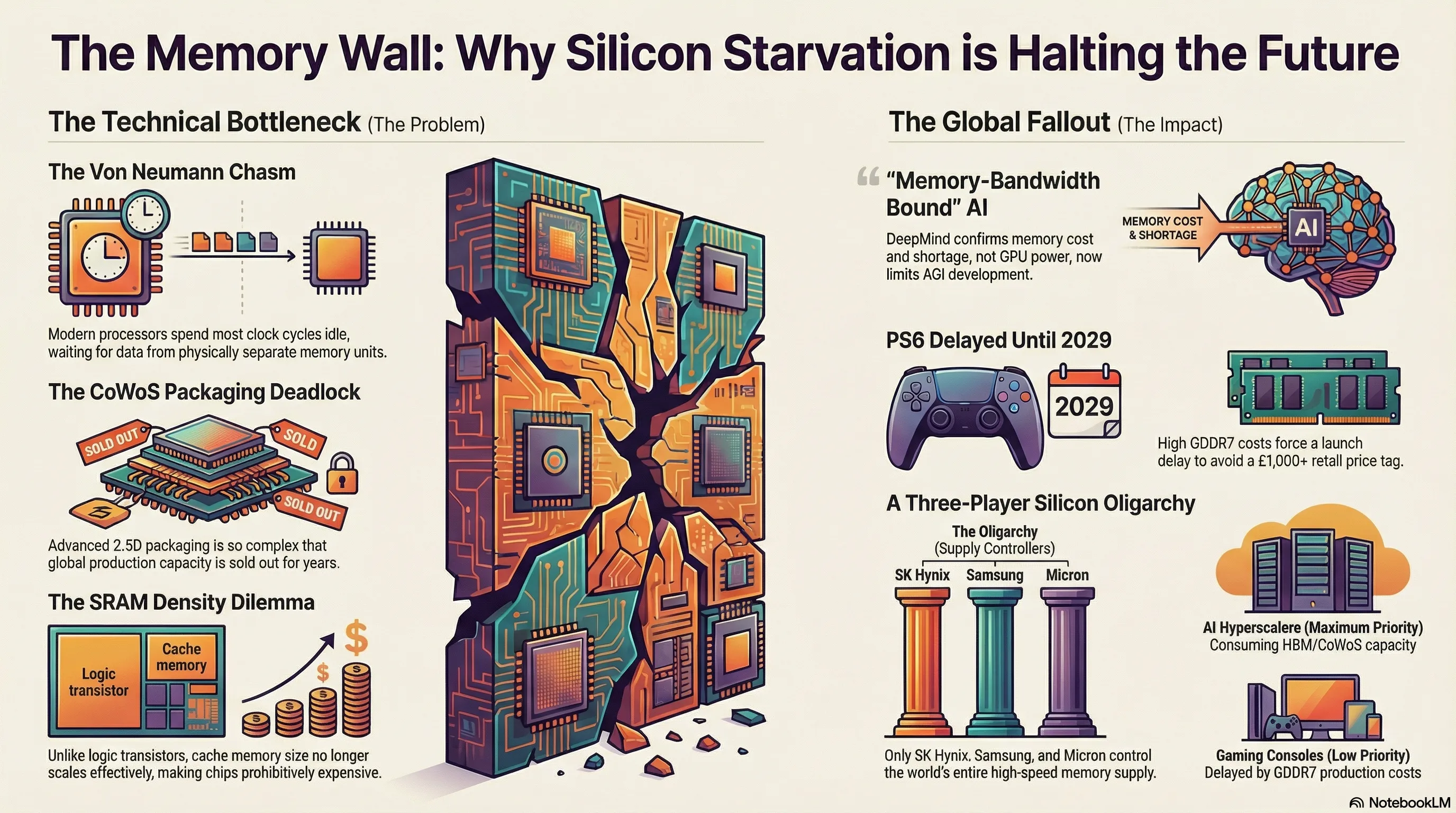
Until a few months ago, the leading headline across all tech media and the primary anxiety of Wall Street investors was the "severe shortage of NVIDIA AI processors." However, Demis Hassabis, the legendary leader of Google DeepMind and one of the founding fathers of modern AI, put his finger on a much deeper, more lethal wound in a recent public revelation. He officially declared that the primary obstacle to training larger, smarter, and multimodal AI models is no longer just raw GPU compute power, but the terrifying shortage and exorbitant cost of high-speed memory arrays.
1.1. DeepMind's Historic Confession: HBM, the New Gold Standard
Gigantic Large Language Models (like Gemini 1.5 Pro or GPT-5) are fundamentally memory-bandwidth bound, not compute-bound. Processing trillions of parameters simultaneously requires feeding the GPU cores with astronomical amounts of data every millisecond. You simply cannot stack this volume of data on standard DDR memory. HBM (High Bandwidth Memory) technology is the only current engineering solution capable of force-feeding data fast enough down the throats of data-starved NVIDIA Hopper and Blackwell architectures.
1.2. The TSMC Packaging Bottleneck (CoWoS): Why Money Can't Buy Memory
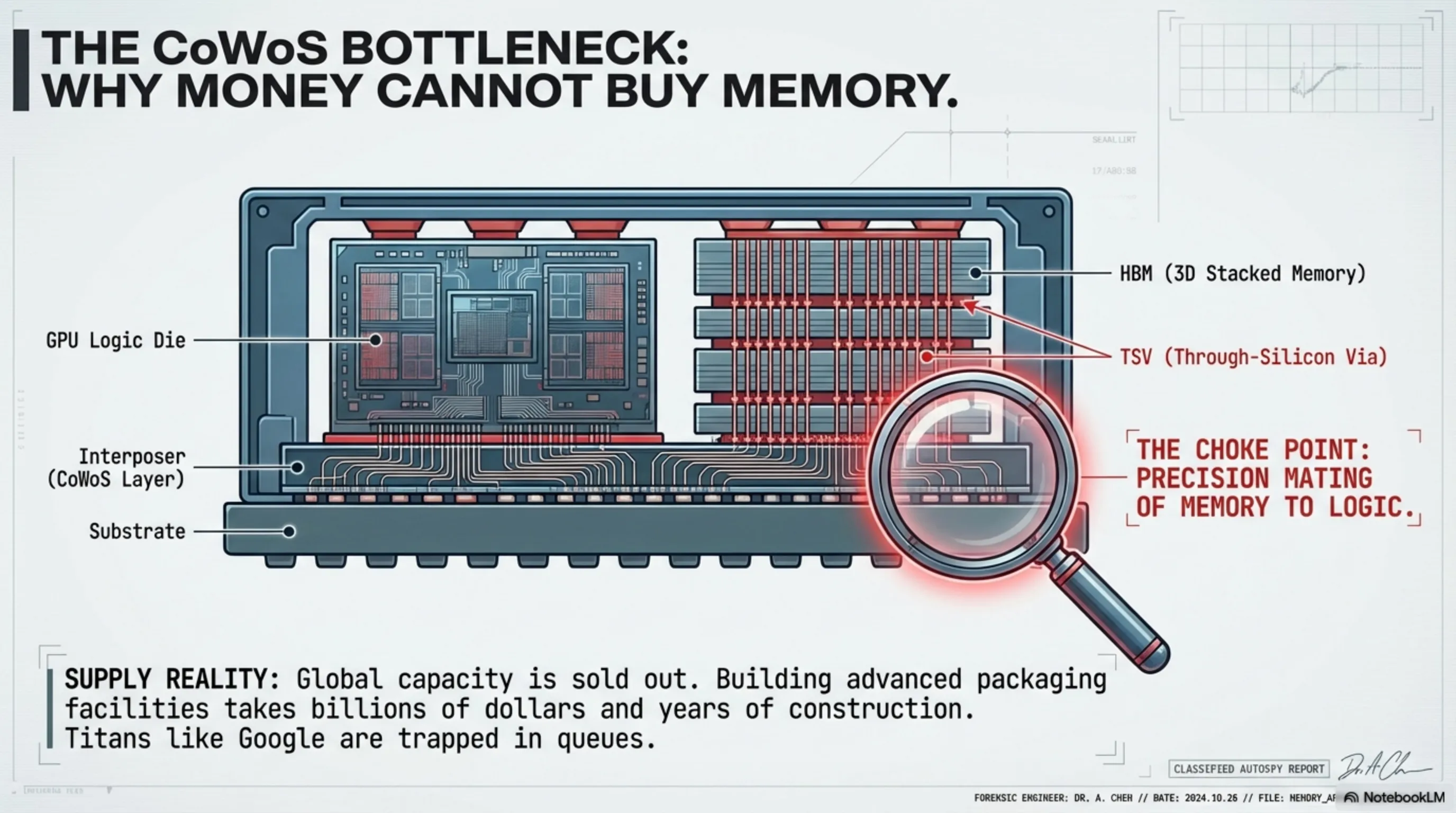
Manufacturing HBM3e chips (and their successors) is obscenely complex. These memory dies are stacked vertically (3D Stacking) and electrically connected via thousands of microscopic pathways known as TSV (Through-Silicon Via). Yet, the core crisis isn't even the fabrication of the memory chip itself; it is the delicate process of mating these memory stacks directly adjacent to the GPU logic die. This requires TSMC's ultra-advanced, proprietary 2.5D packaging technology known as CoWoS (Chip-on-Wafer-on-Substrate).
Global CoWoS packaging capacity is severely constrained. Building a new advanced packaging facility takes years and billions of dollars; it is not a bottleneck that can be solved simply by throwing more venture capital at it. The manic, desperate demand from AI hyperscalers has resulted in the entire global production and packaging capacity for HBM being sold out for years in advance. The result? Titans like Google are trapped in endless supply chain queues, and a massive chunk of their research momentum is effectively paralyzed while they wait for hardware.
📌 Strategic Checkpoint 1 (Tekin Command Center)
Owning the world's fastest and most expensive GPU, when you cannot feed data to it at an equal velocity, is exactly like putting a 1,000-horsepower Formula 1 engine on a heavy tractor chassis! Artificial Intelligence is literally suffocating from memory bandwidth starvation.
2. The Blast Radius in Gaming: Why PS6 is Quarantined Until 2029
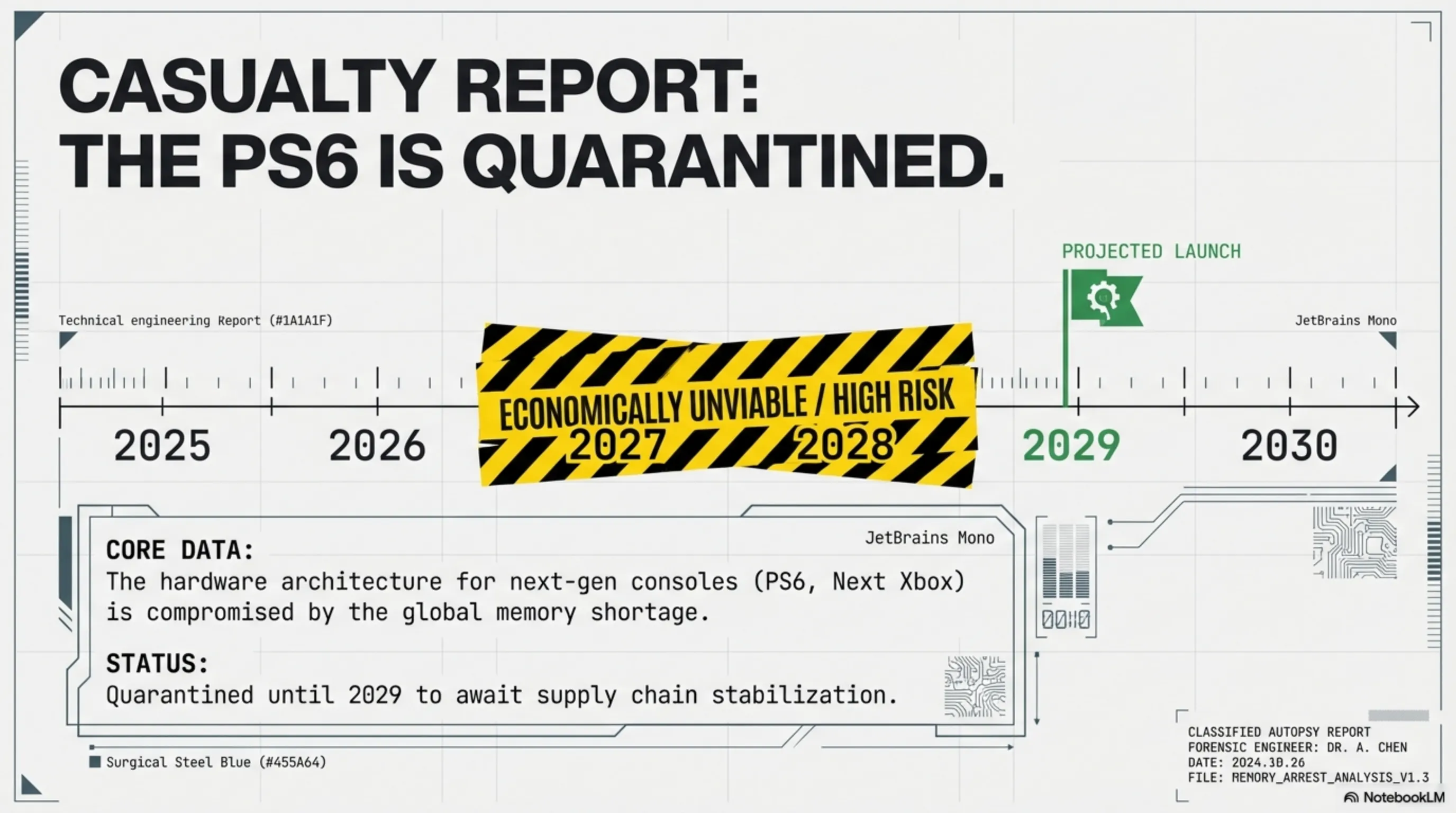
The shockwave of the memory crisis has shattered the fortified walls of hyperscale data centers and slammed directly into the living rooms of gamers worldwide. Deep industry reports from TechRadar and senior supply-chain analysts indicate that the hardware architecture of the next PlayStation (PS6) and next-gen Xbox is severely compromised by this global shortage. Whispers of a delayed 2029 launch have morphed from a pessimistic rumor into a highly probable, unavoidable commercial scenario.
2.1. The Ruthless Console Economy: GDDR7 Costs vs. Subsidized Pricing
For decades, the console business model has relied on a very specific macroeconomic equation: shipping powerful hardware at a subsidized price at launch. Sony and Microsoft sell the physical console at a loss (e.g., $499 or $599) with the explicit goal of recouping those losses later through a 30% cut on software sales and subscription services (PS Plus / Game Pass). To run true 8K resolution, uncompromised hardware Ray Tracing, and most importantly, onboard AI processing for smart NPCs and DLSS/PSSR upscaling, next-gen consoles require massive pools of ultra-fast memory (the upcoming GDDR7 standard) alongside PCIe Gen 5 NVMe storage.
2.2. Survival Strategy: Welcome to the Longest Console Generation in History
The fatal issue disrupting this equation is the Bill of Materials (BOM). The endless thirst of AI data centers has devoured global silicon production lines, driving memory prices to terrifying highs on the open market. If Sony attempts to launch the PS6 in 2027 or 2028 equipped with a necessary 24GB or 32GB of GDDR7 memory, the BOM cost for the memory sector alone will run into the hundreds of dollars. Under these hostile supply conditions, the final retail price of the console would easily breach the $1,000 mark—a price tag that equals commercial suicide in the mass consumer market.
Therefore, the only logical, survival-oriented strategy for Sony and Microsoft is to delay the launch until 2029. They must wait for GDDR7 production yields to mature and for the initial AI hardware frenzy to potentially cool down, hoping that memory prices will eventually stabilize to levels acceptable for consumer electronics.
📌 Strategic Checkpoint 2 (Tekin Command Center)
AI has taken the world's finite silicon resources hostage. Gamers are currently paying the toll for the trillion-dollar ambitions of companies like OpenAI and Google. Consequently, the ninth generation of consoles (PS5 and Xbox Series X) is destined to be the longest and most painfully stretched generation in entertainment history.
3. Technical Autopsy: Decoding "The Memory Wall"
At Tekin Garage, we do not settle for surface-level economic analyses; we debug the base codes and architectures. The phenomenon currently strangling the industry is known in advanced computer science and semiconductor physics as "The Memory Wall."
3.1. Suffocating Von Neumann: Runaway Logic vs. Turtle-Paced DRAM
For decades, Moore's Law dictated that the speed and density of logic transistors in processors (CPUs and GPUs) would increase at an exponential, breathtaking rate. However, memory manufacturing technology (DRAM) never managed to scale at this dizzying pace. This physical discrepancy has created a profound architectural chasm. We have now reached a critical juncture where logic processors are so incredibly fast that they spend the vast majority of their Clock Cycles sitting idle, starved, simply waiting for data to arrive from the main RAM.
This crippling latency in data transfer is a fatal flaw inherent in the Von Neumann Architecture—the foundational architectural standard where the processing unit and memory unit are physically separate entities, forcing data to constantly commute back and forth across a motherboard or substrate bus.
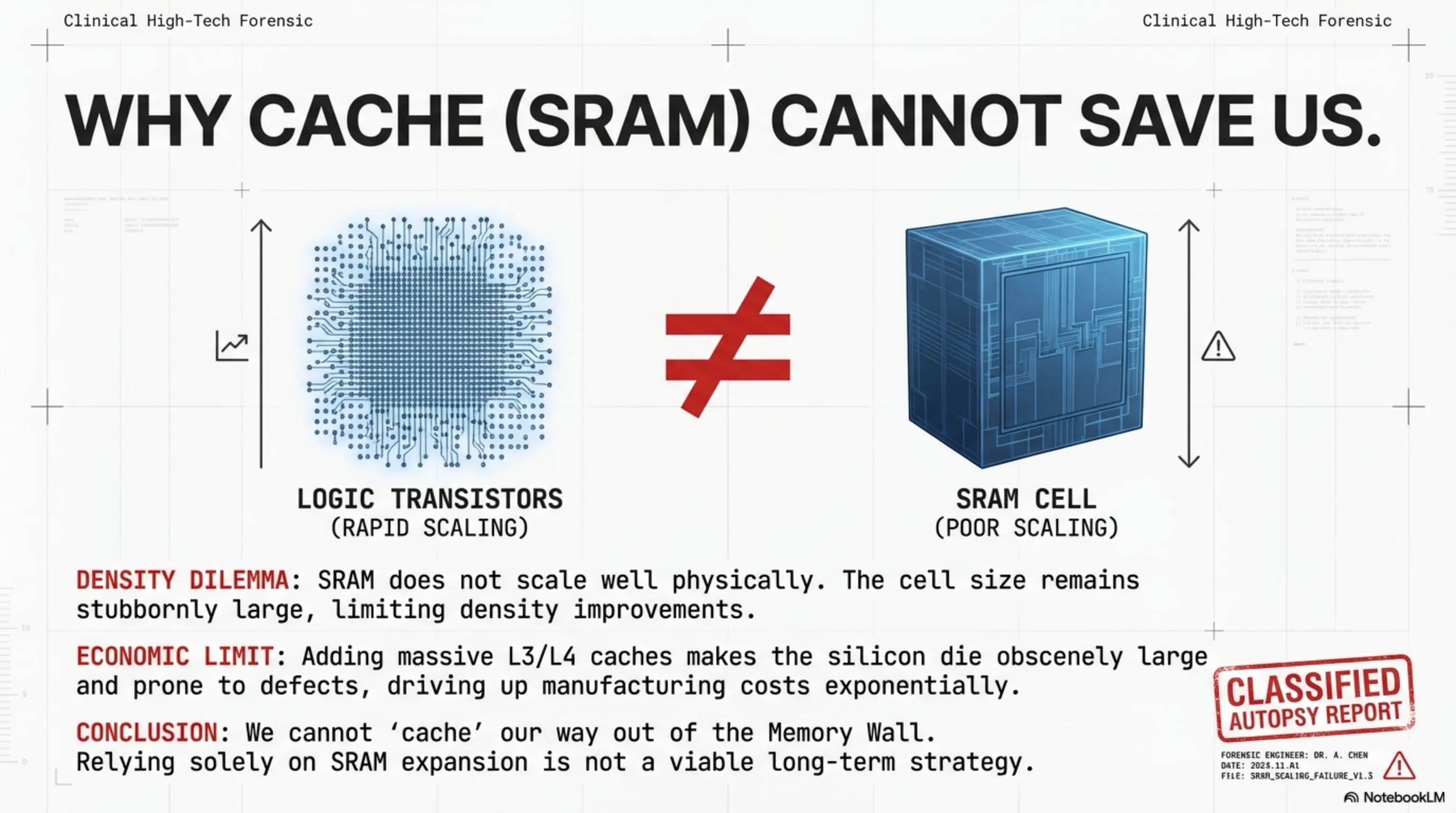
3.2. The SRAM Density Dilemma: Why Cache Cannot Save Us
Engineers have desperately tried to close this gap by embedding massive pools of cache memory (L3/L4 Cache, utilizing SRAM) directly onto the processor die itself. However, SRAM does not scale well. The physical size of SRAM cells has barely shrunk over the last few manufacturing nodes (unlike logic transistors). Adding more cache makes the silicon die obscenely large, prone to manufacturing defects, and astronomically expensive. We cannot simply "cache" our way out of the Memory Wall.
4. The Silicon Oligarchy: The Cartel Controlling Digital Gold
To grasp the true, terrifying depth of this disaster, you must understand that the advanced memory market is not a free, competitive capitalist market; it is a ruthless silicon oligarchy. Only three companies in the entire world possess the technology, patents, and technical know-how to mass-produce these ultra-fast memories: SK Hynix (South Korea), Samsung (South Korea), and Micron (USA).
Currently, SK Hynix is the undisputed king of HBM production, acting as the exclusive supplier for NVIDIA's most advanced AI processors and raking in unprecedented profits. This tight monopoly means that the control of global memory pricing and supply rests entirely in the hands of these three titans. When consumer electronics companies like Sony, Nintendo, or Microsoft approach them to secure memory for console manufacturing, they are pushed to the back of the line. These memory foundries infinitely prefer selling their limited capacity to cash-rich hyperscalers—who are willing to pay thousands of dollars per HBM/GDDR array—rather than to gaming companies attempting to negotiate bulk discounts to keep console prices low.
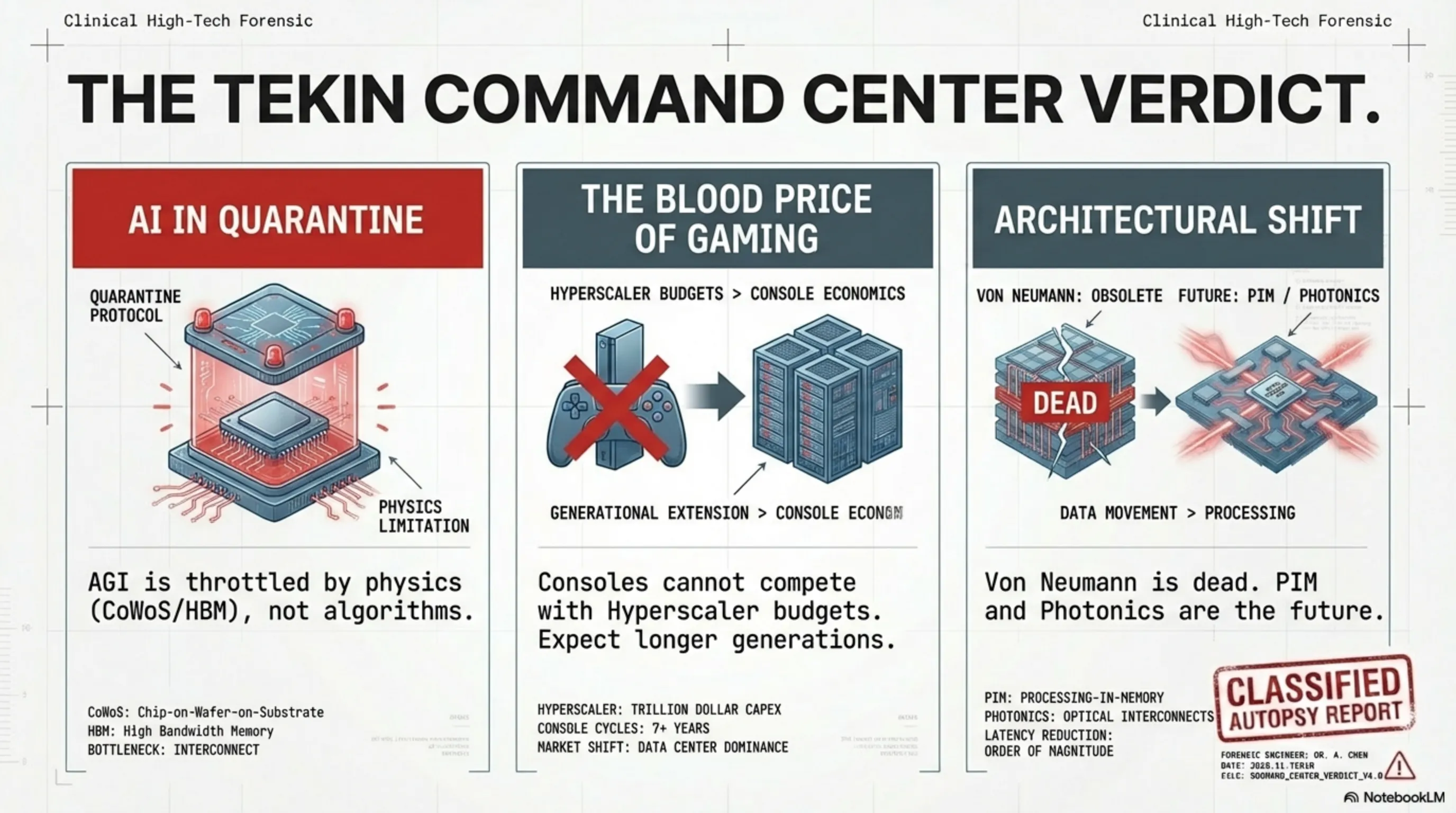
The Final Verdict from Tekin Command Center
- 🧠 AI in Physical Quarantine: Google DeepMind's confession proves that the dream of AGI (Artificial General Intelligence) is being throttled in the short term, not by a lack of innovative algorithms, but directly by the rigid physics of memory scaling and CoWoS packaging limitations.
- 🎮 The Blood Price of Gaming: Sony and Microsoft simply cannot compete in the hardware checkout line against the trillion-dollar budgets of AI hyperscalers. The PS6 is a direct casualty of this macroeconomic war, and gamers must make peace with extending the lifespan of their current consoles.
- ⚙️ The End of an Architectural Paradigm: The classic Von Neumann architecture has reached the absolute limit of its physical viability. The future of technology belongs to radical new architectures such as Processing-in-Memory (PIM), or utilizing Silicon Photonics to transfer data using light instead of copper, attempting to shatter this wall once and for all.
Commander, today's autopsy serves as a massive, unavoidable warning: in the ruthless tech landscape of 2026, the ultimate victor is not the one who can process data faster in an isolated logic core, but the one who can transfer data fast enough to keep the beast fed!