
1. The Thermal Density Crisis: The 2nm Paradox
There is a common misconception in tech: "Smaller chips run cooler." This is only half true. While a 2nm transistor consumes less energy than a 3nm one, the Thermal Density skyrockets.
The upcoming A19 Pro chip packs an estimated 100 billion transistors into a die size that is barely larger than a fingernail. When you concentrate that much switching activity in such a microscopic area, you create intense "Hotspots." Traditional graphite spreaders (which Apple currently uses) are too slow to move this heat away from the core. They spread heat, they don't evacuate it. Without a phase-change cooling system, the A19 Pro would throttle within seconds of hitting peak load to prevent self-destruction.
2. Deconstructing the Tech: The Molecular Dance
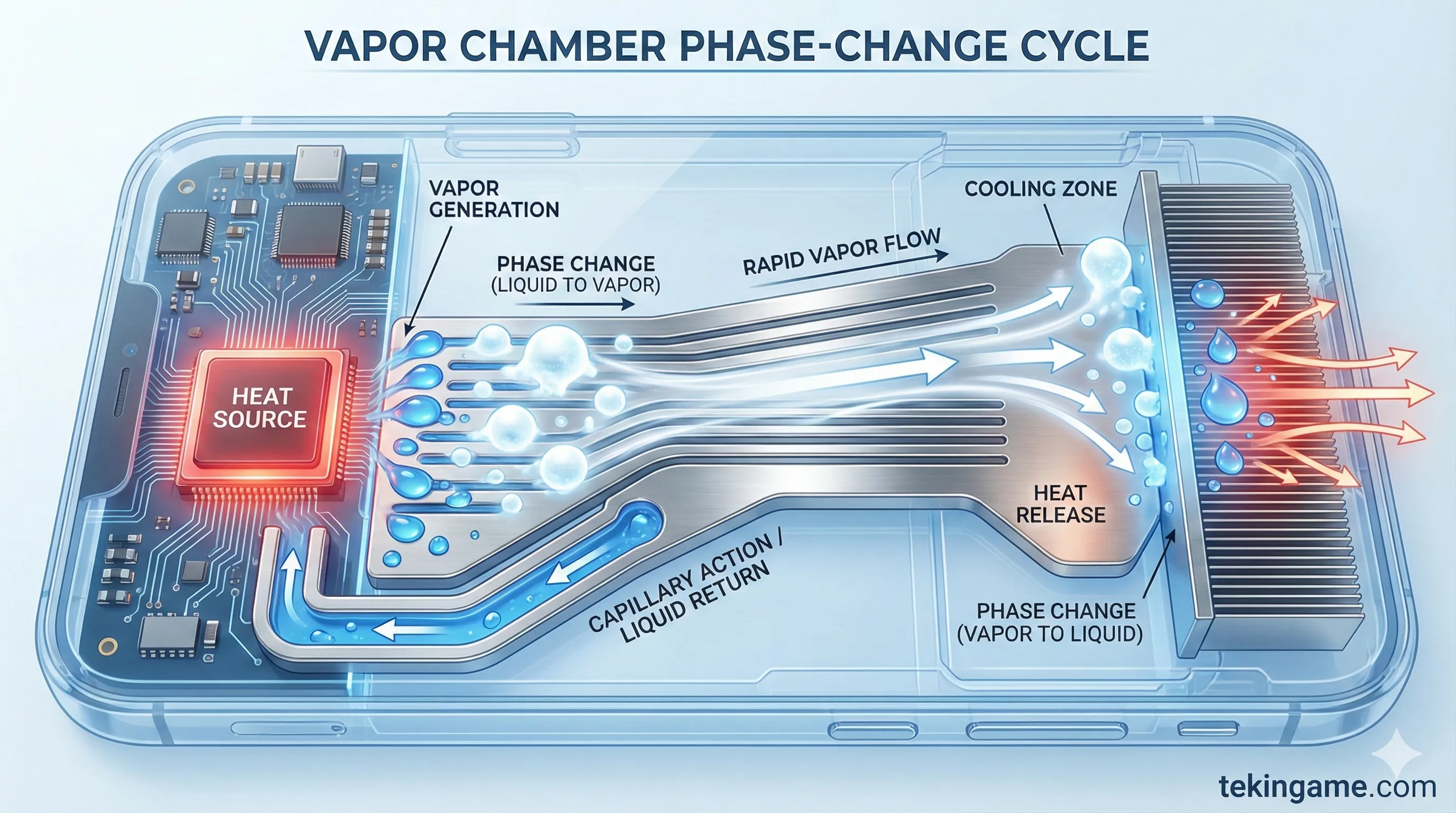
A Vapor Chamber (VC) is not just a piece of metal; it is a thermodynamic engine. It is a vacuum-sealed, ultra-thin metal envelope containing a tiny amount of working fluid (usually deionized water or a specialized coolant).
The Phase-Change Cycle:
- Evaporation (Heat Absorption): As the processor heats up, the liquid at the "Evaporator" zone boils instantly, turning into vapor. This phase change absorbs massive amounts of latent heat.
- Transport: The high-pressure vapor shoots across the vacuum chamber at near-sonic speeds toward cooler areas.
- Condensation (Heat Rejection): Upon touching the cooler walls of the chamber (the "Condenser" zone), the vapor turns back into liquid, releasing its heat into the phone's chassis.
- Wick Return: The cooled liquid flows back to the processor via a microscopic "Wick Structure" (sintered powder or mesh) using capillary action, defying gravity.
This cycle repeats thousands of times per second, offering a thermal conductivity 50x to 100x higher than solid copper.
3. Material Science: The "Apple Twist"
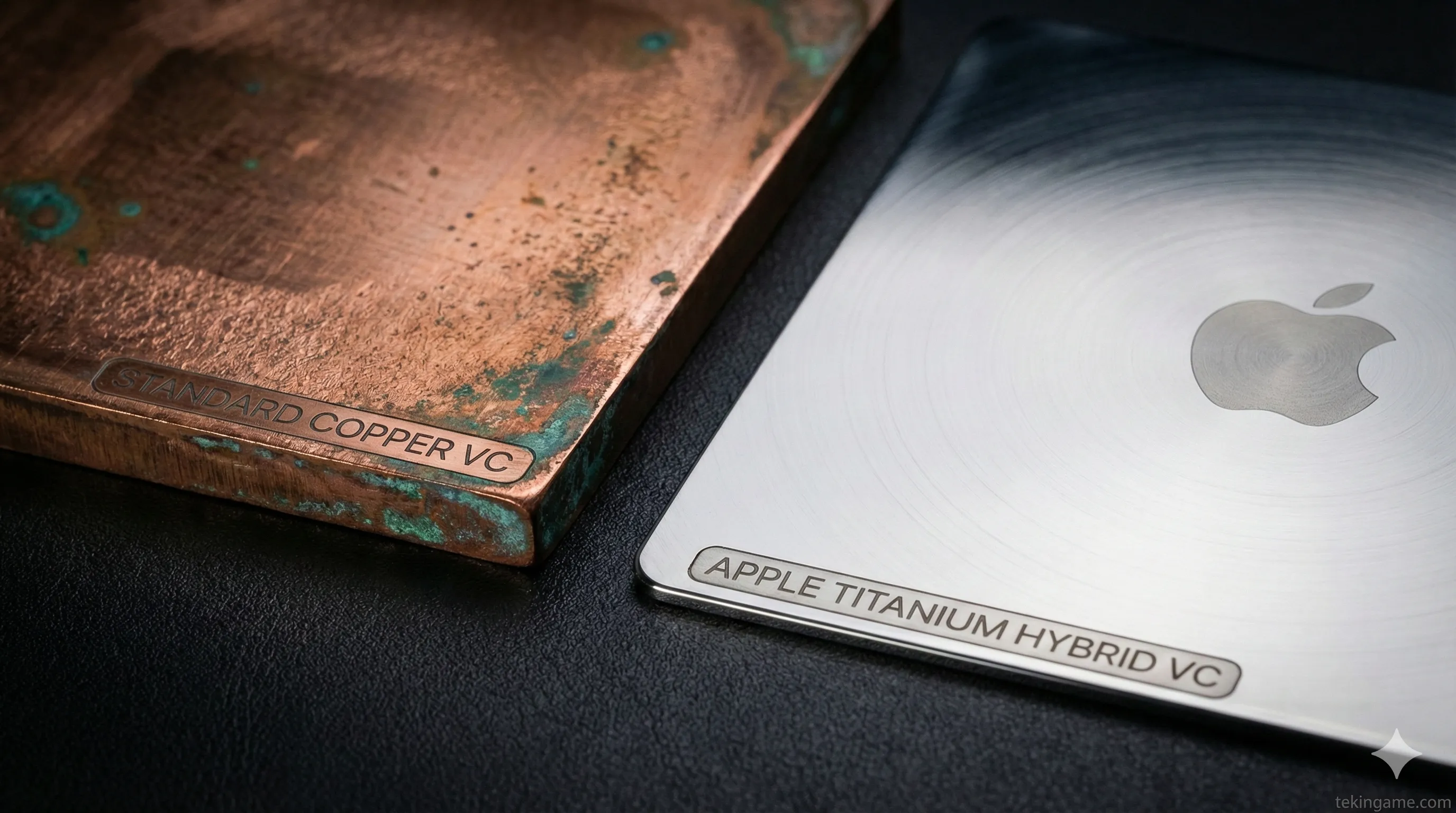
Why did Apple wait until the iPhone 18? Because standard Vapor Chambers are heavy and made of copper, which interferes with RF signals and internal component layouts.
According to supply chain leaks, Apple is not using off-the-shelf parts. They are developing a Hybrid Titanium-Stainless Steel VC. This custom solution solves three problems:
- Weight: Titanium is 45% lighter than copper.
- MagSafe Interference: A massive copper slab blocks magnetic fields. Apple's alloy is designed to be magnetically neutral, allowing MagSafe charging to work through the cooling system.
- Structural Integrity: Apple plans to use the VC plate as a structural "mid-frame" component, actually making the phone stiffer and more resistant to bending.
4. The AI Factor: NPU is the New Heater
This is the variable most analysts miss. In the era of the iPhone 18, Apple Intelligence isn't just a chatbot; it's the OS layer.

Local Large Language Models (LLMs) running on the device need to index your emails, analyze photos, and predict actions in the background. The Neural Processing Unit (NPU) will be running at a sustained load much more often than in previous years. Unlike "bursty" CPU tasks (like opening an app), AI tasks are "sustained." Without liquid cooling, the phone would be perpetually warm, and the AI would become sluggish. The Vapor Chamber is essential to keep the NPU in its optimal thermal window.
5. Professional Gaming: Ending the Nightmare
Apple markets the iPhone as a console competitor, citing Hardware Ray Tracing and titles like Death Stranding. But gamers know the truth: The iPhone is a great console... for 15 minutes.
After that, the Display Dimming Algorithm kicks in. To save the battery and screen from heat, iOS cuts the brightness by 50%, making the game unplayable in well-lit rooms. With the Vapor Chamber in the iPhone 18 Pro:
- No More Dimming: The screen controller stays cool, keeping brightness at max.
- Flatline FPS: Instead of starting at 60 FPS and dropping to 30, the device can maintain peak frame rates for hours.
- Cool Hands: The heat is spread across the entire back surface, eliminating the painful "hot spot" next to the camera bump.
6. Cinematic Video: The 8K Challenge
Rumors point to a 48MP triple-sensor array capable of 8K ProRes recording. Processing 33 million pixels, 60 times a second, puts an immense load on the ISP (Image Signal Processor).

Many professional mirrorless cameras overheat when shooting 8K. For the iPhone 18 Pro to function as a cinema camera, it needs to move that heat away from the sensor immediately. If the sensor gets too hot, digital noise increases and image quality degrades. The VC system acts as a heatsink for the camera module just as much as for the CPU.
7. Comparison: iPhone 18 Pro vs. The Competition
| Feature | iPhone 18 Pro (Leak) | Samsung Galaxy S26 Ultra |
|---|---|---|
| Cooling Tech | Hybrid Ti-Steel Vapor Chamber | Large Copper Vapor Chamber |
| Thickness | Ultra-thin (~0.25mm) | Standard (~0.4mm) |
| Primary Focus | Sustained NPU/AI Performance | Raw Gaming Power |
8. Conclusion: The "Pro" Moniker Earned
Does adding a Vapor Chamber make the iPhone thicker? Probably not. Apple’s engineering prowess lies in shrinking other components (like using stacked logic boards) to make space.
The iPhone 18 Pro marks the moment Apple stopped fighting physics and started using it. By acknowledging that passive cooling is dead, they are preparing a device that isn't just fast in benchmarks, but fast in the real world—whether you are rendering a movie, training a local AI model, or gaming for hours. The heat wave is over.