
1. The Autopsy of Chroma Key: Why a 100-Year-Old Tech Finally Surrendered
Chroma Key (Green Screen) technology has been the king of visual effects since the 1930s. But this king was a ruthless dictator. Anyone who has tried to record a green screen video at home knows the "Three Great Nightmares":
- The Spill Nightmare: Green light bouncing off the screen always landed on the skin, clothing edges, and especially blonde hair. Removing this "spill" in post-production took hours and often ruined natural skin tones.
- The Transparency Nightmare: Glasses, water bottles, or glass cups were the sworn enemies of the green screen. The screen showed through the glass, and software couldn't distinguish which green to remove and which reflection to keep.
- The Matching Nightmare: If the sun was shining from the right in your background footage, but your room lamp was on the left, the viewer's brain instantly flagged the image as "fake."
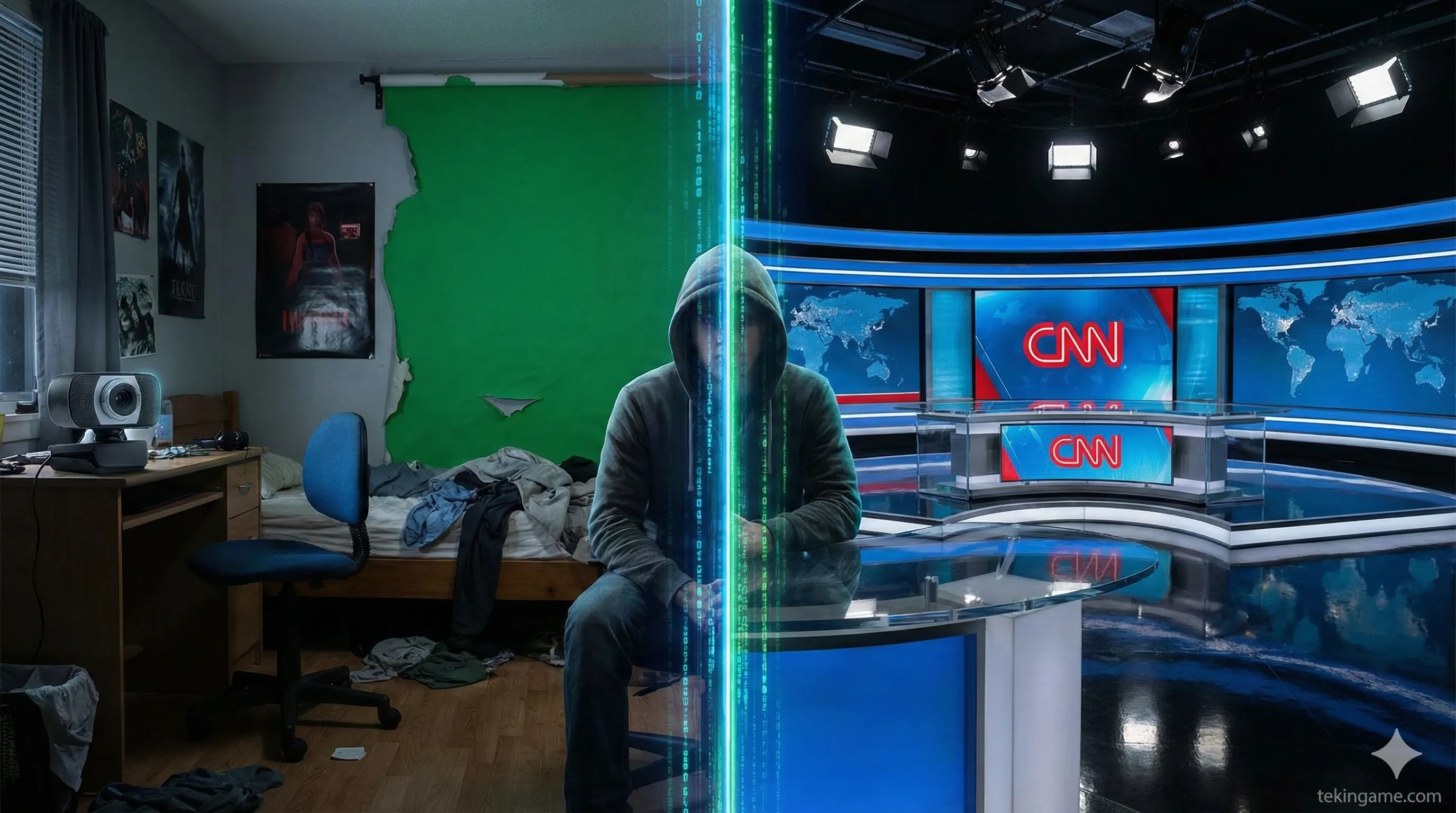
In 2026, AI hasn't fixed these problems; it has deleted the problem entirely. New "Segmentation Models" no longer rely on a specific color (green/blue) to separate the subject. They understand the concept of "Human" and "Depth." The AI now separates your hair strands pixel-by-pixel from the busiest background, even if you are standing in a real forest.
2. The Sora 2 & Veo Revolution: When AI Understands "Hair" vs. "Background"
The turning point of this revolution was the release of **OpenAI Sora 2** and its powerful rival **Google Veo** in late 2025. Before this, AI models were "Text-to-Video" generators. These new models are "Video-to-Video" editors.
The Magic of Relighting
The most critical feature that green screens could never offer is **Relighting**. Suppose you are sitting in a dim room with only the blue light of a monitor on your face. When you ask Sora to place you on a "Hawaiian beach at sunset," something incredible happens:
The AI changes the light source on your face! Your skin becomes warm and orange, the sharp shadows on your face soften, and even the reflection of the virtual sun appears in your eyes. This process, which previously required a team of VFX compositors in Hollywood, is now applied in Real-time to YouTube videos.
3. Under the Hood: Demystifying NeRF and the Magic of Gaussian Splatting
To understand the depth of this revolution, we must get technical. Why do AI backgrounds in 2026 not look flat? Why does the perspective behind you change when you move the camera? The answer lies in two revolutionary technologies:
NeRF (Neural Radiance Fields)
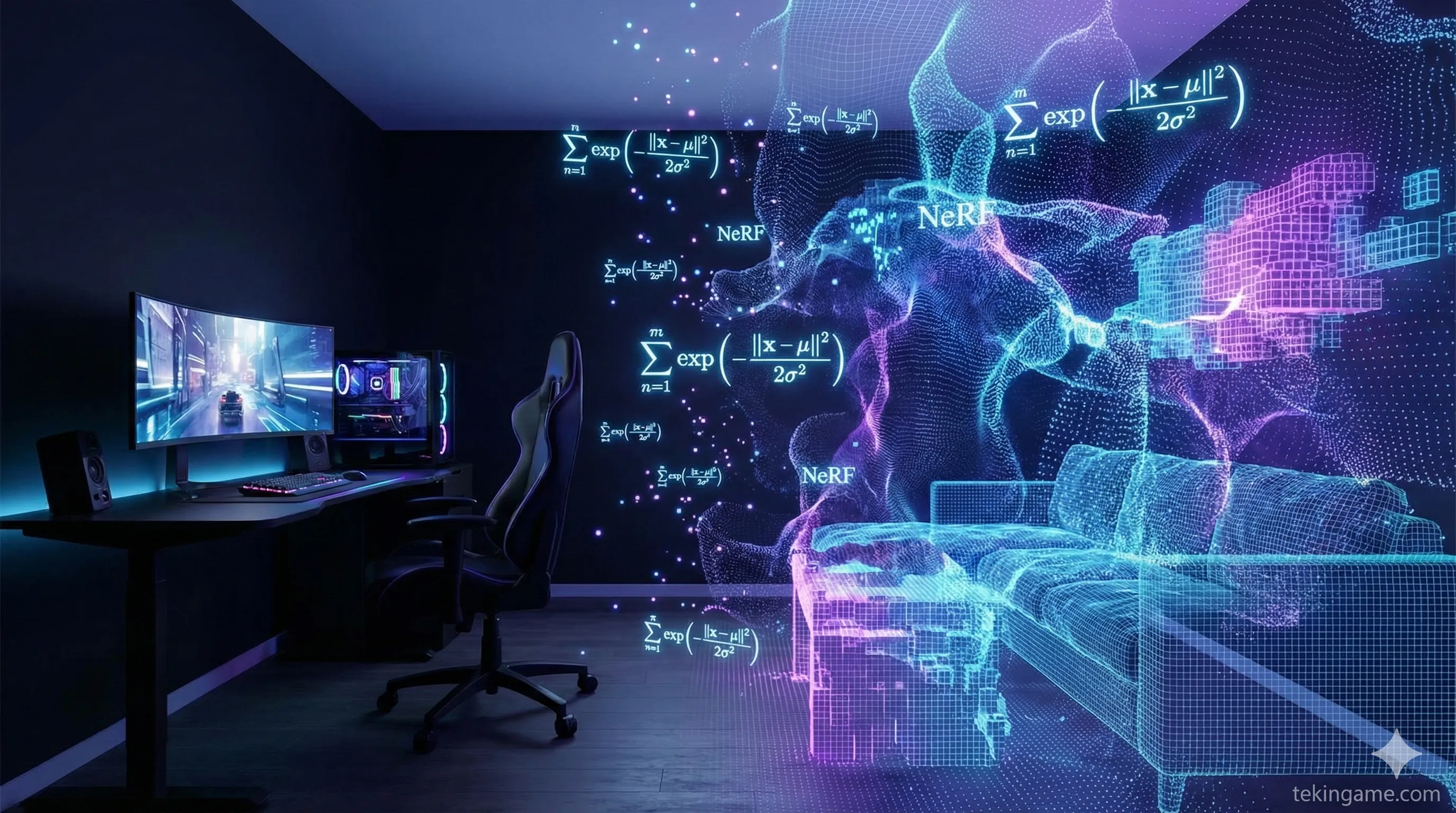
NeRF technology allows AI to construct a 3D understanding from a 2D environment. When you prompt "Modern Office," the AI doesn't generate a flat JPEG; it builds a virtual 3D volume where light has presence. This means if you move your camera forward and backward, objects closer to you (like a virtual microphone on the desk) move faster than objects further away (the parallax effect).
3D Gaussian Splatting
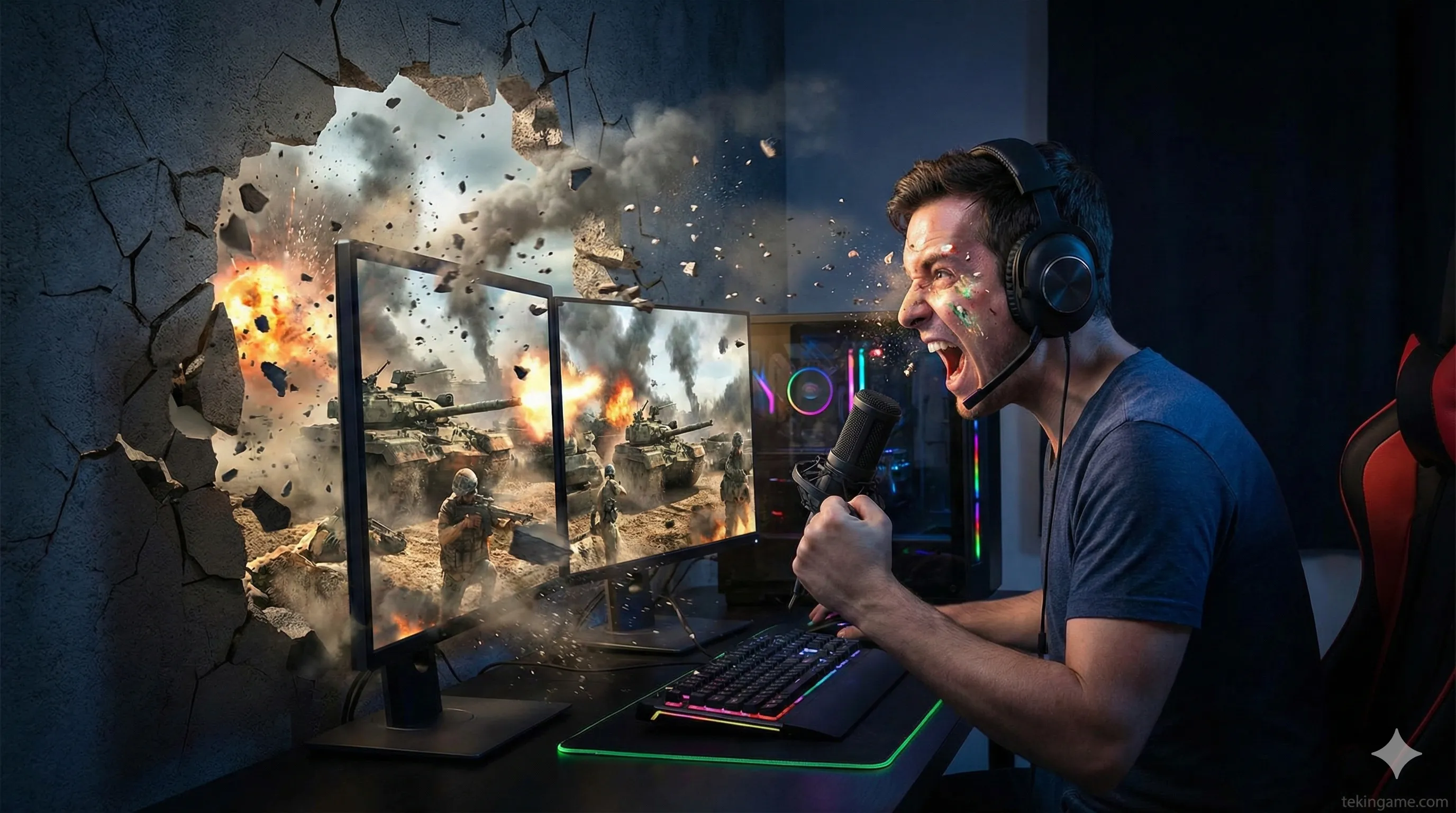
This newer technology, which became mainstream in 2025, allows incredibly complex environments (like a dense forest or a busy cyberpunk city) to be rendered at high speeds. Unlike old methods that used millions of polygons, this method constructs the environment with "colored point clouds" (splats), which are much easier for RTX series graphics cards to render. The result? You can be in the middle of a battlefield full of smoke and explosions during your livestream, without your stream's FPS dropping.
4. Hardware Analysis: What Specs Do You Need for a Virtual Studio in 2026?
All this magic doesn't come for free. While you don't need to buy curtains and lights, the heavy processing load has shifted from the "physical world" to your "PC Case." To run Sora 2 in Real-time (e.g., inside OBS for streaming), you need powerful hardware:
- Neural Processing Unit (NPU): Nvidia's RTX 50 series cards (like the RTX 5080 and 5090), featuring 5th Gen Tensor Cores, are essential. These cores handle the heavy AI math without stressing the game rendering rasterization.
- High VRAM: AI models are thirsty for video memory. To render a 4K environment with Gaussian Splatting, you need at least 16GB to 24GB of VRAM.
- Space Internet: If you don't have a beastly PC, you can use "Cloud Rendering" services like Nvidia Omniverse Cloud, which process the video on a server. However, this requires a 5G or Fiber connection with sub-20ms latency to avoid desync.
5. The New YouTube Economy: Physical Studio Costs vs. AI Subscriptions
Let's grab a calculator and see why new YouTubers are ditching physical studios. Let's assume you want a set design comparable to a late-night talk show:
Traditional Method Cost (2020 Era):
- Studio Space Rent (Monthly): $500 - $1,000
- Professional Lighting (Aputure/Godox): $2,000
- Set Construction & Props: $3,000
- Green Screen & Stands: $200
- Initial Total: ~$5,700 + Monthly Rent
AI Method Cost (2026 Era):
- Sora 2 Pro Subscription (Monthly): $50
- OBS AI Plugin: $20 (One-time)
- GPU Upgrade (Infrastructure Cost): $1,500
- Initial Total: ~$1,520 + $50 Monthly
A 90% reduction in setup barriers! This means the budget can now be spent on better microphones, research, and scripts. This is true democratization of content creation.

6. The Authenticity Paradox: The Uncanny Valley and the Craving for "Raw"
But it's not all about technology; psychology matters too. With the prevalence of hyper-realistic environments, audiences have developed a new skepticism.
In 2026, when a tech YouTuber reviews a product inside a "Space Laboratory," the audience subconsciously knows the environment isn't real. This can impact the "Authority" of the content.
A phenomenon we are currently witnessing is the return to "Raw/Grunge Content." Some creators deliberately show their messy, real bedrooms to prove their authenticity and intimacy. In fact, using AI environments is becoming a "Stylistic Choice"—like using a filter—rather than a way to trick the audience. The viewer knows you aren't on Mars, but they enjoy that you are telling your story *on* Mars.
7. Future Genres: Cooking in Elven Forests and War Zone Gaming
This technology has birthed entirely new genres on YouTube:
- Fantasy Cooking: Cooking channels that recreate movie recipes (e.g., Lord of the Rings) now actually cook inside a Hobbit's kitchen. The steam from their real pot blends with the virtual environment's lighting.
- Immersive News: Political analysts no longer sit behind desks; they walk inside interactive 3D maps of geopolitical conflict zones, moving borders with hand gestures.
- Dynamic Gaming: A streamer's room environment changes based on their in-game Health Bar. If they get injured in the game, the room lighting turns red and pulsing, and the virtual walls behind them start to crumble.
8. Conclusion: Imagination is the Only Limit Left
The death of the green screen is not the death of cinema; it is its rebirth. We have moved from an era limited by "Physics" and "Budget" to an era where the only limit is "Imagination."
For you, the creators of the Tekin Plus community, the message is clear: You no longer have an excuse for a bad location. The white wall of your bedroom can now be a window to New York, Tokyo, or the International Space Station. But remember, AI can build the most beautiful set in the world, but it cannot fake "Personality" and "Charisma" for you. Content is still King; AI has just made its throne much shinier.