
1. The Dead End of Moore's Law: Why Electronic Chips Hit a Wall
To understand the magnitude of China's achievement, we must first understand the current crisis. For decades, the semiconductor industry has obeyed "Moore's Law": the number of transistors doubles every two years. But we have reached the limits of physics.
When transistors shrink below 3nm, electrons suffer from a phenomenon called "Quantum Tunneling," leaking out of the circuit. This results in massive heat generation, terrifying power consumption, and instability. Nvidia's H100, the current king of AI, consumes about 700 watts—equivalent to a household appliance. AI data centers are draining the world's power grids. The solution? Change the carrier of information.
2. Photonics vs. Electronics: Replacing Electricity with Light
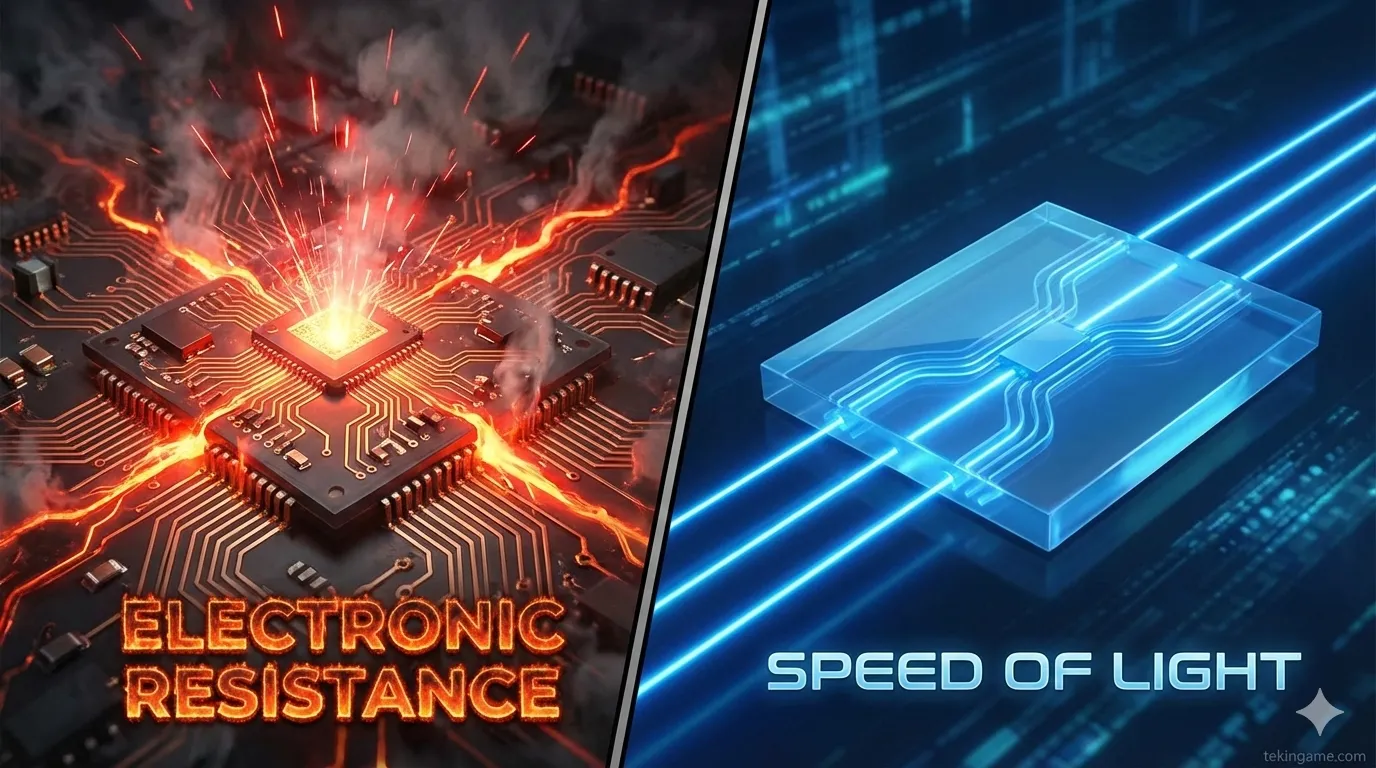
The concept of Optical Computing is not new, but building it was deemed nearly impossible. The difference lies here:
- Electronic Chips: Use electrons. Electrons have mass, collide with each other (resistance), and generate heat. Data transmission suffers from latency.
- Photonic Chips: Use photons (packets of light). Photons have no mass, zero resistance, generate zero heat, and travel at the speed of light.
Imagine being stuck in heavy traffic (electrons in a copper wire). Now imagine you can fly over it (photons in an optical fiber). That is the difference.
3. The "Taichi" Architecture: Tsinghua University's Masterpiece
The main hurdle for photonic chips until today was "Scalability." Light loves to scatter (Diffraction), making it hard to control thousands of light beams on a tiny chip. The research team at Tsinghua University solved this with a new architecture called "Distributed Computing in Synthetic Frequency Dimensions."
In simple terms, instead of trying to cram all calculations into one spot, Taichi distributes calculations across different "clusters" and uses light wave interference to perform matrix multiplication. Matrix multiplication is the beating heart of all modern AI.
4. Scary Numbers: 160 Trillion Operations on 1 Watt
The test results published in the prestigious journal Science are unbelievable:
- Energy Efficiency: 160 TOPS/W (Trillion Operations Per Second per Watt). For comparison, traditional chips hover around 1 to 5 TOPS/W.
- Accuracy: The chip ran AI models with over 91.8% accuracy (on ImageNet classification), a masterpiece for an analog chip.
- Capability: It successfully generated high-fidelity content, a task that was previously the Achilles' heel of optical chips.
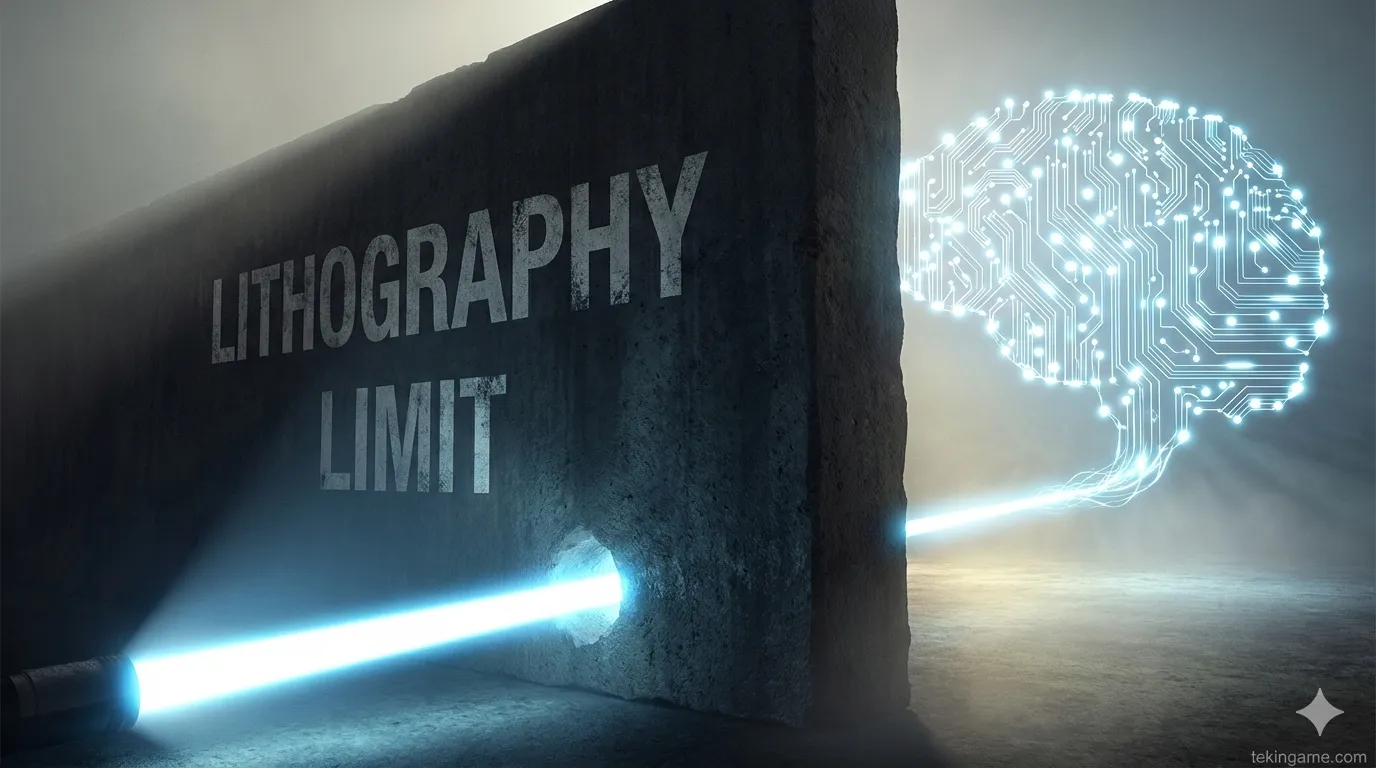
5. Bypassing Sanctions: Why Photonics Don't Need ASML Machines
This is the geopolitical game-changer. The US banned the export of EUV lithography machines (made by ASML) to prevent China from making sub-5nm chips.
But here is the key:
Light (photons) has a much larger wavelength than electrons (hundreds of nanometers vs. a few nanometers). Therefore, to build a photonic chip, you do not need 3nm lithography!
China can use older, mature technologies (like 45nm or even older) to build photonic chips that outperform Nvidia's 3nm silicon chips. This effectively renders the US sanctions obsolete for this specific class of processors.
6. Reality Check: Can It Run GTA VI?
Before we get too excited, let's be realistic. The "Taichi" chip is not going to replace the CPU or GPU in your gaming rig anytime soon.
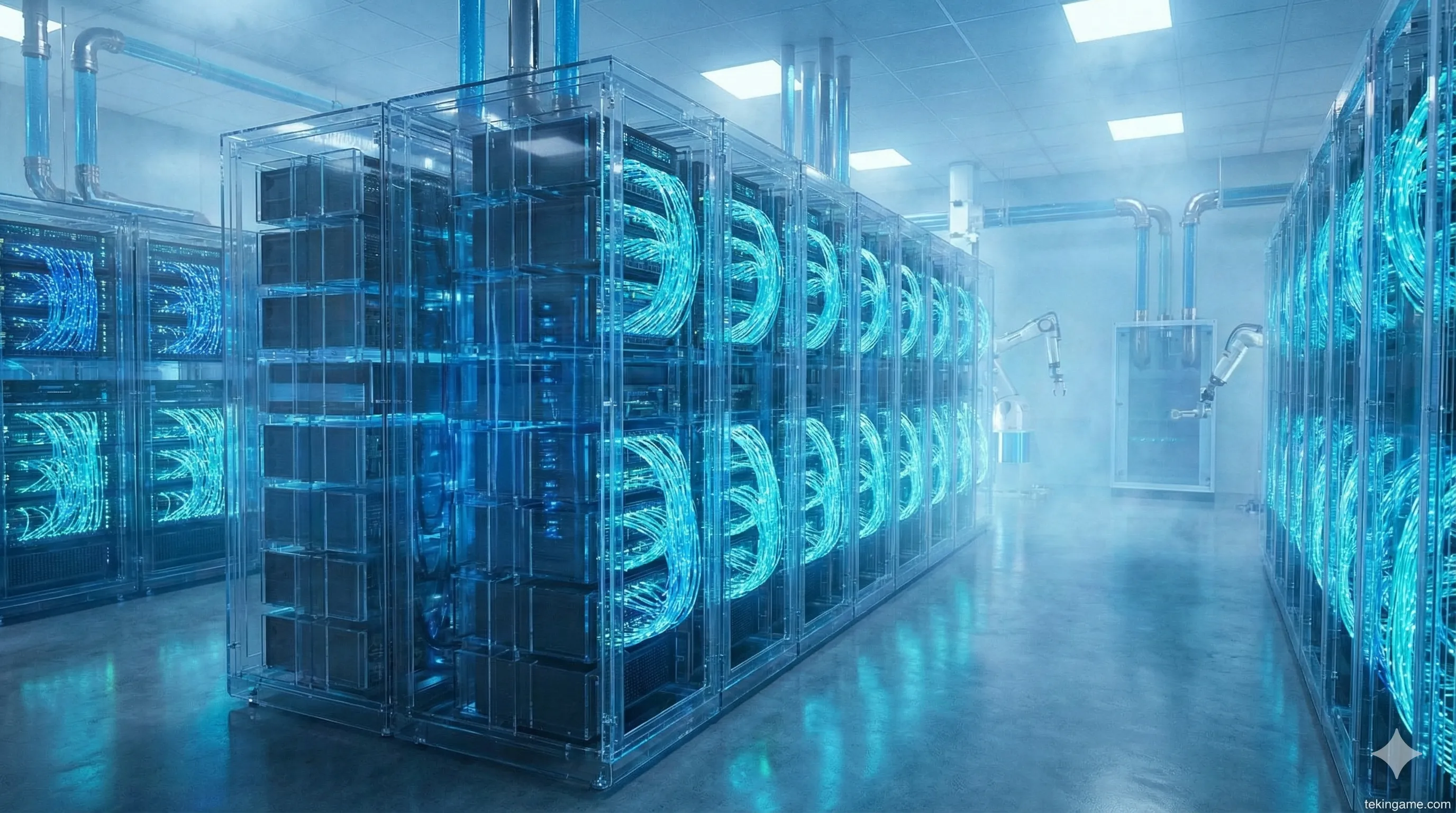
- Specialization (ASIC): These chips are designed solely for specific calculations, like neural networks. They cannot boot Windows or run game logic.
- Programming Challenge: Coding for light is fundamentally different from binary (0 and 1) coding. The software ecosystem is not ready yet.
- Hybrid Future: The near future is likely "Hybrid." Conventional silicon CPUs will handle logic, while an Optical Processing Unit (OPU) handles the heavy AI lifting.
7. The Future of AI: GPT-5 and the Energy Crisis
Sam Altman (CEO of OpenAI) recently stated, "We need fusion energy for the next models." This highlights the energy crisis. AI data centers are literally drying up lakes for cooling.
Photonic technology solves this equation. If energy consumption drops by 1000x, we could run AI models far more powerful than GPT-4 on local devices like mobile phones or laptops, without draining the battery in 5 minutes.
8. Conclusion: The Dawn of the Silicon-Photonic Era
China's "Taichi" chip is a wake-up call for the West and a beacon of hope for science. It proves that when conventional paths are blocked, science finds a new way.
At TekinGame, we believe that within the next 5 years, graphics cards and AI accelerators will shift toward an "Electronic-Photonic" architecture. The day when light shoulders the heavy burden of AI has begun with Taichi.
If you are a Computer Science or Electrical Engineering student, take "Photonics" seriously. This is the high-paying career of the next decade.