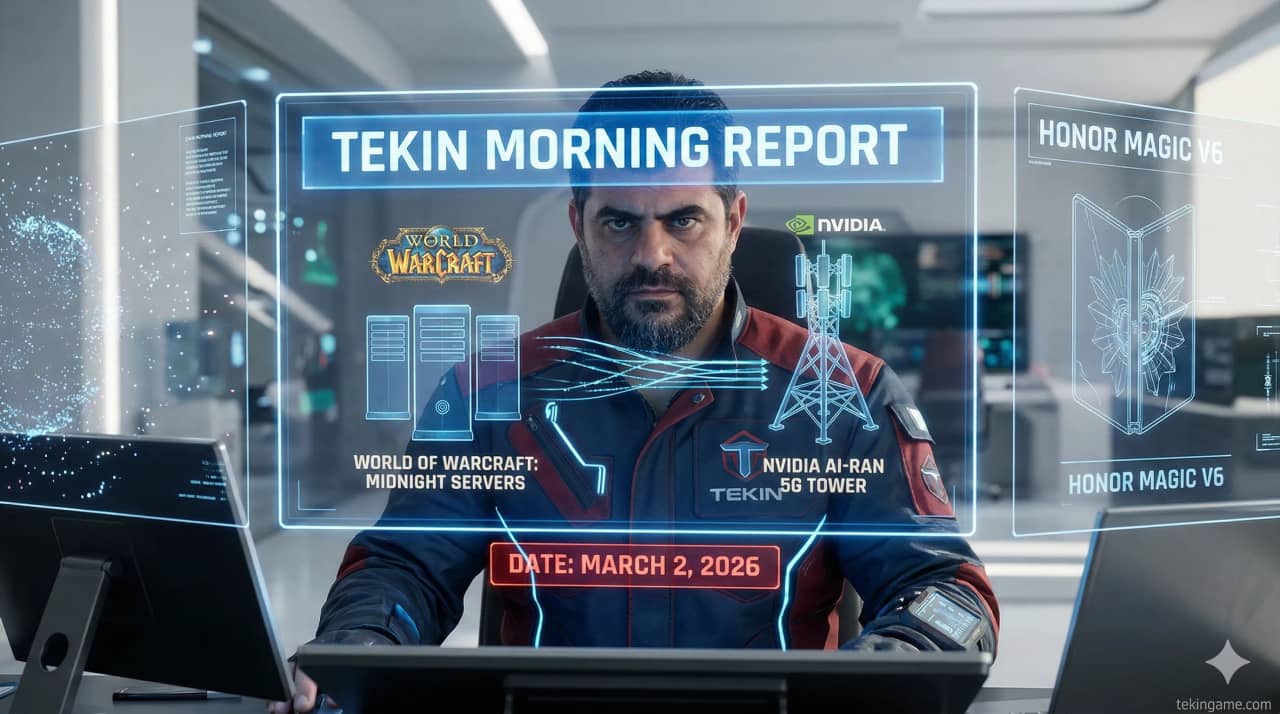
In today's Tekin Morning (March 2, 2026), we execute a cybernetic autopsy on 6 tectonic shifts violently shaking the tech and gaming industries. From Blizzard's infrastructure rebirth in WoW: Midnight and Honor's hyper-engineered Magic V6 foldable, to NVIDIA's AI-RAN taking over 5G towers, Xiaomi's Leica-powered assault on the premium market, the historic metamorphosis of GDC into a festival, and the return of pure horror with the Fatal Frame II Remake on Switch 2. This is not just news; it's the architectural blueprint of the future market.
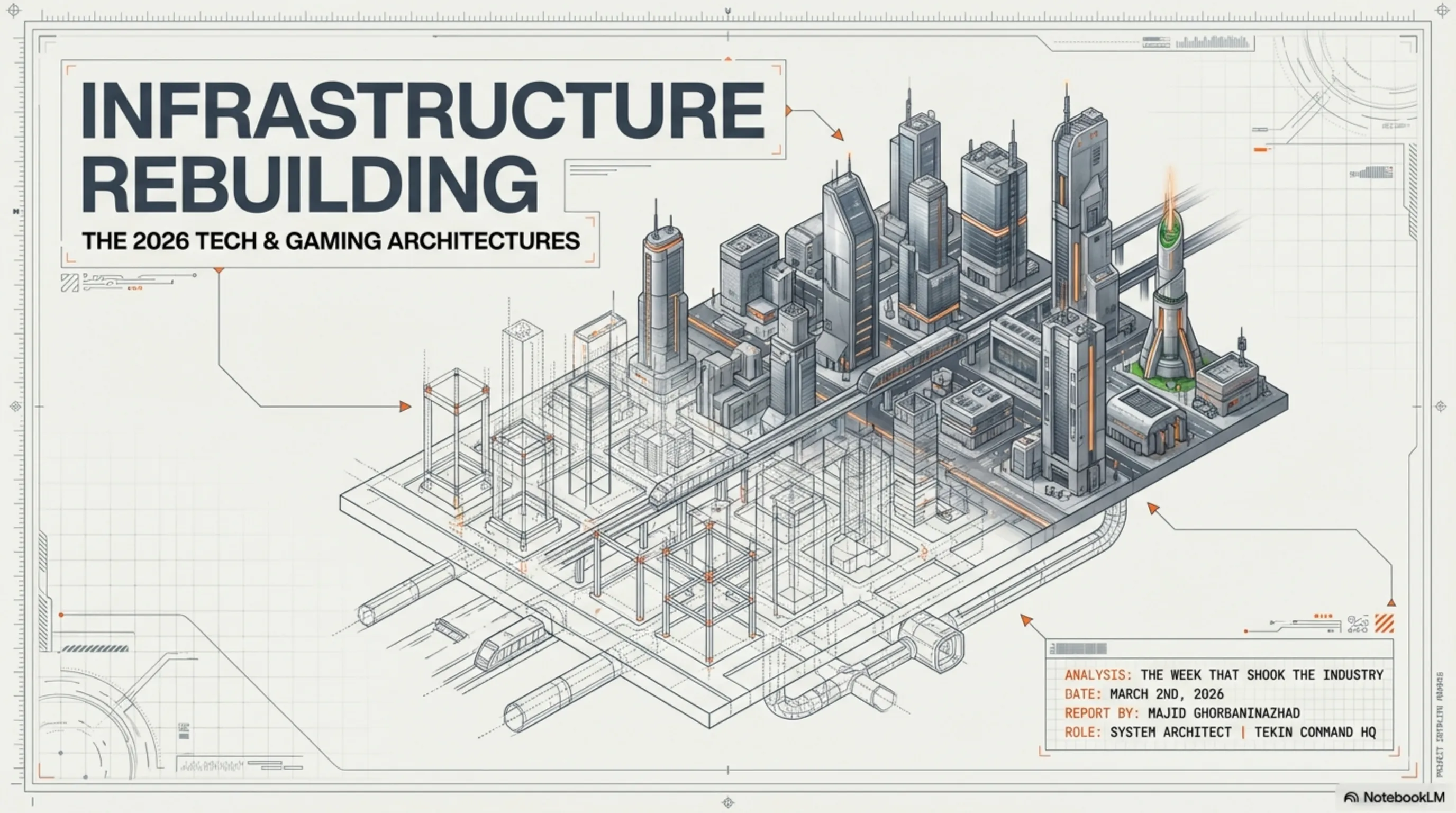
Tekin Morning (March 2nd, 2026): From the Resurrection of Azeroth to the Foldable Wars of Barcelona; The Architecture of a Week That Shook the Industry
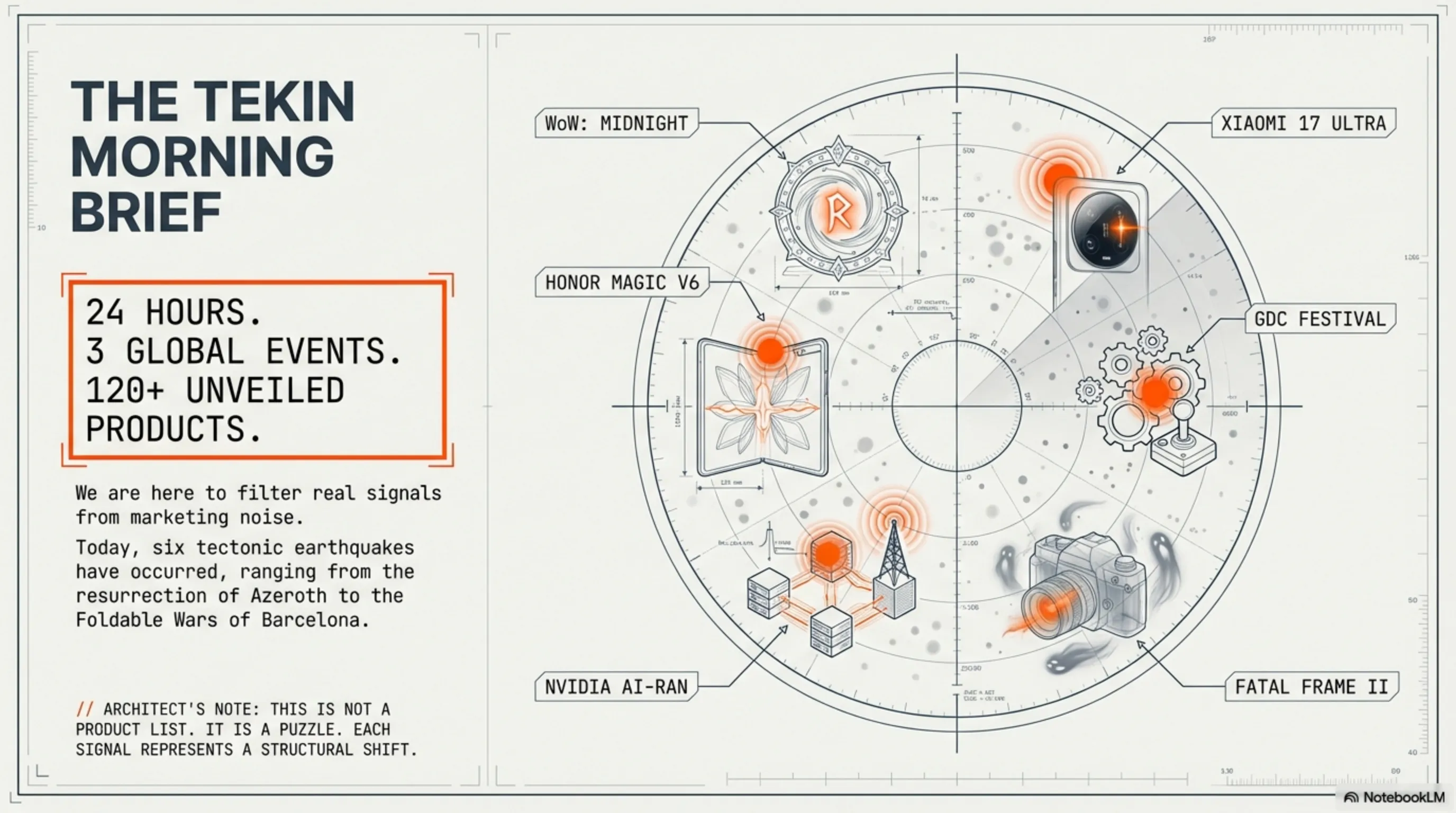
Good morning, Tekin Legion. This is Majid Ghorbaninazhad, your System Architect, and I will open this day — March 2nd, 2026 — with a single data point: in the last 24 hours, over 120 new products were unveiled across three major global events, and we, as always, are here to filter the real signals from the marketing noise.
Today at Tekin Command HQ, we have 6 tectonic earthquakes, each a piece of a larger puzzle: the return of a 22-year-old gaming empire, the thinnest foldable phone in history, a revolution in 5G networks powered by artificial intelligence, a full-scale Chinese assault on the premium smartphone market with Leica lenses, the rebirth of a legendary conference, and the resurrection of the most terrifying game ever made. Grab your coffee — today is a storm.
1. Return to Azeroth: World of Warcraft: Midnight Officially Launches Today ⚔️🌑
Today — right now, at this very moment — the eleventh massive expansion for World of Warcraft, titled "Midnight," has gone live. Blizzard Entertainment, a studio that has been bending under the weight of management scandals and declining content quality, has now placed its biggest bet on the table: reopening the legendary lands of Quel'Thalas and waging war against the Void forces at the heart of WoW's most cherished lore.
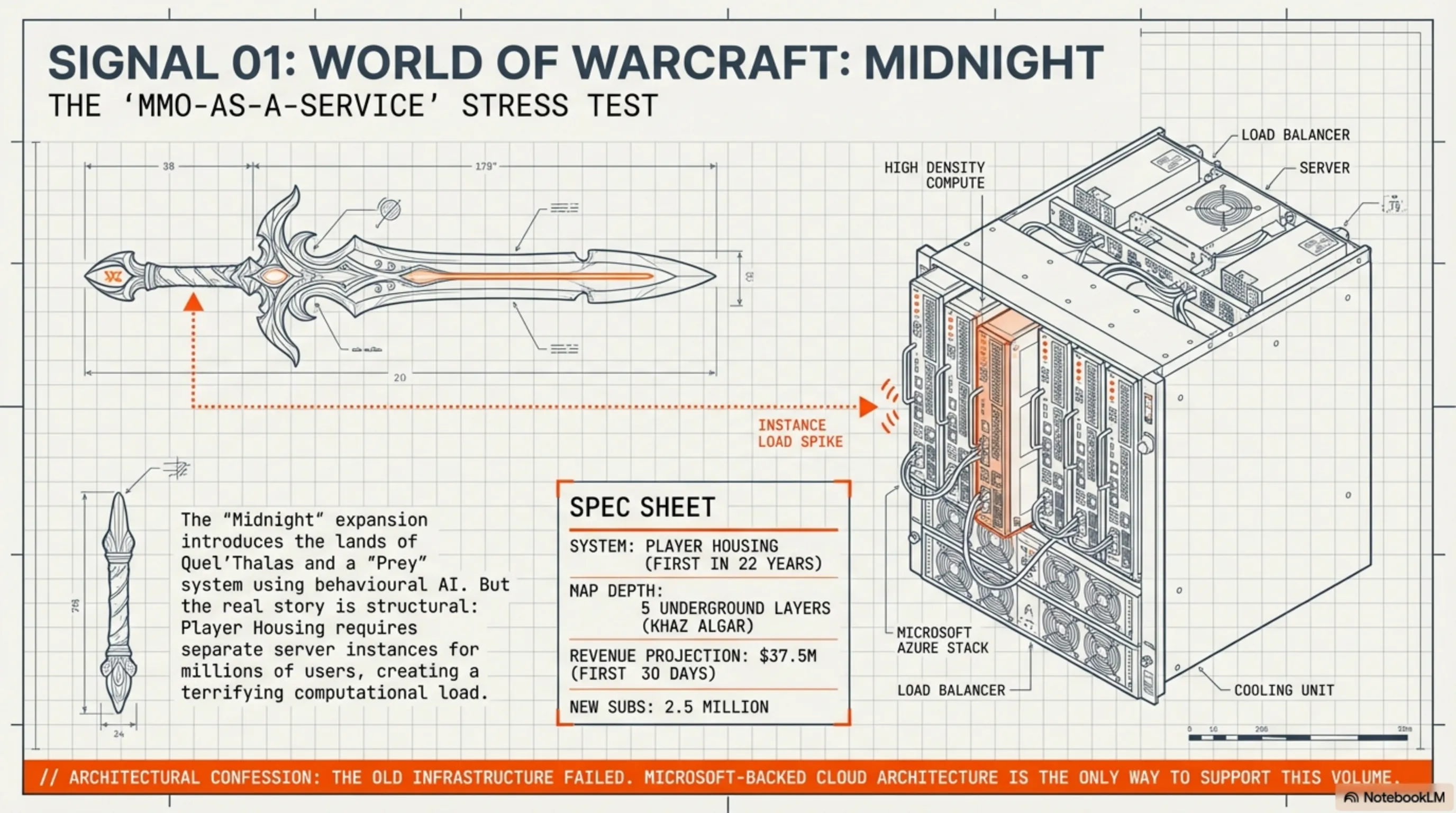
But here is the real bombshell: for the first time in WoW's 22-year history, Blizzard has introduced a Player Housing system. Yes, players who have waited over two decades can finally build their own homes in Azeroth.
Architectural Analysis: Why Player Housing Is an Infrastructure Revolution in MMORPGs
As a system architect, player housing is not merely a feature — it is a fundamental transformation in Blizzard's server architecture. Every house requires a separate server "Instance." When millions of players are simultaneously inside their homes, the computational load on Blizzard's cloud infrastructure increases to terrifying levels.
- The "Prey" System: Blizzard has introduced an entirely new mechanic where enemies flee from you and you must track them — effectively a Predator-Prey mechanic designed using behavioral AI algorithms.
- "Khaz Algar" and Vertical Map Depth: Midnight introduces colossal vertical maps (5 underground layers deep), multiplying the game's geographical data volume and bringing new "Streaming LOD" (Level of Detail Streaming) techniques into the engine.
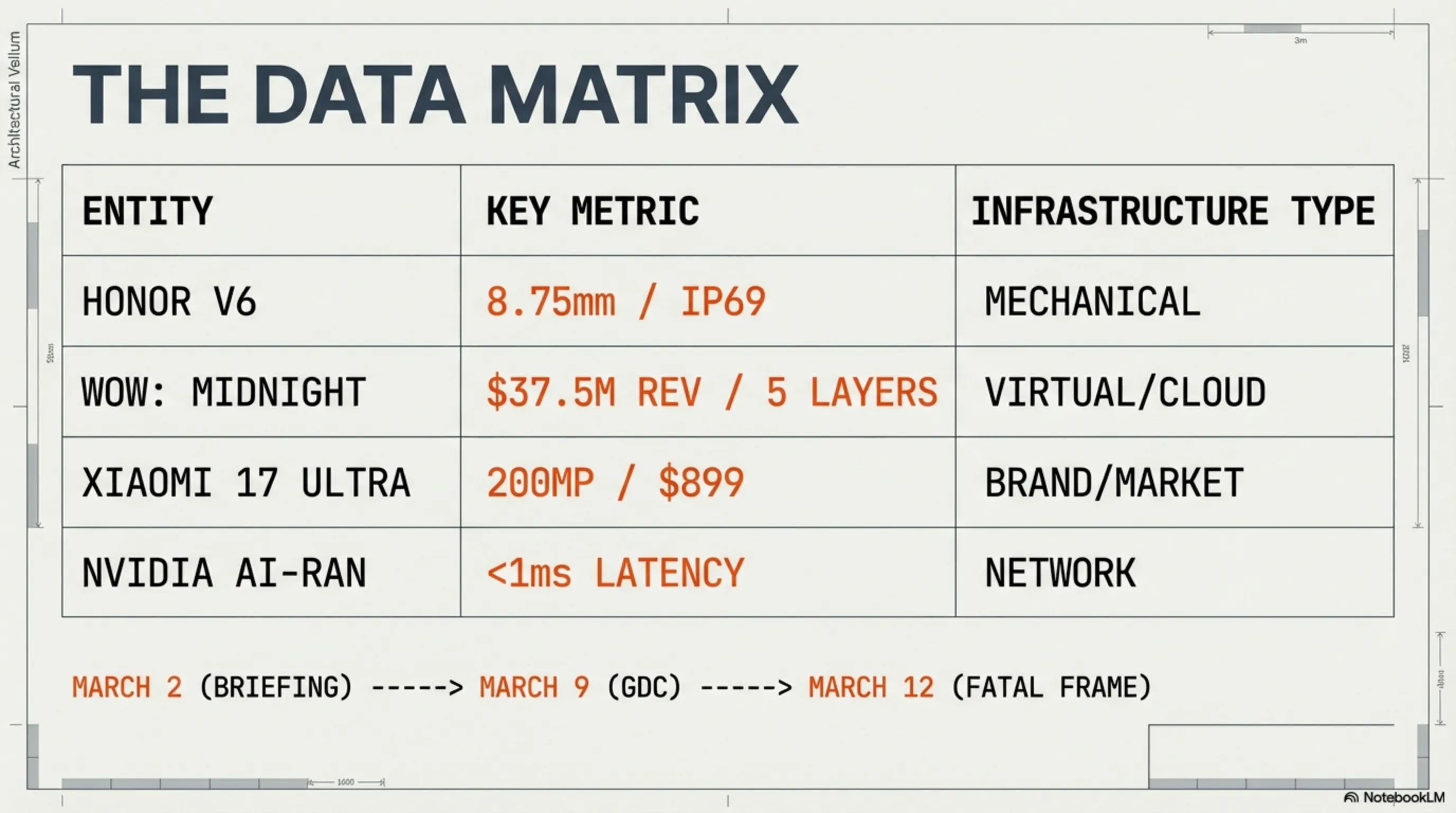
- In-Game Economy Reactivation: Every new WoW expansion generates a massive wave of returning subscriber. Wall Street analysts predict Midnight will generate up to 2.5 million new subscriptions in its first 30 days — revenue equivalent to $37.5 million from subscriptions alone.
With Midnight, Blizzard proves that MMORPGs are not dead — they simply needed a deep structural shock. The core question remains: can Blizzard's servers survive launch night?
"It took Blizzard 22 years to give players a home. This is not a gameplay feature — it is an architectural confession: the old infrastructure could not handle this volume of data, and now Microsoft's clouds are backing it up."
The Architect's Strategy: Midnight will be the greatest stress test in Microsoft-Blizzard cloud gaming history. If the servers hold, the "MMO-as-a-Service" model will be reborn.
2. Honor Magic V6: The Thinnest Foldable in History, the Most Waterproof Phone on Earth 📱🔪
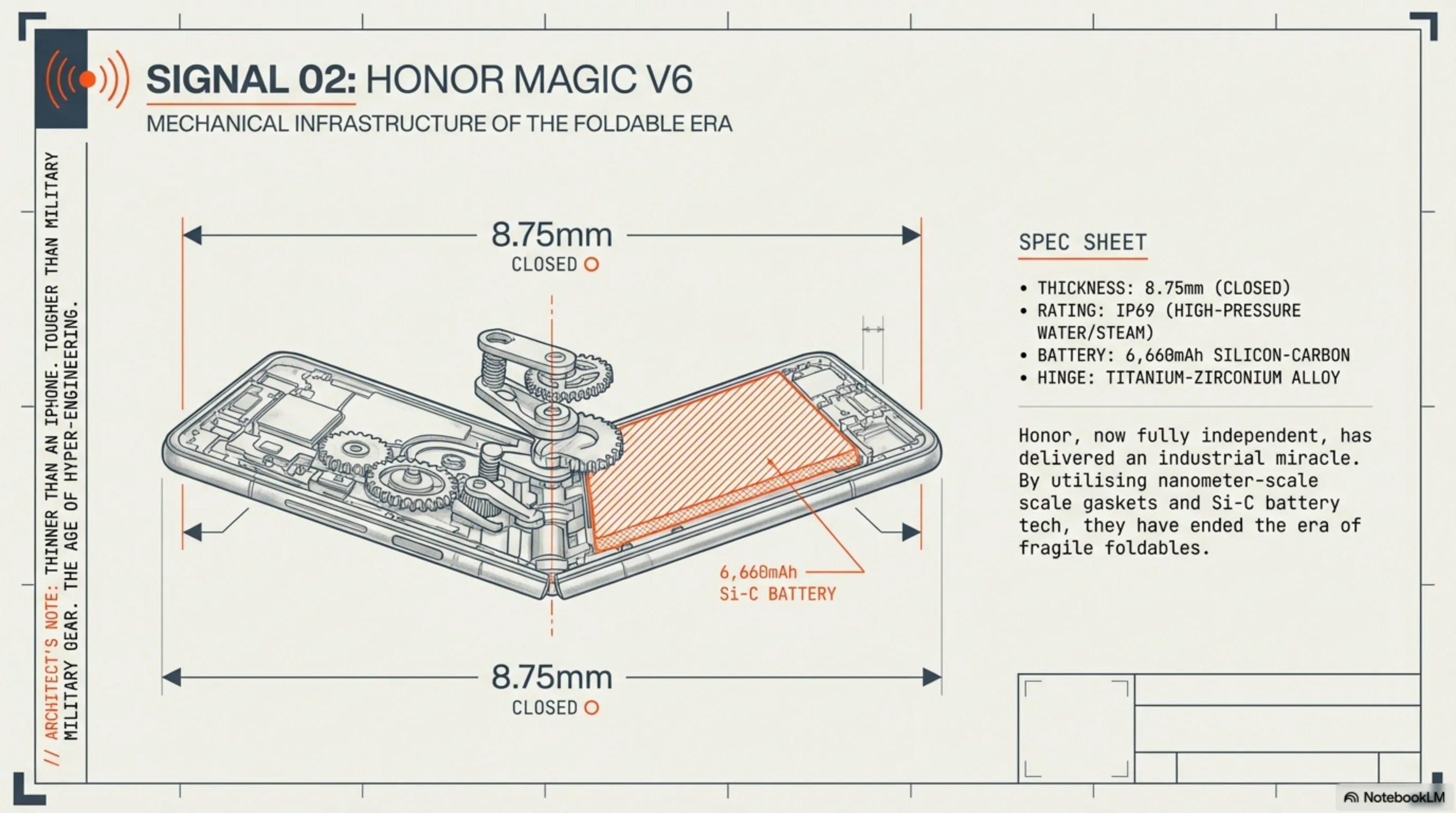
On the grandest stage of MWC 2026 in Barcelona, Honor — a company that was once a Huawei sub-brand and is now fully independent — unveiled the Magic V6: a foldable phone with an unbelievable thickness of just 8.75mm when closed. To grasp the magnitude of this number, consider that most regular (non-foldable) phones have a thickness between 8 and 9mm. Honor has effectively built a foldable phone that, when closed, is thinner than a standard iPhone.
But the more explosive news: the Magic V6 is the world's first foldable phone with an IP69 rating. IP69 means this device not only survives submersion in water but is also resistant to high-pressure water jets and hot steam — a standard typically reserved for industrial and military equipment.
Engineering Analysis: Why 8.75mm Is an Industrial Miracle
Building a foldable phone thinner than a regular phone is an absolute nightmare from a mechanical and thermal engineering perspective. The hinge alone occupies 2 to 3mm of space. The battery must be split in two. And the cooling system must fit into half the space of a normal phone.
- 6,660mAh Silicon-Carbon Battery: Honor uses silicon-carbon (Si-C) battery technology with 15-20% higher energy density than standard lithium-polymer cells. This means more energy in less space.
- 6th-Gen "Falcon Wing" Hinge: The new hinge is made from a titanium-zirconium alloy — the same alloy used in jet engine turbine blades. It can withstand 500,000 open-close cycles without mechanical degradation.
- IP69 and Resistance to 80°C Steam: The Magic V6's sealing system uses nanometer-scale gaskets that are resistant even to extreme air pressure changes (such as in aircraft cabins). This is a military-grade standard.
With the Magic V6, Honor has sent a clear message to Samsung and Google: the era of thick, heavy, fragile foldable phones is over. Chinese engineering now stands at the frontier of mobile hardware innovation.
"When a foldable phone becomes thinner than an iPhone and more waterproof than military equipment, we are no longer in the consumer world — we have entered the age of hyper-engineering."
The Architect's Strategy: The Magic V6 could completely redefine the 2026 foldable market. Samsung's Galaxy Z Fold 7 must deliver an equivalent response, or the crown of foldable supremacy migrates permanently to China.
3. NVIDIA AI-RAN: When Artificial Intelligence Manages 5G Cell Towers 📡🧠
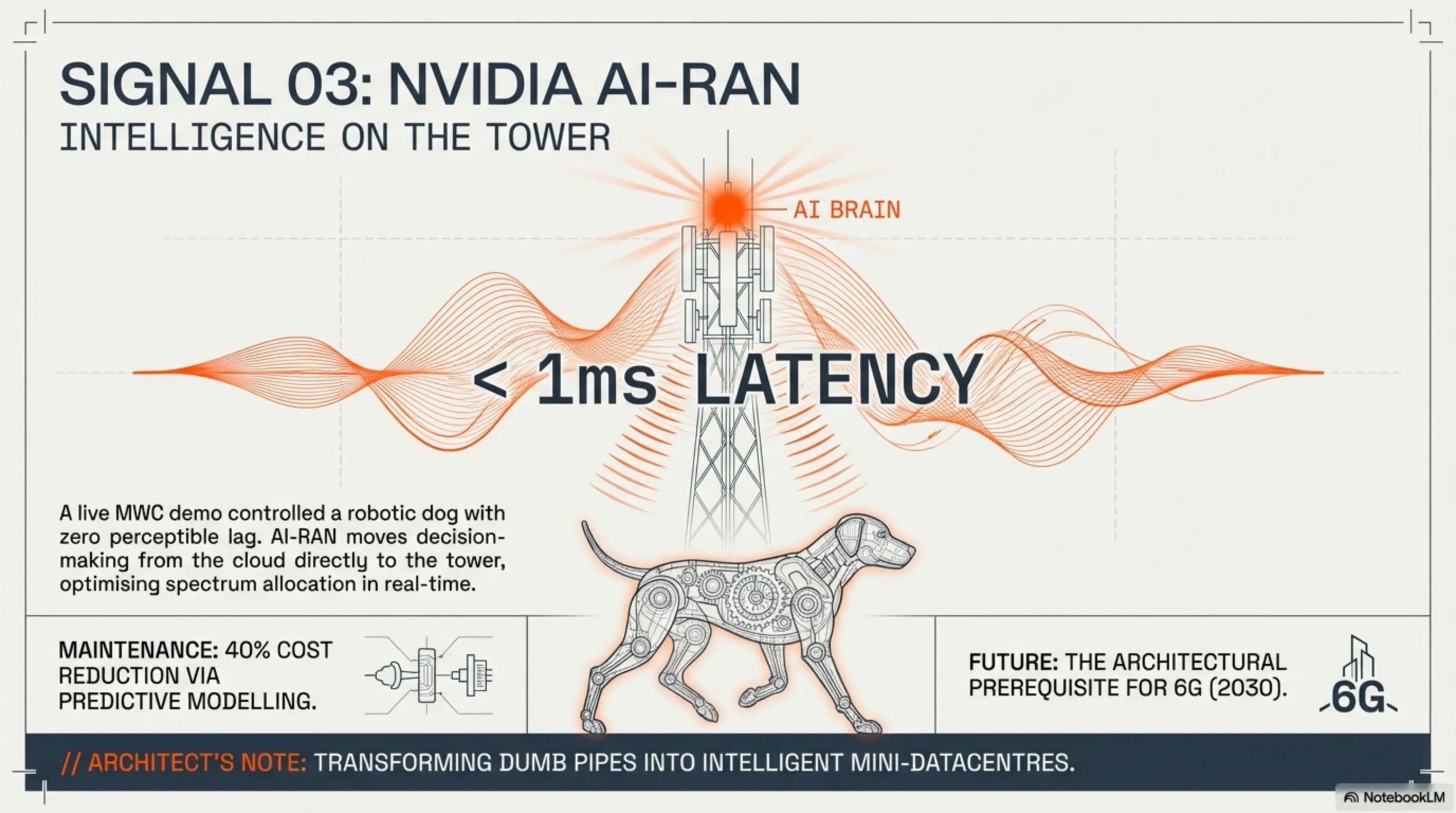
In one of the most important announcements at MWC 2026 that most media outlets ignored, NVIDIA and its telecom partners delivered a live demonstration: complete management of a 5G network by artificial intelligence — not from a cloud datacenter, but directly on the cell tower itself. The name of this technology: AI-RAN (AI-powered Radio Access Network).
In the live demo, a robotic dog was remotely controlled with less than 1 millisecond of latency over a smart 5G network. This level of latency is only possible when network decisions are made instantly on the radio equipment itself, rather than round-tripping to a cloud server.
Infrastructure Analysis: From "Dumb Pipe" Networks to "Intelligent" Networks
Current telecom networks are fundamentally "dumb pipes": they simply transport data from Point A to Point B without understanding what they are carrying. AI-RAN flips this equation 180 degrees.
- Real-Time Spectrum Optimization: AI can adjust frequency band allocation every second based on actual traffic patterns. During peak network hours, instead of degrading quality for everyone, AI intelligently distributes resources.
- Predictive Equipment Failure: Machine learning models running on towers can identify failure patterns before they occur — delivering a 40% reduction in maintenance and repair costs.
- 6G Infrastructure: AI-RAN is effectively the foundation upon which 6G networks (projected for 2030) will be built. Without AI embedded in the radio layer, achieving terabyte-speed 6G is architecturally impossible.
With AI-RAN, NVIDIA demonstrates that its future extends far beyond gaming and datacenters — this company intends to make the entire planet's communications infrastructure intelligent.
"When a robotic dog is controlled from 50 kilometers away with 1-millisecond latency, we are no longer talking about 5G — we are talking about 5G equipped with a brain. NVIDIA is transforming every cell tower into an intelligent mini-datacenter."
The Architect's Strategy: AI-RAN is a clear signal for infrastructure investors: every telecom company that misses this train will be eliminated from the market by 2030.
4. Xiaomi 17 Ultra: China's Full-Scale Attack on Global Markets with Leica Lenses 📸🐉
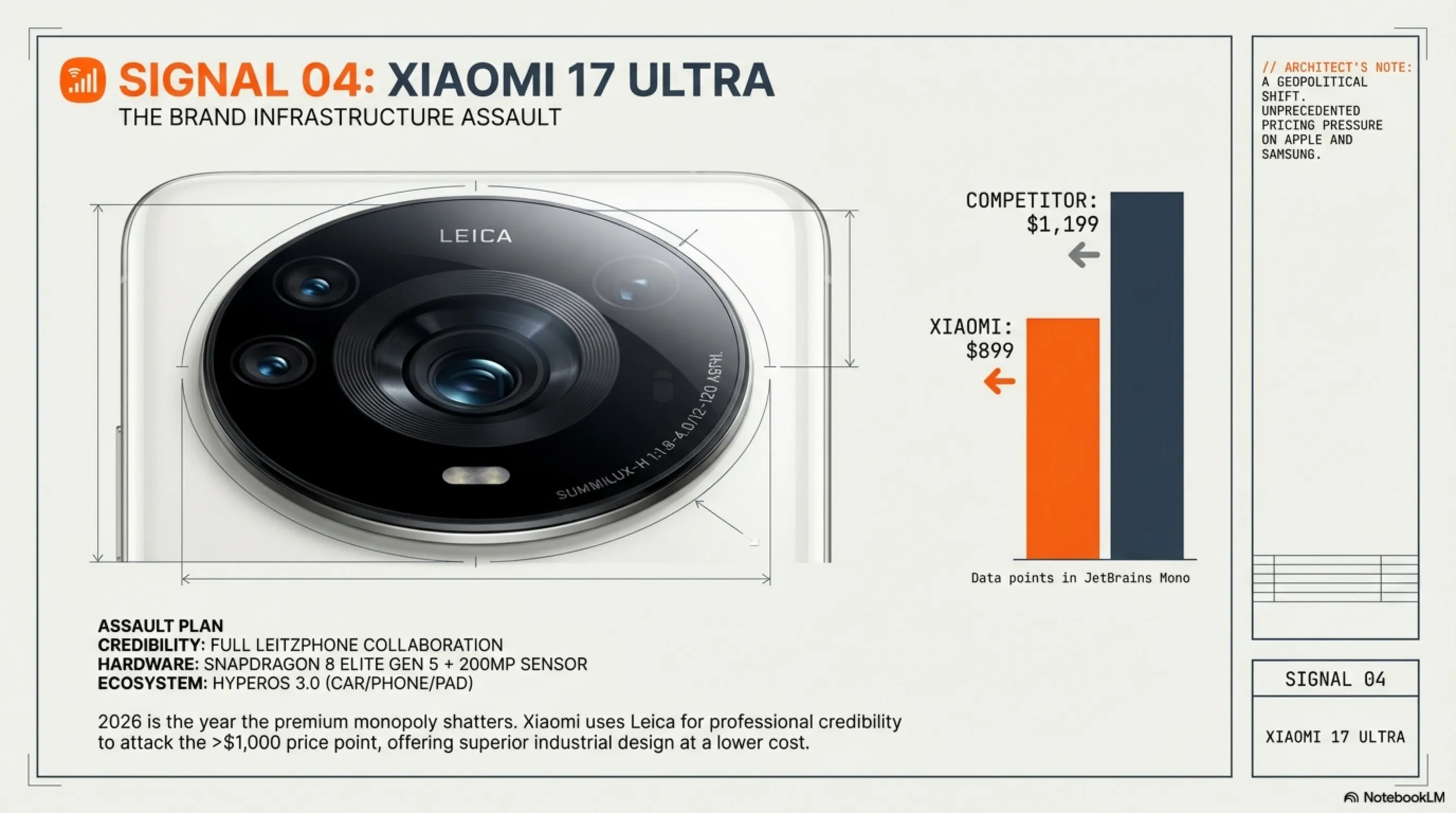
At MWC 2026, Xiaomi finally unveiled the Xiaomi 17 Ultra — alongside the Leica Leitzphone, a full-blooded collaboration with the legendary German lens manufacturer. This is the first time Leica has placed its complete name (Leitzphone) on a Chinese product, and this means: Leica is no longer "Huawei-exclusive."
The Xiaomi 17 Ultra features Samsung's new 200-megapixel ISOCELL HP9 camera sensor, 10x optical zoom with a Leica periscope lens, and the Snapdragon 8 Elite Gen 5 processor. But the real story is not the camera — the real story is the coordinated assault by Chinese brands on the Western premium market.
Market Analysis: The End of Samsung and Apple's Premium Market Monopoly
Until just two years ago, the market for phones above $1,000 belonged almost exclusively to Apple and Samsung. But 2026 is the year this monopoly shatters.
- Leica as a Credibility Weapon: The collaboration with Leica gives Xiaomi something no amount of advertising can buy: professional photography credibility. When the name "Leitz" appears on a phone, professional photographers and luxury buyers are automatically attracted.
- Aggressive Pricing: The Xiaomi 17 Ultra is projected to launch at $899-$999 — $300 less than the iPhone 17 Pro Max and $200 less than the Galaxy S26 Ultra. In the inflationary world of 2026, price is the decisive factor.
- HyperOS 3.0 Software: Xiaomi has created a unified ecosystem across phone, tablet, laptop, and even its SU7 electric vehicle with HyperOS 3.0 — precisely Apple's strategy, but at Chinese prices.
Xiaomi is no longer a "cheap Chinese brand." With Leica, Snapdragon 8 Elite Gen 5, and industrial design that surpasses many Western flagships, the 17 Ultra is a serious contender against any phone on the planet.
"When Leica — a brand that invented the 35mm camera 110 years ago — places its full name on a Chinese phone, we are witnessing a geopolitical shift in the technology value chain."
The Architect's Strategy: If Xiaomi can deliver a Leica camera under $1,000, the pricing pressure on Apple and Samsung in the second half of 2026 will be unprecedented.
5. GDC 2026: Death of a Conference, Birth of a Festival — and Hideo Kojima's Keynote 🎪🎮
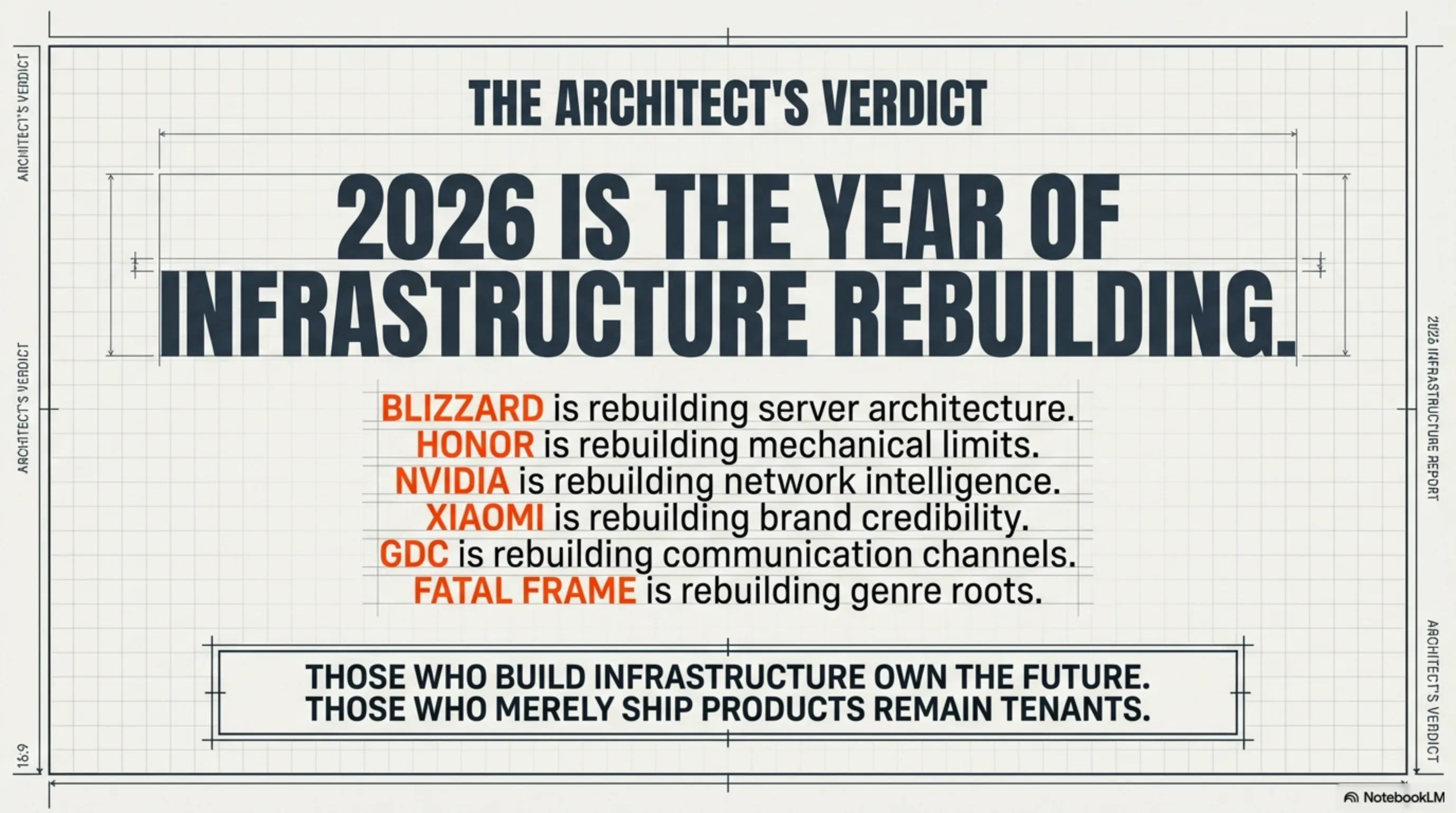
The world's largest video game developer event has undergone a metamorphosis. The Game Developers Conference, which since 1988 operated as a dry, professional technical conference, is being reborn this year (March 9-13) under the new name "GDC Festival of Gaming." And the brightest star of this festival? Hideo Kojima — creator of Metal Gear and Death Stranding — who after 5 years of silence returns as the main keynote speaker.
But beyond the name and format, a profound philosophical shift is underway: GDC is no longer just for developers — it wants to fully integrate the "gaming community" into the game creation process.
Industry Analysis: Why GDC Was Forced to Transform
The gaming industry in 2025 and 2026 has weathered multiple crises: massive layoffs (over 15,000 in 2025), the identity crisis of generative AI, and mounting pressure from labor unions. GDC, by changing its format, is attempting to escape gradual death.
- Kojima's Keynote: The last time Kojima spoke at GDC was 2021. Now, with Death Stranding 2: On the Beach set for PC release on March 19th, he carries messages about the future of interactive narrative and AI's role in crafting game worlds.
- Game of the Year Nominations: "Clair Obscur: Expedition 33" leads the GDC 2026 Awards with 8 nominations — a French turn-based RPG that proved small European teams can compete with Japanese and American giants.
- The 2026 "State of the Industry" Report: GDC is set to release its annual report, predicted to contain shocking data about generative AI's impact on employment, rising unionization, and shifting platform preferences (from console to PC and mobile).
By becoming a "festival," GDC aims to bridge developers, players, and investors — a model similar to the old E3, but with deeper technical substance and without the extravagant corporate spectacles.
"When GDC renames itself from 'conference' to 'festival,' this is a crisis signal: the gaming industry desperately needs audiences and public support to survive the storm of layoffs and artificial intelligence."
The Architect's Strategy: GDC 2026 is a historic inflection point. If the festival format succeeds, E3 will remain permanently dead. If it fails, the gaming industry loses its largest public stage.
6. Fatal Frame II: Crimson Butterfly Remake — The Most Terrifying Game in History Returns with Switch 2 🦋👻
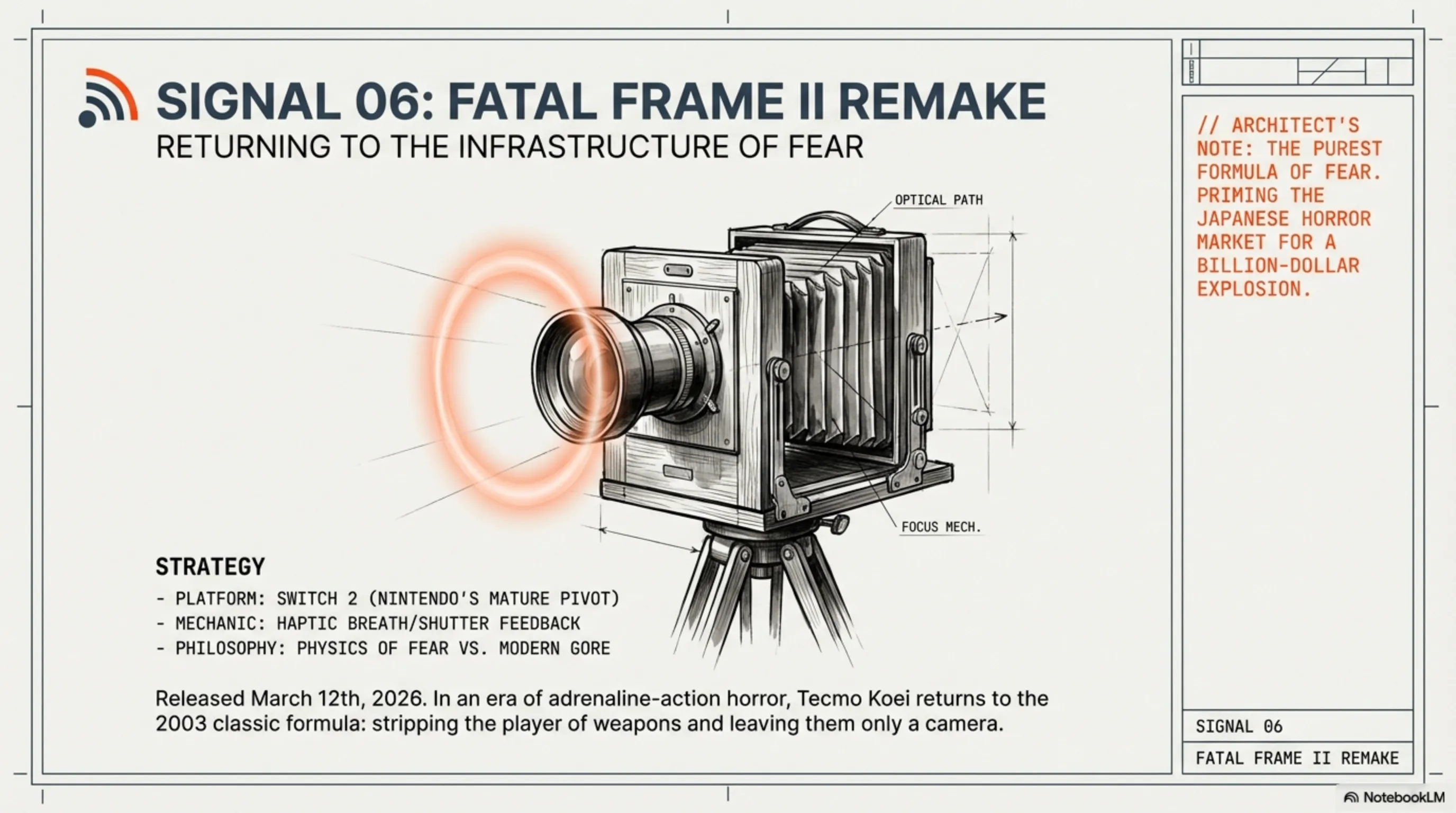
If you belong to that generation that owned a PlayStation 2, the name "Fatal Frame II: Crimson Butterfly" likely sends a shiver down your spine. This game — released in 2003 — is recognized as one of the most terrifying video game experiences in history. Now, Tecmo Koei has announced that a complete remake of this horror masterpiece will launch on March 12th, 2026, for PS5, Xbox Series X|S, PC, and — for the first time — Nintendo Switch 2.
The story revolves around twin sisters (Mio and Mayu Amakura) who become trapped in a haunted Japanese village, and their only weapon is an ancient camera called the "Camera Obscura" — a camera that both photographs and destroys spirits.
Design Analysis: Why the Fatal Frame II Remake Is a Brilliant Strategic Risk
In an era where horror games like Resident Evil have evolved into adrenaline-fueled action titles, Fatal Frame II returns to "pure fear" — fear built on atmosphere, sound, and the unknown, rather than jump scares and violence.
- The "Camera Obscura" Mechanic in 2026: The remake preserves the original's camera photography system but now merges it with PS5 DualSense haptic capabilities — trigger-press shutter feedback, controller vibration during spirit presence, and character breathing through the controller speaker.
- Switch 2 and Horror Games: Releasing Fatal Frame II on Switch 2 is an astute strategic move by Nintendo. Nintendo has always been known as the "family platform," but with Switch 2, it seeks to attract a more mature audience. Fatal Frame is one of the strongest proofs of this strategic shift.
- The Japanese Horror Renaissance: With the success of Silent Hill 2 Remake in 2024 and Resident Evil Requiem in 2026, we are in the midst of a genuine renaissance of Japanese horror games. If Fatal Frame II is built correctly, it could grow into a billion-dollar franchise.
Horror games built on the "physics of fear" (sound, light, and anticipation) have always outlasted those relying on graphic violence. The Fatal Frame II Remake is a return to this fundamental principle.
"In a world where every horror game tries to terrify through blood and violence, Fatal Frame II gives you nothing but a camera and says: 'Look into the darkness yourself.' This is the purest formula of fear in gaming history."
The Architect's Strategy: If the Fatal Frame II Remake succeeds commercially, expect Tecmo to immediately announce a Fatal Frame III Remake and an entirely new entry. The Japanese horror market is primed for an explosion.
📸 Event Image Gallery
The Verdict | The Architect's Strategic Summary (Tekin)
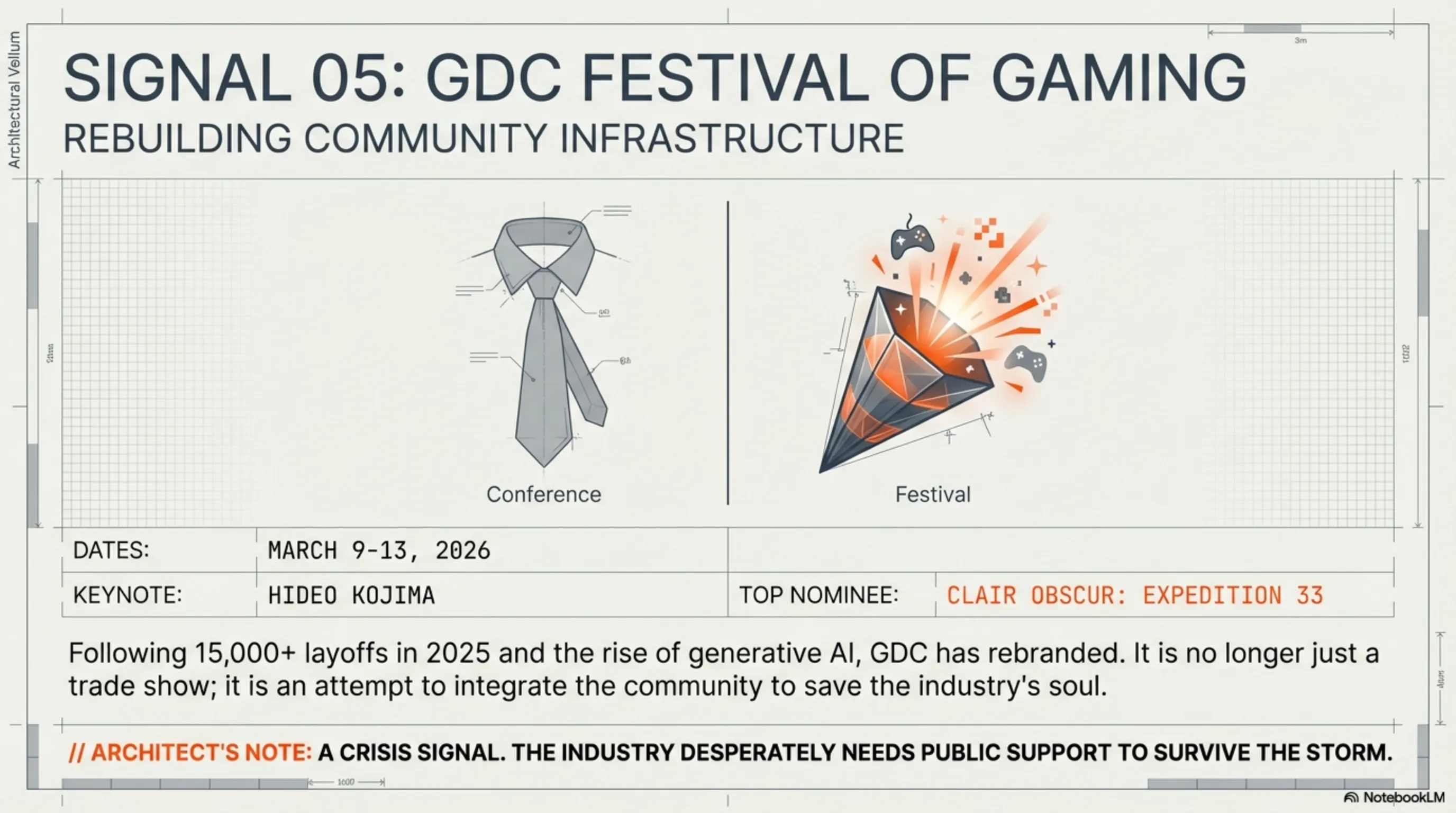
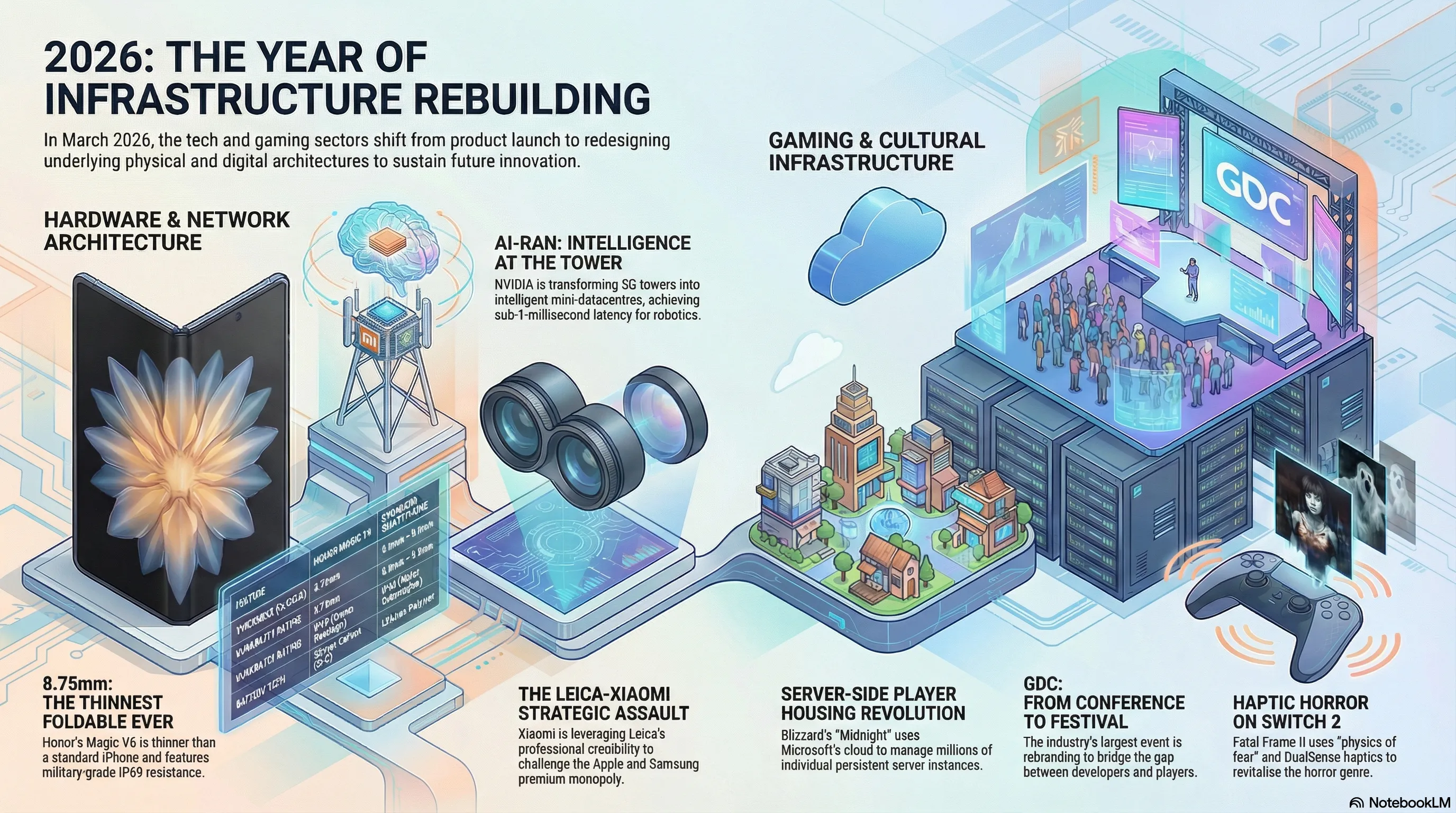
Legion, this morning we received 6 signals from 6 different fronts, and they all carry one shared message: 2026 is the year of "Infrastructure Rebuilding" — not just in hardware, but in business models, event formats, and even game genres.
Blizzard is rebuilding its server infrastructure with Midnight to make player housing possible. Honor with the Magic V6 is rewriting the mechanical infrastructure of foldable phones. NVIDIA with AI-RAN is making the planet's telecommunications infrastructure intelligent. Xiaomi with Leica is building China's brand credibility infrastructure in the premium market. GDC is transforming the gaming industry's communication infrastructure from "conference" to "festival." And Fatal Frame II is returning the horror genre's infrastructure to its original roots.
The Architect's message for today: Those who build infrastructure own the future. Those who merely ship products remain tenants. Keep your analytical eyes wide open — next week will be even more turbulent than this one.