
1. Project Grimoire: Dissecting the New AMD Custom APU
The most critical part of this leak concerns the custom Accelerated Processing Unit (APU) AMD has designed specifically for Valve. Unlike the ROG Ally, which uses off-the-shelf Z-series chips, Valve always takes the "Custom" route to perfectly balance raw power with battery life.
According to the leaked schematics, this chip is codenamed "Grimoire", and its specs are a technological marvel:
- Manufacturing Process: TSMC 3nm (Optimized for ultra-low power consumption).
- CPU Architecture: 8 Cores / 16 Threads based on Zen 5c. The "c" stands for "Compact." These are high-density cores that deliver 90% of the performance of standard Zen 5 but consume 40% less space and power. Moving from 4 cores (Deck 1) to 8 cores means eliminating the CPU bottleneck in CPU-intensive open-world games.
- NPU (Neural Processing Unit): Yes, the Steam Deck 2 is entering the AI era. An XDNA 2 unit is onboard to handle background tasks and intelligent upscaling without stressing the GPU.
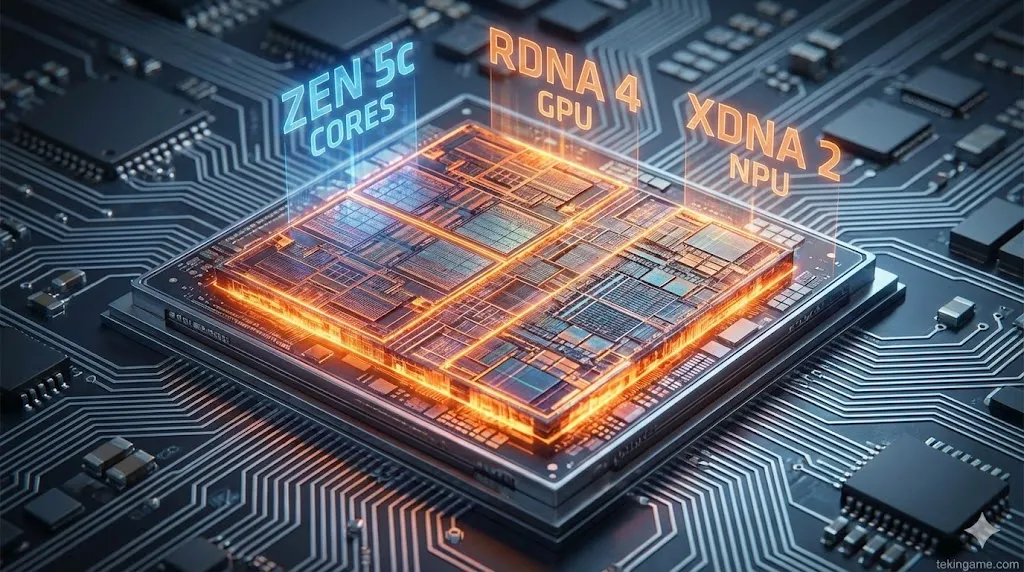
This combination suggests a raw processing power of approximately 4.5 TFLOPS, which is roughly 3 times more powerful than the original Steam Deck. It is a beast in a cage.
2. RDNA 4 Architecture: Goodbye FSR 2, Hello Native Resolution
The Achilles' heel of handheld consoles has always been graphical horsepower. But with the RDNA 4 architecture, AMD is focusing on one thing: Optimized Ray Tracing.
The GPU component of the Steam Deck 2 reportedly features 12 Compute Units (CUs). While the core count isn't a massive jump from the previous 8, the clock speeds have skyrocketed to 2.8 GHz! This implies:
- Hardware-Accelerated Ray Tracing: Finally, RT without the slideshow frame rates.
- FSR 4 Support: This is the game-changer. Unlike FSR 3 which relies on software compute, RDNA 4 supports AI-driven frame generation at the hardware level.
This means if a game like Black Myth: Wukong struggled to hit 30 FPS on the Deck 1, the Deck 2 could target a locked 60 FPS using these new technologies. Of course, to load these heavy RDNA 4 textures quickly, we highly recommend upgrading to a high-speed A2 Class microSD card.
3. The Screen Debate: Why 900p OLED is the "Golden Ratio"
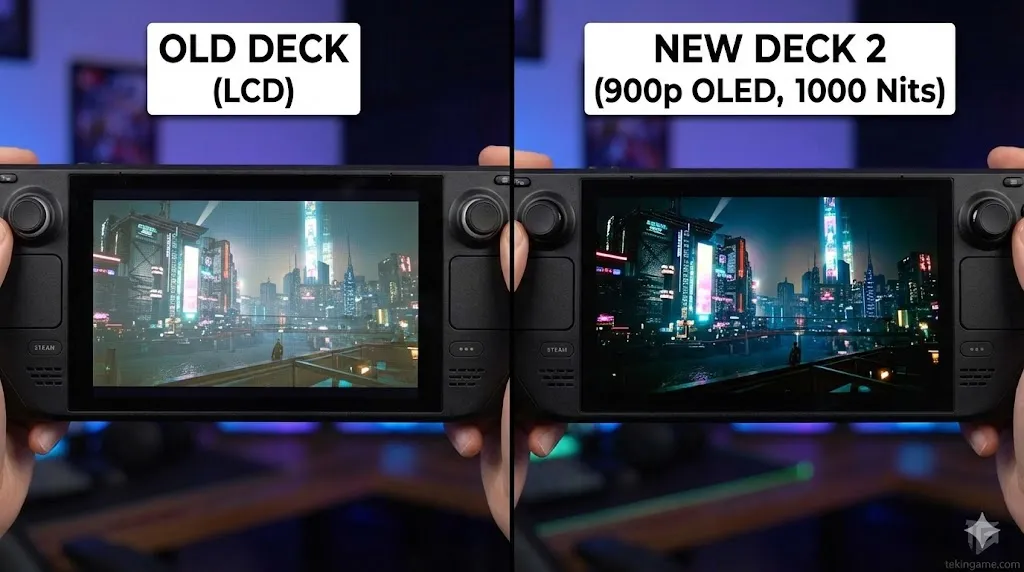
Valve learned a valuable lesson with the OLED refresh: "Gamers want deep blacks." Going back to LCD for the sequel is impossible. The rumors point to a custom Samsung OLED panel with a 900p resolution.
Why not 1080p? Because Valve engineers argue that on a 7 or 8-inch screen, the visual difference between 900p and 1080p is negligible to the human eye, but the strain on the battery and GPU is significantly higher at 1080p. 900p is the "Sweet Spot."
Rumored Display Specs:
- Resolution: 1600x900 (16:10 aspect ratio).
- Refresh Rate: 120Hz Variable Refresh Rate (VRR). This is vital. If your game fluctuates between 45 and 55 FPS, VRR makes it look perfectly smooth.
- Brightness: 1000 Nits peak (for outdoor visibility).
Design-wise, the device is expected to be slightly slimmer, with trackpads that feature "High-Definition Haptics," simulating physical clicks more realistically than ever.
4. Battery & Cooling: Solving the Thermal Throttling Crisis
More power usually equals more heat. However, the 3nm lithography of the Grimoire chip is Valve's ace in the hole. It runs cooler naturally. Even so, the cooling system has been completely redesigned.
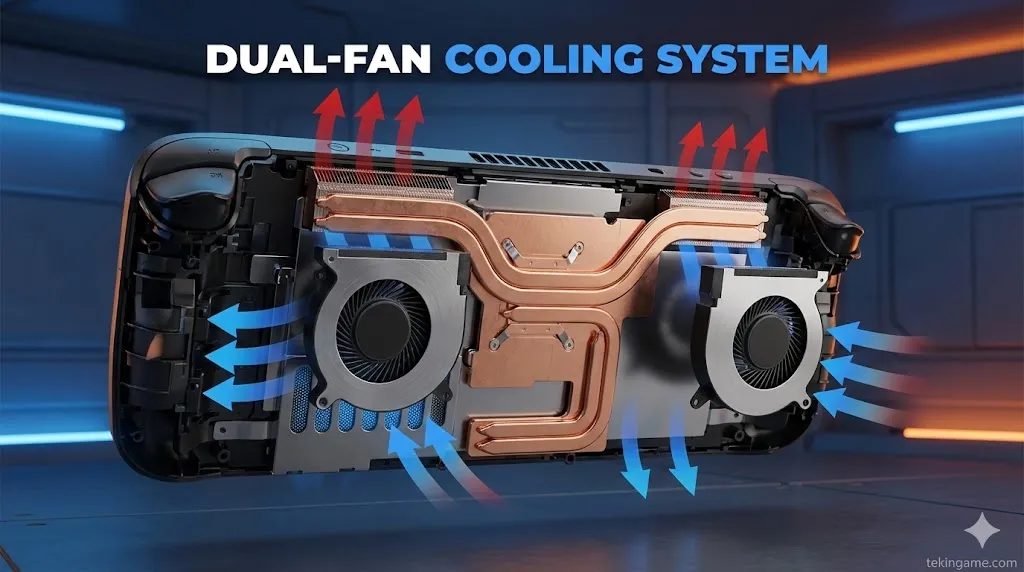
Leaks suggest the single loud fan is being replaced by a dual-fan system that pulls air from the back and exhausts it upwards, away from your hands. This means quieter operation and cooler grips.
On the battery front, Valve is adopting "Stacked Battery" technology (similar to electric vehicles) to increase density without increasing physical size. We expect a 70Wh battery, which could guarantee 3 hours of heavy AAA gaming. However, for long trips, carrying a 65W Laptop-Grade Power Bank remains a necessity for any serious handheld gamer.
5. Theoretical Benchmarks: GTA VI and Cyberpunk 2 on High Settings
This is the section everyone is waiting for. Based on the 4.5 TFLOPS raw power, let's estimate the performance:
| Game Title | Steam Deck OLED (Current) | Steam Deck 2 (Estimated) | Notes |
|---|---|---|---|
| GTA VI | Unplayable (< 20 FPS) | 40-45 FPS (Medium/Low) | With FSR 4 and VRR, this will be the ultimate portable experience. |
| Cyberpunk 2077 | 35 FPS (Low) | 60 FPS (High) | RDNA 4 architecture shines here. |
| Elden Ring | 40 FPS (Medium) | 90 FPS (Maximum) | A flawless Soulslike experience. |
This console is exactly what we need to run Gen 9 and early Gen 10 games without compromise.
6. SteamOS 4.0: AI Integration and "Archimedes" Update
Hardware is nothing without software. Valve is reportedly developing SteamOS 4.0 "Archimedes". The key feature? Intelligent Game Recording.
The OS will automatically detect key moments (like a Boss Kill or a Victory Royale) and clip them in the background using the NPU, with zero performance loss. Furthermore, the Proton translation layer has advanced so much that practically 100% of Windows games run without tweaking. The need to install Windows on a Deck is vanishing.
7. Price & Release Date: Can Valve Keep it Under $500?
Valve's strategy has always been: "Sell the hardware cheap, make money on software." But with expensive components like LPDDR5X RAM and Samsung OLED panels, a $399 starting price is mathematically impossible.
TekinGame Analyst Predictions:
- Base Model (256GB SSD): $499
- Pro Model (512GB + Anti-Glare): $599
- Ultra Model (1TB + Accessories): $699
The reveal? Likely Summer 2026 (Summer Game Fest), with a release in Holiday 2026 to coincide with the PC release of major titles.
8. Conclusion: Should You Sell Your Old Deck?
If you own a Steam Deck OLED right now, you still hold a fantastic device. But if you are rocking the old LCD model or looking to buy your first handheld, it might be worth waiting a few months. Steam Deck 2 isn't just a console; it's Valve's thunderous reply to everyone who said "the handheld era is over."
At TekinGame, we will stock all exclusive accessories (Skins, Cases, Docks) the moment pre-orders go live. Until then, guard your wallets!
🎮 Commander, Choose Your Weapon!
Between the raw power of the ROG Ally and the smooth OS of the Steam Deck, which side are you on?
Are you willing to wait until late 2026 for the Deck 2?
Drop your comment below (Best comment wins a discount code!) 👇