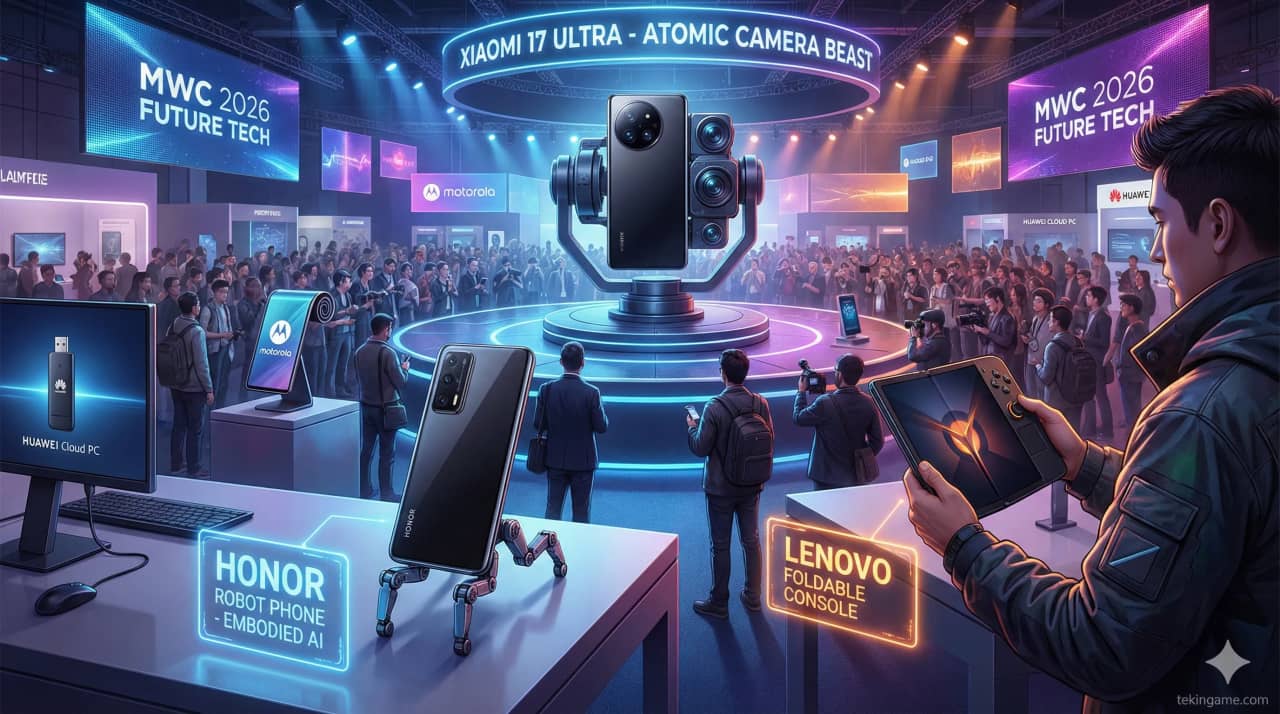
The Mobile World Congress (MWC) 2026 in Barcelona marks the definitive end of the incremental smartphone era and the dawn of "Embodied AI," where artificial intelligence has transitioned from mere software to the mechanical backbone of hardware. This strategic teardown and deep-dive analysis examines six revolutionary products rewriting the rules of the tech industry. At the forefront is Honor's "Robot Phone," featuring a 200MP camera mounted on a motorized three-axis gimbal, elevating the smartphone into a "sentient companion" through visual a
The Silicon Valley Earthquake in Barcelona: MWC 2026 and the End of the "Boring Smartphone" Era 📱🤖
The Mobile World Congress (MWC) 2026 in Barcelona, taking place from March 2nd to 5th, has officially transformed from a predictable trade show into a high-stakes, all-out technological warzone. While Apple quietly dropped the M5 Max chip on its website back in Cupertino via a sterile press release, the giants of the Android and PC ecosystems were launching fireworks in Spain. From Honor's Sentient Robot Phone that literally tracks your movements with digital eyes, to Lenovo's Foldable Gaming Handheld featuring an 11.6-inch morphing screen that completely erases the boundaries between a tablet, a laptop, and a console, all the way to Xiaomi's 17 Ultra and its 200MP mechanical telescopic Leica lens that puts professional DSLR mechanics in your pocket. In this TekinGame urgent Deep Dive, we dissect the 6 most earth-shattering products of MWC 2026 through a rigorous engineering and analytical lens.
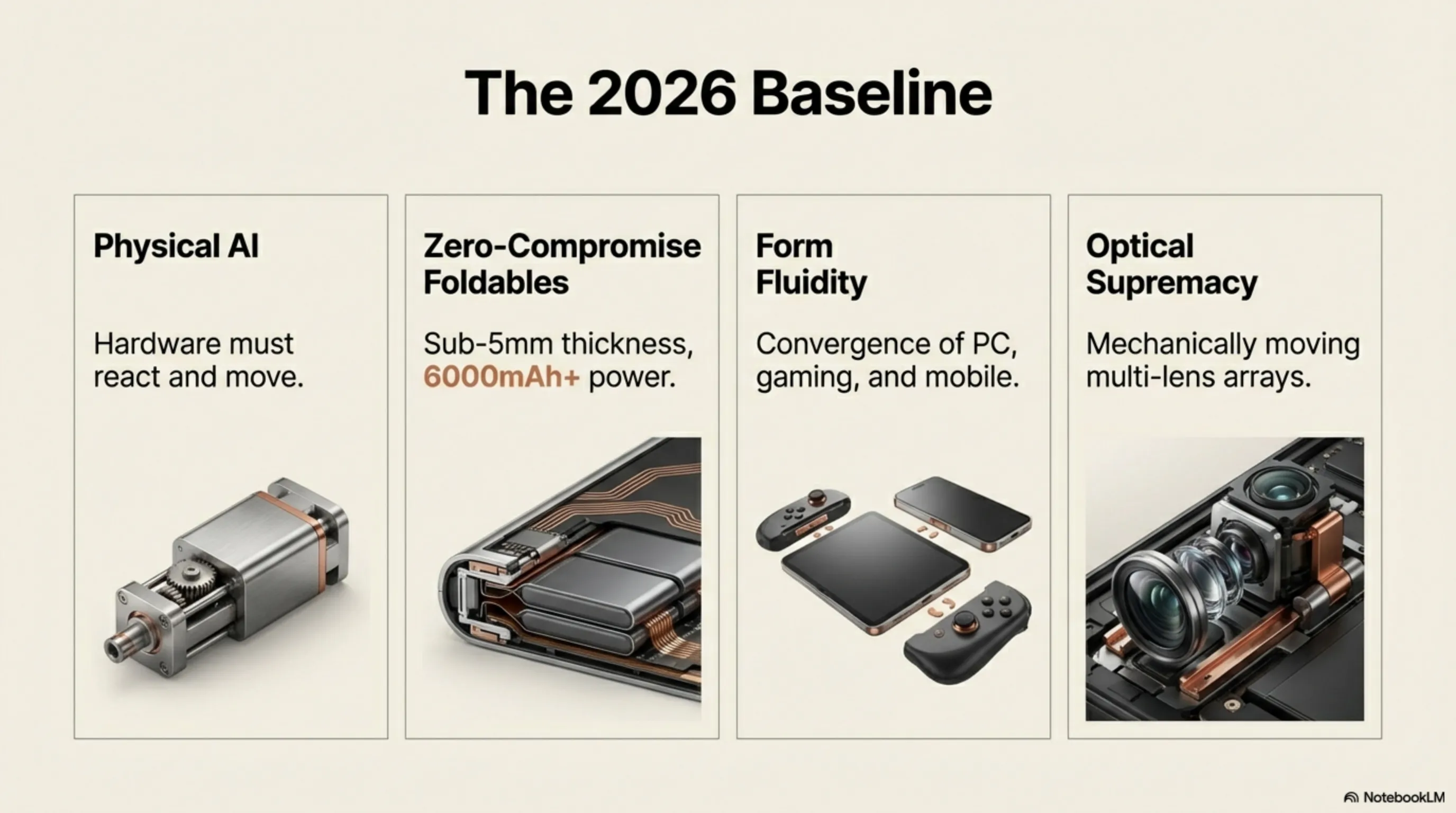
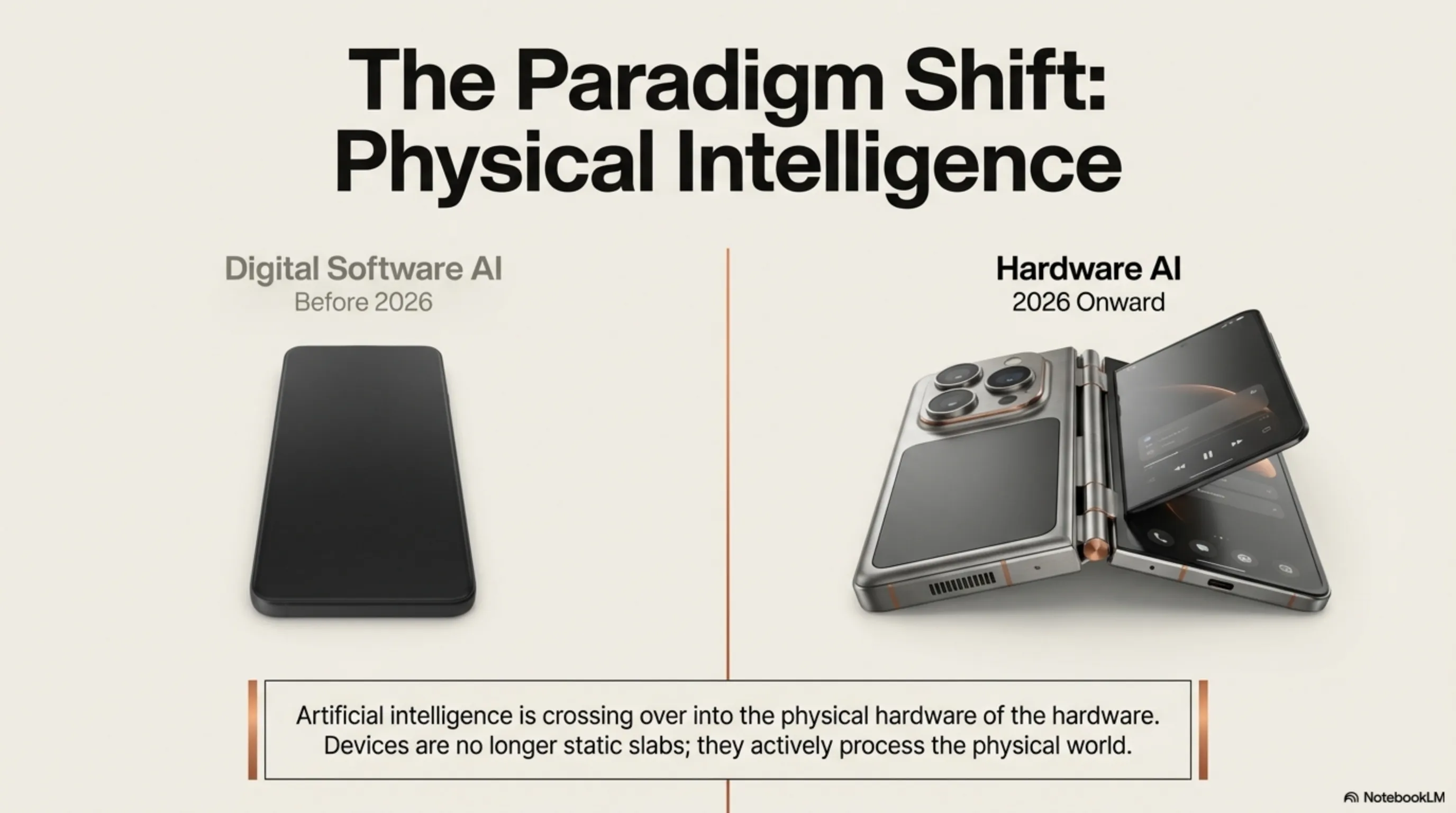
This year, the MWC organizers branded the event with the slogan: "The IQ Era." Consequently, nearly every product unveiled in Barcelona dragged along a thick layer of Artificial Intelligence. However, the fundamental difference between this year and the previous half-decade—when companies merely slapped "AI" stickers on their packaging—is profound: AI is no longer simply a marketing buzzword or a software application; Artificial Intelligence is now the physical backbone of the hardware. We are actively witnessing the paradigm shift from cloud-based computing to "Embodied AI," an era where physical hardware reacts mechanically based on neural network processing.
If you are ready to peer into the absolute future of mobile technology, robotics, and cloud computing in 2026, buckle up. This event has been a technological bloodbath for companies that have failed to keep pace with the hyper-speed of innovation.
1. Honor Robot Phone — The Smartphone That Is Alive, Listening, and Watching 🤖📱
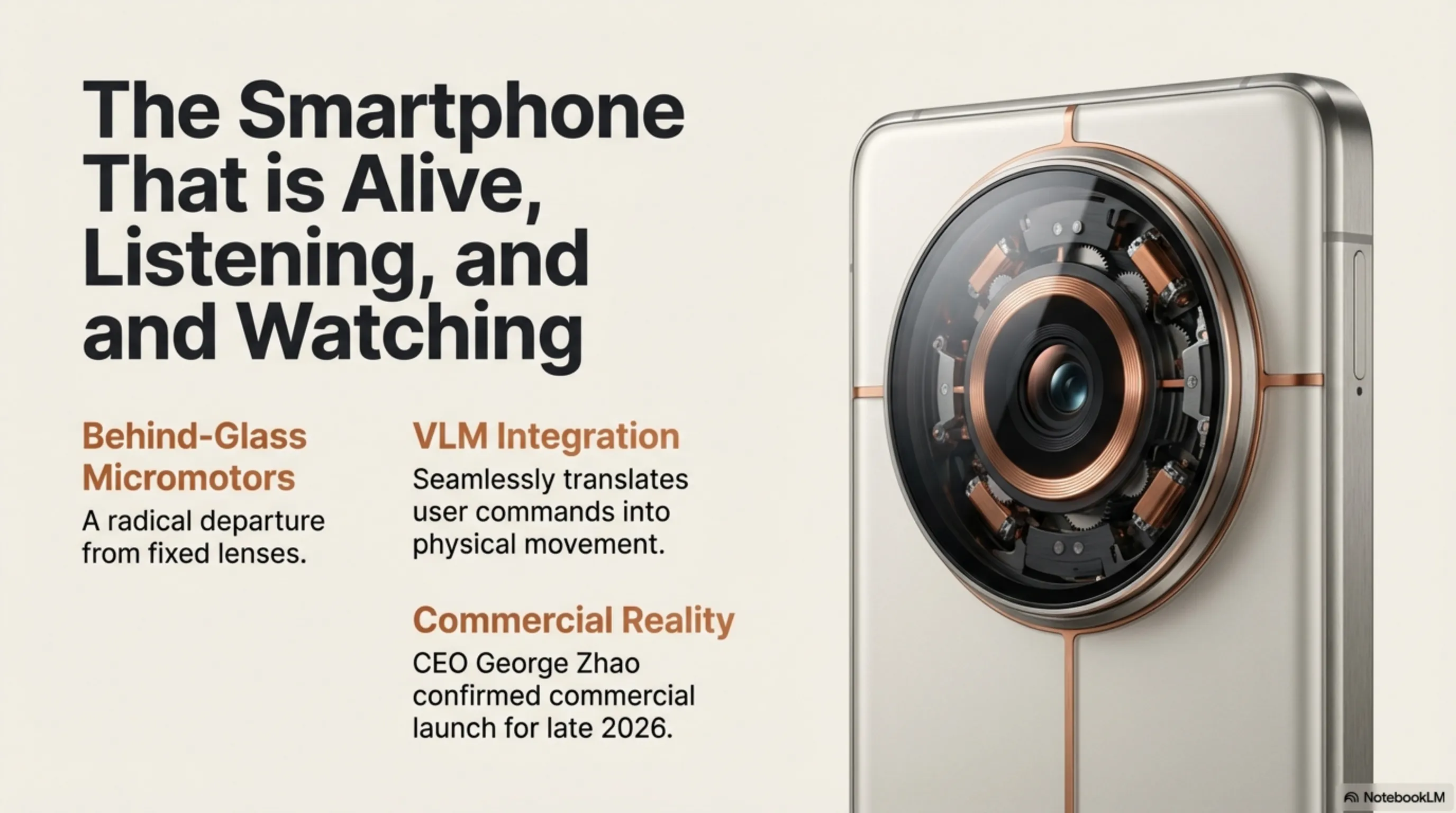
Honor didn't just shock the mobile industry with the unveiling of the commercialized "Robot Phone" concept at MWC 2026; they actively questioned the very definition of the word "smartphone." This is not a tedious, behind-glass demonstrator concept. Honor's CEO, George Zhao, took the stage and officially confirmed that a commercial version of this device will hit the Chinese market, followed by a global rollout, in the second half of 2026.
The Mechanical Architecture of the 200MP Moving Camera
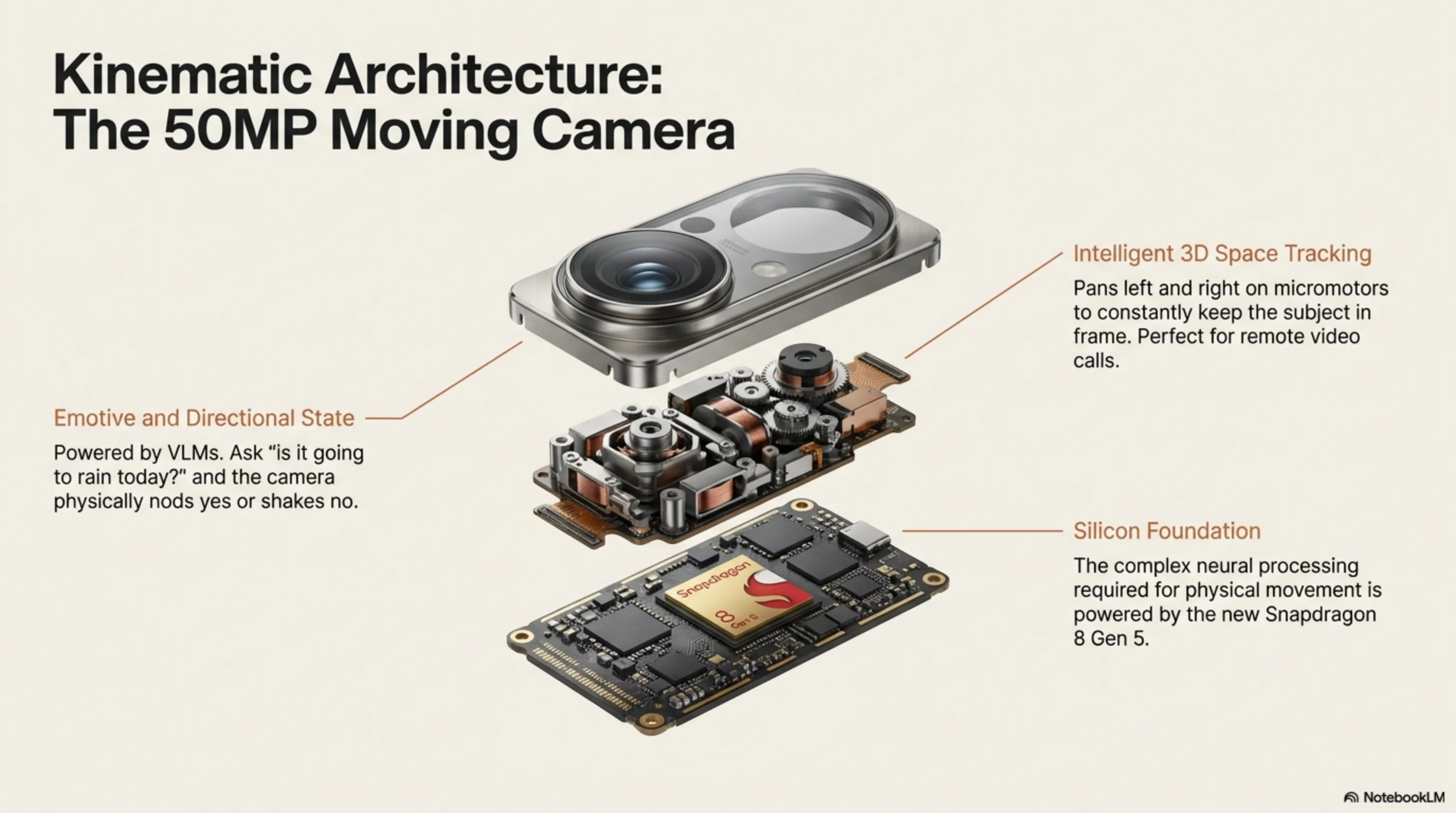
The most critical and differentiating feature of the Robot Phone is its rear camera module, which looks and operates like absolutely nothing else on the consumer market. The device is equipped with a gargantuan 200MP camera sensor housed entirely within a miniaturized, motorized three-axis gimbal system. This means the camera lens can physically move across the Pan, Tilt, and Roll axes autonomously. When the phone is placed on a desk, you no longer need to position yourself perfectly in the frame; the camera physically rotates and pivots to keep you dead center.
- Intelligent 3D Space Tracking: The camera array is capable of identifying environmental audio sources. If someone to your right begins speaking, the camera module will execute a smooth, robotic pan to face them. During video calls or live vlogging sessions, the phone essentially acts as a dedicated, highly precise professional cameraperson.
- Expressive and Emotional States: This is where the technology becomes simultaneously fascinating and slightly terrifying. The Robot Phone is designed to react "emotionally" to voice commands or environmental stimuli. Ask the device, "Is it going to rain today?" and if the answer is no, the camera lens will physically shake side-to-side in a "no" gesture. When playing music, the camera module synchronizes with the rhythm, performing a miniature mechanical dance.
- Embodied AI (The New Frontier): Honor refers to this new trend as a "New Species of Smartphone." In this paradigm, artificial intelligence has transcended a purely text-based user interface (like ChatGPT) and has gained access to mechanical, physical actions and reactions. Combining precise robotics with the processing power of a Snapdragon chip turns the mobile phone from a "cold tool" into a "sentient companion."
The Engineering Nightmare of Moving Parts and Wear-and-Tear
Of course, any hardware engineer knows that introducing moving parts into a device that is pulled out of a pocket 100 times a day and subjected to diverse environments is an absolute engineering nightmare. Honor claims that the miniature stepper motors driving this gimbal have been rigorously tested for up to 500,000 movement cycles and feature an instant magnetic lock mechanism triggered automatically during freefall. However, the true test will be the real world: will pocket lint, dust, and sudden impacts paralyze this delicate mechanism over time?
TekinGame System Architect's Take: The Robot Phone is neither a cheap marketing gimmick nor a toy gimbal; it is the first serious, commercial step toward "Sentient Devices" in the general consumer market. By 2028, we predict that every flagship smartphone in the "Ultra" tier will feature at least one physical-kinetic sensor module deeply integrated with Vision Language Models (VLMs).
2. Honor Magic V6 — The World's Thinnest Foldable With a 6,600mAh Atomic Heart 📐
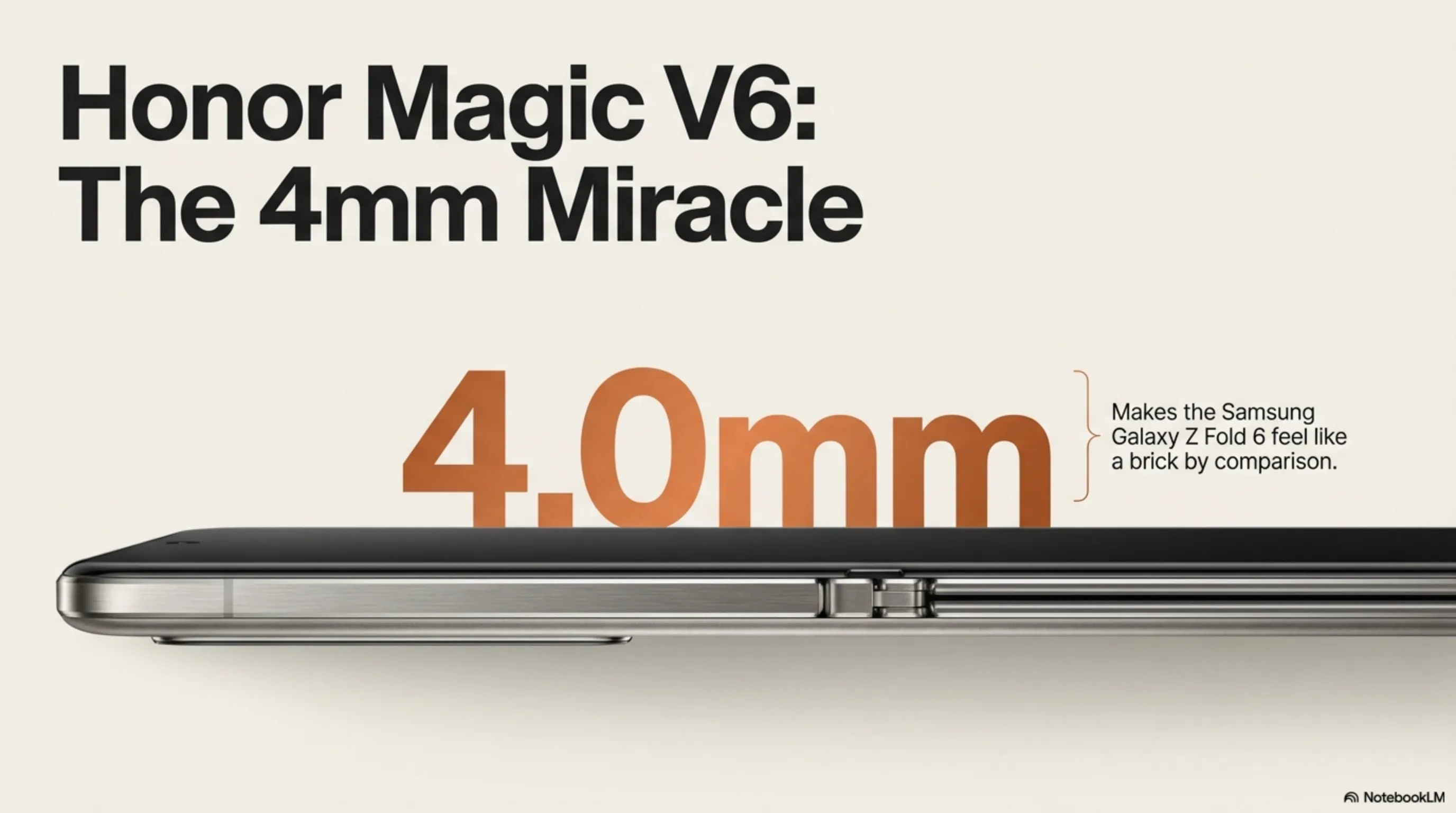
Alongside the bombshell announcement of the Robot Phone, Honor also unveiled its guaranteed blockbuster flagship designed to conquer the premium foldable market: the Magic V6. While Samsung continues to struggle with thickness and sub-5000mAh batteries in the Galaxy Z Fold series, Honor has seemingly shattered the laws of physics with the Magic V6.
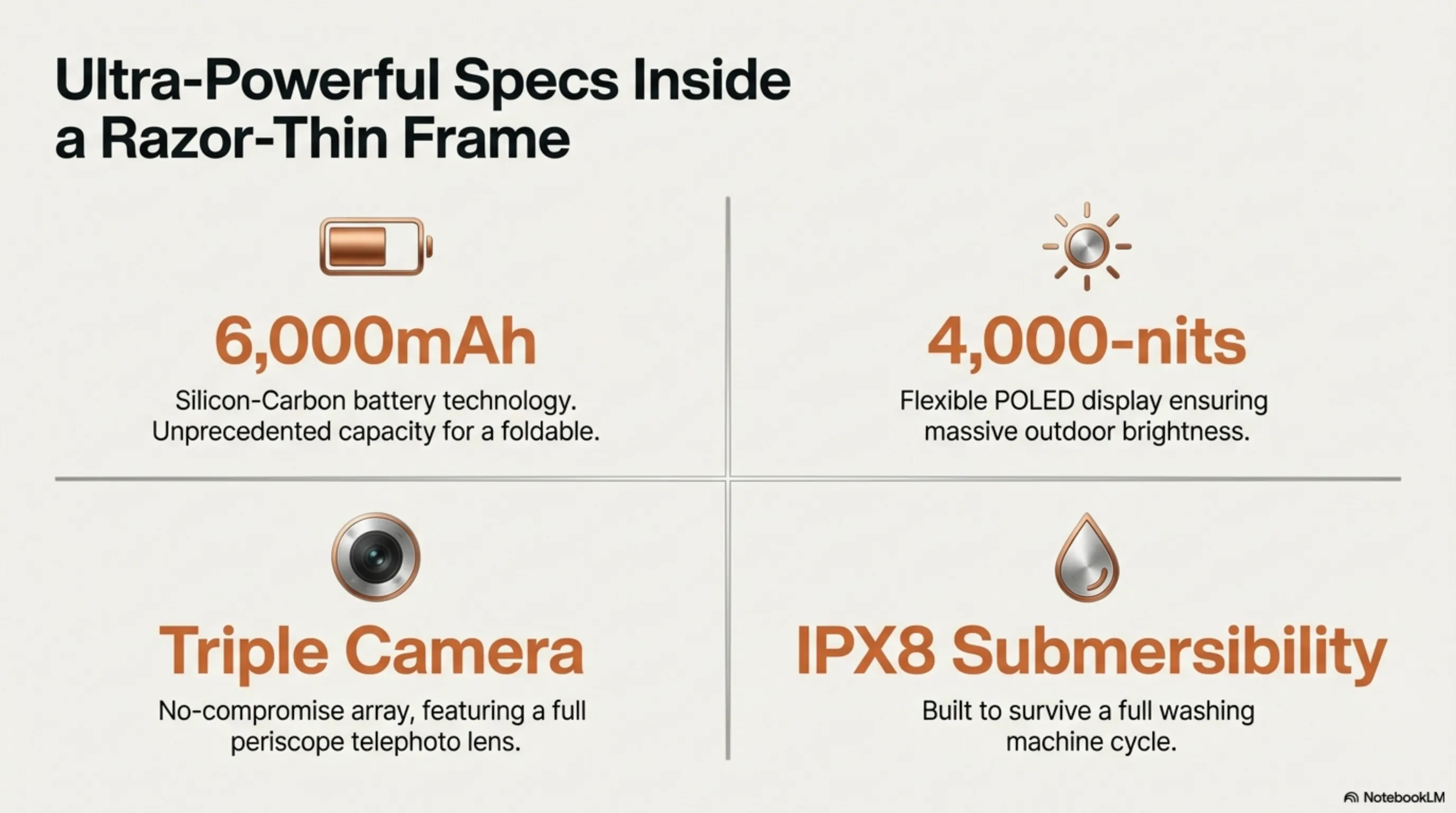
Ultra-Powerful Specs Inside a Razor-Thin Frame
The Magic V6 is a book-style foldable phone that, when closed, feels almost identically thin to an iPhone 17 Pro. Yet, beneath this ultra-light titanium chassis lies an absolute monster of processing power and endurance.
- Diamond-Tier Displays: The external cover screen is a 6.52-inch LTPO AMOLED panel featuring microscopic bezels. For the first time in the world, this panel achieves an unbelievable peak brightness of 6,000 nits. When unfolded, the internal screen provides a massive 7.95-inch canvas. Honor claims that their 4th-generation titanium hinge has reduced the crease depth by 44% compared to the V5, making it practically invisible to the eye and imperceptible to the touch.
- Snapdragon 8 Elite Gen 5 Chip: The beating heart of this device is Qualcomm's latest flagship silicon. The Snapdragon 8 Elite Gen 5, built on TSMC’s cutting-edge 3nm lithography, not only delivers unparalleled raw computational power but operates with hyper-efficiency.
- 6,600mAh Silicon-Carbon Battery: This was the biggest shock on the Magic V6 spec sheet. While similar-sized competitors struggle to fit 4,800mAh cells, Honor utilized 3rd-generation Silicon-Carbon battery technology—which boasts a significantly higher energy density than classical graphite/lithium-ion cells—to cram a massive 6,600mAh power plant into this phone. This guarantees the V6 can easily survive two full days under heavy stress. 80W wired fast charging and 66W wireless charging (which is still faster than many competitors' wired charging) complete the package.
- No-Compromise Triple Camera Array: Foldable phones traditionally sacrifice camera hardware for thickness. The V6 defies this trend by including a primary 50MP sensor with powerful OIS, a 64MP periscope telephoto camera with true 3x optical zoom, and a 50MP ultrawide sensor.
Durability and Long-Term Software Support
Honor has finally upgraded its ingress protection certifications. The Magic V6 now boasts not only an IP68 rating (resistance to prolonged submersion) but also an IP69 rating (resistance to high-pressure, high-temperature water jets). The hinge is certified for 500,000 folds—equivalent to folding and unfolding the device 100 times a day for 14 straight years!
On the software front, MagicOS 10 runs right top of Android 16. Marking a historic shift for the brand, Honor has guaranteed an unprecedented 7 years of major OS upgrades and security patches. The phone will hit the Chinese market on March 10th and launch globally in the second half of 2026.
3. Lenovo Legion Go Fold — The Holy Matrimony of Windows, Gaming, and Foldable Screens 🎮
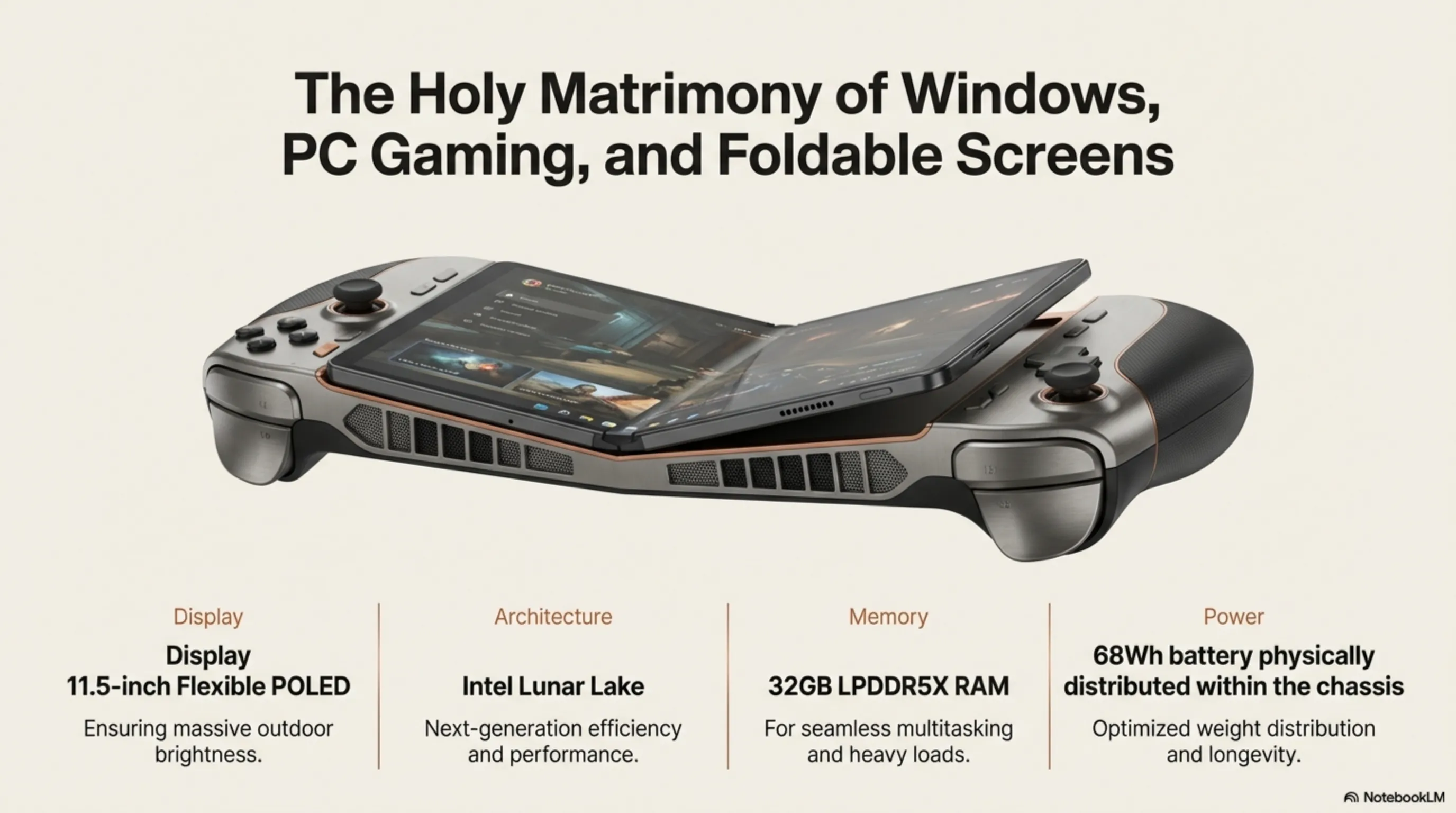
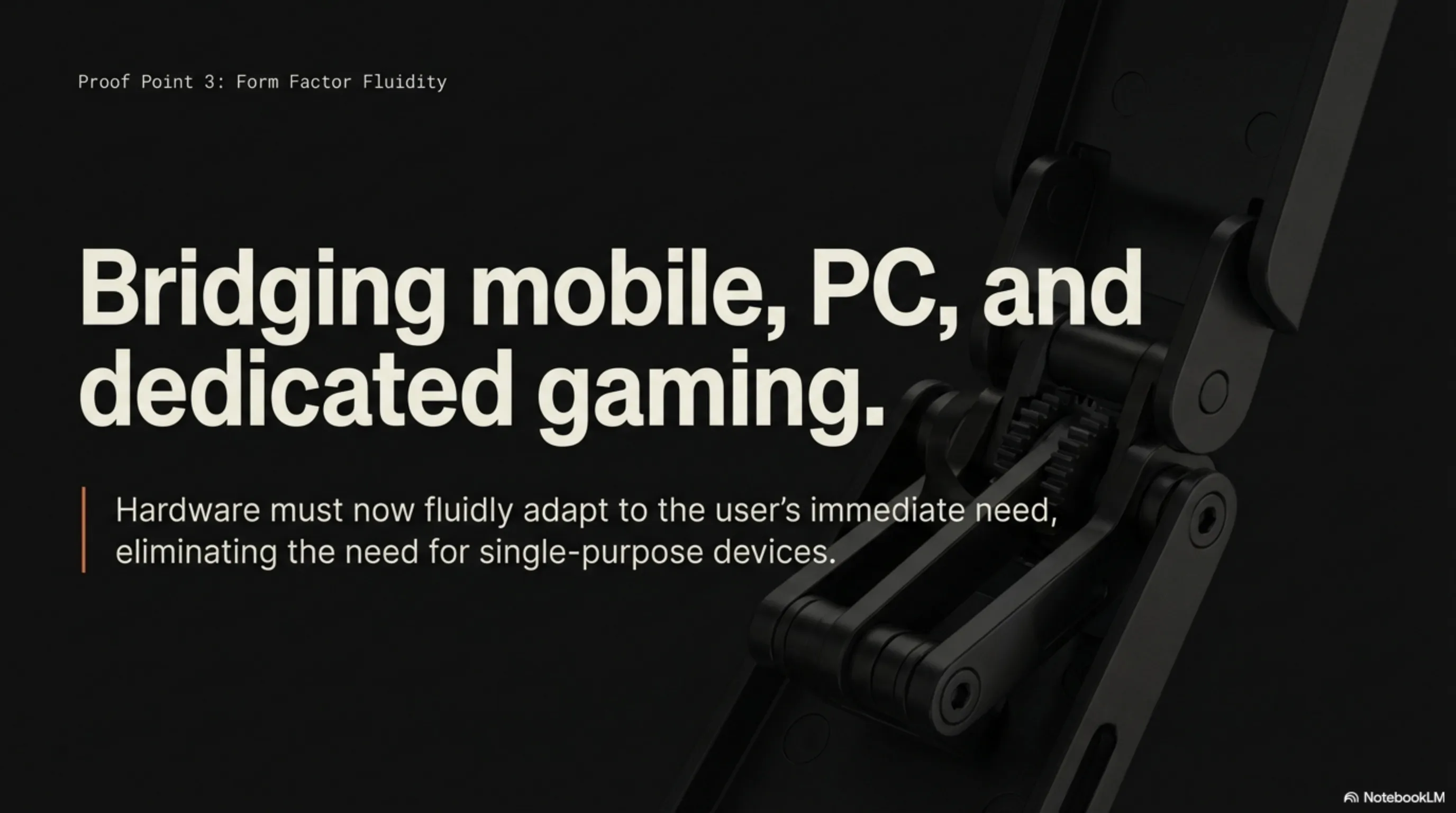
With the Legion Go Fold, Lenovo has completely re-engineered the concept of "Handheld Gaming" from the ground up. A device that, at first glance, resembles a thick remote control suddenly expands via manual force into a gigantic tablet and gaming console. This machine pushes the "Liquid Gaming" paradigm—pioneered by Valve with the Steam Deck—into uncharted territory.
An 11.6-Inch Flexible POLED Canvas
The core of Lenovo's magic is a foldable plastic-OLED (POLED) display. In its closed state, or "Standard Handheld Mode," you are presented with a 7.7-inch display—dimensions very similar to the Nintendo Switch OLED or Asus ROG Ally. Lenovo’s potent controllers, equipped with 3D haptic feedback and drift-immune Hall-Effect analog sticks, attach to either side of this 7.7-inch screen.
But when you unfold the screen down the middle—note that unlike book-style phone foldables, this display bends outwards—a spectacular, seamless 11.6-inch canvas appears before your eyes. The resolution of this fully opened display is 2435 x 1712 pixels (widescreen format), boasting a 165Hz refresh rate and a peak brightness of 500 nits; specifications that are perfectly ideal for competitive and AAA Windows gaming.
Lunar Lake Architecture: The Dance of Watts and Framerates
The processing core of this concept device is the ultra-modern, highly efficient Intel Core Ultra 7 258V chip from the Lunar Lake family. This x86 chip, combined with the integrated Intel Arc 140V GPU, is so energy-efficient that it can run AAA titles like Cyberpunk 2077 or Death Stranding 2 at 11.6-inch resolution with stable framerates, all without turning the device into a brick oven. 32GB of ultra-fast LPDDR5x RAM, soldered directly onto the processor package, provides massive bandwidth for the Arc graphics, while a 1TB PCIe Gen 4 SSD handles storage.
Supplying power to this foldable behemoth is a 48Wh battery, carefully distributed within the chassis to maintain perfect weight balance while gaming handheld.
Four Form Factors in a Single Chassis
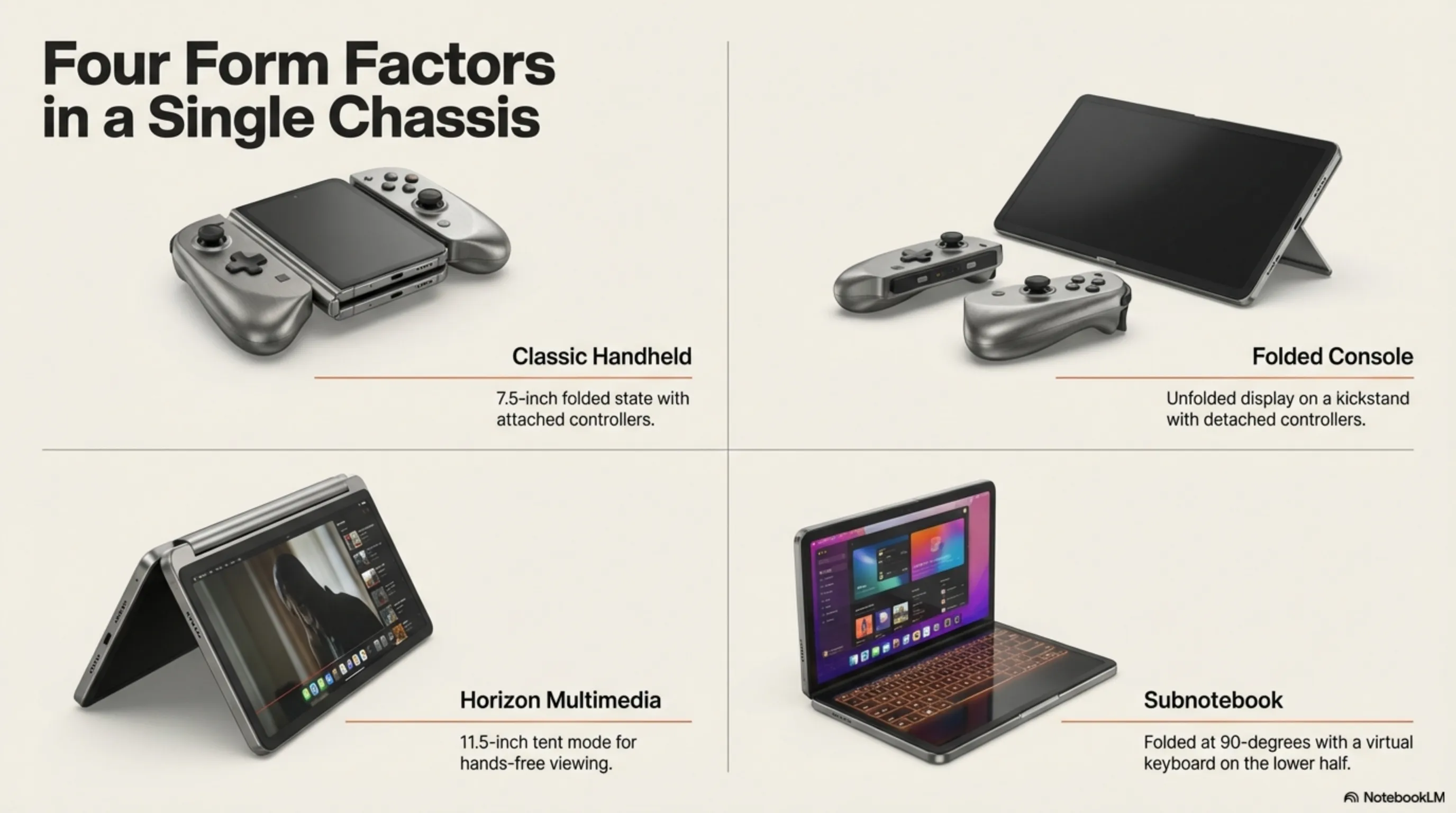
Lenovo's innovation lies not just in hardware, but in redefining the Human-Machine Interface (HMI). The Legion Go Fold can be used in four distinct modes:
- Classic Handheld Mode: Utilizing the 7.7-inch screen while the device is folded. Perfect for the subway, bus, or playing in bed.
- Vertical Split-Screen Mode: The screen is unfolded halfway and placed on a desk like a miniature laptop. You can game on the top (horizontal) half while keeping a walkthrough, performance monitor, or Discord chat open on the bottom (vertical) half. This is the ultimate dream for traveling streamers.
- Horizon Full Screen Mode: The device unfolds completely (11.6-inch tablet-style). By rotating it 90 degrees and reattaching the controllers to the top and bottom (or left and right), you experience the most expansive handheld gaming experience in the world.
- Expanded Desktop Mode: By opening the device fully, propping it up on its kickstand, and connecting Lenovo's wireless keyboard with an integrated touchpad, this gaming device suddenly transforms into a highly capable 11.6-inch content creation laptop ready for Premiere Pro video editing.
TekinGame Golden Insight: Although Lenovo repeatedly stressed that this is currently a "Proof-of-Concept" prototype with no price or release date, history shows the Legion brand rarely designs a concept that doesn't eventually land on store shelves. If the Legion Go Fold commercializes in late 2026 or early 2027, Valve and Asus must radically redesign their Next-Gen architectures. An 11.6-inch screen in a gamer's pocket effectively spells the death of sub-notebook gaming laptops.
4. Xiaomi 17 Ultra — The Definitive Death of Compact DSLR Cameras 📸
For years, the "Megapixel War" in smartphone cameras had been largely replaced by computational processing and AI algorithms (Computational Photography). However, at its global event just prior to MWC 2026 (on February 28), Xiaomi sent a terrifying message to competitors like Samsung (S26 Ultra) and Apple (iPhone 17 Pro Max) with the Xiaomi 17 Ultra: the physics of light and mechanical optics still reign supreme.
Historic Leica Collaboration and Moving Lens Systems
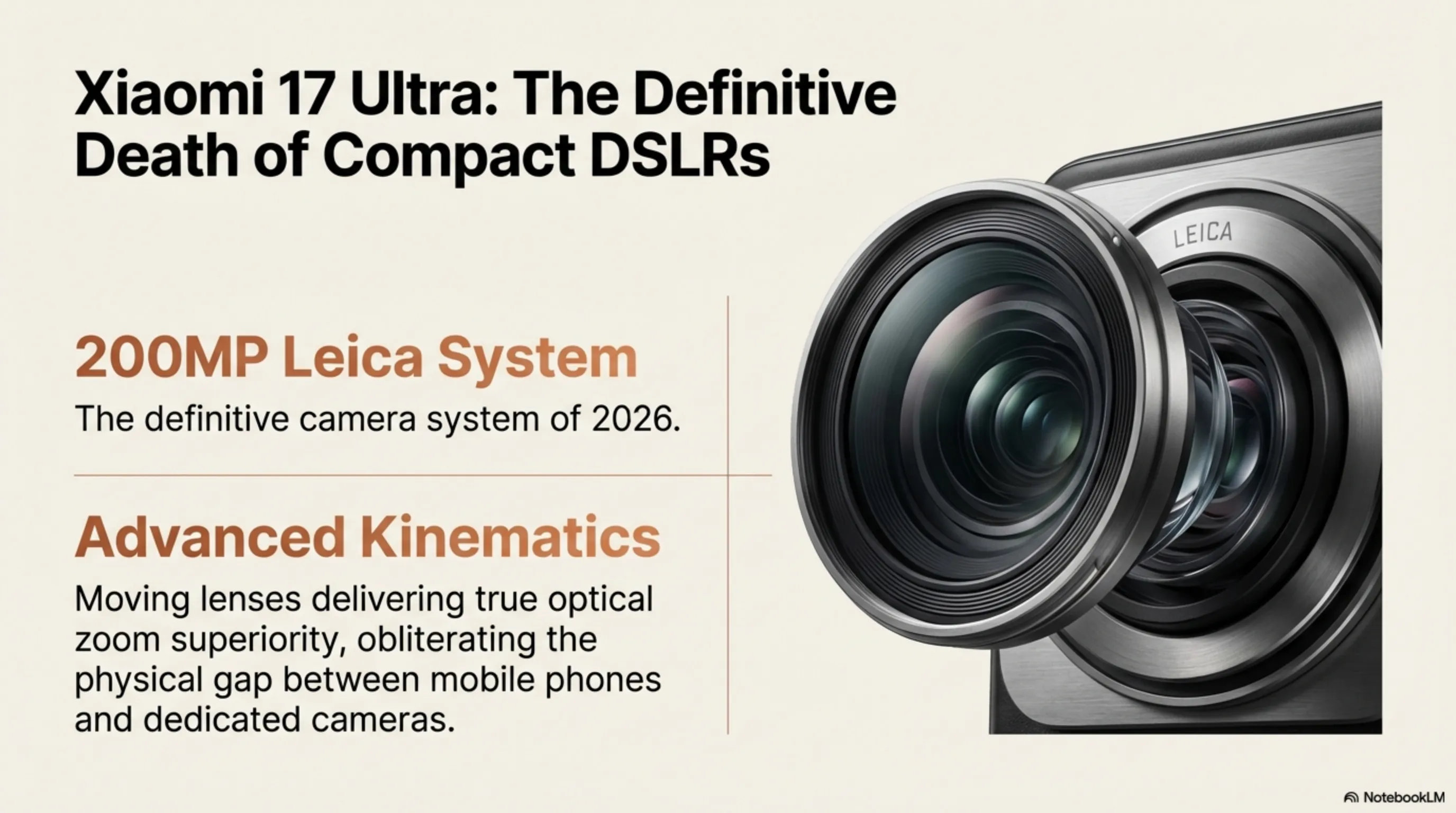
The shining star in the Xiaomi 17 Ultra galaxy is its massive rear camera circle, heavily co-engineered with the legendary German optics company Leica. Xiaomi has doubled down on its "Strategic Co-creation" strategy with Leica, and the result is a system that defies written description.
- Light Fusion 1050L Primary Sensor: The main camera utilizes a custom 1-inch sensor dubbed the Light Fusion 1050L, outputting a native 50 megapixels. The real masterpiece, however, is the implementation of LOFIC HDR technology. This sensor is capable of capturing a mind-blowing 14 stops of dynamic range (14EV)—a figure previously exclusive to professional cinematic cinema cameras from RED or ARRI. This means you can shoot directly into glaring sunlight and still capture perfect shadow details and bright clouds without any blown-out highlights.
- 200MP Telephoto Camera with Mechanical Optical Zoom: This piece of hardware is pure magic.
Xiaomi has combined an ultra-advanced 200MP sensor with Leica's mechanical moving lens elements. This lens
can physically and mechanically alter its focal length continuously from 75mm to 100mm (True Mechanical
Continuous Zoom). Furthermore, when utilizing an in-sensor crop on the 200MP sensor, you achieve a 400mm
focal length equivalent (roughly 17.2x optical magnification) without any of the digital degradation
typically associated with AI upscaling.
Crucially, this system adheres to Leica's insanely strict APO (Apochromatic) lens coating standards. This means chromatic aberration (the purple fringing around objects in harsh light) is physically eliminated to absolute zero by perfectly aligning color wavelengths! A phenomenon previously only observed in $4,000 full-frame camera lenses.
Thinner Design, Vampiric Performance
Despite housing all these massive optical elements, Xiaomi managed to design the 17 Ultra slimmer and lighter than its predecessor, the 16 Ultra (8.29mm thick and 218.4g). It utilizes an aerospace-grade aluminum alloy frame perfectly sealed against water and dust with an IP68 rating.
The central brain of this beast, like many other MWC 2026 juggernauts, is the 3nm Snapdragon 8 Elite Gen 5 chipset, fed by 16GB of ultra-fast LPDDR5X RAM and 1TB of UFS 4.1 storage. The 6.9-inch flat 2K M10 OLED display (2608 x 1200 resolution) with a variable 1-120Hz refresh rate and a blinding 3500 nits peak brightness makes any Dolby Vision content look more vibrant than reality. The entire monolithic package is kept alive by a 6000mAh battery, supported by 90W wired and 50W wireless HyperCharge technology.
The price tag in Europe starts at a daunting €1,499 for the 512GB version and stretches to €1,699 for the 1TB model. It’s scary, but truthfully, Xiaomi is essentially selling a €1,500 Leica camera and throwing in a top-tier Snapdragon smartphone as a free bonus.
5. Motorola Razr Fold — Motorola's First Book-Style Foldable Solves the Biggest Pain Point 📖
For years, Motorola concentrated its foldable expertise exclusively on the clamshell "flip" form factor under its beloved Razr series. Finally, at MWC 2026, they broke the spell and unveiled their first-ever book-style foldable to the world: the Razr Fold.
While Honor laser-focused its marketing for the Magic V6 on achieving infinite thinness, Motorola adopted a completely different, risky, yet incredibly intelligent strategy. Extensive market research shows that the number one complaint from users of book-style foldables is battery life. Pushing pixels to an 8-inch, 120Hz display drains power like a vampire, and when manufacturers like Samsung settle for 4,400mAh batteries in the Z Fold series, users find themselves hunting for a charger by mid-afternoon.
Motorola's answer? A monstrous 6,000mAh battery.
Instead of participating in the "who can make it thinner" race, Motorola decided to allow the device to be slightly thicker (likely around 10.5mm to 11mm when folded) but in exchange, they packed the largest energy capsule ever fitted into a book-style foldable straight into the chassis. Armed with this battery, the Razr Fold is guaranteed to survive two full days under virtually any workload imaginable.
Product Management Strategic Analysis: Motorola's move is a classical lesson in identifying the user's ultimate "Pain Point." Executives and professionals willing to drop $2,000+ on a foldable device to edit Excel sheets, reply to emails, and attend virtual meetings don't care if the phone weighs 10 grams more or is half a millimeter thicker; they demand a machine that will not die during a long-haul flight from New York to Dubai. The Razr Fold is precisely that machine.
6. Huawei Cloud Foundation + AI Foundry — The Eastern Answer to Amazon and Microsoft's Reign ☁️🏭
However, from a macroeconomic and geopolitical standpoint, there is arguably no MWC 2026 announcement more significant than Huawei's B2B and enterprise-focused unveils. While the West is busy fighting over megapixel counts and hinge thickness, Huawei has shifted the battleground to global scale and foundational infrastructure.
Huawei officially unveiled the Huawei Cloud Foundation (HCF) platform. On the surface, it’s just a cloud server reveal. But beneath the surface lies a loud, political-economic message to nations that refuse to process their critical data and databases on Amazon (AWS), Google (GCP), and Microsoft (Azure) servers located in the US or subjected to American jurisdiction.
Infrastructure Sovereignty and Localized AI Execution
The HCF platform is an immensely powerful Hybrid Cloud architecture that natively, and built-in, provides the training and inference infrastructure required for massive AI models. The primary targets for this service are central banks, defense ministries, intelligence agencies, and state hospitals located across the Middle East, Africa, and Latin America.
Huawei understands perfectly well that governments worldwide have an urgent need to deploy AI (for big data analysis, biometric control, etc.), but strict security laws prohibit them from connecting their databases to public cloud servers. HCF allows these governments and megacorporations to unleash the full processing power of Large Language Models (LLMs) and Computer Vision within physically isolated, walled-off On-Premises servers located within their own borders, boasting military-grade security.
- CodeArts with Cyber-Sovereignty: Huawei's second front in the Cloud war was the unveiling of CodeArts—an integrated development and coding platform similar to GitHub. However, CodeArts is now equipped with a terrifyingly smart AI assistant (a direct Copilot competitor), with one major difference: 100% of the source code analysis occurs in absolute isolation. Not a single byte of data is uploaded to the global network, guaranteeing absolute Data Sovereignty.
- Industry AI Foundry — Metamorphosis of Traditional Industries: Huawei also introduced a model of "Industrial AI Factories"—pre-trained AI packages specifically designed for traditional sectors such as oil refineries, mining operations, regional power grids, and port logistics. Instead of trying to fine-tune a generalized model (like GPT-4) to run an oil rig, Huawei’s system provides specialized geophysical and fluid-dynamics AI models deeply integrated with hundreds of thousands of IoT sensors, effectively grafting a digital nervous system onto a physical, heavy industry.
Hidden Digital Economy Insight: Huawei has essentially abandoned the American and Western European retail consumer markets. Instead, they have rapidly accelerated a grand strategy of building a "Parallel Cloud Ecosystem" to the West. In the ensuing AI wars, the primary factor will not just be the models themselves (like OpenAI or Claude); the real battle is over the acquisition and control of Sovereign Infrastructure. And Huawei is silently constructing an empire across the Eastern hemisphere.

📸 Gallery — MWC 2026 Highlights
The Definitive Verdict from the TekinGame Command Room
- 🏆 Boldest Leap into the Future: Honor Robot Phone. The commercial release might launch riddled with bugs, but it has forcibly opened the door for a decade of "Mobile-Robotics." Such audacity commands respect.
- 📸 The Unrivaled Optical Monster: Xiaomi 17 Ultra. Combining a 14EV dynamic range sensor with a 200MP mechanical moving Leica lens officially closes the coffin on buying any compact or cheap DSLR camera in 2026.
- 🎮 The Steam Deck's Nightmare: Lenovo Legion Go Fold. If Lenovo can manage Lunar Lake thermals within this form factor and keep the price tag below $1,000, this concept will completely reconstruct the handheld gaming industry.
- 💰 Physics Alarms Ringing: Honor Magic V6 vs. Motorola Razr Fold. Honor has pushed the boundary of thinness and battery density (6,600mAh in an iPhone-thickness frame), but Motorola's strategy with a thicker, more reliable frame feels more logical. The winner will solely be determined by time and battery degradation.
- 🌏 The Silent Cold War: Huawei's Infrastructure. While newspaper headlines obsess over camera lenses and folding screens, Huawei is locking down multi-billion-dollar sovereign contracts with global governments to replace Amazon and Microsoft infrastructure with a heavily fortified, AI-centric platform.