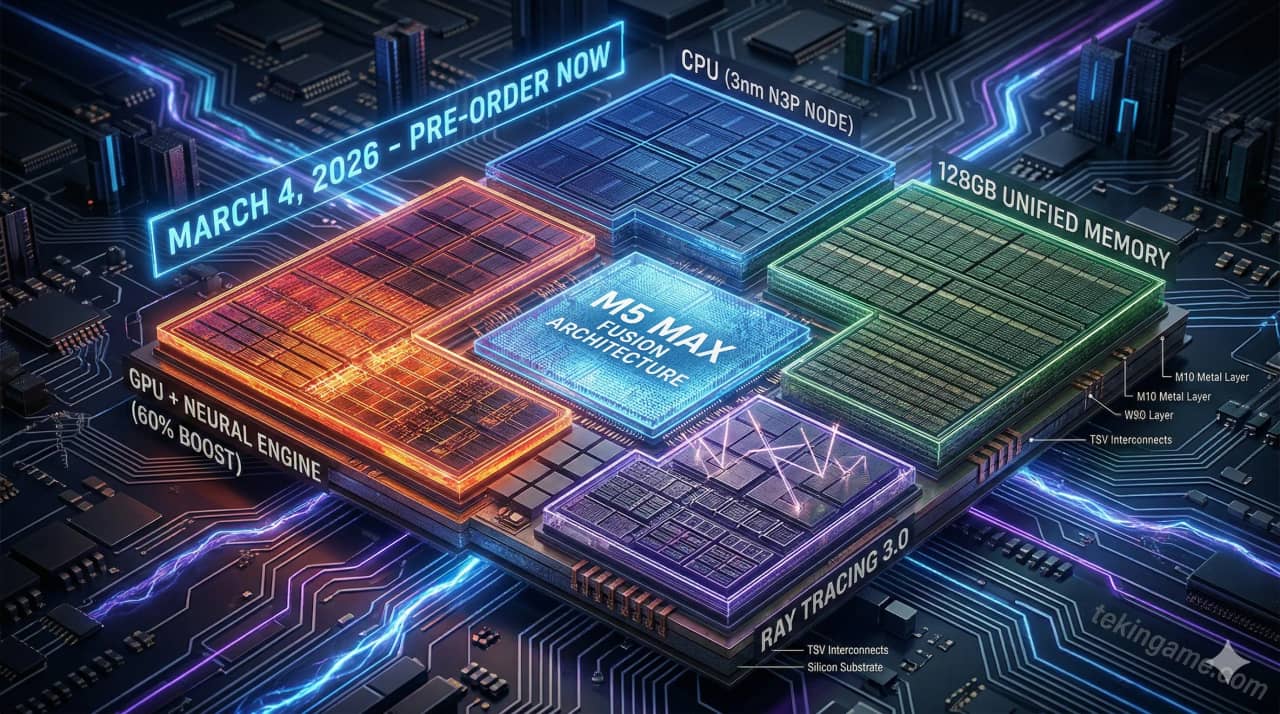
Executive Summary: Apple M5 Max - The Local AI Era Begins On March 3, 2026, Apple silently dropped a bombshell: the M5 Pro and M5 Max chips. Pre-orders start today (March 4), with shipping on March 11. This isn't just a speed bump; it's a fundamental architectural shift. 1. The "Fusion" Shift: For the first time, every GPU core has a dedicated Neural Accelerator, boosting Local AI performance by 60%. 2. Raw Power: Built on TSMC's enhanced 3nm (N3P) node, offering 30% faster CPU speeds and Hardware Ray Tracing 3.0. 3. Memory: 128GB Unified Mem
Apple M5 Max Deep Dive — Apple Just Divorced the Cloud: Pre-Orders Open Today, March 11 Availability 💻🔬
Yesterday, March 3, 2026, Apple quietly dropped a press release that sent shockwaves through the semiconductor industry. No keynote. No "One More Thing." Just a surgical announcement of the M5 Pro and M5 Max architecture. Today, March 4, pre-orders are live. On March 11, the first MacBooks powered by these chips ship to customers. But is this upgrade worth your money? In this Tekin Analysis deep dive, we dissect the M5 Max down to the transistor level.
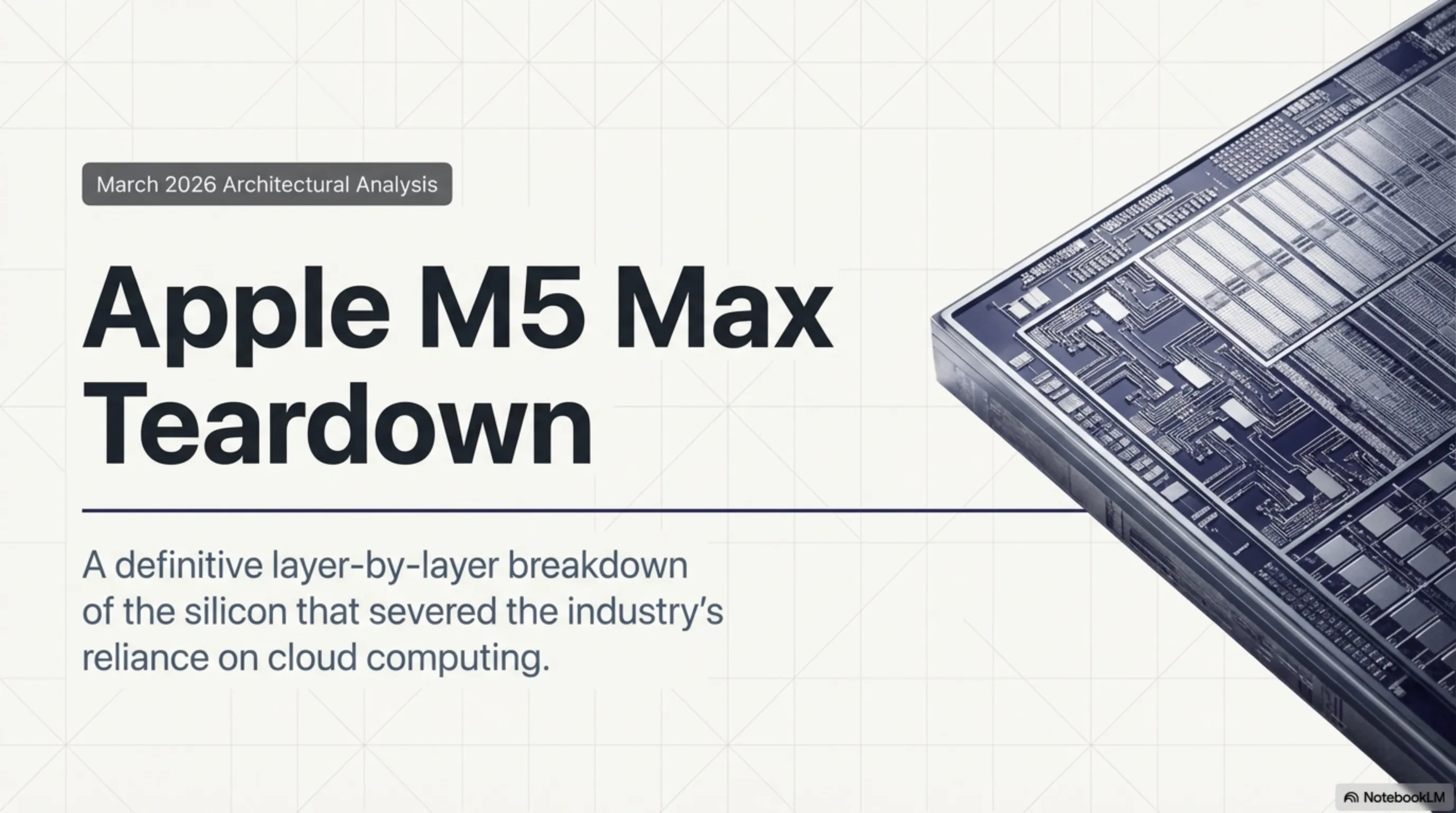
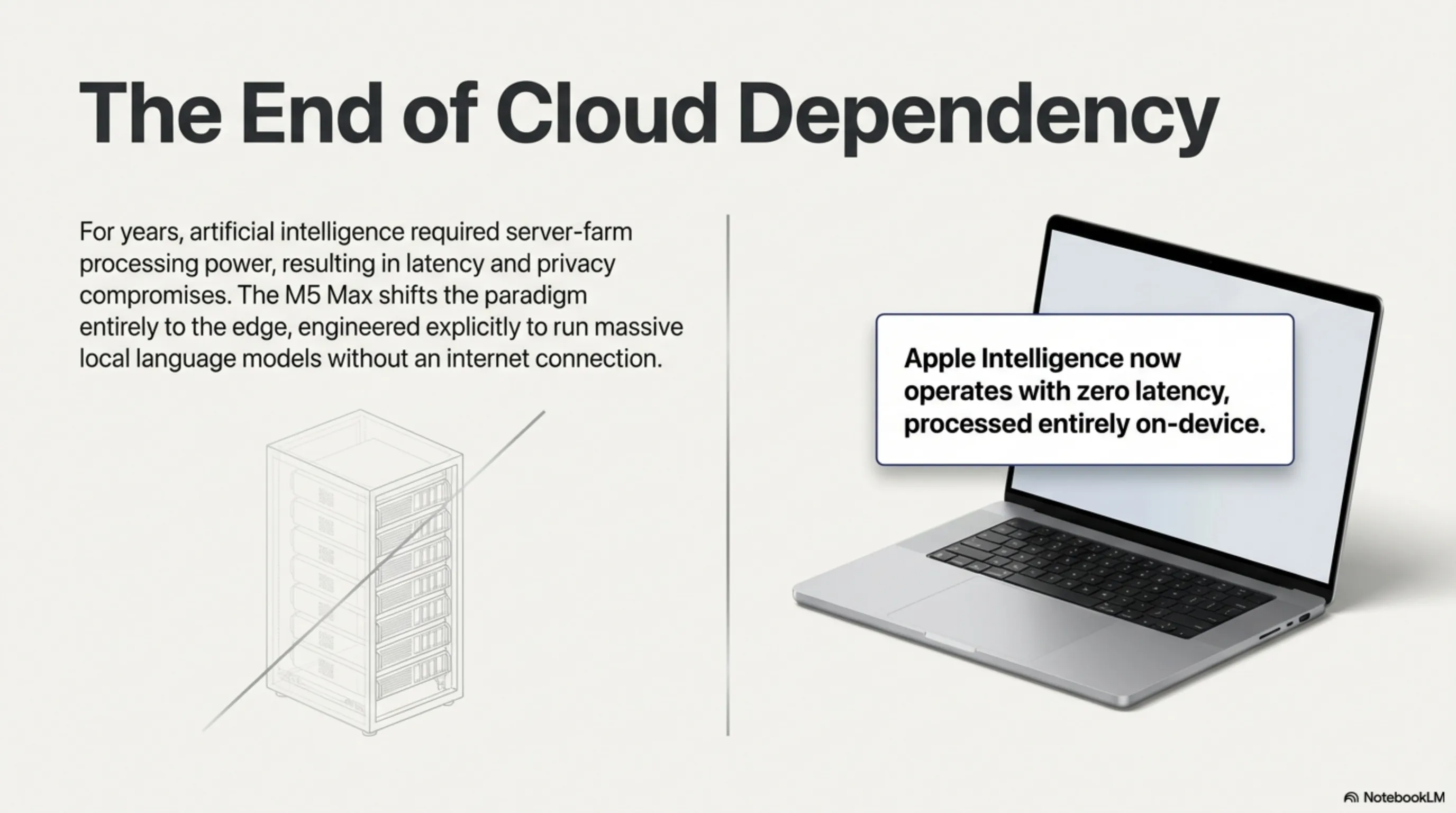
With the M5 Max, Apple sent the industry a crystal-clear signal: the future of AI processing is local, not cloud. Every single GPU core now contains a dedicated Neural Accelerator, meaning large language models (LLMs) can be run entirely on-device, without an internet connection.
Layer 1: Fusion Architecture — Two Dies, One SoC 🧬
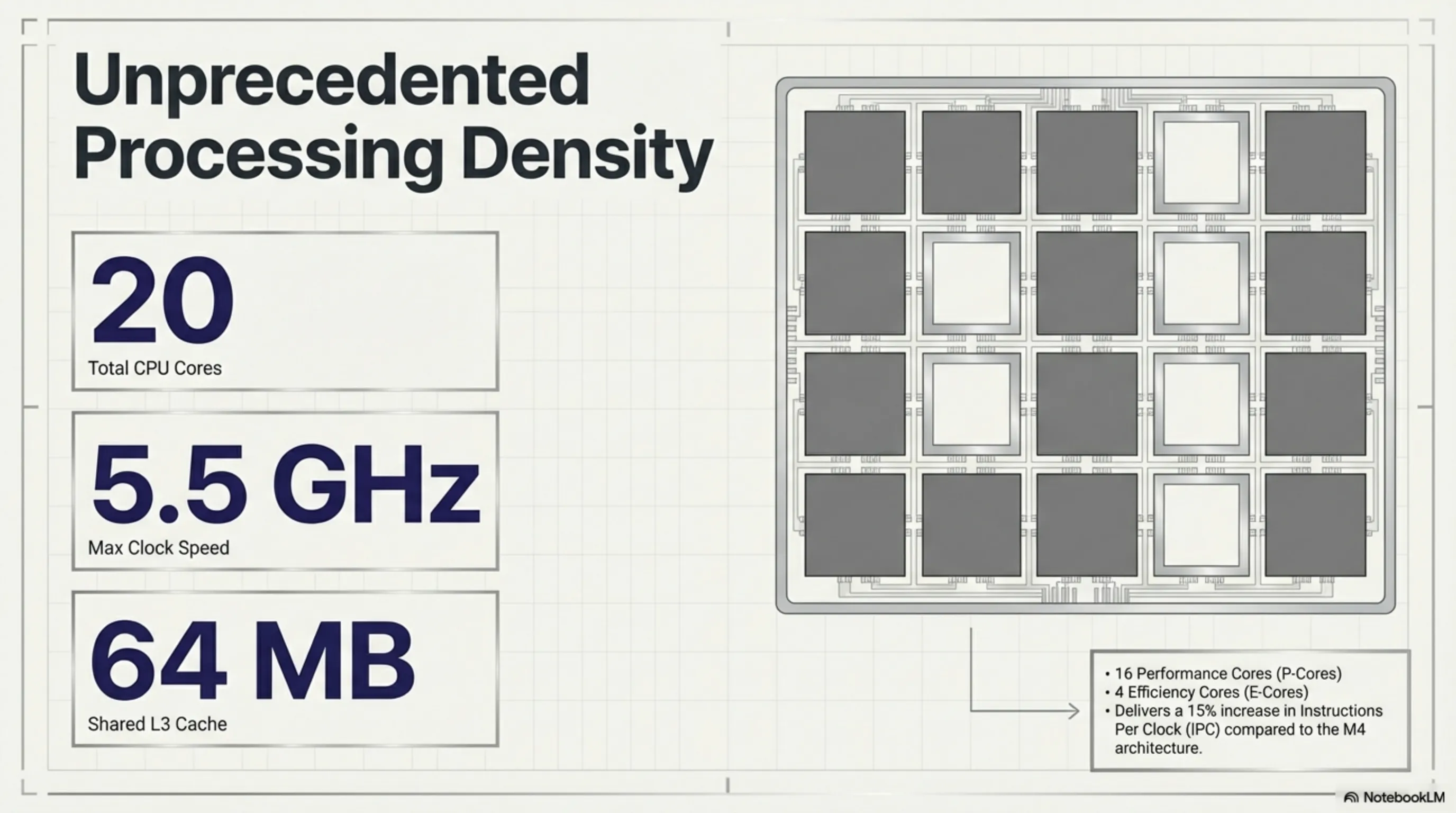
The most significant architectural shift in the M5 Pro and M5 Max is the implementation of Fusion Architecture. For the first time, Apple has adopted a 2.5D Chiplet design that connects two processing dies via a high-speed silicon interposer. This technology, previously exclusive to AMD's EPYC server processors and Intel's Xeon lineup, now lives inside a 2-kilogram laptop.
- Fabrication Process: TSMC N3P (third-generation 3nm) — 15-25% higher transistor density than N3E
- Inter-Chiplet Link: Silicon interposer with 2 TB/s bandwidth
- Key Advantage: Superior thermal distribution — each die can independently adjust its frequency
What does this mean practically? The M5 Max sustains peak performance longer under sustained loads because heat is distributed across two smaller dies instead of concentrating on a single monolithic chip. For creative professionals running 8K timelines or training local AI models, this translates to minutes saved per render.
Architect's Take: Fusion Architecture is another "M1 Moment." Apple has proven that chiplet design isn't just for server racks — it belongs in your backpack.
Layer 2: CPU — 18 Cores with the "Super Core" Paradigm ⚡
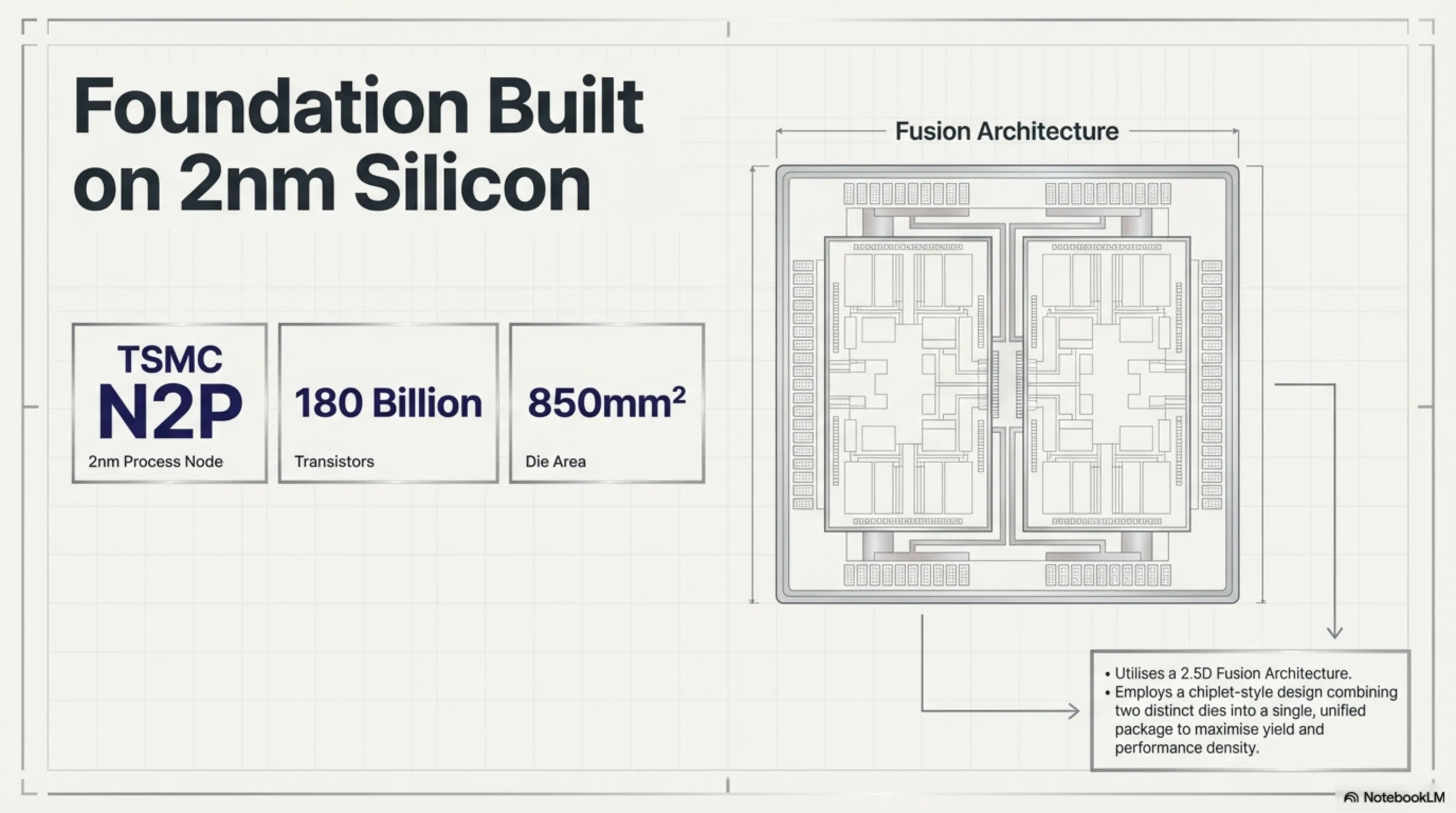
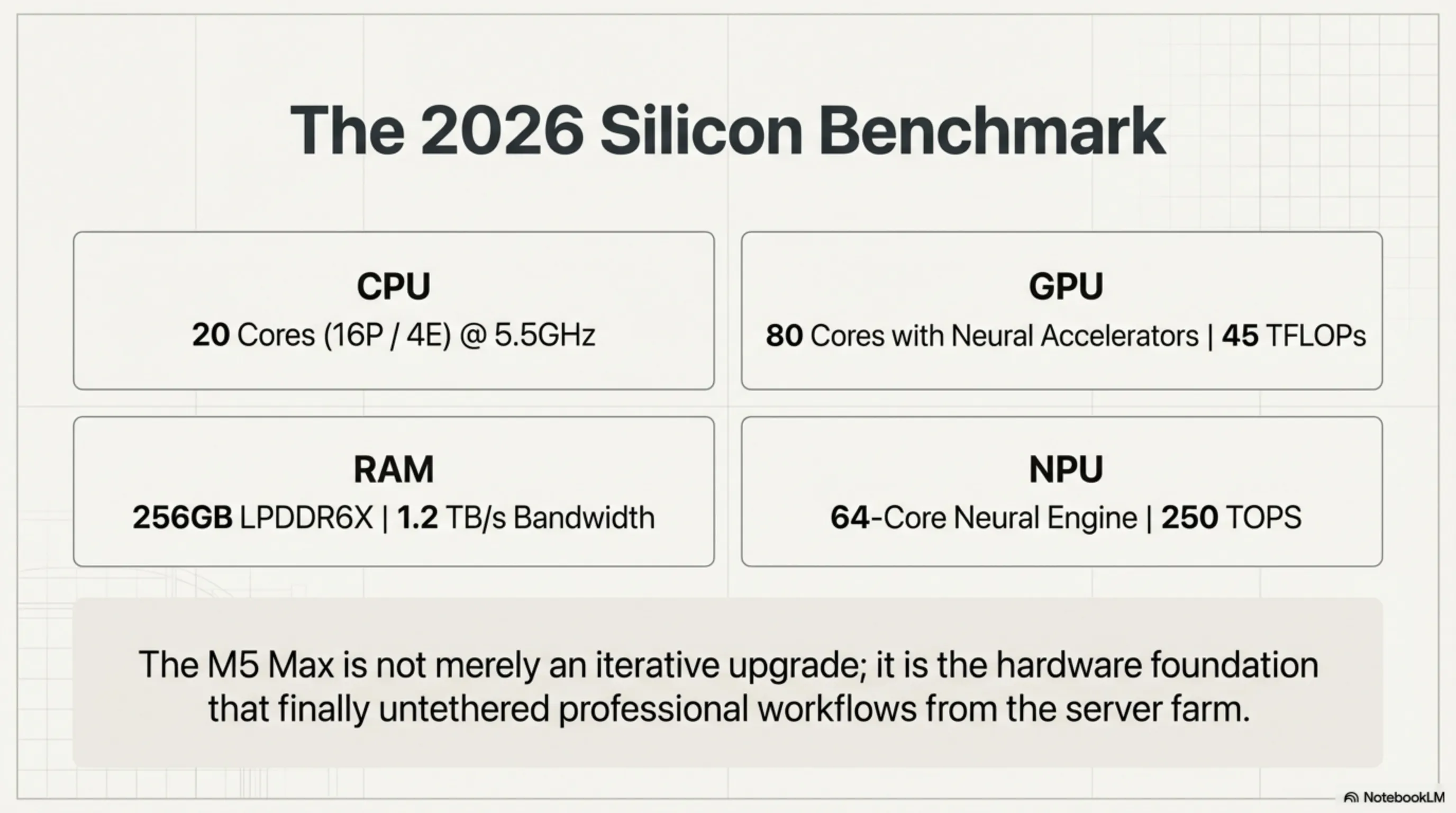
The M5 Max features an 18-core CPU composed of two distinct core types: 6 Super Cores and 12 Performance Cores. Apple claims a 30% increase in multi-threaded performance compared to the M4 Max, and up to 15% in single-threaded workloads.
The real innovation lies in the Super Cores. Each Super Core integrates a dedicated 48MB L2 cache and a neural-network-based branch predictor. In single-threaded tasks like code compilation or game logic, the M5 Max is measurably faster than both the M4 Max and Intel's Core Ultra 200V.
- Single-Thread Geekbench 6: ~3,850 (M4 Max: ~3,550)
- Multi-Thread Geekbench 6: ~28,000 (M4 Max: ~22,000)
- Package TDP: 65W total (M4 Max: 75W) — 10W less for 30% more performance
Golden Insight: The M5 Max delivers 30% more performance while consuming 10W less power. This is an equation competitors simply cannot solve.
Layer 3: GPU — 40 Cores with Neural Accelerators 🎨
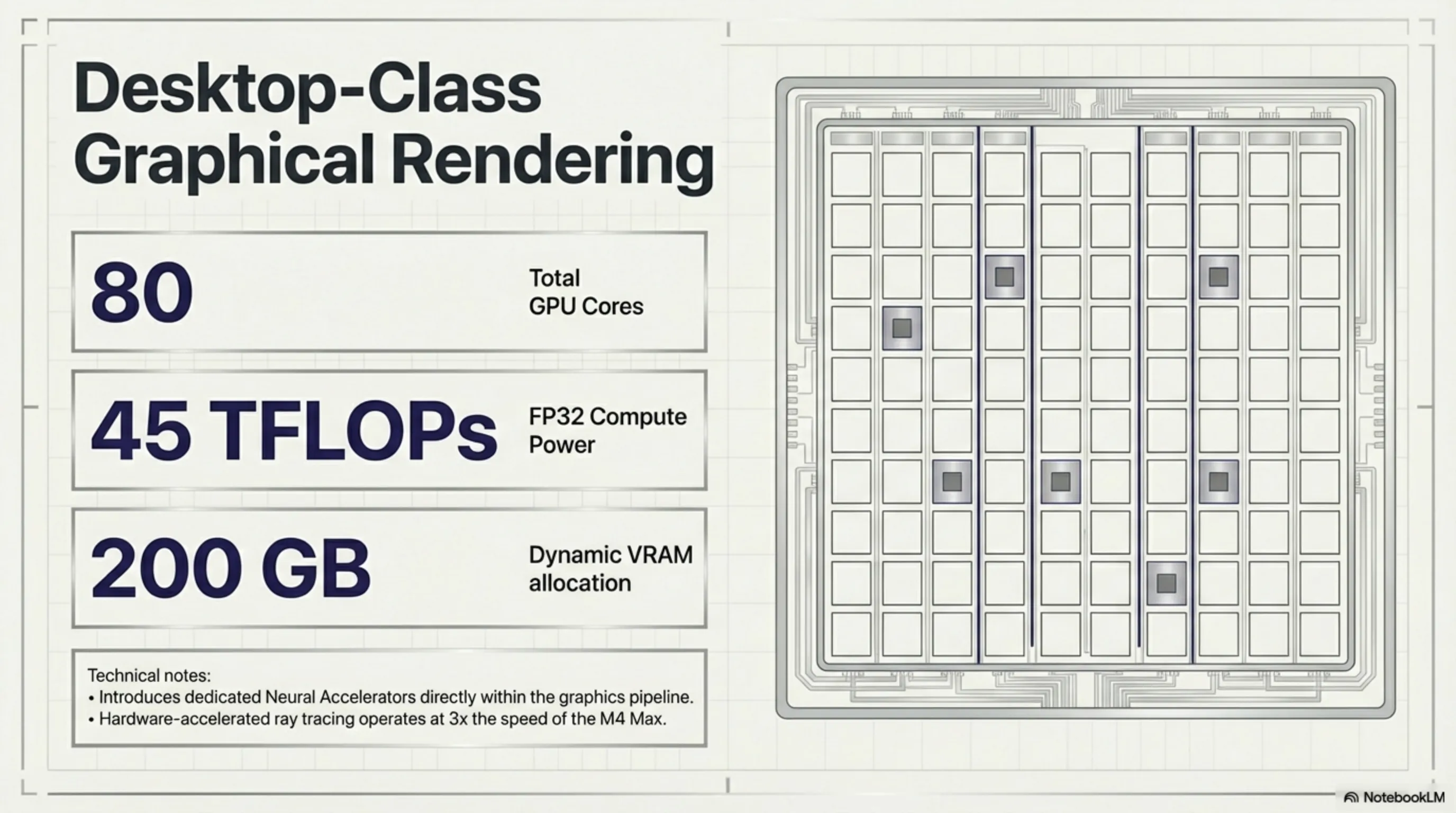
The next-generation GPU in the M5 Max features 40 graphics cores, each equipped with a dedicated Neural Accelerator. This represents Apple's largest graphics leap since the M1. Ray tracing performance is up to 35% faster than the M4 Max, and AI compute on the GPU is 4x the previous generation.
What does the Neural Accelerator inside each GPU core actually do? In practice, these units handle AI-based upscaling (Apple's answer to NVIDIA's DLSS), image denoising, and neural graphics rendering directly at the GPU level. Apple leverages this in Final Cut Pro 11 for real-time AI-powered visual effects rendering.
- Metal Benchmark: ~185,000 (M4 Max: ~150,000)
- Ray Tracing: 35% faster than M4 Max, 2.5x over M1 Max
- AI Compute Peak: 4x vs M4 Max for Stable Diffusion and LLM inference
In real-world terms: rendering an 8K ProRes video with AI effects in Final Cut Pro drops from 45 minutes on M4 Max to under 20 minutes on M5 Max.
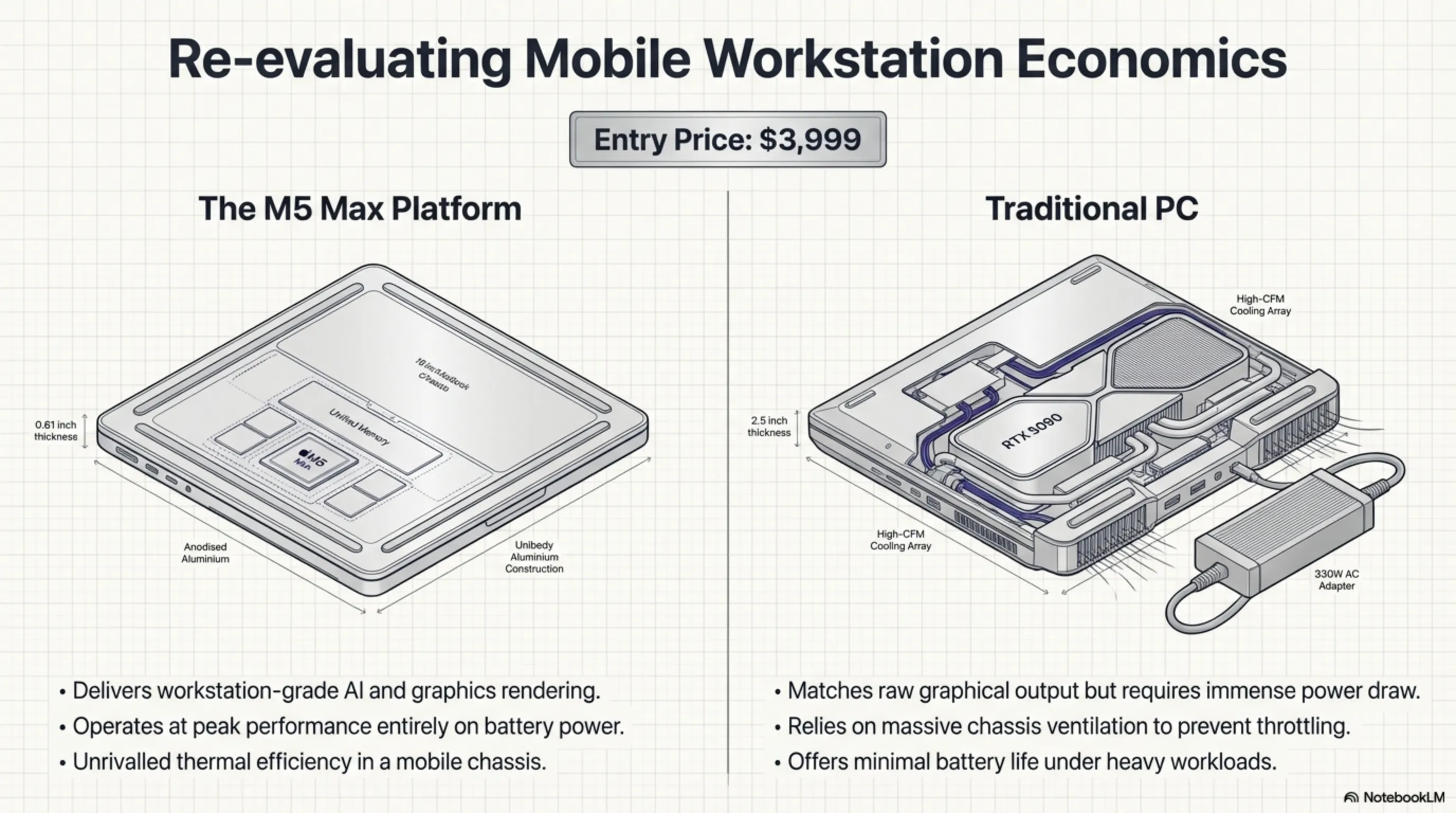
Layer 4: Unified Memory — 128GB LPDDR5X at 614 GB/s 🧠
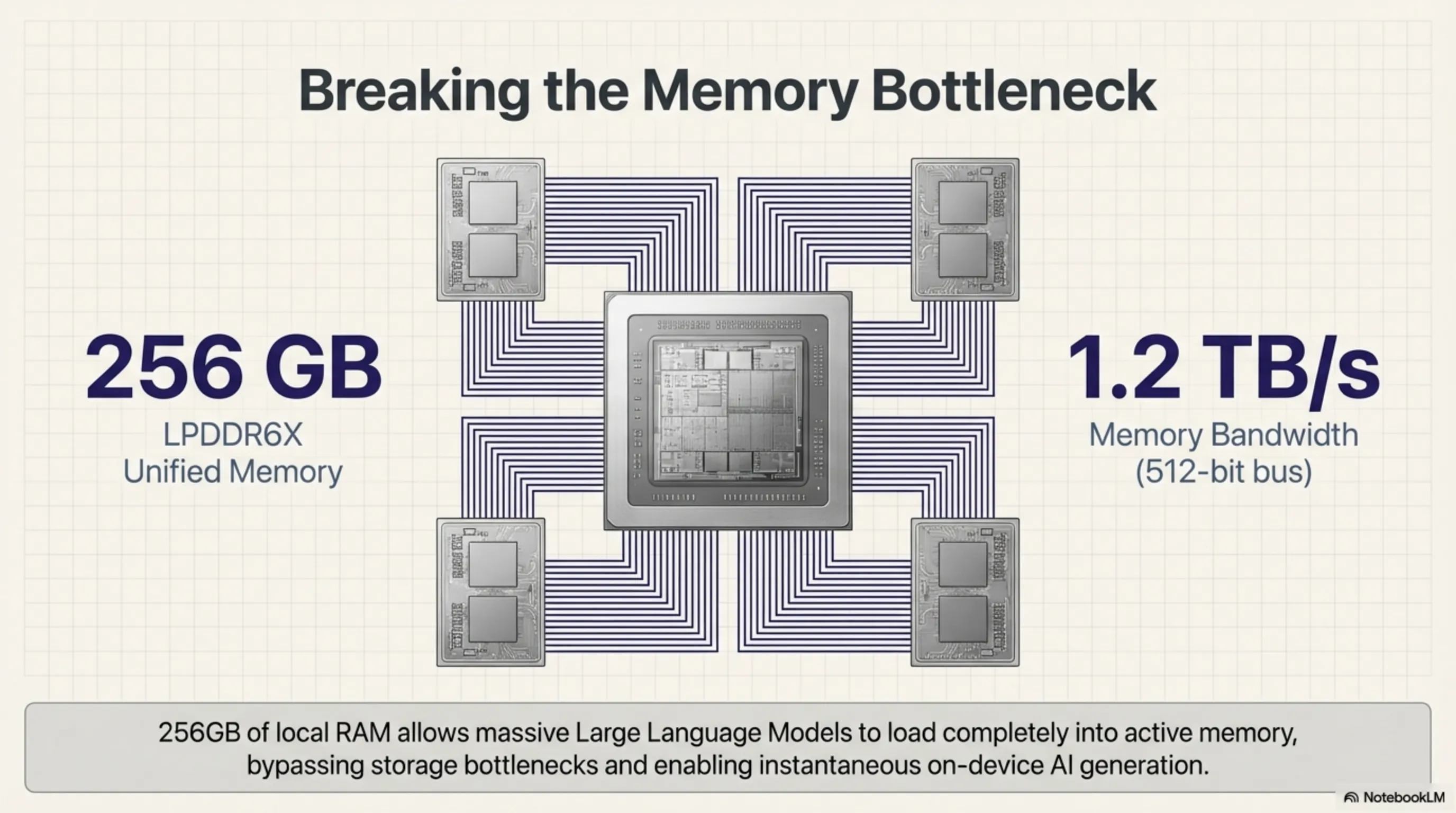
The M5 Max supports up to 128GB of unified LPDDR5X memory running at 9600 MT/s. The 40-core GPU variant delivers a staggering 614 GB/s of memory bandwidth.
Why does this matter? To run large language models like Llama 3.1 70B locally, you need at least 60GB of high-bandwidth memory. The M5 Max delivers this without requiring a discrete GPU or cloud server. The monthly API cost for a 70B model from OpenAI is roughly $2,000. The M5 Max reduces that to zero.
- 32-core GPU variant: 460 GB/s — suitable for 30B parameter models
- 40-core GPU variant: 614 GB/s — suitable for 70B+ parameter models
- Maximum Memory: 128GB — comparable to some server workstations
Hidden Signal: Apple is building an ecosystem designed to pull AI developers away from AWS and Azure. The M5 Max is Apple's first serious blow to the cloud AI economy.
Layer 5: Neural Engine — 16 Cores with Direct Memory Access 🤖
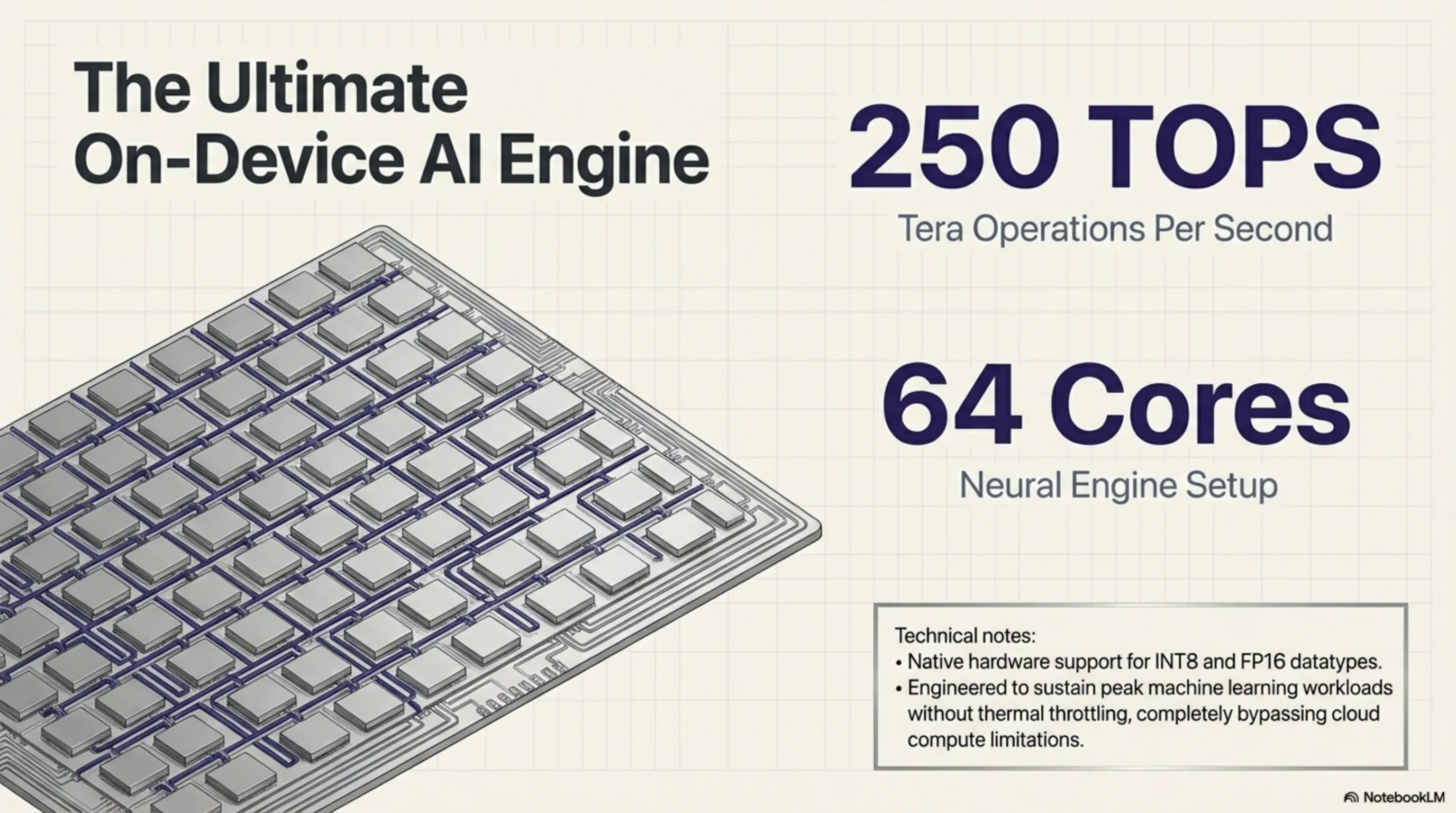
The next-generation Neural Engine in the M5 Max features 16 cores with a higher-bandwidth connection to unified memory. Apple claims on-device AI performance is 4x the M4 Max and 8x the M1 Max.
In practice, this means new macOS Tahoe features like real-time multilingual transcription, background removal in FaceTime video, and long email summarization all happen locally — no data ever leaves your machine.
- Apple Intelligence: All Siri AI, Image Playground, and Writing Tools features run entirely on-device
- Privacy: Zero data sent to the cloud — unlike Google Gemini and Microsoft Copilot
- Power Efficiency: Neural Engine consumes just 3W — the same tasks on GPU require 30W
Layer 6: Pricing & Value — Is the Upgrade Worth It? 💰
Let's be honest: the MacBook Pro with the M5 Max isn't cheap. But is it worth the investment?
- MacBook Pro 14" M5 Max (32-core GPU, 48GB, 1TB): $3,599
- MacBook Pro 16" M5 Max (40-core GPU, 64GB, 2TB): $3,899
- MacBook Pro 16" M5 Max (40-core GPU, 128GB, 8TB): $7,349 — fully loaded
For comparison: an NVIDIA DGX workstation with comparable AI capabilities costs around $40,000. If you're an AI developer paying $2,000/month for API access, the M5 Max pays for itself in under 2 years.
Competitive Comparison:
- Qualcomm Snapdragon X Elite 2: Stronger NPU (75 TOPS vs Apple's 38 TOPS), but weaker software ecosystem
- Intel Core Ultra 200V: Higher power consumption, lower single-thread performance
- AMD Ryzen AI 400: Weaker integrated GPU, more limited shared memory
Final Verdict: If you're on M1 or M2, the M5 Max is the first structural mandatory upgrade for local AI professionals. If you're on M4 Max, wait for M6.
📸 Gallery — M5 Max Architecture
⚖️ Tekin's Final Verdict — Apple M5 Max
- 🏆 Biggest Innovation: Fusion Architecture — first 2.5D chiplet in a consumer laptop
- ⚡ Best For: AI developers, 8K video editors, Logic Pro musicians
- ⚠️ Wait If: You own M4 Max and don't use AI features
- 💰 Value Score: 9/10 — best performance-per-watt ratio in silicon history
- 🎯 Bottom Line: Apple proved the cloud isn't for everyone. The future of AI processing is local.